When Hilmi Öğütçü sent me a short message saying they were organizing an entrepreneurship summit and asking if I’d be willing to speak, I didn’t hesitate for a second. The reason was simple—he had handled that first interview we did, and everything afterward, in a very professional and respectful manner.
You can watch that interview at the following link:
I always support people like Hilmi—those who spread positivity and strive to make things happen
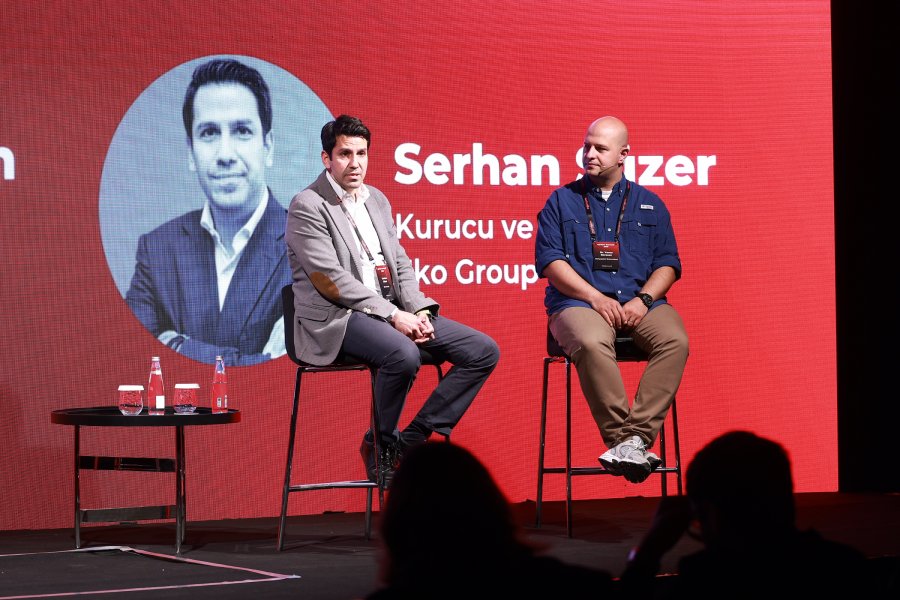
I arrived at the event on 14 May about half an hour before my scheduled talk. I wanted to get a feel for the atmosphere, but due to delays in the program, it took a bit longer for me to take the stage.
During my 10-minute talk titled “Multidimensional Entrepreneurship: From Fintech to Sustainability,” I smoothly answered a few questions and didn’t even realize how quickly the time passed. It was a very enjoyable panel from my perspective. Judging by the round of applause I received afterward and the number of people who came up to me with questions outside the hall—keeping me at the venue for another 45 minutes, I’d say the talk sparked real interest.
I’d like to take this opportunity to congratulate Hilmi Öğütçü and his team for organizing this entrepreneurship summit.
On my drive back to the office after the event, a few thoughts crossed my mind:
“When I re-read the interview I did before the talk, even though there were some solid comments underneath, I let a few absurd, baseless ones get under my skin. The people making off-topic, ignorant remarks clearly never listened to any of the talks I’ve given. If they had, they’d probably be embarrassed by what they wrote. And if they’re not embarrassed, that just shows bad intentions. And I have zero tolerance for people who act in bad faith.”
First and foremost, I want to thank everyone—whether they know me or not—who left thoughtful, respectful comments. I’m always open to constructive criticism.
As for the comments that crossed the line into insults instead of offering any kind of useful feedback, I divide those into four categories. The main reason I want to respond to them is that people who may be inclined to make such comments in the future might see this and become a bit more informed—and, ideally, provide more thoughtful feedback moving forward. Below, I’ve laid out the comment topics, the comments themselves, and my responses to each:
1) “He comes from money—he’s not a real self-made entrepreneur.”
Comment 1:
If you come from family money in Turkey, there are a million ways to make more money. That’s how brands like NEF came to be. Sure, this isn’t info you should ignore, but this guy didn’t go from zero to the top.
Comment 2:
Why are you making entrepreneurship videos about a guy who inherited trillions from his father? How about covering entrepreneurs who come from working-class families? Did you even ask him how he looted Kentbank?
My Responses:
1)I’ve been separated from my family’s business since 2011. Yes, there are many opportunities in Turkey—but I’ve always ventured into fields that no one else was even thinking about, let alone entering. For example, back in 2011, I founded a solar energy company—specifically in CSP (Concentrated Solar Power), which produces heat and steam—long before it became a hot topic. Since 2013, I’ve also been running a PV (Photovoltaic) company focused on solar electricity, and I’ve been deeply involved in that sector for 11 years now. In 2014, I launched a fintech firm (Moka Payment Institution Inc.), which I sold to İşbank in 2021.
So yes, I take pride in being a pioneer in both solar energy and fintech in Turkey. As you can probably tell, this has absolutely nothing to do with continuing a family business.
2) I have no connection whatsoever with NEF or its founder, Erden Timur. I only got to know him through NGO work (specifically via the Disaster Platform), and unfortunately, my impression is not positive. In my opinion, he is not a trustworthy individual. He has a habit of saying one thing to your face and doing another behind your back. I, on the other hand, have always been clear and upfront about my intentions, and I pride myself on being direct and principled. This approach has made my life harder in Turkey, but I’ve never compromised my values.
So in terms of character, Erden Timur and I are complete opposites. It’s also worth clarifying that while Erden Timur may have inherited wealth from his father, my situation is different. Our family business was originally founded by my grandfather in 1952. My father worked with him for a while before branching off and building his own successful company, eventually becoming a prominent businessman in Turkey. In 2011, I left my father’s companies entirely to build my own path. So, in terms of both family dynamics and personal character, there is no valid comparison between me and Erden Timur. Frankly, I see that comparison as an attempt to belittle me and my family, and I don’t take it lightly.
3) The guy who supposedly inherited trillions simply walked out of his family business in 2011 with nothing but a jacket. He left behind every privilege and opportunity and took only a small loan when he did it. At the time, all the core operations of the family business—except for finance—were under his control. Yet he had the courage to walk away. There’s no other example like this in Turkey: being part of a third-generation legacy, with every door open and a life of comfort, but still choosing to break away from it all in pursuit of your own ideals. And not just any ideals—he founded a company to commercialize solar technology at a time when no one was even talking about it. When I first launched my solar energy venture, most people thought I was out of my mind. Back then, no one even knew what the ‘s’ was in ‘solar energy.’ And now, look where we are, everyone wants a piece of the solar energy market.
4) ‘They looted Kentbank’ is one of the most insulting things you could possibly accuse me of doing. I really must restrain myself from responding to such ignorant, baseless accusations with the same level of harshness. But I’ll keep it classy. Still, I’d like to ask this person:
Do you actually know what happened with Kentbank? Do you know the full story? Do you have any idea how many lawsuits were involved, and that we won all of them? Do you know that every Turkish court, including the Council of State, ruled in our favor—stating that Kentbank should either be returned to its rightful owners or that the government must pay compensation?
Do you know that this was the first case in the history of the Republic of Turkey with such an outcome, and that the only other example since then was Demirbank, whose owners won a case just like ours? Do you know that when these court decisions weren’t implemented, we filed a case with the European Court of Human Rights—and won that as well? Do you know that, as a result, the Republic of Turkey faced a €4 billion compensation liability for this wrongful and unjust action? These are facts that everyone in the banking sector knows. So how can someone still throw around a phrase like “they looted Kentbank” as if they’re talking in a back alley? What kind of ignorance, carelessness, or sheer disrespect does that show? If you really don’t want to stay ignorant, I suggest you read the article I wrote about the Kentbank case: https://www.serhansuzer.com/tr/15-yillik-is-hayatim-ve-gelecege-notlar
Read it, educate yourself, and stop spreading false narratives. Learn to accept reality and, even if you don’t like someone, at least show some respect.
2) “Why don’t you ever talk about Süzer Plaza?”
Comment 1:
Did you benefit from that monstrous tower that scars the beauty of Istanbul?
Comment 2:
This guy is the heir to Süzer Plaza, which towers over İnönü Stadium. Meanwhile, people on the hill watch the game for free while he gives life advice. What a joke.
Comment 3:
How about discussing the ugly Süzer Plaza that’s stabbed into the heart of Istanbul? We’d love to hear your thoughts on the environment now.
My responses to these comments:
Yes, when people hear the name “Süzer,” they often immediately think of Süzer Plaza. And many like to call it “Gökkafes” (Sky Cage) as a kind of insult. But we don’t use that term—because in Turkish, the word kafes (cage) has very negative connotations. People say things like, “They’re caging democracy” or “They’ve caged the judiciary.” So we avoid that term and simply refer to it by its proper name: Süzer Plaza. The whole “Gökkafes” nickname is derived from the architectural term “Sky Cage,” which refers to the iron structure at the very top of the building. Journalists heard this and twisted it into something negative. Ironically, that structure makes up less than 10% of the entire building. Using the name of a small architectural detail to brand the whole building is both misleading and unfair—but people do it just to stoke the fire.
Now let me be crystal clear: Süzer Plaza has absolutely nothing to do with the work I do. As I’ve said before, I left the family business in 2011 with only a small loan and have been forging my own path ever since—for 14 years now. I was one of the first in Turkey to get into solar energy and fintech at a time when no one was even thinking about these sectors. The vision, effort, and sacrifices I’ve put into these ventures have nothing to do with Süzer Plaza or the family legacy. Criticize me if you must—but give credit where credit is due.
Let me also point this out: my current work has absolutely nothing to do with Süzer Plaza. In 2011, I left the family business after taking out a small loan, and for the past 14 years, I’ve been building my own path. As I’ve mentioned before, I was among the first in Turkey to enter the then-unheard-of sectors of solar energy and fintech. My vision, my tireless work ethic, and the sacrifices I’ve made have nothing to do with the family business or Süzer Plaza.
So, when people say things like, “Why don’t you talk about Süzer Plaza?” or use words like “heir” to belittle or delegitimize what I do—portraying me as some spoiled rich kid—I reject that attitude entirely. Maybe it makes them feel better to dismiss me with these lazy stereotypes: “Oh, he’s just a typical rich kid doing whatever he wants—anyone could do that.” But the image they’ve created is flat-out wrong. If they want to keep lying to themselves and those around them, so be it. Sooner or later, the truth always comes out. Now, to correct this false image—whether built deliberately or out of ignorance—I’ll share what I know, and what I feel and think, about Süzer Plaza:
Criticism I find valid—and criticism I don’t
- I have no problem with comments like “Ugly building,” “Too tall,” “Ruins the skyline,” or “Why put something like this here?” These kinds of remarks don’t bother me, and I actually find some of them justified. But let’s also not forget: Istanbul is full of much taller buildings in far less appropriate locations—and many of them are clustered right next to each other. So, when people say things like “a dagger in the heart of Istanbul,” or worse, “Istanbul’s genitalia,” or “monstrosity”—those kinds of vulgar insults? I don’t condone them. Honestly, in most cases, people’s inner bitterness just comes out in their words.
No Legal Violation Involved
- I have no objection to valid criticisms of Süzer Plaza such as “It’s too tall” or “It spoils the silhouette.” However, what angers me the most is the claim that “this building was constructed illegally and trampled the law.” You may not like the building, you may say it’s too tall—those are your personal opinions. But you cannot claim that Süzer Plaza was built unlawfully. There is no way to construct an illegal building in such a central location—where the districts of Şişli, Beşiktaş, and Beyoğlu converge, the very heart of Istanbul. Say what you will, but don’t say Süzer Plaza is illegal. On the contrary, this is a building that was constructed within the bounds of the law. In fact, more than 40 lawsuits were won—each lasting at least five years—just to make this building a reality. Since we’re on the topic, I’d also like to briefly recount the history of Süzer Plaza:
The story of Süzer Plaza begins in the early 1980s. My father, Mustafa Süzer, began acquiring the parcels of land in this central location, one by one, from dozens of different owners. His intention was to build a hotel on the land where Süzer Plaza now stands. As he explained to me, the Hilton Hotel—built in the 1950s—was located just behind this property. In the years that followed, the Hyatt and InterContinental hotels were built in the same area. The construction of the Lütfi Kırdar Convention Center also helped turn the area into what became known as “Congress Valley.” My father’s goal was to contribute something meaningful to Congress Valley in the form of a new hotel. The initial hotel project was a “short and wide” design—resembling the Hilton Hotel behind it. In terms of square footage, it matched what Süzer Plaza is today: about 125,000 m2. My father brought this first hotel design to the then-mayor of Istanbul, Bedrettin Dalan, who also happened to be his friend. His aim was to receive the necessary approvals and permits from the municipality. But instead of backing the project, Mayor Bedrettin Dalan’s perspective would end up shaping the building’s destiny—and laying the groundwork for the criticisms that persist today. Uncle Bedrettin (I say “uncle” because I personally know him, his wife, and his sons, and I like them) told my father: “My vision for this area is to build Manhattan-style high-rises. Istanbul needs to modernize, and some parts of the city should have tall buildings.” He rejected the original hotel project outright. So, with Bedrettin Dalan’s directive in mind, my father commissioned a new architect named Doruk Pamir to redesign the building into a slim, tall structure aligned with the mayor’s vision. The project’s cancellation, the hiring of a new architect, the creation of a new design, and the process of resubmitting it to the municipality for approval took about two to three years. Just as permits were finally granted and construction on the building’s foundation began—on the slope behind where Süzer Plaza now stands—municipal elections were held, and to everyone’s surprise, a new mayor was elected: Nurettin Sözen.
Sözen’s Opposition to Dalan
Nurettin Sözen was entirely anti-Dalan. He waged war on every project started or approved by Bedrettin Dalan, doing everything he could to reverse them. His entire political career was built on dismantling what his predecessor had done (which, frankly, tells you a lot about his negative personality). He made zero contributions to Istanbul. Against Süzer Plaza and our family business, he filed more than 40 lawsuits. Worse still, he tried to sway public opinion by making false and slanderous claims, labeling us as “agents of imperialism” and accusing us of “violating the law to build this tower,” all to damage our reputation and gain public support. He did absolutely everything within his power to stop the project and filed every lawsuit he could think of. As a result, construction was halted for 5–6 years. However, we won every single lawsuit based on the legal principle of continuity in public administration. In other words, permits granted by a previous administration are considered official public approvals, and they cannot simply be revoked on a whim. The principle of continuity in governance held strong, and we emerged victorious in every case. It took a long time, but once all the lawsuits were won, preparations for resuming construction could finally begin. Just about a year before we had completed winning all those legal battles, yet another round of municipal elections took place. This time, Nurettin Sözen lost, and a new mayor came to power: Recep Tayyip Erdoğan. Although Erdoğan had a generally negative stance toward this building—which had developed quite a bad reputation in the public eye—he, too, couldn’t block its completion. Despite his own reservations and other reasons for disapproval, we were able to finish construction because we had won every single legal challenge. The building’s office section opened in 1999, and on October 6, 2001, the Ritz-Carlton Hotel officially opened its doors—marking the full activation of most of the building.
The opening of the Ritz-Carlton Hotel, which elevated Turkish hospitality standards with Turkey’s most significant deluxe concept, marked a milestone for Süzer Plaza. The building made a substantial contribution to Turkish tourism. In fact, during that period (between 2001 and 2006), I was leading the team that opened the hotel, and since I was the asset manager of the project, I was able to closely follow all developments. From the very first day, the hotel regularly hosted general managers from 5-star hotels in both Istanbul and Antalya. I distinctly remember personally welcoming the general managers of our biggest competitors: the Çırağan Kempinski and the Swissotel. The reason these general managers and hotel executives frequently visited our property was to assess our standards and adjust their own to remain competitive. So, I can confidently say that from the early years of its operation, the Ritz-Carlton helped raise the bar for hotel service levels in both Istanbul and Antalya.
3) “The hideous Süzer Plaza stabbed into the heart of Istanbul”: to the friend asking about my environmental values… I’d like to say this: there’s no inherent conflict between tall buildings and environmental consciousness. I’m one of the first 1,000 people to become a member of Greenpeace in Turkey. I joined back in the 1990s and have been supporting the organization ever since. So, there’s no need to question my environmentalism—I know who I am, and my past actions clearly reflect my mindset.
A city that can’t breathe
What’s more, many environmentalists I’ve been in contact with support high-rises. I personally don’t fully agree with that view, but some individuals who’ve served as executives in environmental NGOs have told me: “We’re not against tall buildings—on the contrary, we support them. When you build upwards, it helps preserve green space in cities. But if you cover every inch of land with 8–10 story buildings lined side by side, there’s no room left to allocate for green areas.” I agree with that logic. To the person who made the earlier comment, I’d ask this: “Have you ever flown into Istanbul and looked down at the city from above?” It looks as though someone carved out the entire landmass and poured concrete into it. Buildings are packed side by side with barely any green space. The city can’t breathe—it’s completely paved over. And personally, that really bothers me.
To address this issue, I’m kicking off a project this year that I’ve been planning for a long time: the concept of self-sustaining buildings. With buildings that generate their own energy, water, and food, I intend to integrate this model into future urban planning—creating cities where people can breathe, where everything is accessible within 15 minutes, and where the design is visually and spatially pleasing from every angle. These cities will meet basic human needs and support physical and mental well-being. I’m writing this here as a kind of timestamp. I will bring this topic up again in the future.
3) “So, you’re the first to do everything? Man, you sure love to praise yourself.”
Comment 1: “Alright bro, so you did and said it all first. Wishing you continued success with Süzer Plaza and the Ritz-Carlton.”
Comment 2: “His self-congratulatory tone is a bit much, and while he may be the heir to a tower that doesn’t belong where it is, there’s still some effort there, and that deserves respect.”
Comment 3: “Okay, okay we get it—you’re a big deal, man (ah, ah, ah, ah).”
Comment 4: “Is there anything you didn’t claim to say first back in the 2010s, king?”
My responses to these comments:
Whether it is people close to me or those who’ve interacted with me from a distance, the one thing they consistently say is that I’m a humble person. In fact, some of my close friends even tell me, “Don’t be too humble. In Turkey, people will mistake it for weakness and take advantage.” Praise be to God—regardless of what I may or may not have in terms of wealth or personal attributes, humility is built into my character. The reason these friends made such remarks is because they assume I’ve attributed too much to myself without knowing me. But the truth is, I say exactly what is—nothing more, nothing less. What you see is what you get. I’ve never had a hidden agenda, and I never will. If I say I was the first or amongst the first to do something, it’s because it’s true. I don’t say it to boast, but to convey accurate information. In fact, I’ve probably undersold how many “firsts” I’ve accomplished. So now, let me share with you a full list of the pioneering things I’ve done to better illustrate the mindset and vision I bring. Here are the “firsts” I’ve achieved as Serhan H. Süzer:
The pioneering firsts I’ve in accomplished Turkey:
1) Changing “Turkey” to “Türkiye”: Back in 2019, I published a blog post suggesting that Turkey’s English name should be changed from “Turkey” to “Turkia.” You can read the full post here: https://www.serhansuzer.com/tr/ulkemizin-ingilizce-adi-turkia-olmali. After publishing it, I received thousands of messages, mostly via LinkedIn and Instagram. The overwhelming majority supported the idea, though of course, a few criticized it as absurd. Some even mocked me—those people are no longer part of my life. The messages came from people in all sectors: private industry, NGOs, and even government. One particularly noteworthy message came from a presidential advisor who wrote something along the lines of, “This is a very interesting suggestion. We’ve taken note of it and will consider it in the future.” Roughly 1.5 to 2 years later, the Republic of Turkey officially changed its English name from “Turkey” to “Türkiye.” Believe it or not, I was among those who laid the groundwork for that shift, and I take pride in that. My original proposal was to go with “Turkia,” but instead they adopted “Türkiye,” the form we use in Turkish. Personally, I still think that adopting “Turkia” in the long run would be more appropriate, because “Türkiye” doesn’t fit well with English phonetics. The English alphabet doesn’t include the letter “ü,” and people end up pronouncing it incorrectly saying things like “Turkay,” “Türkiy,” or “Törkiy.” If we went with “Turkia,” I’m confident 99% of people would pronounce it correctly. As I also explained in my original article, the “-ia” suffix in English denotes “the land of” a particular people—e.g., Estonia (land of the Estonians), Bulgaria (land of the Bulgars), Russia (land of the Russians), Croatia (land of the Croats). So, it would make perfect linguistic sense for the land of the Turks to be written as “Turkia.” It’s a better fit both phonetically and grammatically.
2) Solar Energy: I was one of the pioneers of the solar energy industry in Turkey. In 2011, I entered the sector through CSP (Concentrated Solar Power) technology, which generates heat and steam from solar energy. In 2013, I moved into the PV (Photovoltaic) side, which produces electricity. Since then, I’ve been involved in dozens of projects. When I first entered the field, the number of companies operating in solar energy could be counted on one hand. I recommend reading the blog post where I share the story of how I entered the solar sector and how our rise unfolded: https://www.serhansuzer.com/tr/onur-duydugumuz-bir-yukselis-oykusu-ekore.
3) 100% Renewable Energy: I was also one of the first to advocate that Turkey should meet 100% of its energy needs through renewable sources. While I’m sure there were valuable professors in academia who voiced this idea, I believe I was the first in the private sector to raise the “100% renewable” banner. In fact, back in 2013, I wrote an article for Turkish Policy Quarterly titled “Why Should Turkey Aim for 100% Renewable Energy?” At the time, some energy professionals ridiculed me, saying I was being too utopian. But I’ve since watched many of those same people become staunch advocates of renewable energy, which I must say, has been very satisfying to witness.
4) Financial Technology (Fintech): I was among the first to help launch the fintech industry in Turkey. In 2014, we founded Moka Payment Institution Inc. and later sold it to İşbank in 2021. Moka was one of the very first fintech companies to offer services in Virtual POS and Web POS. It was also one of the first companies in Turkey to obtain an official “Payment Institution” license. I’m proud of that history. I recommend reading the blog post where I tell the story of Moka’s founding: https://www.serhansuzer.com/tr/mokadan-bonbona-rotadan-sasmayan-manevralar, as well as the post about the successful sale to İşbank: https://www.serhansuzer.com/tr/mokanin-is-bankasina-basarili-satisi.
5) Food Banks: I was one of the initiators of the food bank system in Turkey. In May 2010, we established the Food Bank Association. A few years later—around 2014, if I recall correctly—we changed the name to the Basic Needs Association (TİDER), based on my suggestion. The idea was to expand the food banking model to include not only waste prevention but also programs to “teach people how to fish” rather than just giving them a fish. I served as the founding chairman and first board president of TİDER. After holding that position for seven years, I handed the reins to my successor and continued supporting the board in an advisory role until 2021. I’m proud that we established this pioneering organization, which has helped millions of people to date. For more information, I recommend reading the blog post I wrote about TİDER’s founding: https://www.serhansuzer.com/tr/yoksullukla-mucadelede-ideal-bir-model-destek-projesi.
6) Turkey’s First Electric Cars: In 2013, I purchased and began using one of the first 200 fully electric cars that Renault brought to Turkey. At the time, because the rear window of the vehicle had a “100% Electric” label, people would often stop me on the street and ask things like, “Wait, so you don’t put gas in this car?” or “How does this electric car even work?” Although Renault soon discontinued the production of these Renault Fluence models, I had the battery replaced (which increased the driving range), and I’m still using the car today. It’s an ideal vehicle for city driving, saves me a significant amount in fuel costs, and is very easy to drive.
7) TİDER Wins the First Innovation Award from the Global Foodbank Network: TİDER officially became a member of the Global Foodbank Network (GFN)—the international civil society organization representing food banks around the world—in 2017. That same year, we participated in the first innovation competition announced at the global summit attended by all food banks under the GFN umbrella, and we were voted first place by the member food banks from across the globe.
This was a great honor. I personally attended the event as the chairman of the board, gave a presentation on TİDER’s model, and spoke one-on-one with every delegate. The result was outstanding. The recognition of a model created by a nonprofit from Turkey as “the most innovative” clearly demonstrates just how effective our work has been and how forward-thinking our perspective truly is. If you’d like to learn more about the TİDER model, you can read my blog post here: https://www.serhansuzer.com/tr/temel-ihtiyac-dernegi-tideri-anlamak. You can also read the story of the event where TİDER won GFN’s first innovation award at this link: https://www.serhansuzer.com/tr/global-bir-stk-olma-yolundaki-tidere-buyuk-odul.
8) Disaster Platform: I’m one of the conceptual architects and co-founders of the Disaster Platform. Following the Elazığ Earthquake, I called Ali Ercan from “Needs Map” and said, “Let’s bring all the NGOs together and create such a platform.” That initiative led to the establishment of the Disaster Platform. Once we founded it, I was unanimously appointed as the platform’s first spokesperson (or, in other words, its president). The name “Disaster Platform” was also approved by majority vote upon my suggestion. Finally, the logo I proposed and had designed was selected as the organization’s official emblem—again, by majority vote. I’m proud that we created a mechanism like the Disaster Platform, where NGOs can work together, and that we carried out so many impactful initiatives through this platform, particularly during times of crisis. I recommend reading my detailed blog post about how the Disaster Platform was founded: https://www.serhansuzer.com/tr/elazigda-bizim-stklar-tarih-yaziyor
9) The first post-war investment: Coca-Cola Iraq: After the U.S. entered Iraq in 2003, the country remained in a war-torn state for quite some time. In the thick of this turmoil, in 2006, Tuncay Özilhan—Chairman and CEO of Anadolu Group, which held the Coca-Cola franchise in Turkey and several neighboring countries—called my father for support, and that’s how we became involved. They had acquired the Coca-Cola franchise in Iraq, but due to the challenging conditions and local dynamics, they were unable to start production. My father brought the issue to our family company’s board of directors, and after detailed discussions, I volunteered to lead the project. I was appointed to manage it as a board member. After one year of planning, one year of building the factory, and one year of operations, we sold our minority stake to The Coca-Cola Company and exited the venture. It was both a valuable learning experience and a profitable business for us. Moreover, we had the distinction of launching the first investment in Iraq after the war. Coca-Cola returned to Iraq after more than 70 years, and in our single year of operation, we achieved over 60% market penetration—a major success. You can read more in my blog post on the Coca-Cola Iraq project: https://www.serhansuzer.com/tr/coca-cola-irak-projesi
10) The first official state visit from Central America to Turkey: In 2008, I was appointed honorary consul of Costa Rica in Istanbul. At the time, I was one of the youngest honorary consuls. One of the key milestones I helped achieve was organizing the first-ever official visit from a Central American country to Turkey. Toward the end of 2009, Oscar Arias, then-President of Costa Rica and a Nobel Peace Prize laureate, asked me if I had any requests. I said, “It would be wonderful if you visited Turkey officially.” And just like that, we launched a process that led to the first official visit from a Central American head of state since the founding of the Turkish Republic. I’m proud of this achievement. The full story is available here: https://www.serhansuzer.com/tr/2009-turkiye-kosta-rika-iliskilerinde-donum-yili
11) Opening of embassies between Turkey and Costa Rica: This was one of the major goals I pursued during my tenure as honorary consul. I achieved it six years into my term. In 2014, for the first time in their histories, Turkey opened an embassy in San José, the capital of Costa Rica. Shortly afterward, Costa Rica opened its embassy in Ankara. I was specially assigned to help determine the Costa Rican embassy’s location and carried out that task with great pleasure. This mutual establishment of embassies marked a turning point in the two countries’ relations, and I played a leading role in making it happen on Costa Rica’s behalf. For more about our accomplishments during my 2010–2015 term, see this post: https://www.serhansuzer.com/tr/kosta-rika-fahri-konsolosu-olarak-gecen-5-yil-2010-2015
12) The first flight route from Turkey to Central America: Another significant initiative we pursued was to establish a direct flight between the two countries to increase travel and economic exchange. In 2013, a Civil Aviation Agreement was signed between the Turkish and Costa Rican Ministries of Foreign Affairs, laying the groundwork. I remember personally meeting with Turkish Airlines at every level. Eventually, we convinced senior executives to establish a direct route to Central America. Upon conducting research, they decided that Istanbul–Panama City would be the most viable route—and so the route was launched. I had personally advocated for a direct Istanbul–San José route, but I’m still thankful. After all, Panama City and San José are only about an hour’s flight apart—roughly the same as Ankara–Istanbul. I must say, it was deeply satisfying to see all our efforts come to fruition.
13) Yum International’s first LEED-certified green restaurant (KFC – Bostancı): The last major role I held in our family company was CEO of the parent firm for KFC and Pizza Hut Turkey. After stepping down from that position, I launched my solar energy business. My final contribution before leaving was to open Yum International’s first LEED-certified green restaurant. At KFC Bostancı, we installed a solar rooftop system and designed the kitchen and restrooms to minimize water consumption. I did extensive media outreach to promote this model across the food retail sector and spread the concept of sustainability. I’m proud to have opened Yum International’s first green restaurant, right here in Istanbul. Unfortunately, despite our best intentions, the sector failed to carry the momentum forward—mostly because retailers I spoke with hid behind “extra cost” excuses. Still, we did our best to lead by example. For more on this, read my blog post: https://www.serhansuzer.com/tr/gida-perakendesinde-enerji-ve-su-verimliligi
14) Automated Food Banking: When we were just starting to solidify the TİDER model, I spearheaded the initiative to create “Automated Food Banking” in order to streamline aid distribution. Our first pilot project was conducted jointly with the Municipality of Kadıköy, but unfortunately it didn’t catch on. Had it worked, it would’ve introduced a low-operating-cost aid channel to the country. There were many reasons why it didn’t succeed, which I won’t go into here, but you can read my blog post for more: https://www.serhansuzer.com/tr/turkiyede-bir-ilk-otomat-gida-bankaciligi
15) Turkish premiere of Costa Rican director Hilda Hidalgo’s “Of Love and Other Demons” at Istanbul Modern: As honorary consul, I invited one of Costa Rica’s top filmmakers, Hilda Hidalgo, to Istanbul for a weekend premiere of her film “Of Love and Other Demons” at Istanbul Modern. This marked the first time that a major Costa Rican director—and her renowned film—were screened in Turkey.
16) Exhibition of Costa Rican sculptor José Sancho’s Erotic Nature at Pera Museum: We also brought another of Costa Rica’s foremost artists, sculptor José Sancho, to Turkey for the first time. He held a summer-long exhibition at the Pera Museum. Sancho, his family, and his foundation representatives were thrilled about the show. For more on this cultural collaboration, read: https://www.serhansuzer.com/tr/jose-sancho-sergisi-bir-sanat-ve-dostluk-oykusu
After sharing this information with you, I’d like to emphasize that my visionary nature isn’t related to family wealth, but rather that foresight is innate. I’d also like to announce that I will continue to use this gift God has bestowed upon me for the benefit of humanity and that I will continue to achieve many firsts in my life. Stay tuned.
4) What does skiing, a sport bestowed upon the wealthy, have to do with climate change?
Comment: Since we’re poor and can’t ski, we can’t notice seasonal changes and global warming due to the quality of the snow or the quality of the sun while sunbathing on private beaches. Of course, that’s probably why I don’t notice it.
My response to this comment:
I’d like to address the person who made this comment directly: My friend, I’m explaining how I noticed climate change with good intentions, and you’re once again pointing out the rich-poor divide and pointing out why I’m bothering you with these qualities. My intentions are different; you’re trying to divert the conversation and imply that I’m arrogant, self-righteous, and unsympathetic to the plight of those who are less fortunate.
Yet, with this comment you made after listening to my interview, you’re only distracting from the main point with your negative feelings.
First of all, being a skier isn’t a bad thing. Thanks to my family’s resources, skiing, which I’ve been doing since I was five, has benefited me greatly, both physically and spiritually. I’ve been able to practice this wonderful sport every year and laid the foundation for a healthy life for myself physically. I enjoy being alone with nature, and thanks to skiing, I’ve also been able to identify the elements that harm nature. From a very young age, I’ve been thinking about how to protect nature. All of this has happened thanks to skiing. My skiing doesn’t harm anyone, and the projects I’ve initiated through it have greatly benefited nature, the environment, and humanity.
My philosophy of life in capital letters
Finally, I reiterate my philosophy of life at every opportunity. I’ll share it again, emphatically, in this article. I’m writing my philosophy in capital letters so that those like you, who criticize people without trial, can read it more easily. Read this section carefully.
We all know that none of us born into this life have the right to choose where we will be born, who our parents or siblings will be, what position we will be in (rich or poor, in a good family or without parents), what language we will speak, or what religion we will follow (especially before the age of 18).
It’s not right to judge people based on things we don’t have control over. Everyone has a starting point in this life. IT’S NOT THE STARTING POINT THAT’S IMPORTANT; IT’S THE DIFFERENCE BETWEEN WHERE YOU STARTED AND WHERE YOU ENDED IN THIS LIFE. THE CLEARER THIS DIFFERENCE, THE MORE YOU’VE COMMANDED, THE MORE MEANINGFUL AND BEAUTIFUL LIFE YOU’VE LIVED. WEALTH OR POVERTY IS NOT NECESSARILY THE MEASURE OF THIS. YOUR STATUS AND TIMES MAY BE WRONG, BUT YOU’VE STILL RAISE TWO CHILDREN WHO ARE BENEFICIAL TO OUR COUNTRY AND HUMANITY, THEN IT MEANS THAT YOU’VE LIVED A POSITIVE AND BEAUTIFUL LIFE. TO GIVE ANOTHER EXAMPLE, YOU MAY STILL BE HAVING A HARD TIME, BUT DESPITE ALL THE CIRCUMSTANCES, YOU HAVE HELPED HUNDREDS/THOUSANDS OF PEOPLE THROUGH NGOS, AND THAT’S WHAT YOU’VE LIVED A VERY POSITIVE LIFE.
THEREFORE, INSTEAD OF JUDGETING PEOPLE BY THEIR WEALTH OR POVERTY, YOU SHOULD LOOK AT THE LONG WAYS THEY’VE MADE IN THE NAME OF HUMANITY.
My best wishes and gratitude.
The biggest reason Turkey is such a difficult environment for entrepreneurs who could make a difference is because they’ve grown up with a culture of tearing others down, disrupting the environment with their negativity, and truly contributing nothing to the country, nation, or humanity. I hope these people learn from their experiences and, instead of falsely judging those who strive to be beneficial to society, strive to contribute to this life.
No matter what, backbiting, jealousy, false criticism, and harboring negative emotions do not indicate a positive life. On the contrary, negativity always finds those with negative mindsets. Therefore, I hope that these people who make comments that seem insulting to me without any knowledge will embark on the path of truth and positivity.
Furthermore, despite all the negativity, I extend my heartfelt gratitude to all my brothers and sisters, whether they know me or not, who express their observations and criticisms in a fair and honest manner, and who also respond to malicious comments. These people’s hearts are in the right place. While they weren’t obligated to defend me, they wrote what was necessary. I hope this optimism returns to you in the best possible way.