
I closely follow the world of running because of my hobbies. Seeing people push their limits and improve excites me. I also share important milestones in running history with you in my blog posts. Below, I’m sharing some of the articles I’ve written so far about professional runners. Before reading this article, I recommend you take a look at the following articles:
17 February 2024: The tragic death of the marathon record holder: https://serhansuzer.com/tr/maraton-rekortmeninin-aci-vefati/
15 October 2023: Amazing world record in marathon!: https://serhansuzer.com/tr/maratonda-muthis-dunya-rekoru/
16 October 2022: The human race has become even faster: https://serhansuzer.com/tr/insan-irki-daha-da-hizlandi/
Most recently, in 2024, I wrote an article titled “Amazing world record in marathon” about Kelvin Kiptum, who came very close to breaking the record for finishing the marathon in under 2 hours. Kelvin, a young man with incredible potential, was expected to win the 2024 Olympics in a record-breaking fashion and even push the limits of human capabilities by becoming the first man to run a marathon in under two hours in an official competition. If Kiptum were alive today, he would likely have already broken the psychological barrier of two hours. Sadly, he tragically lost his life in an accident about two years ago. I expressed my deep sorrow in my last article that such a young man with such tremendous potential at the age of 24 died in this way. Exactly two years after this tragic event, another Kenyan finally broke the psychological barrier of two hours, this time in London instead of Chicago, in an official race.
The First Official Record Under 2 Hours
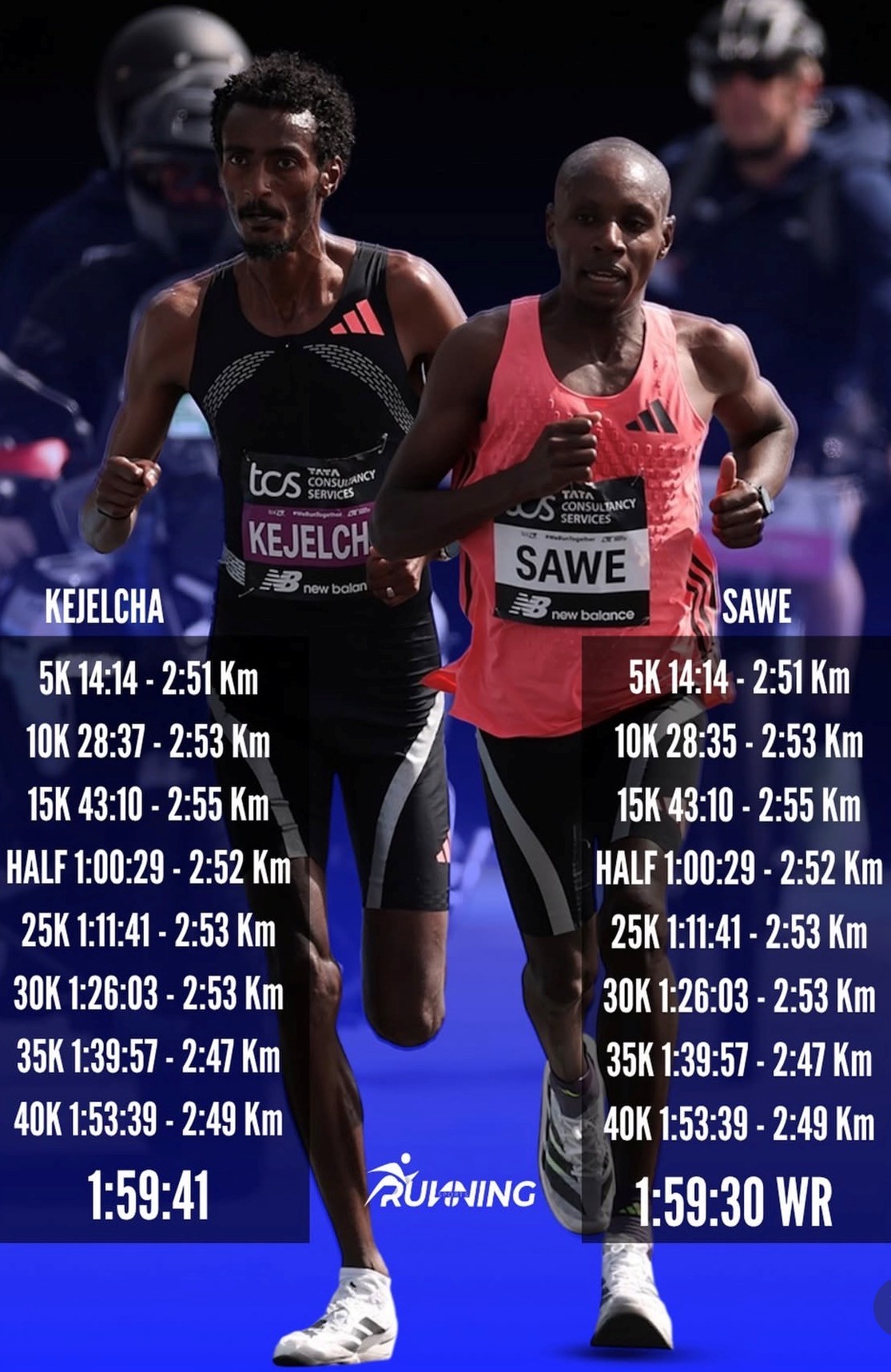
Sabastian Sawe from Kenya won the London Marathon on April 26, 2026, in 1:59:30, becoming the first male marathon runner to break the two-hour barrier in an official competition. World Athletics announced the result as a “world record”.
What makes this special is that Eliud Kipchoge ran 1:59:40 in 2019, but this wasn’t considered an official world record; there were special pace setters, special arrangements, and conditions that didn’t qualify for a record. Sawe’s time in London, however, took on a different meaning because it came in a competitive environment.
The previous official men’s marathon world record was Kelvin Kiptum’s 2:00:35; Sawe improved it by 65 seconds. The level of the race was also extraordinary: Yomif Kejelcha finished second with 1:59:41, and Jacob Kiplimo third with 2:00:28. Let’s summarize the situation in the table below:
2026 London Marathon men’s results:
Rank Athlete Country Time Score
- Sebastian Sawe Kenya 1:59:30 World record; subject to ratification
- Yomif Kejelcha Ethiopia 1:59:41 Second fastest marathon in history; Fastest Marathon Debut
- Jacob Kiplimo Uganda 2:00:28 Below the previous world record
Kejelcha finished just 11 seconds behind Sawe. According to World Athletics, this time is the second fastest time in marathon history and the fastest marathon debut* since it was Kejelcha’s first marathon. Can you imagine, you’re running a marathon for the first time in your life and you manage to run it in under 2 hours, a time never before reached, considered a turning point in human history. An incredible achievement.
What’s even more interesting about the race is that not only did two people break the two-hour barrier; the top three athletes also ran faster than the previous official world record of 2:00:35 held by the previous record holder, Kelvin Kiptum. Kiplimo didn’t break the two-hour barrier with 2:00:28, but he beat the old world record by 7 seconds.
He made history in his first marathon
Kejelcha’s performance is also striking in terms of his athletics background: the Ethiopian athlete was better known for his middle-to-long-distance career in track and road races; his 1:59:41 in London showed that his transition to the marathon was at a world record level in his very first race. Therefore, while Sawe went down in history as the “first official sub-2 marathon runner,” Kejelcha became the “second person to break the sub-2 barrier” in the same race.
I think this doesn’t just mean “humans have gone under two hours”; the new benchmark in marathon running is now the 1:59 mark. The combination of shoe technology, nutrition, route optimization, and in-race pace management has transformed what was once seen as a psychological limit into a competitive goal. But still, what Sawe did is a giant leap, showing how quickly we’ve come from Kiptum’s 2:01:25 course record in London 2023 to this point.
Marathon Records Throughout History
Let’s look at the history of marathons and remember where people came from and how they started running marathons in under 2 hours: I will present the official list chronologically, separating early “world best” records from World Athletics’ modern “world record” terminology.
The following list is for the progression of men’s marathon world records/world best times. Incidentally, it’s important to note that the marathon distance was standardized at 42.195 km in 1921. Also, the IAAF/World Athletics tracked the marathon as “world best” for a long time; the “world record” status, in its modern sense, was clarified in the 2000s. Therefore, early records are not evaluated on the same grounds as today’s criteria.
However, to give you an idea, I am sharing the world records for marathon distances from 1908 onwards below:
| Date | Athlete | Country | Time | Race / Location |
| 24 July 1908 | Johnny Hayes | USA | 2:55:18.4 | London Olympic Marathon |
| 1 January 1909 | Robert Fowler | USA | 2:52:45.4 | Yonkers |
| 12 February 1909 | James Clark | USA | 2:46:52.8 | New York |
| 8 May 1909 | Albert Raines | USA | 2:46:04.6 | New York |
| 8 May 1909 | Henry Barrett | Great Britain | 2:42:31.0 | Polytechnic Marathon |
| 31 August 1909 | Thure Johansson | Sweden | 2:40:34.2 | Stockholm |
| 12 May 1913 | Alexis Ahlgren | Sweden | 2:36:06.6 | London |
| 22 August 1920 | Hannes Kolehmainen | Finland | 2:32:35.8 | Antwerp Olympic Games |
| 12 October 1925 | Albert Michelsen | USA | 2:29:01.8 | Port Chester |
| 31 March 1935 | Son Kitei / Sohn Kee-chung | Korea/Japan | 2:27:49 | Tokyo |
| 3 April 1935 | Fusashige Suzuki | Japan | 2:26:44 | Tokyo |
| 3 November 1935 | Yasuo Ikenaka | Japan | 2:26:42 | Tokyo |
| 19 April 1947 | Suh Yun-bok | Korea | 2:25:39 | Boston |
| 14 June 1952 | Jim Peters | Great Britain | 2:20:42.2 | Polytechnic Marathon |
| 13 June 1953 | Jim Peters | Great Britain | 2:18:40.2 | Polytechnic Marathon |
| 4 October 1953 | Jim Peters | Great Britain | 2:18:34.8 | Turku |
| 26 June 1954 | Jim Peters | Great Britain | 2:17:39.4 | Polytechnic Marathon |
| 24 August 1958 | Sergei Popov | USSR | 2:15:17 | Stockholm |
| 10 September 1960 | Abebe Bikila | Ethiopia | 2:15:16.2 | Rome Olympics |
| 17 February 1963 | Toru Terasawa | Japan | 2:15:15.8 | Beppu-Ōita |
| 15 June 1963 | Leonard Edelen | USA | 2:14:28 | Polytechnic Marathon |
| 13 June 1964 | Basil Heatley | Great Britain | 2:14:04.6 | Polytechnic Marathon |
| 21 October 1964 | Abebe Bikila | Ethiopia | 2:12:11.2 | Tokyo Olympics |
| 12 June 1965 | Morio Shigematsu | Japan | 2:12:00 | Polytechnic Marathon |
| 3 December 1967 | Derek Clayton | Australia | 2:09:36.4 | Fukuoka |
| 30 May 1969 | Derek Clayton | Australia | 2:08:33.6 | Antwerp |
| 6 December 1981 | Robert de Castella | Australia | 2:08:18 | Fukuoka |
| 21 October 1984 | Steve Jones | Great Britain | 2:08:05 | Chicago |
| 20 April 1985 | Carlos Lopes | Portugal | 2:07:12 | Rotterdam |
| 17 April 1988 | Belayneh Dinsamo | Ethiopia | 2:06:50 | Rotterdam |
| 20 September 1998 | Ronaldo da Costa | Brazil | 2:06:05 | Berlin |
| 24 October 1999 | Khalid Khannouchi | Morocco/USA | 2:05:42 | Chicago |
| 14 April 2002 | Khalid Khannouchi | Morocco/USA | 2:05:38 | London |
| 28 September 2003 | Paul Tergat | Kenya | 2:04:55 | Berlin |
| 39 September 2007 | Haile Gebrselassie | Ethiopia | 2:04:26 | Berlin |
| 28 September 2008 | Haile Gebrselassie | Ethiopia | 2:03:59 | Berlin |
| 25 September | Patrick Makau | Kenya | 2:03:38 | Berlin |
| 29 September 2013 | Wilson Kipsang | Kenya | 2:03:23 | Berlin |
| 28 September 2014 | Dennis Kimetto | Kenya | 2:02:57 | Berlin |
| 16 September 2018 | Eliud Kipchoge | Kenya | 2:01:39 | Berlin |
| 25 September 2022 | Eliud Kipchoge | Kenya | 2:01:09 | Berlin |
| 8 October 2023 | Kelvin Kiptum | Kenya | 2:00:35 | Chicago |
| 26 April 2026 | Sebastian Sawe | Kenya | 1:59:30 | London |
According to this list, the biggest breaks in the record line were during the Jim Peters era in the 1950s, the Abebe Bikila and Derek Clayton leap in the 1960s, the Berlin/Rotterdam/Chicago line from the 1980s to the 2000s, and the “super shoes + modern nutrition + ideal course” era after 2018. It arrived. The transition, particularly from Kiptum in 2023 to Sawe in 2026, completely changed the psychological threshold, with the record dropping from 2:00:35 to 1:59:30.
The role of shoe improvements in record-breaking achievements
Let’s also look at the technical side. In addition to improvements in runners’ training and nutrition techniques, I believe that significant improvements in footwear are making official races faster. Below, I’ll share information about the evolution of shoes, from the Reebok shoes in which Steve Jones broke the 1984 London Marathon record with a time of 2:08:05, to the Adidas Adizero Adios Pro Evo 3 shoes in which Sebastian Sawe broke the 2-hour barrier in the recent London Marathon, and how they were developed with different technologies:
https://www.instagram.com/p/DXtf6VbChIE/?img_index=1&igsh=ODVnZGVkcWM2b2Rp
My expectations for the future
Let me share my expectations for the future and conclude this article:
1) I believe that now that this psychological barrier has been overcome, many racers will frequently finish under 2 hours in numerous competitions.
2) I expect Kenyan Sabastaian Sawe, who broke the two-hour barrier in an official race, and Ethiopian Yomif Kejelcha, who finished the race in under two hours shortly after him, to further improve their times. After all, both are young runners with high potential.
3) I think that in the next 2-3 years, new young runners will follow in Sawe and Kejelcha’s footsteps and bring this time down to 1:58.
4) In the long term, this record will also drop below 1:50.
My hope is that Türkiye will take Kenyan and Ethiopian athletes as examples and that athletes capable of breaking world records will emerge from our country. This could be in short distances or long distances. The important thing is that our athletes win medals at world championships and the Olympics, and even more importantly, contribute to pushing the boundaries of humanity by breaking world records.
I believe our people have the physical capacity to achieve these successes. They can break world records in international competitions and the Olympics for middle and long-distance running, provided they train with the skills, techniques, and discipline of East African runners.
*Debut: First official race
Below Form