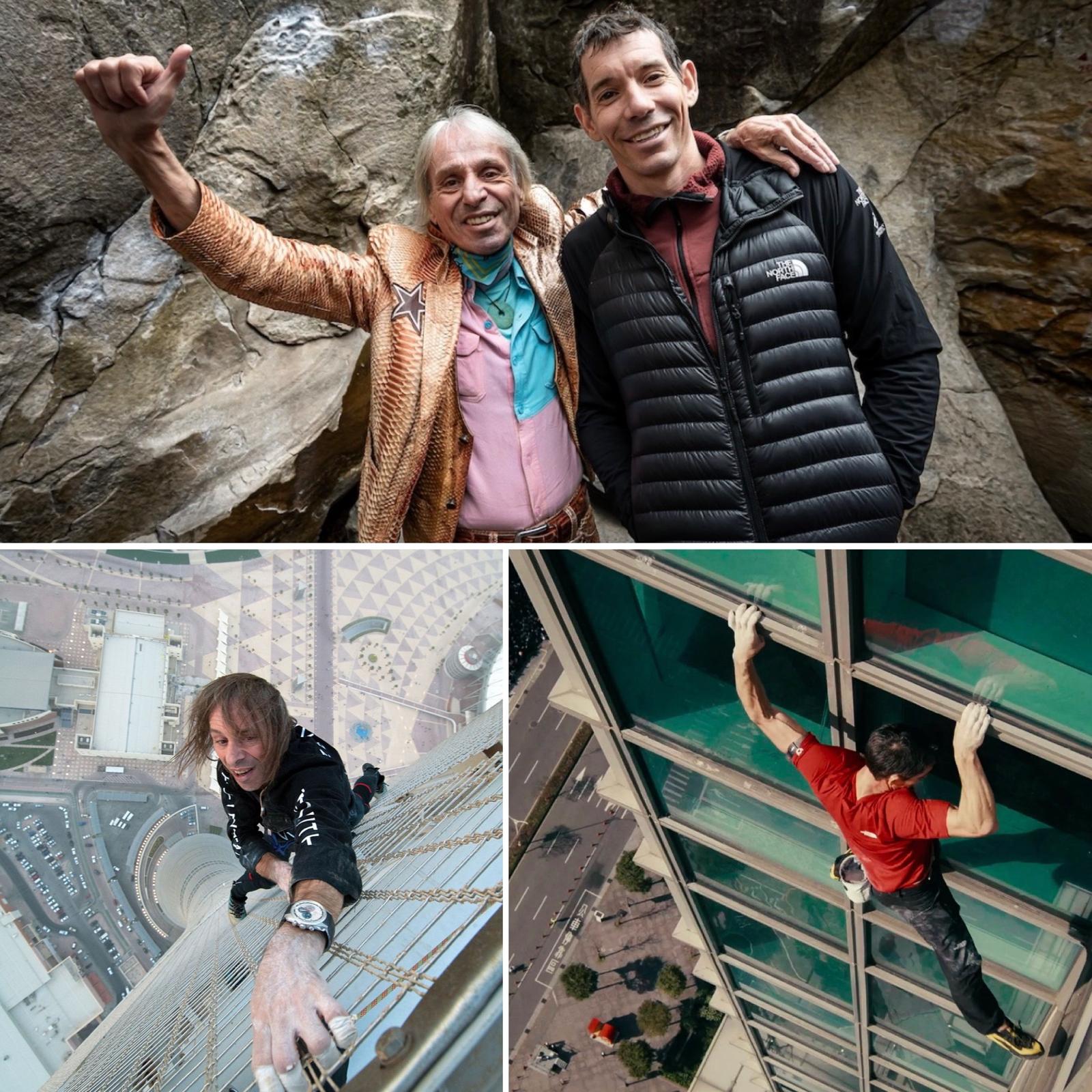
First, let me briefly mention the documentary I watched. Watching Alex Honnold climb the 508-meter giant structure in the 90-minute documentary brought back memories: I once again admired the incredible athletic skills of free solo climbers who climb without any equipment like ropes, harnesses, or protective gear. First, let’s get to know Alex Honnold.
Alex Honnold’s life
Alexander J. Honnold (born 17 August 1985) is an American rock climber known for his free solo climbs of big wall climbing routes. Honnold gained worldwide fame in June 2017 as the first person to free solo climb the 880-meter (2,900 ft) 5.13a graded freerider route on El Capitan in Yosemite National Park. This was the first free solo climb of that grade on a big wall and was described by The New York Times as “one of the greatest athletic achievements of all kind.”
In 2015, he won the Piolet d’Or in mountaineering with Tommy Caldwell for completing the Cerro Chaltén Group (or Fitzroy Group) peak chain in Patagonia in five days (known as the Fitz Traverse). On 25 January 2026, he completed a free solo ascent of Taipei 101 Tower in Taipei, Taiwan; this was the highest free solo ascent in history and had a difficulty rating of approximately 5.11.
Honnold is the author (with David Roberts) of the memoir Alone on the Wall (2015) and the subject of the 2018 Academy Award and BAFTA-winning biographical documentary Free Solo (Wikipedia).
What makes Honnold interesting is not just his climbing, but the fact that he has almost entirely simplified his life around this goal. His story fits the “modern hero” narrative, but it’s not flashy in the classic sense: highly disciplined, introverted, risk-averse but not shy about risk. On his official website, his 2017 El Capitan ascent is described as a “history-making” climb, and Free Solo is mentioned as an Oscar-winning documentary.
Now, let’s talk about Alex Honnold’s climb of Taipei 101 on 25 January and the documentary they made.
A magnificent climbing documentary
I watched this documentary with great pleasure. Above all, I got the impression that Alex is a person with special talents, and that the adrenaline is felt by everyone, including himself. The key element here is the fact that such climbs, pushing human limits without equipment, are possible – the “Free Solo” aspect, as it’s technically called. The documentary’s strength lies not only in the athlete’s rope-free ascent of El Capitan, but also in portraying this act not as an “adrenaline show,” but as an almost mathematical preparation, repetition, mental control, and a cold relationship with death.
This documentary is more about the aesthetics of preparation than courage. While watching Honnold, the viewer realizes this: Free soloing, while seemingly madness from the outside, has been transformed into a controllable problem in his world. Honnold’s training, pushing the limits of human endurance, his physical and mental preparation, are all geared towards a single goal: the limits of control are extremely fine, with no room for error.
While watching Alex’s climb, I kept thinking of Alain Robert, nicknamed “Spider-Man,” whom I’ve followed for a long time due to his similar abilities. Without going into details about Alain Robert, let me give you some information about the documentary:
Alex Honnold’s climb up the 508-m. high Taipei 101 skyscraper in Taiwan without any safety equipment or ropes was broadcast on the Netflix event “Skyscraper Live.” Honnold successfully reached the summit in a time of 1:31:34, using the building’s bamboo balconies and ledges.
Highlights of the Show
- Timing: The climb was successfully completed on 24 January 2026, after being delayed by one day due to weather conditions.
- Distance and Time: Honnold scaled the top of the 508-meter (1,667-foot) 101-story building in a remarkably short 1.5 hours.
- Platform: The entire climb was streamed live to viewers worldwide on the Netflix platform.
- Design Influence: Taipei 101’s “bamboo box” design, repeated every eight floors, provided Honnold with critical resting points throughout the climb.
Breathtaking Details
The “Skyscraper Live” documentary event, focusing on Alex Honnold’s Taipei 101 climb, made history both for its technical background and the risks involved in the broadcasting world. Other notable details about the production included:
1) 10-second safety delay (Live broadcast risk): Because the climb was entirely without ropes or safety nets, Netflix delayed the live stream by 10 seconds to allow for immediate interruption in the event of a fall.
2) Plan B: Netflix executives had prepared an emergency protocol to immediately change the camera direction in case of an unfortunate incident, preventing viewers from experiencing trauma.
3) Weather and postponement crisis (Wet surface danger): The event was originally scheduled for 23-24 January. However, rainy and extremely windy weather in Taiwan turned the glass and steel surfaces into deadly slides, causing the climb to be postponed by a day.
4) Winds: When Honnold reached the upper floors of the building, he had to contend with strong winds and significant physical exhaustion.
5) Interesting Hosting Team: The team managing the broadcast from the studio was quite unusual. Former NASA engineer and famous YouTuber Mark Rober, WWE champion Seth Rollins, sports commentator Elle Duncan, and professional climbers accompanied the broadcast.
6) Family Interviews: During the climb, not only Honnold’s movements but also his wife Sanni McCandless’s anxious wait, her life with their two children at home, and Honnold’s private training footage were presented to the audience as documentary segments.
7) Calm During the Climb (Greeting): Alex Honnold continued to speak calmly into the live microphone he carried hundreds of meters high. He even smiled and waved to the office workers inside the building and the viewers outside as he climbed.
8) Summit and Descent: Upon reaching the summit, he simply said, with his usual composure, “Great (Sick).” After completing his climb on the summit pole, he descended to the 88th floor by rope for safety reasons and left the building by elevator.
9) Broken record and controversies (Largest urban climb): The media declared this climb “the highest urban free solo climb in history.” It halved the time taken by French climber Alain Robert’s 2004 Taipei 101 climb using ropes. However, some in the mountaineering world point out that this record is still controversial when compared to Dan Goodwin’s 1986 CN Tower climb.
Now, let’s introduce you to Alain Robert, the French Spiderman who inspired Alex Honnold and whose school of thought he continues.
The Alain Robert legend
Alain Robert, known in the climbing world as “The French Spider-Man,” is the world’s greatest pioneer and initiator of urban solo climbing (skyscraper climbing). Born in 1962, the French climber is famous for climbing the world’s tallest buildings without any safety equipment, ropes, or nets, using only climbing shoes and chalk dust (skyscraper free solo).
Let’s look at Alain Robert’s life and notable details:
- Pioneer of urban climbing: He has climbed over 200 skyscrapers and iconic structures worldwide, including the Burj Khalifa, the Eiffel Tower, the Sydney Opera House, the Empire State Building, and the Petronas Twin Towers.
- Tremendous success in rock climbing: While most people only see him climbing buildings, Robert is actually one of the most skilled rock climbers in the history of climbing. In 1991, he was the first person in the world to free solo climb a 5.13d (8b) graded rock route, an extreme difficulty level in the climbing world.
- Major injuries and defiance: Early in his career (in 1982), a horrific fall left him in a coma for several days, breaking bones, and doctors said he would never climb again and would have a 60% permanent disability. However, despite permanent balance problems (vertigo), he managed to continue climbing.
- Arrests and activism: He has been arrested or detained dozens of times around the world for carrying out the majority of his climbs without legal permits, secretly sneaking into buildings at dawn. In his later years, he began to use these actions to draw attention to issues such as climate change and global warming (by hanging giant banners on buildings). Despite being in his 60s, he is still actively climbing.
My Encounter with Alain Robert
It was during this period that I met Alain Robert in person. While I was studying in Montreal, in 1999, the year I graduated, he made a free solo climb of Place de la Cathédrale (now known as Tour KPMG) without permission. After a brief period of detention, he was released.
When I saw this climb on television, a crazy project immediately came to mind. At that time, my father, who was the head of Süzer Holding, was about to open Süzer Plaza. I wanted to introduce Alain Robert to him. The scenario I had in mind was this:
Alain Robert would come to Istanbul. He would see Süzer Plaza, like it very much, and decide to climb it. He would do the climb without permission. When he reached the roof, we would greet him with flowers.
To realize this plan, I needed to contact Alain Robert as soon as possible. He was in Montreal. I could have the meeting there and finalize the deal. I asked my close friend Nicolas, who was interning at one of Montreal’s most prestigious marketing firms at the time, for help in contacting Alain Robert. He immediately passed the message on to his acquaintances, and Nicolas got back to me. He delivered the wonderful news, saying, “We’ve reached Alain. I’ll arrange a meeting with you.” Following this fantastic news, we arranged to meet the very next day at a cafe.
My meeting with Alain Robert went wonderfully. I found myself face-to-face with a small, sharp mind and fearless personality.
The challenging persuasion process
During our conversation, he showed me how he could do push-ups with just one finger. I couldn’t believe my eyes. I was quite fit during my university years. I used to show off to my close friends that I could do push-ups with one hand. Seeing someone who could do push-ups with one finger made me stop bragging. I took my hat off to him.
Interestingly, he also told me he was hesitant to climb in Türkiye. He had seen the movie Midnight Express, which is a stain on Türkiye’s image. He was terrified after watching a completely fabricated scenario depicting the suffering of an American imprisoned in Turkish prisons.
I told him, “There will be no unauthorized climbing, therefore no arrest. Besides, we Turks are not like that; this is a film based on a manipulative scenario designed to tarnish the country’s reputation and spread false information. Don’t worry about it.”
As a result of all these conversations, I convinced Alain Robert to come to Istanbul. Thankfully, he showed his humility at the end of the meeting and said to me, “You reassured me. If such an invitation comes, I would gladly free-solo climb your building.” I had completed the most important part of the job. Next, I needed to get approval from our people. With great joy, I called my father and explained the situation. He said, “It’s a great idea, but we can’t take such a risk. When he said, “God forbid, the man might fall or something, and then there would be very serious problems,” my crazy project was shelved.
Of course, I had to share this result with Alain Robert, and he, too, accepted this negative outcome maturely, saying, “Never mind.”
A lesson in humility…
The most striking aspect of my meeting with Alain Robert wasn’t his ability to do push-ups on one finger. It was the incredible humility of someone so famous, known worldwide as “Spiderman,” and capable of overcoming superhuman risks. He never lost touch with the public, and his humility was evident throughout our conversation.
I observed similar qualities in Alex Honnold, in his interviews for his documentary. I believe it’s no coincidence that these exceptional athletes, who accomplish extraordinary feats, are so humble. They are living proof of the saying, “The higher you rise, the humbler you must be.”
If we compare the two, we can certainly observe many similarities and differences. Alain Robert’s legend stands apart from Honnold’s. While Honnold identifies with nature and rock surfaces, Robert identifies with the city, glass, concrete, prohibitions, and public spectacle. This is the origin of the nickname “French Spiderman”: his climbs of skyscrapers in different cities around the world, often without permission and safety equipment. Sources state that Robert was known as the “French Spiderman,” and that he typically climbed skyscrapers with only climbing shoes and chalk.
The Alain Robert legend is more “punk” and defiant. While Honnold’s narrative is one of pure performance and perfectionism, Robert’s is one of defying authority, the city, and seemingly impossible architecture.
The Relationship Between Alain Robert and Alex Honnold
Although media and social media users frequently pit the two against each other over the question of “Who is the best free-climber in history?”, there is not competition between them, but a deep-rooted friendship and immense mutual respect that has lasted for over 15 years.
Key points regarding their relationship include:
- Generational Difference and Inspiration: There is a significant generational gap between Alain Robert (in his 60s) and Alex Honnold (in his 40s). Honnold considers Robert a “true legend” (OG) in climbing history, noting that his freediving in the ‘80s and ‘90s pushed the limits of human potential at that time.
- Honnold’s protection of Robert’s image: Urban climbing is sometimes dismissed in popular culture as “showmanship” or “cheap promotional tricks.” However, Alex Honnold defended Alain Robert’s climbing techniques, stating, “People may see his climbing as a show, but behind these shows lies a technical skill unparalleled in the climbing world,” thus acknowledging his friend’s merit at every opportunity.
- Book foreword: Alex Honnold wrote the foreword for Alain Robert’s last autobiography, “Spiderman, Alain Robert, Free and Unattached.” Robert expressed his great honor at this gesture from Honnold.
- The Taipei 101 connection: One of the most important structures connecting the two is Taipei 101. Alain Robert climbed this building in 2004; however, due to safety requirements imposed by the Taiwanese government, he was forced to climb it using ropes (toprope) at the time. Alex Honnold, in 2026, achieved a first by climbing the same building completely free-solo. Following the climb, Alain Robert congratulated his friend Honnold live on air, saying, “Tremendous mental preparation and a wonderful achievement.”
In short; one is the “rope-free” king of the massive granite walls in nature (El Capitan), the other of the concrete and steel towers of modern metropolises. Because they are among the few people who live on the edge of danger, they are two friends who understand each other best in the world.
The branch with the lowest margin of error!
Free soloists are the athletes who exhibit the lowest margin of error in the world of sports.
A free solo athlete must simultaneously possess strength, flexibility, balance, technique, memory, route reading, breath control, stress management, and the ability to make decisions under life-threatening pressure. Many athletes lose points for making mistakes; for a free soloist, a mistake can be fatal. From this perspective, free solo is one of the most raw and rigorous tests of human performance.
A marathon runner’s endurance, a gymnast’s coordination, a swimmer’s physiology, a tennis player’s reflexes, or a footballer’s game intelligence are different areas of superiority. Free soloists are perhaps the athletes who must perform flawlessly under the highest risk.
In free solo, it’s not just about physical strength; it’s about mental clarity, technical perfection, and the absolute nature of risk.
Given that Alain Robert and his successor Alex Honnold are leaders in the free solo world, we can say that these two magnificent athletes, through the challenges they presented, pushed human limits and achieved extraordinary performances by eliminating the margin of error.
A huge round of applause for these two magnificent athletes and high-character individuals, who represent two different generations and the same school of thought, and who exemplify friendship.
Note: I used ChatGPT and Wikipedia for certain textual adjustments while writing this article.