With its unforgettable storytelling that fuels the imagination, its delightful iconic characters, its groundbreaking visual effects in every era it was made, and its cult-like, memorable music, the Star Wars saga has left its mark on cinematic history. I rewatched ‘Return of the Jedi,’ the third film in the series in terms of production order and the sixth in terms of story structure, accompanied by the Istanbul Film Orchestra under the direction of conductor Timothy Henty. My readers will remember that I watched the second film in the Lord of the Rings series, “The Two Towers,” in a similar way last year and wrote about my experience in my article at this link: https://serhansuzer.com/tr/sinemanin-canli-performansla-muhtesem-bulusmasi/
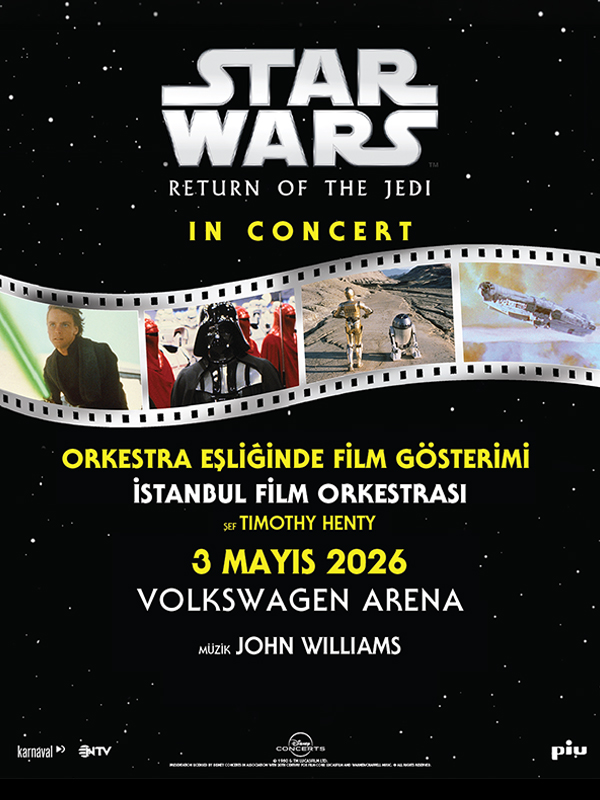
This year, around the same time, on 3 May, I once again enjoyed watching the works of the legendary composer John Williams, who won an Academy Award for Best Original Music for his work on the Star Wars universe, in a live symphonic orchestra performance synchronized with the film at the Volkswagen Arena. While the intergalactic battle raged on the silver screen, the orchestra’s live performance was magnificent.
About the film
To give more information about the film; Star Wars: Episode VI – Return of the Jedi is a 1983 American epic space opera film written by George Lucas and Lawrence Kasdan and directed by Richard Marquand. A sequel to The Empire Strikes Back (1980), it is the final film in the original Star Wars trilogy and the sixth chronological film in the “Skywalker Saga”. The film stars Mark Hamill, Harrison Ford, Carrie Fisher, Billy Dee Williams, Anthony Daniels, David Prowse, Kenny Baker, Peter Mayhew, and Frank Oz.
The film premiered in theaters on 25 May 1983. It grossed $374 million worldwide on its opening weekend, becoming the highest-grossing film of 1983. The film was well-received by critics; The film received praise for its actors’ performances, John Williams’ music, special effects, and action scenes. Over the decades, the film underwent various re-releases and revisions, grossing a total of $482 million. The United States Library of Congress selected the film for preservation in the National Film Archive in 2021. This was followed by a prequel trilogy released between 1999 and 2005, and a sequel trilogy released between 2015 and 2019. (Source: Wikipedia)
Now, let’s get to the plot. Star Wars: Return of the Jedi follows the Rebel Alliance’s efforts to destroy the second Death Star and Luke Skywalker’s struggle to save his father, Darth Vader, from the dark side. The fate of the galaxy is decided in this final battle for the defeat of the Empire and the rebirth of the Jedi Order. (Source: IMDb)
The Rescue of Han Solo
The film begins with Luke Skywalker and his friends’ operation to rescue Han Solo, who has been frozen and delivered to Jabba the Hutt on Tatooine. After long and dangerous battles, they manage to free their friend from Jabba’s clutches and reunite. (Source: Science Fiction Club)
Preparation and New War
The Empire is building a Death Star, even more powerful than before, to control the galaxy. Luke returns to Yoda’s side, completes his training, and receives the title of Jedi Knight. Here, he also learns that Princess Leia is his twin sister and that Darth Vader (Anakin Skywalker) is his father. The rebels ally with the Ewoks, the local people, to destroy this deadly station controlled from the forest satellite Endor, which serves as a defensive shield. (Source: Cinemas)
The Final Confrontation
Luke, believing his father still possesses goodness, surrenders himself to Emperor Palpatine and Darth Vader. In this epic battle on the Death Star, the Emperor attempts to lure Luke to the dark side. Luke resists, but is forced into a sword fight with his father. Desperate, Darth Vader must choose between his son and the Emperor, and to protect his son, he kills the Emperor. (Source: IMDb)
Freedom of the Galaxy
With the Emperor’s death, the dark side is defeated, and the Rebel fleet successfully destroys the second Death Star. In the final scene, Luke burns his father’s body; with Anakin Skywalker’s return to the light side, peace returns to the Galaxy, and our heroes celebrate victory. (Source: Wookieepedia)
I thoroughly enjoyed watching the film, and I’d like to share some of my memories from that day with you.
Based on my previous experiences, we arrived two hours before the screening. It was a good idea to go early, considering the large crowd and the long queues that would likely form at a similar time. This time we were able to park our car easily. After grabbing a bite to eat an hour before the screening, we managed to get in before the queue got too long.
Our seats in the theater were excellent. I was surprised by the smaller crowd compared to The Lord of the Rings. However, this audience was much more enthusiastic than in the previous film. I saw costumes of almost all the Star Wars characters. It was quite fun. I even took a picture with Darth Vader, whose real name I learned is Osman.
The symphony orchestra was quite successful. They played all the pieces composed by John Williams in the film back-to-back. Listening to these legendary Star Wars soundtracks live personally gave me goosebumps. As it should be, the entire film was shown in its original language with Turkish subtitles. The live orchestra accompanied the 150-minute film.
The notes that built a Galaxy
There are some film series that we remember not only for their stories but also for the emotions they evoke. Star Wars is one of them. But what makes Star Wars Star Wars is not just its characters, space battles, or visual world. One of the unseen but most powerful heroes of this universe is its music.
With the release of the first film in 1977, John Williams’ scores became some of the most recognizable works in cinematic history. Today, when we think of Darth Vader’s walk, Luke Skywalker’s hopeful gaze, or intergalactic journeys, a significant portion of what comes to mind is actually Williams’ notes. In fact, the music often stays in our memory longer than the scenes themselves.
A recent Star Wars Symphony Orchestra concert reminded me of this fact once again. Although I’ve known the films for years, listening to these pieces live was a completely different experience. Because when watching a film, the music often blends into the story. But when the symphony orchestra takes the stage, all your attention is focused on the music, and you realize just how great a work of art has been overshadowed by the films for so many years.
A concert like a journey through the Universe
The atmosphere in the hall changed the moment the first notes were heard. Melodies I had heard hundreds of times before gained a much stronger meaning with the live performance of dozens of musicians. The tension created by the strings, the grandeur and energy of the brass piano, all conveyed the emotional depth of the Star Wars universe.
At a certain point, you forget you’re listening to a concert. You feel like you’re not in a concert hall, but traveling to different corners of the galaxy. The music takes you back to your childhood; it reminds you of the scenes you first saw, the excitement you felt, and the dreams you had.
Perhaps that’s why film scores are one of the most powerful elements of cinematic art. Images may change over time, technologies may advance, effects may become outdated. But a good composition manages to create the same emotion even decades later. That’s exactly what the Star Wars score does. Despite almost half a century having passed, it still carries the same excitement as the first day.
As I left the concert, what stayed with me wasn’t just a successful orchestral performance. More than that, I was thinking about the power of music in storytelling. Sometimes we know a character through their music before we know them. Sometimes we remember a scene through its melody before we remember it. And sometimes what truly makes a universe unforgettable is not what we see, but what we hear.
The Power of Appealing to Both the Eyes and Ears
The Star Wars Symphony Orchestra concert showed me once again that some stories are written for the eyes, and some for the ears. Star Wars is one of the rare examples that perfectly achieves both.
As I mentioned in my previous post, I am eagerly awaiting to watch other productions with wonderful soundtracks. In my previous post, I listed 20 foreign and 5 domestic films. Star Wars was among them. It was great that the Star Wars film was released. Now, from this list, in my opinion, are The Godfather, Zorba the Greek, Interstellar, Rocky 4, and Pulp Fiction. From Turkish films, there are Selvi Boylum Al Yazmalım and Hababam Sınıfı. I hope this wonderful series of events, organized by Piu Entertainment, where classic films are accompanied by a symphony orchestra, continues.
Note: I would like to express my heartfelt thanks to my dear Rengin Arzu for helping me write this post.