- I see you give speeches in many venues. Where do you speak? What themes do you explore in your speeches?
I can speak in many different places. I’ve taught elementary, middle, high school, university, and graduate students, as well as given talks at seminars and conferences attended by business professionals, executives, and entrepreneurs, as well as to social entrepreneurs, NGO professionals, and public officials. I’ve even spoken twice in the Turkish Grand National Assembly (TBMM).
My speeches are usually in my home country. However, I’ve also spoken and continue to speak in many other countries, including Brazil, Austria, the UK, Germany, the US, and Canada. For example, I’m speaking in China next month.
The themes of my speeches are generally sustainability, renewable energy, EkoRE, and TİDER. However, if requested, I can also speak on specific energy areas such as zero waste, family businesses, my career, solar energy, or biogas, or on other topics depending on demand.
- What kind of world does Serhan Süzer want to see?
I want to see a world where people protect and care for our nature and therefore our planet, where technologies constantly evolve while preserving ethical values, where a certain balance (population, etc.) is achieved on our planet, where people can live on other planets and galaxies, where education levels are high, where life is free of hardship, where all people can build happy lives wherever they are, where there are no wars, threats, or harassment, where the crime rate has fallen to near zero, where bad people are suppressed and evil is minimized, where borders are abolished, and where everyone can live happily.
- How do you ensure sustainability with TİDER (Basic Needs Association)?
We achieve this in two ways. First, we contribute to the natural sustainability of the world through our waste prevention vision. You can better understand what I mean by looking at my waste prevention vision below:
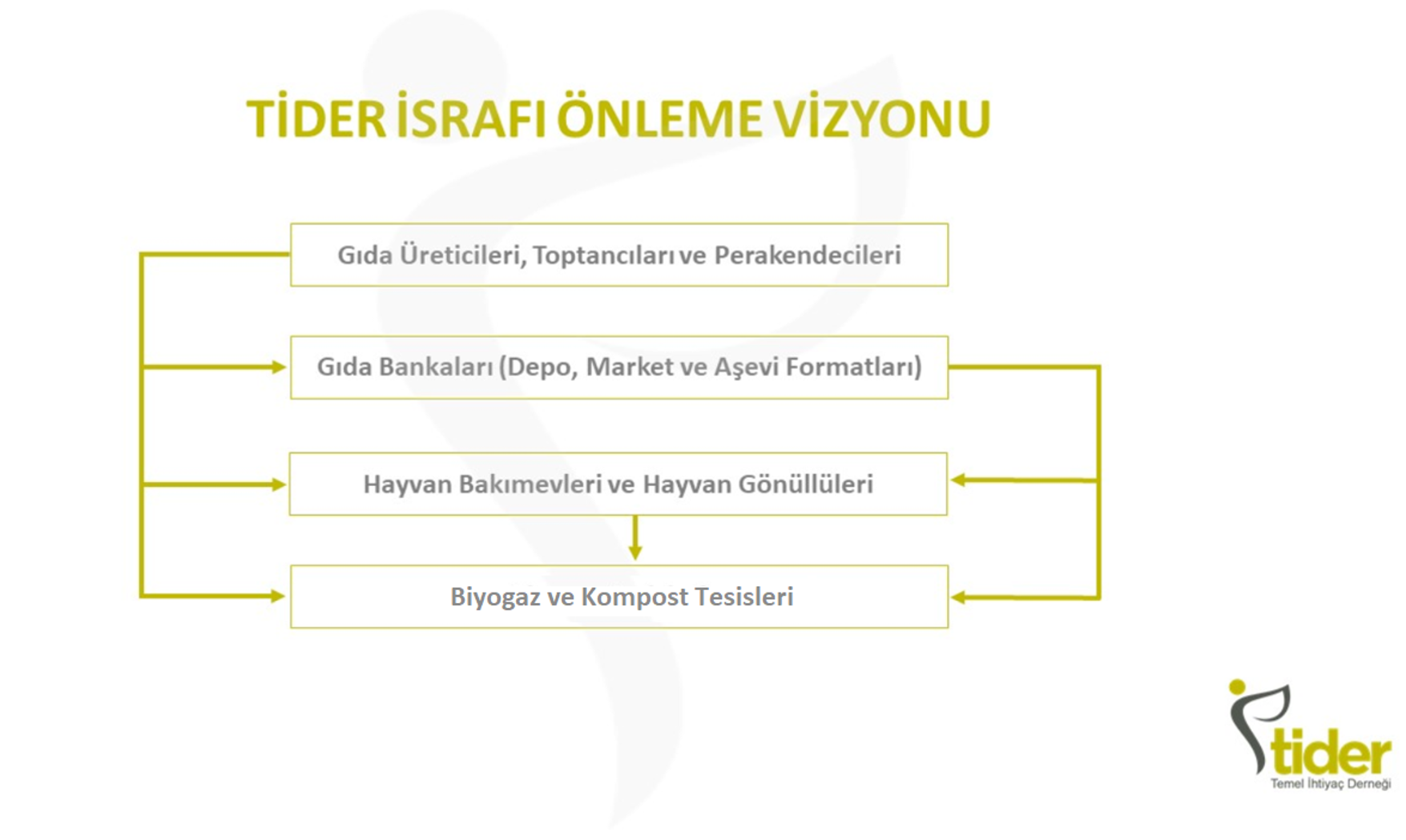
Second, we aim to provide jobs for those in need by meeting their basic needs on a temporary basis or by generating income through our micro-entrepreneurship programs, enabling them to achieve their own economic sustainability.
- When I say, “The English word for Turkey should be ‘Turkia’ instead of ‘Turkey,’” a common comment is: “’Türkiye’ should be used instead of ‘Turkia.’” Wouldn’t Turkey be a better fit for us?
A nice wish, but not practical. Foreigners can’t pronounce Turkey the way we do. They end up with words like ‘Törkay’ or ‘Türkay.’ However, as I mentioned in my article, which you can find at https://www.serhansuzer.com/tr/ulkemizin-ingilizce-adi-turkia-olmali , “The English suffix ‘-ia’ is the equivalent of the Turkish suffix -istan. So, when you add ‘-ia’ to the end of a nation or ethnicity, you define “its country.” For example, Bulgaria means the country of the Bulgarians, and Malaysia means the country of the Malays. This is the case all over the world. I could give you many more examples:
Albania, Algeria, Armenia, Australia, Austria, Bosnia, Bulgaria, Croatia, Estonia, Georgia, India, Indonesia, North Macedonia (I don’t want my Greek friends to get mad), Malaysia, Mongolia, Nigeria, Romania, Russia, Saudi Arabia, Serbia, Syria, and many more countries I can’t list here.
The most recent addition to the list of countries whose names end in ‘ia’ is ‘Czechia,’ or the Czech Republic. If they managed to convince the world to accept ‘Czechia’ instead of ‘Czech Republic’ at length, why don’t we? Can’t we?”
- The second classic comment to my suggestion that we call it ‘Turkia’ instead of ‘Turkey’ was: “Let them call us Turkey. So what, when they say ‘Turkey,’ do we become Turkey? Instead, let us try to improve ourselves as a country. Mind our own business, improve our image. Isn’t that right?”
I don’t want my country to be called ‘Turkey.’ I know that the vast majority, especially those living abroad (I know from the messages I receive), think like me. Because when you live abroad, you often encounter underhanded mockery of our country’s name, whether well-intentioned or not. Interestingly, some people in Turkey fail to grasp this. We are trying to correct a mistake that has been made about our country for decades, and I have difficulty understanding how unconstructive criticism is being leveled at us in our own country, saying, “Why bother? Mind your own business.” I want to emphasize again that I will continue to do everything in my power to correct this mistake.
Furthermore, you can’t just leave the responsibility of improving the country’s image to the public (Ministry of Tourism and Culture, etc.). This would be a repeat of past mistakes. The responsibility to correct this image rests with all of us.
I’ve been an action-taker throughout my life. So, unlike many, I don’t just sit around and lecture. I’ve done a lot for the country’s image, and I will continue to do so. Here’s an example: I spoke on behalf of Turkey on former US Vice President Al Gore’s program on climate change: https://www.youtube.com/watch?v=O_25mBIoP34
Here’s a second example:
In 2017, TİDER, which I founded, won the first-ever innovation award organized by the Global Foodbanking Network, of which all food banks are members. GFN celebrated this significant achievement for Turkish NGOs with this interview: https://www.foodbanking.org/lifting-people-out-of-poverty-tiders-support-hr-program-wins-global-food-bank-innovation-award/
Here’s a third example:
As EkoRE, the company I founded, we laid the foundation for Turkey’s first integrated solar panel production facility, which combines four processes, and we launched our ‘Turkia’ campaign with a promotional video for this facility, which could potentially create a global brand from Turkey: https://www.youtube.com/watch?time_continue=3&v=9LX3lLEtOK8
So, personally, I do everything necessary to enhance the country’s image, together with my teams. I want citizens of English-speaking countries to use the name ‘Turkia’—which suits us well (both in terms of sound and meaning)—while also appreciating our achievements and the country’s potential and placing us at the top of their minds (this doesn’t just happen with calling us ‘turkey’). To that end, I don’t just speak; I do what’s necessary.
I will correct the use of ‘Turkey’ everywhere I go abroad. I will always use ‘Turkia’ in my speeches and presentations. Let it be known.
- You held a groundbreaking ceremony in Niğde Bor. Did it resonate with the market?
Yes, it did. News about us appeared in many places both in Turkey and abroad. In addition to the news in Turkey, we were pleasantly surprised to see our news appearing in many places abroad, from Italy to China. I’d like to share some of this news:
https://kknews.cc/zh-cn/world/qgm5v3o.html
http://www.rinnovabili.it/energia/fotovoltaico/turchia-fabbrica-fv-integrata/
We’re seeing the results of all this now. Last May, I spoke at Intersolar, one of the world’s largest solar energy events, organized in Germany. In June, I will also speak at SNEC, another of the world’s largest solar energy events, organized in China.
These are the harbingers of the bright future we will build as EkoRE…
- What do you think is most needed in the energy sector for the world’s future?
I believe 100% renewable energy should be used globally. Whether through a distributed system or a centralized power plant model, we absolutely must meet our energy needs entirely with renewable energy.
Fossil resources should also be used as raw materials for energy rather than fuel. In other words, oil should be used in the petrochemical sector, and natural gas in fertilizer production. Furthermore, materials like plastics must be completely recyclable. By burning fossil fuels, we not only pollute our environment and cause climate change, but we also waste a resource that could be crucial for future generations.
- What opportunities do you think renewable energy offers to new companies and independent entrepreneurs who will invest in this field? What might be the threats to bank financing models and new investors?
There are excellent opportunities. Everyone has a role to play in the sector’s restructuring process. Renewable energy investors and entrepreneurs, technology manufacturers, companies requiring distributed systems for their own consumption, and banks have many different opportunities.
For example, when the market for rooftop or distributed systems fully opens, the market will grow significantly for everyone.
Similarly, tenders for large power plants will continue to be held in various regions in our country and around the world. Investors and banks should keep an eye on these projects. There are significant opportunities in the neighboring region, especially in Africa and Central Asia.
As EkoRE, we are open to collaborating with all companies that do their job properly and strive to serve the solar energy sector.
Let’s also add a note about our banking sector. Bankers in Turkey are very outdated in this regard. Many still don’t understand the nature of the business. What they call project finance is not actually project finance. Bankers need to change their perspective. Otherwise, they will not be able to support this innovative and vital sector for our world as much as they should. In other words, bankers need to seriously improve their skills in this area.
- When will the integrated facility to be built in Niğde become operational? Can we get information about the facility’s employment opportunities and production capacity?
We plan to roll out the first solar panels in the first half of next year. We will initiate investments in panel and cell production simultaneously. Cell production will begin after panel production. In other words, we plan to have both cell and panel production operational next year.
We plan to create 1,500 jobs in a total 1 GW factory. Of course, this number of jobs will increase with the expansion of the factory’s capacity.
It is important to understand the scope of this massive project. We are building a large facility that combines four key production stages in crystal technology: ingot, wafer, cell, and module production. Our project area is approximately 620 acres. A site of this size can accommodate a total capacity of 2 GW across all processes. This means it’s twice the 1 GW capacity subject to the incentive. Our vision is based on continuously increasing demand and increasing capacity. In other words, if demand builds in the domestic market or we increase our exports, we plan to make the necessary additional investments for capacity expansion.
- What are your thoughts on the liberalization of the energy market? Should we transition to a liberal economy, or should we continue with the government-developed project model?
I believe the government should encourage self-consumption or PPA (power purchase agreement) models rather than the government-developed project model. I am in favor of the eventual liberalization of all markets. Energy models worldwide are beginning to be based on “on-site production and on-site consumption” and “renewable energy.” This is a globally evolving situation, and it will be impossible to stop it. In other words, every building or electricity consumption point should be able to generate its own energy through its own investment or through another investor. If this is achieved, there will be no need for incentives. Contrary to the perception, renewable energy does not need incentives once the sector is liberalized.
We also need to take steps quickly to support this trend. To those who comment, “There are laws and regulations for self-consumption, anyone can do it,” I’d like to say this: Laws and regulations are certainly important, but we need to look at the core of the issue and what’s happening in practice. There are two reasons for the insufficient demand for self-consumption. First, everyone faces significant challenges in practice. Municipalities and relevant institutions and organizations create all sorts of obstacles for the installation of these power plants. These practices must be impartial, transparent, and carried out within a specific timeframe. For example, permits should be issued within a maximum of one week of the application date. No one should have any additional expectations for these practices, which operate equally and quickly for everyone. Of course, the financing mechanisms for the self-consumption model must also be worked on. Banks and financial institutions have a role to play in this. To accelerate financing outside the banking sector and ensure a healthy financing structure, the capital of various investors should be channeled into this business, at least through PPA (power purchase agreements). Finally, I must mention the reality of “distribution companies” in Turkey. A model that includes them and benefits all stakeholders in the industry can easily be created.
Tag: education