You can also perceive these teachings as achievements. Personally, I see them as acquired virtues. Here’s what the coronavirus has taught us:
- The most important thing in life is health.
The rest is meaningless. Vehbi Koç has a famous saying. I’d like to share it below:
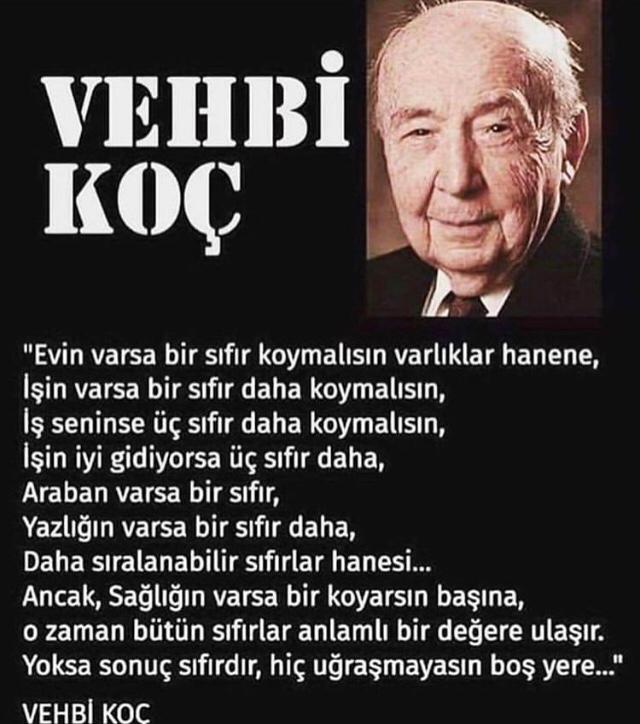
“Ultimately, health is the one put in front of those zeros. In other words, if you have health, everything else has meaning.” The COVID-19 pandemic has taught us this truth in a very painful way. Thank God, I and my close circle haven’t had any problems so far, but I hear from friends. Those who are suffering in the hospital, those whose loved ones have passed away, those whose health has been permanently damaged—my God, how tragic. So, appreciate your health while it’s still there and do everything you can to protect it.
- The importance of hygiene
We all grew up learning certain hygiene rules from our families and those around us. Turkey is doing well in this regard compared to other countries. I know this because I travel a lot. And I recently came across this image. In this image showing the habit of washing hands after using the toilet, you can see that Turkey ranks second in Europe (by a small margin).
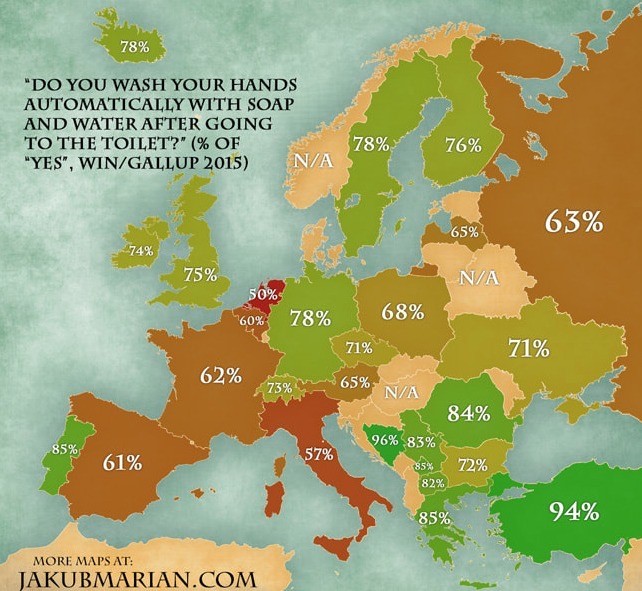
However, because we still believe that many things aren’t enough, we now meticulously implement things we used to do, like soaping our hands for 20 seconds, cleaning objects we frequently touch, like computers, daily, and keeping our homes constantly clean. These acquired hygiene habits should continue even after the pandemic.
- Freedom is priceless
During the gradual curfews, we all realized what a luxury it is to be able to go out and wander freely. I eagerly await the day when we can all enjoy freedom to the fullest when we heal the wounds of the pandemic. Living our lives freely is humanity’s greatest blessing.
- How important it is to show your loved ones you care
I didn’t see them that often before. At worst, I visited my mother or grandmother once a week (usually on Sundays). Now we’ve started video chatting almost every day or every other day. This brings joy to both me and my close circle. The joy of being physically in the same space is, of course, something else entirely, but even this keeps our morale and motivation high. So, make sure to spend plenty of time with your loved ones while they’re alive. Appreciate their presence.
- Sustainability is essential
In all my presentations, I always say this: Make it a principle to embrace sustainability in both your personal and professional lives. In other words, whatever you do, always consider the natural cycle and make sure your actions always contribute to the natural cycle. In other words, don’t disrupt the natural cycle. For example, separate your garbage. Collect your organic waste (food waste, etc.) in one place, compost it, and use it to rehabilitate the soil around you. If everyone doesn’t respect these principles, climate change could do what the virus couldn’t in the future. Humanity must carefully assess the threats it faces. The three biggest threats to humanity’s survival are pandemics, climate change, and nuclear threats.
- Modesty should be one of our principles
We’ve all been living modestly in our homes for weeks, living a modest life in a certain amount of space. So, it turns out there’s no need for that extravagance or luxury. We can do with less. After the pandemic, we need to continue with the same habits and discipline—and after all, a tidy life and modesty always have their benefits. They protect you from external harm and help you make ends meet.
- Self-sufficiency is essential
Due to COVID-19, we started working from home on 16 March. My first question to the cleaning lady who came to our house that week was, “Can you teach me how to use the dishwasher and washing machine? What mechanism do you use to clean the floors?” When she looked at me in surprise, I laughed and said, “Don’t worry, I can do these chores too, so you’ll have less work to do, so you can focus on other aspects of the house, like cleaning the terrace, etc.” Then I added, “It’s my shortcoming that I’ve never done these things before. Now I’m starting the process of learning about housework. I need to be able to manage the house, at least minimally, on my own when a crisis arises.” She asked, “You’re right, Mr. Serhan. This would make me feel a lot more comfortable. Where should I start? The dishwasher or the washing machine?” I can say I’ve made great strides since then. My daily effort to keep the house clean has also made a big difference in terms of daily hygiene. For example, as a matter of principle, I now rinse my plates, cutlery, etc. after every meal (mine, of course, goes beyond rinsing and more like a prewash) and put them in the dishwasher. I’m glad I’ve solved these issues. My next goal is to learn to cook. Even though my aunt and mother feed me meals, I need to learn to cook for myself.
Oh, by the way, I’ve always respected them, but after taking on this household chore, I’ve experienced the immense work women do. Even at home alone, I wash a lot of laundry and dishes, and it can be really tiring at times. And think of the women who run the entire family. Kudos to them.
- All people are fundamentally the same.
After all, we all have a life. We have a life. We can eat and move around to a certain extent. Humans have many limitations. If we assume that we all have a limited time, we are fundamentally the same—rich or poor, white or black, short or tall. This pandemic has affected everyone on earth in the same way. Of course, it has particularly affected those with chronic illnesses, health problems, those with weakened immune systems, and the elderly. Countries constantly bickering with each other are also suffering from the same problem, and perhaps for the first time, everyone is working together to save humanity from this pandemic. For example, if someone discovers this vaccine, the entire world will benefit. This won’t be confined to just one country. Therefore, although we humans differ greatly in terms of culture, race, language, and beliefs (and even within the same family, there can be very different profiles), we are fundamentally the same. Therefore, we need to shed absurd habits like racism, bigotry, and prejudice.
- Digitalization
I recently came across a survey question. It asked: Who implemented digitalization in your company? There are options: Your manager, your CEO, your employees, etc. I think the last option will be the one with the most checks: COVID-19. Indeed, we are all constantly on video calls at home. I used to use Zoom, but it was very sporadically. Now, our lives have become Zoom, Skype, WhatsApp, FaceTime, etc. I’m happy with this situation because my productivity has increased. It’s traffic, this, that—we don’t waste any time; we get straight to the point. This is a good thing.
- Cultural differences can determine a country’s fate in disaster situations.
The culture of any country’s people and how they perceive the post-disaster situation can determine that country’s fate. For example, the Chinese, with complete discipline, uncompromisingly implemented whatever their government told them to do. The same isn’t true for developed Western countries. The governments of countries with Mediterranean cultures, famous for their lack of strictness, have had significant difficulties in influencing their people. Despite this, those who understand their people’s culture and take proactive measures accordingly have managed this crisis relatively better.
We are currently in an environment where all information and data can instantly reach every part of the world, everyone is aware of everything, and therefore, everyone compares themselves. Due to this comparison and the consensus among the public, many countries will experience post-pandemic changes. Those who managed the crisis relatively well will strengthen their positions and continue to govern the countries they are responsible for, while citizens of some countries will say, “God forbid!” and overthrow those in power in the first election. This pandemic has exposed all the weaknesses in various countries like a glaring red light. Consequently, be prepared for changes in some countries after the pandemic.
- Scientists should always be held in high regard.
I overheard someone say recently. He’s comparing soccer players to scientists in Spain and asking, “Let’s see if those soccer players you paid millions of dollars can save you from this virus outbreak.” He then added, “This is what happens when you hire R&D scientists at minimum wage. You can’t stop the outbreak.” He’s absolutely right. Countries were caught off guard for this crisis. If they had allocated additional budgets for different vaccines and had some vaccines and medicines ready, the impact of this pandemic would have been very limited. The situation is different now. We’re all going through this ordeal. Let million-dollar soocer players or singers solve this crisis then (figuratively speaking, of course)…
I hope that from now on, we will give scientists, doctors, experts in various fields, and healthcare workers the value they deserve, both materially and morally.
- The critical role that the healthcare sector and manufacturers of essential goods play in our lives
My words for scientists: This also applies to doctors, healthcare workers, agricultural workers, those who produce and deliver essential goods like food and cleaning products, and those who work in markets. We have all seen how critical these individuals play in sustaining our lives. We must continue to give them the material and moral value they deserve.
- War isn’t just about weapons
We all feel like we’re in a movie right now. None of us have experienced anything like this in our lives. Perhaps the equivalent of this post-disaster situation we’re experiencing is the atomic bomb. Even an atomic bomb is a post-disaster situation that can be prevented by living underground for a certain period. Here, we are fighting an enemy we cannot see, whose nature we cannot fully predict. God forbid, if this COVID-19 were more lethal, humanity would face the threat of extinction. Although its epidemic impact is very high, its lethality rate is thankfully low compared to other viruses. However, this also shows that we must not ignore the risk that a more lethal virus could turn into a pandemic again in the future.
- Humanity is extremely fragile and could be wiped out from the face of the earth.
We humans are fundamentally very fragile. We are resilient. Our greatest strength is our flexibility and ability to adapt quickly. That’s why we’ve been able to go beyond simply finding our place in this world. Otherwise, many factors like excessive heat or cold, illnesses, bumping our heads, viruses, stress, lack of sleep, unhealthy eating, being overweight, excessive smoking and drinking can harm our health and even cost us our lives. This coronavirus has reminded us once again of our fragility and has even brought to our attention the reality that all of humanity could lose their lives en masse. Therefore, all people and the governments they form must consider health and how we can prevent such potential disasters and take proactive measures. Otherwise, we may not be able to prevent humanity from being wiped out from the face of the earth.
- Living “for the moment”
Let’s give a short and concise definition of living in the moment, as you can find online: It is the ability to focus on and enjoy the moment without feeling the pressure of the past or future. My favorite Latin word is Carpe Diem. It’s about being able to feel that moment in time, to block out the positive and negative thoughts stemming from the past and future, to focus on what needs to be done, and to savor it. This is a profound topic, even a topic for a solid blog post. At this point, many people have learned, or are learning, how important it is to live in the moment at home and to savor the life they can somehow fit into a home, no matter how frustrating their circumstances.
My advice to those who insist on not learning this is to research the Carpe Diem philosophy online and challenge yourself. I’m sure living according to this philosophy during these times will be beneficial for you.
- Always strive to be optimistic
All COVID-19 patients share a common explanation. More important than medication is morale and motivation. We always tried to keep our spirits high during our recovery. The messages of support we received for this have had a profound impact. In fact, whether we’re sick or not, we must always be optimistic and remind ourselves that these times are temporary. Otherwise, life becomes unbearable. This is precisely why many people at home suffer from severe depression. For this reason alone, COVID-19 patients who would normally recover are either taking a very long time to recover or are dying. Let’s keep our spirits high, in sickness and in health, no matter what.
- We must transition to a new world order
From now on, many things will never be the same. We must change some of our habits, our order, our way of life, and even our lifestyle. In other words, we will bring about a new world order. I plan to share the details of this in my next blog post.
For now, stay well.
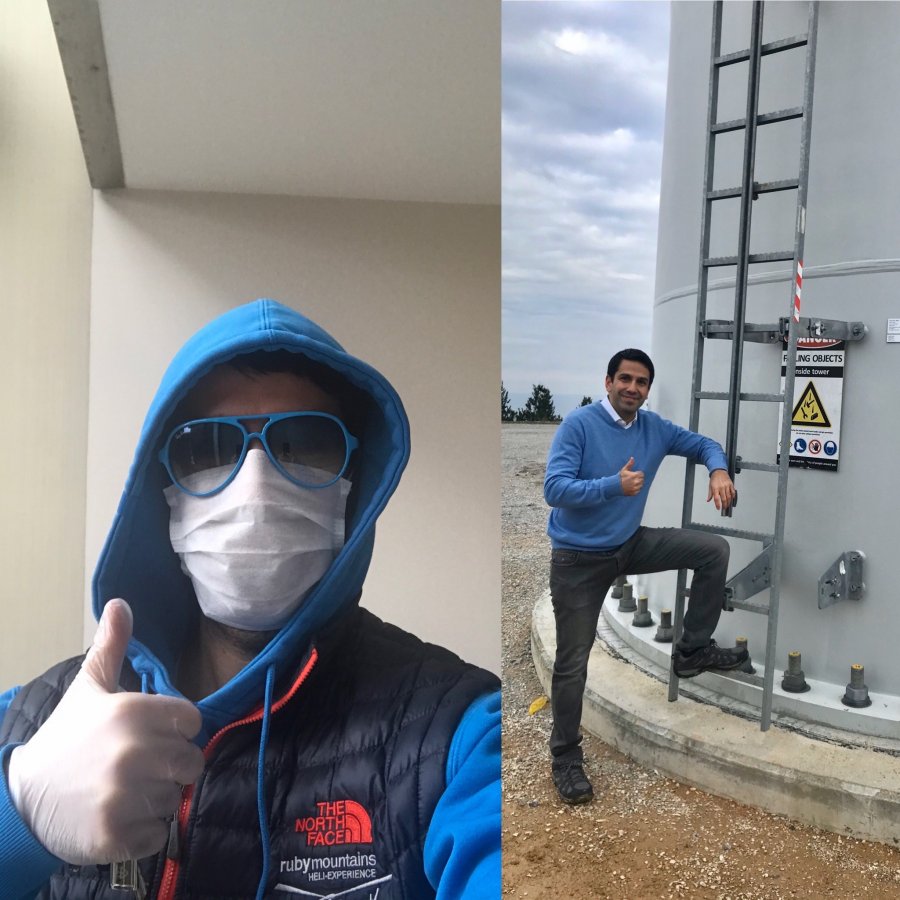
Note: The composition of the banner image for this post is as follows: The photo on the left is a selfie I took before going to the supermarket during the pandemic. The photo on the right is a photo I took at the foundation of turbine T2 at the İzmit Kandıra WPP project, which was about to be commissioned, but was again disrupted by the pandemic (we will eventually commission this project, rest assured). As you can see from the “everything is fine” sign in both photos, I’m keeping my morale and motivation high.
Bonus for this post:
- On Friday evening, 3 April, I was a guest on Idema. I had a pleasant conversation with Sarıca from Needs Map and Itır from Adım Adım. You can access the Spotify broadcast of that conversation at this link: http://www.idemahaber.com/good4cast-besinci-program-ile-yayinda-pandemide-inovatif-cozumler/
- On Friday evening, 10 April, we discussed Food Banking and the Pandemic as part of JCI Turkey’s Inspirational Talks. Here is the broadcast of that conversation:
Tag: health