In July 2011, exactly 10 years after I started working at the family company, Süzer Holding, I knocked on my father’s door. I vividly remember his expression when I told him I wanted to leave the family business and start my own venture. He was deeply hurt.
Essentially, I kept the promise I’d made to myself 10 years earlier. When I started working with my father in 2001 (a choice I made myself; I could have stayed in Canada, where I was studying), I told myself that if the problems in the family business were resolved and everything went well, I would talk to my father and do what was truly in my heart. At that time, when the Kentbank incident broke out, everything fell apart, and our family business was on the verge of collapse. Under my father’s leadership, we resolved all the problems through a very painful and challenging process, and I was one of the few executives working tirelessly to keep the company afloat. Eventually, the day arrived, and Kentbank was seized on 11 July 2001. I quickly received my discharge from the military and joined my father in this struggle the next day. I wrote about the details in a blog post titled “My 15-Year Business Life and Notes for the Future…”: https://www.serhansuzer.com/tr/15-yillik-is-hayatim-ve-gelecege-notlar
Everything had gone well in the family business. Despite being treated unfairly, we signed an agreement with the Savings Deposit Insurance Fund (TMSF) in 2007, and despite the significant losses we sustained, we retained our freedom and focused our attention on all other businesses. In 2009, I was at the helm of KFC and Pizza Hut Turkey, first joining the board of directors and later becoming CEO. I enjoyed my work, but it was time to turn a new page in my life. Frankly, I didn’t see myself in a position to sell fried chicken and pizza all my life. I was involved in many exciting projects, including marketing campaigns, immediate returns on every job, product development, developing home delivery, and opening restaurants in new locations (especially in new cities). However, my heart was in sustainability.
The Allure and Risks of Renewable Energy
Since my university years, I’d been particularly interested in renewable energy. Solar energy captivated me. In 2010, I began to reconsider the promise I’d made to myself. Leaving a world where everything was going well and I had every opportunity to start my own business seemed like madness to many. I gradually began to share this idea with my close circle. Not many seemed to agree. Of course, everyone had my best interests at heart. The consensus was, “Oh, Serhan, how can you leave your family business in such an environment and embark on such an adventure? You’ll run into a lot of problems. Don’t make that mistake.”
In 2010, while reflecting on my life’s general trajectory, I was planning my next move. Entrepreneurship is all well and good, but which sector would I pursue? Frankly, it didn’t take me long to figure out which sector. I made a list, and, at the top of the list, I placed solar energy, which truly excited me. After that, I couldn’t see any other work. While selling fried chicken and pizza, I was practically talking about solar energy in my sleep.
Solar energy is all well and good, but what was I going to do about it? After all, it’s a vast industry. There are different technologies. Different business models for different technologies. Where would I start?
To answer this question, I decided to hire a professional consultant. Without telling anyone, I hired someone who had previously applied for a job with me and whose CV I liked. In addition to my own busy routine, I asked the consultant to prepare a results-oriented research report on the topic, “Where should I start in solar energy?” If all went well, I would eventually hire this consultant as a manager at our newly established solar energy company.
A Major Crossroads
The report was being prepared at full speed. We met with the consultant at specific times every day to determine the right direction. Meanwhile, I was also attending to my own routine. Around this time, my path crossed with Barış Öney, a financial consultant. As I recall, I met with him somewhere, told him I wanted to get into solar energy, and gave him a brief overview of my work. He told me he knew someone who was developing solar energy technology and could introduce me to him. Frankly, I was at a crossroads. Generally, you can generate electricity from solar radiation, or you can generate heat/steam (I’m explaining this for those unfamiliar with the industry). The technologies for both are different. The electricity-generating technology is called PV (Photovoltaic), and the heat-generating technology is called CSP (Concentrating Solar Power). At the time, I was trying to decide whether to start with PV or CSP. In 2011, CSP was more prominent, but PV was also a rapidly developing technology.
Barış Öney introduced me to Oğuz Çapan as part of his consulting work. He had long-standing friendships with him, and Çapan was seeking investors for his technology development. When Barış Öney learned that I wanted to leave my professional life to pursue entrepreneurship in the solar energy field, he matched our ideas and then introduced us.
Oğuz Çapan was in his 60s, a retired petroleum engineer. He had worked for many years on behalf of oil companies in difficult-to-extract regions and was a successful technical expert known for providing practical solutions to complex problems. After his retirement, while wondering, “What can I do next?”, he discovered CSP. He envisioned that combining CSP’s heat and steam generation technique with the practical solutions of petroleum engineering would yield more efficient results, and he implemented this firsthand.
Different Technologies Used in CSP
Those familiar with CSP know that there are different technologies. The most well-known are the Parabolic Trough, the Tower (especially popular in the US), the Linear Fresnel, and the Parabolic Dish (also known as the Stirling Engine), to help you visualize these technologies. I’ve shared illustrations of these technologies below:
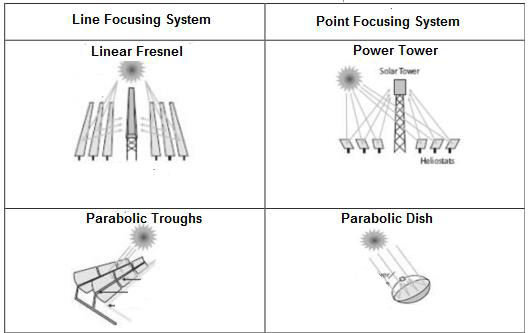
Normally, in Parabolic Trough technology, heat is transferred by a synthetic oil called HTF (Heat Transfer Fluid). In other words, in a Parabolic Trough, a specially alloyed tube (receiver) passing through the reflecting focus of the concave mirrors you see is heated by sunlight, and the HTF passes through this tube. This heat reaches up to 500° C., and when this HTF comes into contact with water, it releases steam at high pressure and temperature. I hope I haven’t confused you.
Oğuz Çapan’s most significant development was the ability to directly replace the HTF with water, raising the water’s temperature to 500° C. at the end of the collector chain. Of course, this heated water would escape as steam at the end of the collector chain under high pressure and temperature. This was called “Direct Steam Generation” in the industry. Oğuz Çapan also pioneered the CSP mechanism. Thanks to the collectors’ ability to rotate on their own axis, he managed to make the system lighter.
My Decision and My Meeting with My Father
After mastering all these details, and driven by my passion for technology development, I said to myself, “Okay, I’ve found the job I’ve been looking for. It involves both solar energy and technology development. There’s risk, but this business also has potential.” Once all this was clear in my mind, I requested a meeting with my father.
When I went to meet with my father on 12 July 2011, it was clear what I would discuss. The conversation between my father and me went as follows:
– Dad, for 10 years I’ve tried to serve you and our family to the best of my ability. Now it’s time to keep the promise I made to myself.
– What promise?
Exactly 10 years ago, when I started working at your company, I said to myself that if Kentbank’s processes were resolved and everything went smoothly, I would start my own venture in a field truly dear to my heart. Today, exactly 10 years have passed since the Kentbank takeover, a major misfortune we experienced, and although we suffered significant losses, we still managed to retain a significant business. Everything has also improved. The KFC and Pizza Hut companies I manage are growing healthily. You can continue to grow them if you wish, or you can sell them to generate significant cash. You no longer need me. So, I’ll ask your permission. From now on, I want to pursue something truly dear to my heart.
– What do you want to do?
– Solar Energy.
– Is solar energy available in Turkey?
– Not yet. There are water heaters, a rudimentary version of what I want to do.
– Do you want to sell water heaters?
– Not exactly. You heat water to 500 degrees Celsius to generate high-pressure, hot steam. Then, you connect it to a steam turbine and generate electricity. There’s a technology currently being commercialized. I’d like to try my hand at this.
– I haven’t seen the technology you mentioned anywhere else.
– These systems exist, especially in the US. The most important feature is that you can generate electricity 24 hours a day thanks to heat storage.
– Son, don’t get us into trouble…
Let me keep the rest of the conversation to myself. Let’s just say it’s a private matter and move on.
Ultimately, my father, of course, wasn’t convinced. These discussions lasted from July to November. Although reluctant, I think because he saw my determination, he finally agreed to my request and allowed me to leave KFC and Pizza Hut Turkey by the end of the month. Beyond granting permission, they thankfully gave me a loan from the family business. I invested this loan as capital in the newly established CSP company.

And Hitit Solar is on its way…
In November 2011, during my last job at KFC & Pizza Hut Turkey, I opened the first green restaurant within Yum International, KFC Bostancı, and then left the company. With features such as a solar energy system (PV) on the roof and minimal water use in the kitchen and restrooms, this restaurant was recognized as the first green restaurant within Yum International. You can read my article about it at https://www.serhansuzer.com/tr/gida-perakendesinde-enerji-ve-su-verimliligi .
After leaving the company at the end of November, Oğuz Çapan and I founded Hitit Solar on 5 December 2011. According to our agreement, we formed a 50/50 partnership. I contributed the capital, and he contributed the technology and all patent rights to the new company. Of course, he pulled a last-minute surprise by giving Barış Öney 5% of his share as a gift. In addition to the consulting fee he received from me, Barış Öney received a gift share from Oğuz Çapan. Normally, such shares are awarded to critical professionals with technical expertise for the company. Giving such a bonus share to someone who had no benefit to the company, who only came to the company once in his lifetime to provide financial advice, was a strategic mistake. In the years to come, Oğuz Bey would admit that this was a mistake.
US expansion and successful test runs
Let’s move on to Hitit Solar’s first year. We established Hitit Solar in December 2011, secured all the patents, and began operations. Our initial goal was to bring this technology to the US, where it was gaining value, and to take our place among the large-scale CSP power plants planned there. To this end, we contacted NREL (National Renewable Energy Laboratory), the leading authority in the renewable energy field in the US. Thanks to Oğuz Bey’s connections there, we arranged a meeting. We then headed to the US.
The meeting at NREL was a great success. We were delighted when they offered us a place at their test site near the Denver airport. We could install our own collector, have it tested, and even receive certification at a location where giants like Abengoa, the largest in the CSP industry, are located.
Before installing the system at the test site recommended by NREL, we had to complete an installation and test it ourselves in Turkey. We successfully completed this trial. The collector system was working successfully. Everyone was happy.
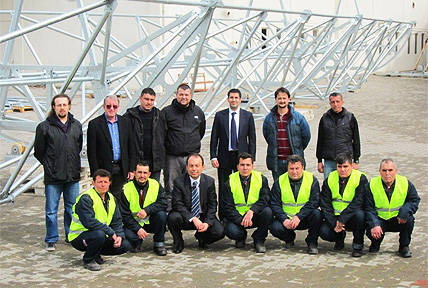
Here’s a photo from our test installation in Turkey. The Turkish team here installed the collector within a week, working day and night. The results were better than we expected.
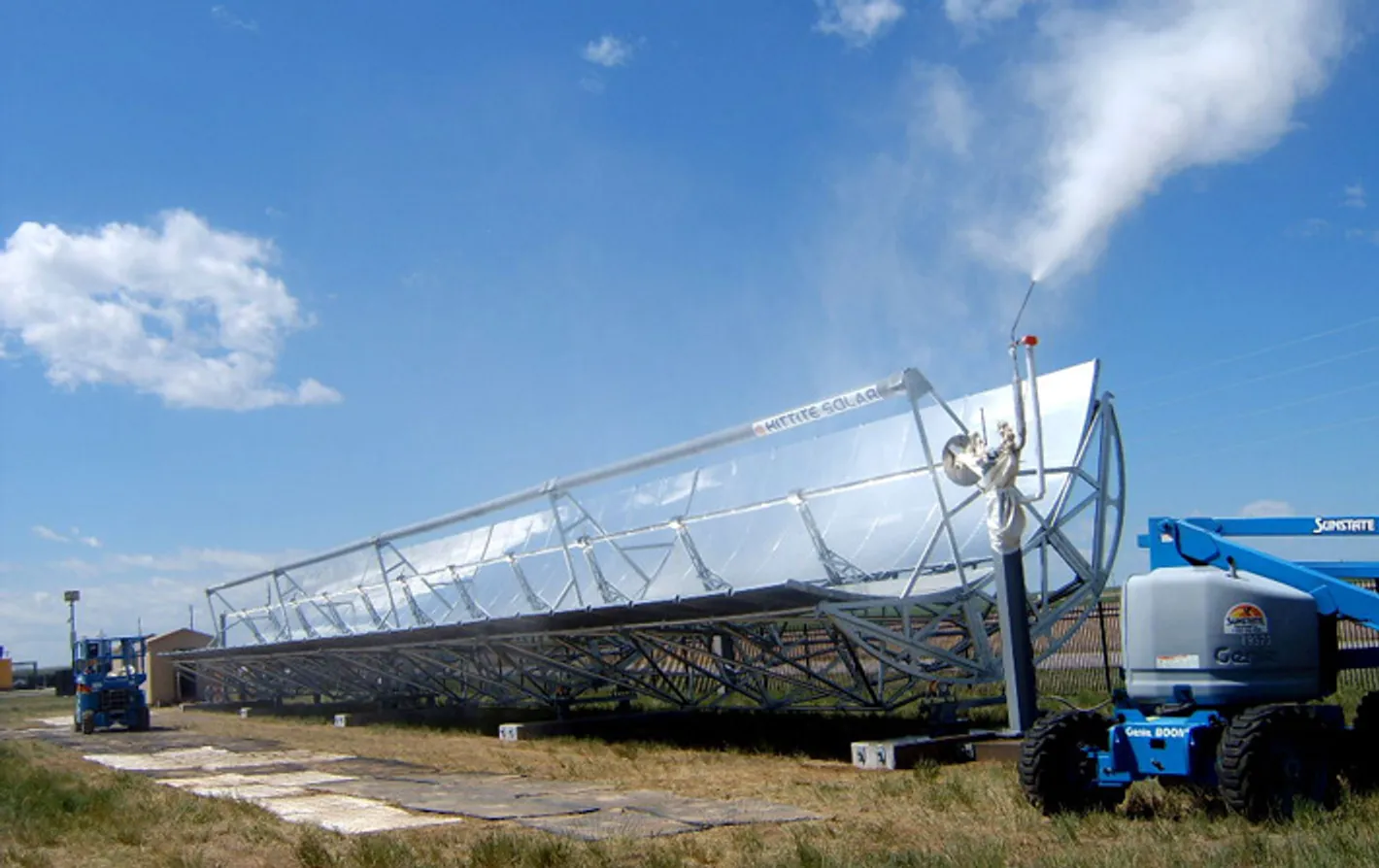
Of course, we then successfully completed the installation at SolarTAC, the test site NREL had assigned to us at Denver Airport. Here’s a video showing the production of our collector in Denver:
After this test installation, we also installed a collector in the garden of the Ege University Solar Energy Institute to motivate students, and to benefit our own universities. Of course, that collector was performing like a lion in Izmir.
I had financial doubts about the choice of technology.
However, when I examined the details at the time, I was struck by a deep nagging feeling. How economically viable could a technically functioning system be? Was it sustainable? I was trying to find answers to hundreds of questions in my head.
One of the most significant problems here was the rapidly declining costs of the PV sector. With the parabolic trough system we designed as a model, we managed to directly heat water to 500°C and then generate high-pressure steam at the end of the collector chain. When you feed this steam into a steam turbine, you generate electricity. Of course, let’s also consider PV. You can generate electricity directly from the movement of electrons in a solar cell. At the time, the unit cost of electricity generation between PV and CSP was 3 to 1, but the gap was widening.
When I discussed this with Oğuz, his general attitude was to ignore the problem and change the subject. I realized the situation within a few months, and eight months after investing in the company, I decided to sit him down and have a serious conversation. Because we were generating heat and steam with this technology, but the cost was prohibitive. We could have gotten it to a point with improvements, but when we added steam turbines and indirect electricity generation, the Hittite Solar technology we were working to commercialize became expensive due to its incomplete design. The conversation went like this:
The focus should be on heat, not electricity.
– Mr. Oğuz, there’s no way we can compete with the PV sector with these costs.
– We can reduce our costs too.
– We can, but we can’t reduce them as much as the PV sector. They’re slashing their prices by almost 70% annually. It’s impossible for us to cope with that. First of all, they generate electricity directly from solar radiation.* We generate electricity indirectly.
– But electricity storage isn’t as efficient as heat storage. We can store heat in molten salt and generate electricity 24 hours a day.
– Storing heat in molten salt, then combining it with water to create steam and generate electricity through a steam turbine is an additional indirect method. No matter how successful it is, when additional layers are added, our costs inflate significantly.
– The world is heading in a very different direction. Everyone will turn to solar now.
– Yes, I agree, they will, but which solar? I think it will be PV.
– I disagree. Our technology has its advantages, too.
– Yes, it may have its advantages, but I don’t think we’re using them optimally.
– Why? Because we’re constantly focused on generating electricity. However, we need to focus on our core product. That’s not electricity, but heat.
– So, what will we do then?
– The cost of building a CSP plant is in the billions of dollars. We don’t have that kind of financing. So, we need to discuss models that can generate consistent revenue.
– What could happen?
– If we can make the parabolic trough collectors we’ve installed smaller, more compact, and lower in cost, we can convert heat generation into direct sales. For example, like the heat needs of factories. Some industries need this heat during their production processes. The textile industry is one such example. So, we’ll sell our collectors directly to the factory, install a small CSP plant in the factory’s garden, and enable them to generate heat from the sun, saving them fossil fuels like natural gas. They can immediately calculate the financial implications, and if the payment term is reasonable, they might want to purchase our product. Another option is to hybridize geothermal power plants. We could install these collectors next to geothermal power plants, increasing both the plant’s efficiency and installed capacity. The third model that comes to mind is the EOR model you’ve always mentioned. Being a former oilman, you’ve been saying that EOR could be a model you could use, and that oilmen could even make purchases without worrying too much about costs (by the way, for those unfamiliar with the subject, EOR stands for “Enhanced Oil Recovery.” EOR refers to the process of pumping steam generated by solar radiation underground and extracting oil that has penetrated even the smallest veins underground using this heating method).
– Yes, frankly, EOR excites me the most. I’m well-versed in all the processes. But my vision for this project is different.
– Let’s try it. Let’s simplify and reduce the size of this collector and work on a model that directly utilizes the heat generated. I think if we can establish this model, we have a chance; otherwise, we won’t make any progress.
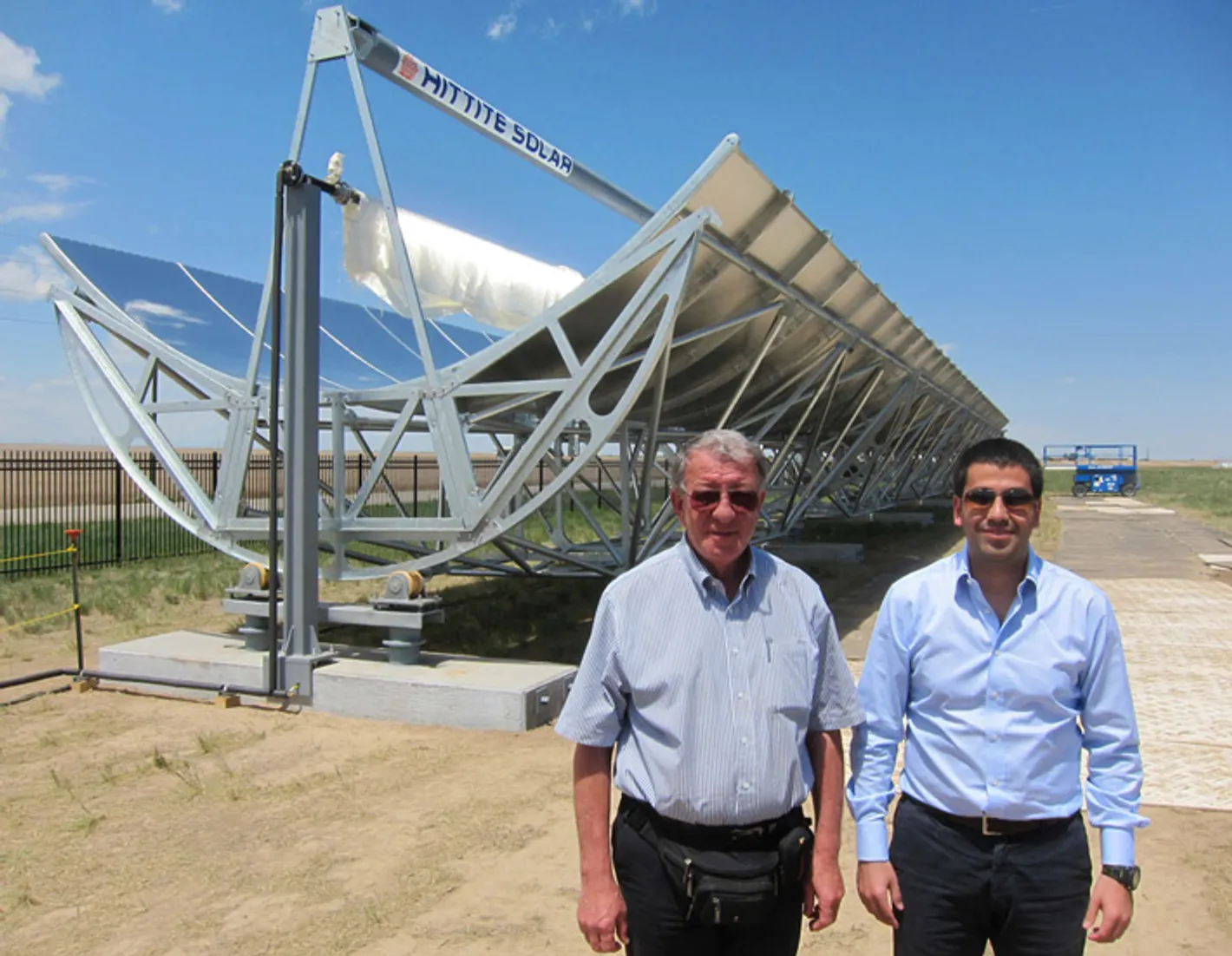
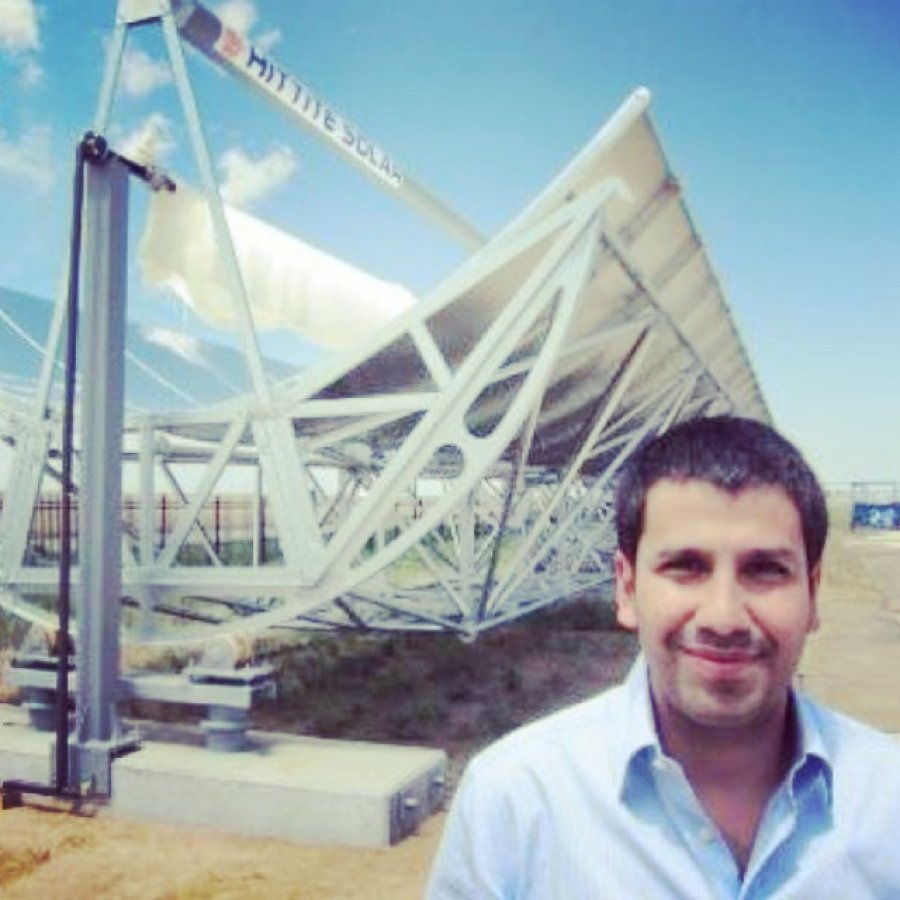
We installed this Hittite solar collector near Denver Airport in the USA. Oğuz Çapan and I proudly took this photo in front of the collector. There’s a white cover over the special alloy receiver running through the center of the collector. This is to prevent overheating.
Towards a new intersection
After lengthy discussions, I managed to convince Mr. Oğuz. The following week, we were already discussing what changes we could make to the collector. I was overjoyed. I finally found a way to fix our failing, cash-burning business. After two months of work, our new model collector was well and truly in place. The drawings were complete, and it was time for production.
At that very moment, Mr. Oğuz stormed into the office one morning, came right up to me, and told me we needed to talk urgently.
I hurried off to the meeting room. The following conversation unfolded between us:
– Serhan, I’ve thought a lot about this and decided I don’t want to work in this new business model.
– Why?
– This isn’t my dream or vision. It makes no sense to continue in a business I don’t believe in.
So, where will we find the financing for these CSP power plants? Each of these plants costs billions of dollars. No one would invest billions of dollars in technology that hasn’t been fully proven in every respect.
– I believe we can prove ourselves, and great things can happen afterward.
– This is nothing more than dreaming. If we really continue with this mindset, we’ll hit a wall.
– I disagree. I think we’re in a very good place right now.
– We’re not. We’re just starting out, and we’ve already burned through a significant portion of our capital. If we continue like this, we’ll hit a wall soon, and I don’t want to be in this boat when we do.
– Okay, leave then.
– For the first time in my life, I left the family business and started this kind of venture, and I’ve sunk all my money into this company. These things can’t be done by just snapping your fingers and leaving. I need to sell my stake and exit without losing any money.
– Okay, then let’s find a new investor for the company, and you can sell your stake to them.
– Then that’s it. Let’s talk about how we’ll find an investor.
Developing a Network While Searching for Investors
We then began working to find investors. At the time, $110 billion worth of solar energy projects were announced in Saudi Arabia. 60% of these projects were CSP and 40% were PV. This created the perfect environment for me to sell my shares.
We traveled extensively during the Hitit Solar period. The US, India, Saudi Arabia, the UAE, and Germany were just a few of the countries we visited for business. We immediately contacted several potential investors. These individuals were among the dozens we had been meeting with for a year. I told them straight away that I was selling my stake. We delved into the details and even visited some of them in person, but to no avail. After three months of effort and nearly 10 meetings, we were in a position of zero assets. The company was burning significant cash, and frankly, I was eager to exit. During this period, I was proactive and established my PV company so I could be ready when the time came. After establishing the PV company in 2012, I passively waited. But what I really needed to do was sell my stake in Hitit Solar without losing money.
Oğuz Bey, among the people we met at that time, also remembered someone else. A Saudi Arab businessman he had known before was very interested in technology. Most importantly, in our last meeting, he had told Oğuz Bey that he wanted to participate in this $110 billion tender. When Oğuz Bey shared this information with me, I immediately suggested we contact him. He called the Saudi Arab businessman and, after a long conversation, broached the subject. The man reacted positively, even inviting us to Saudi Arabia for a detailed discussion.
Positive Meetings with the Saudi Investor
The following week, we completed our preparations for our trip to Saudi Arabia and set off. Our meeting was also very positive. We discussed all the details about the company. When he asked, “Why do you want to sell your shares?” I explained my reasons clearly: I didn’t believe in the model of building large power plants, that we needed to focus CSP on a distributed system and focus on our core product, heat. It was impossible to compete with PV in electricity generation, and Oğuz Bey and I didn’t agree on this issue. Therefore, I wanted to sell. His reaction was as I expected: “Building large power plants isn’t a problem for us; in fact, with this technology, we could even participate in this major solar power tender.”
When it came to discussing the share price, I told him the price I had in mind, and he gave his own price. We didn’t go on too long; there wasn’t much difference. I gave him the discount he requested, and we agreed to a price slightly higher than his initial offer. I was making a profit from this sale. Frankly, I was happy.
A surprise that could ruin a sack of figs
But when we returned to Istanbul, we were dealt a blow from an unexpected source. Oğuz Bey told Barış Öney about the situation. After he said, “Serhan is selling his shares, just so you know,” all hell broke loose. Despite having no authority and having received his shares for free from Oğuz Çapan, Barış Öney first tried to demand an explanation, asking, “How can you make this sale without my knowledge?” Oğuz Bey replied, “You’re aware of it, and now I’m telling you, Serhan is leaving the company.” He then sent him very harsh messages, saying, “You cannot make this sale without my permission.” Then, after Oğuz Bey revealed the name of the buyer, he did some research, found the Saudi businessman’s email address, and sent him messages like, “I’m Barış Öney, the company’s partner. This sale is being made without my permission, and I do not approve of it. If Serhan Süzer is going to sell, it will only happen with my permission.” He even threateningly called his lawyer in, and had his lawyer issue a warning.
Frankly, when I learned of this, I was completely stunned. Because someone who shouldn’t have been in the company had acquired a 5% stake entirely through Mr. Oğuz’s gesture, and with that stake, he had turned on us and used it to obstruct a successful exit. He had no right to do so, but as you know, people with financial backgrounds sometimes do these things with a deliberate approach. However, he didn’t realize he was wreaking havoc like an elephant entering a glass shop. Because if this sale opportunity were to be lost, we would all have suffered perhaps irreparable damage.
In the end, the process was smoothed over.
I’ll never forget that I was in Costa Rica when these events unfolded. From there, I sent Barış a very harsh e-mail. I wrote down everything that came to mind. I didn’t care anymore, because these actions, which alienated the Saudi businessman from this business, had worn my patience thin. Then, we called the Saudi businessman and explained the situation together with Mr. Oğuz. He couldn’t make sense of these actions either. He said, “If he wants to sell his shares, this isn’t the way to do it. If he wants to, he can come to me and buy his shares at a similar price.” Thank God, the man saw the situation clearly and reacted with extreme balance. Then, in accordance with the Saudi businessman’s decision, Oğuz Bey sent Barış the following message: “Don’t ever send such messages and threats again. You’re obstructing the future. We spoke with the Saudi businessman; he will first buy Serhan’s shares, and after that, he will sit down with you.
The Saudi businessman’s refusal to back down from this sale, my very strong reaction, and Oğuz Bey’s effective communication saved this sale. Ultimately, Barış Öney remained silent, and my sale went through. I activated EkoRE companies immediately after this sale. It was perfect timing because unlicensed projects were just beginning.
To help potential young entrepreneurs benefit from this article, I’d like to share with you the mistakes and correct decisions I made in my Hitit Solar venture. I hope young people benefit from this information:
The Mistakes I Made
1) The Wrong Consultant: The consultant I hired when entering the solar energy sector was the wrong person. He had no experience in solar energy. Therefore, his report, “Let’s get into CSP, the future is here,” was completely wrong and misled me as well. We had assigned him a management role at Hitit Solar. However, he never I’ll remember, we all went to a Galatasaray match to celebrate our partnership. There, I don’t remember exactly, but something happened involving his wife, and that calm and composed man left, and suddenly he was a man shouting and accusing everyone. All the partners were there, and we were all shocked, and when we saw him in that state, we said to each other, “This isn’t going to work.” I announced the next day that we wouldn’t continue with him.
2) A wrong move into the right sector: Solar energy was a very good sector. However, I entered CSP instead of PV. This mistake could have cost me a significant amount of money and destroyed my motivation. I was lucky, and I left at the right time and continued on my path. I should have sought advice from more sources and developed my know-how before entering the sector. I rushed.
3) Giving a gift share to an unnecessarily important person: This wasn’t my fault, it was Oğuz Bey’s. He even admitted to me later that he had made a mistake and said he was sorry. Oğuz Bey was generally a good person, but on some occasions, he approached matters with a naive tone. His insistence and inflexibility were his weaknesses, and I was trying to manage that. I can’t do him any favors; he gave me all the support he could during the sales process. Thankfully, he didn’t want me to suffer any harm, and we were successful.
Long story short, if you’re going to give someone free stock in a company, I think that person needs to hold a very important, key position for the company’s future. Otherwise, if they’re not content with it, they might see themselves as bosses and act more royally than the king, become a hindrance, and even hinder your strategic moves. Therefore, I recommend considering these types of stock deals for people with significant commitment and technical know-how, and not the other way around.
4) Preparing a business plan: Before joining Hitit Solar, we had prepared a business plan, but I don’t think it was sufficient. We should have planned everything in much more detail, from the initial investment to our final exit plan. We entered this business with a simpler and more flexible business plan. Furthermore, our assumptions were flawed due to our lack of knowledge. That’s why I entered the CSP sector. We continued on our way, adjusting and adding many things, like a caravan being straightened along the way. We struggled at times. Thankfully, it all turned out well.
What I Did Right
1) Foresight: Despite being new to the industry, I quickly identified the main problem in the CSP sector. Even those who had worked in the CSP sector for a long time still insisted on their mistake: trying to generate electricity. Their primary product was heat. They should have focused on a heat-focused business model and avoided competing with PV. Indeed, the dynamics of the sector put the pieces in place. The CSP sector halted large power plant investments, everyone shifted to PV, and CSP’s heat-focused and distributed system business models became more visible.
2) Network: We traveled extensively during the Hitit Solar period. This was the right approach because by traveling extensively, we developed our network. When I was about to sell my shares, we were able to find our own investors because we were part of a substantial network.
3) Flexibility: I quickly realized my mistake, accepted it, and took the necessary steps to get back on the right track. I initially attempted to change our model, but after the company’s technical partner, Oğuz Bey, objected, I quickly decided to sell my stake and exit the company. These moves were sound, and thanks to this flexibility, I was able to continue where I wanted.
4) Timing: Selling my stake and entering the PV sector in 2013 was a very smart move. Unlicensed projects began in 2013, and I entered the sector at the right time. My vision was right, and I was able to establish the timing.
I hope this information has been helpful. Based on all the bittersweet experiences I’ve had, I recommend that young aspiring entrepreneurs pursue sustainability. Not only does the sector have significant potential and constantly growing momentum, but they can also take pride in contributing to projects that benefit humanity.
* For those who don’t know, let me quickly explain: CSP and PV have different solar irradiance levels. CSP requires Direct Normal Irradiance (DNI), while PV requires Global Horizontal Irradiance (GHI). In other words, there’s not just one type of radiation coming from the sun. DNI generates heat, while GHI generates electricity. You can find solar maps for both.
Bonus:
Below you can find news about Hitit Solar published in the local and international press at the time:
https://www.greentechmedia.com/articles/read/solartacs-mile-high-solar-proving-ground
https://spectrum.ieee.org/profile-hittite-solar-energy
https://www.enerjigazetesi.ist/solar-termal-tam-turkiyeye-gore/
https://yesilekonomi.com/hitit-gunesi-koloradoya-uzandi/
https://ekoiq.com/2022/05/gem-gunes-ve-ruzgar-uretimini-gosteren-yeni-araclarini-tanitti/
Here is my blog post explaining the system in 2012:
https://www.serhansuzer.com/tr/dogrudan-buhar-uretme-hibridlestirme-ve-parabolik-canak-inovasyonu
Note: After this last post for July, I’ll be taking a break from writing in August, as I do every year. I’ll be back in September and continuing until the third week of December. Just for your information.
Tag: ecology