

First, let me share it with my readers who don’t know. Good4Trust is a community where producers who produce ecologically and socially fair products come together with buyers who meet their needs, to make the world, depleted by our current lifestyle, livable again. Good4Trust is a non-profit social enterprise. It protects natural and human resources that are being exploited for profit, and together, it contributes to the improvement of both human and environmental health. Local producers produce in cooperation with nature, using non-toxic, waste-free, clean energy, and fair working conditions. Buyers, through their preferences and participation, express their needs, participate in governance, and help transform the system. We are working together in the true community we long for. For more details, you can visit the website: https://good4trust.org/
Now, let’s turn to the article written by Zehra Yakut on the Good4Trust blog, “The Temple of Growth: ECOLOGY: The Missing Piece of the Economic Puzzle.” It offers excellent content. I’m sharing this article with you verbatim. Afterward, I’ll highlight some points I want to emphasize and make some additions. First, you can read Zehra’s article from the following link (https://blog.good4trust.org/2023/04/08/buyume-tapinagi-ekonomik-bulmacanin-eksik-parcasi-ekoloji/):
The Temple of Growth: ECOLOGY: The Missing Piece of the Economic Puzzle
GDP, an indicator of economic growth that captures a narrow and arbitrary slice of reality, has become quite obsolete in the 21st century world. In today’s world, where sustainable growth is debated and unsettling power shifts are taking place, this indicator is unfortunately not solely informed. So, can we expand the scope of nation’s growth and development to encompass a richer view of reality? To what extent does this require statistical acrobatics? In achieving this meticulous balance, can we ignore ecology, which constantly reminds us of our origins?
David Pilling’s engaging and provocative 2018 book, The Growth Delusion, inspired this article.
Ecological Economics and Its History
Ecological economics, founded in the 1980s on the work and interactions of various European and American scholars, is a field of academic inquiry that is both transdisciplinary and interdisciplinary (economics, ecology, psychology, archaeology, anthropology, and history). This field, also known as bioeconomics and ecoeconomics, addresses the interdependence and co-evolution of the human economy with the natural ecosystem.
Robert Costanza, one of the founders of ecological economics, argues that this field has three interrelated goals that contribute to human well-being and sustainability: sustainable scaling, equitable distribution, and efficient sharing. Sharing and distribution, in particular, provide us with important insights into how society functions. While the traditional view focuses solely on having more, ecological economics encompasses many direct and indirect feedback loops that this view overlooks (as illustrated in Figure 1). This school of thought prioritizes harmonious activities that maximize the well-being of the economy, the individual, and entire ecosystems. This leads us to the realization that it is impossible for individuals to meet their needs without interacting with nature.
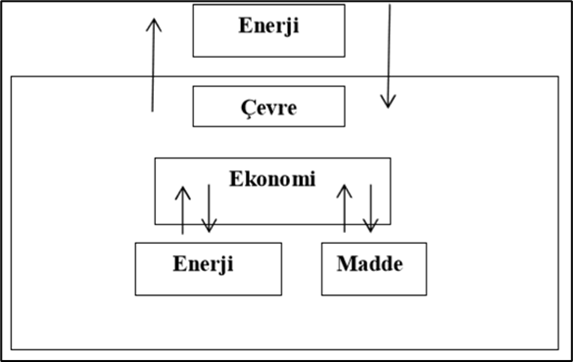
Figure 1 – The relationship between the economy and the environment
What is the role of ecological economics in the current market?
Mainstream (neoclassical) economics has practically deified growth. Nothing in nature, to which most disciplines are tied and dependent, grows forever; it’s finite. Organisms grow for a certain period of time and then stop growing, but they continue to develop and progress without physical growth. Let’s watch this tragicomic video to see what would have happened if they had continued to grow as they do in today’s economy.
In pursuit of the targeted profit maximization required by perfect competition, tam rekabet koşullarının gereği olarak hedeflenen kâr maksimizasyonunun sağlanması uğruna doğadaki optimal dengeyi bozabilecek her türlü dışsal faktörü ikinci plana the neoclassical school prioritizes any external factors that could disrupt the optimal balance in nature. However, contrary to popular belief, environmental and social externalities are substantial and cannot be ignored. In this context, ecological economics advocates the view that these externalities must be internalized through appropriate pricing mechanisms (For example, Figure 2 illustrates how the environmental impacts arising from traditional economics and the processes that lead to environmental pollution should be addressed within the context of ecological economics).
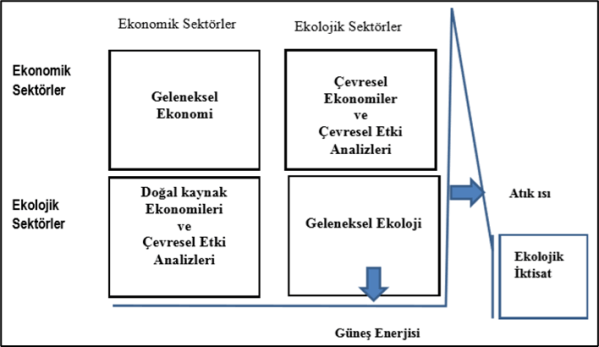
Figure 2 – Concepts affecting ecological economics and their relationships
Resource scarcity and inequality, resulting from the inappropriate and timely pricing of excessive consumption, have been telling us for years that we are entering a period of concern. Cornell University economics professor Robert Frank advocates the need for solutions such as progressive taxation—for example, higher taxes on luxury goods. If we apply this economic field to the business world, we can see that it signifies a shift from fierce competition to more cooperative and stable relationships.
Ecological economics strongly advocates that the environment should be evaluated from a global and public good perspective, as increasing environmental pollution transcends national borders and negatively impacts cross-border regions. For example, knowledge, which falls into the conceptually frequently used category of “non-rival, non-excludable goods,” should not be privatized, as in neoclassical economics, according to ecological economics, and accordingly, the number of publicly funded research should be increased.
Time to Reconcile with Degrowth
As mentioned in the previous paragraphs, the deified growth is currently measured by GDP*, which is accepted by countries. Of course, there are other methods that can replace this method, which ignores most negative (or positive) external problems (solutions). Below are some methods that consider ecological and social capital, rather than just financial and physical capital:
- Genuine Progress Indicator: Developed by Clifford Cobb in 1965 after renowned American economist Simon Kuznets pointed out that GDP was insufficient to measure a country’s well-being, the Genuine Progress Indicator is used to measure “growth and development” in ecological economics. Designed to fully calculate a country’s well-being by including environmental and social factors not measured by GDP, this indicator separates the concept of social progress from economic growth. For example, air pollution doubles GDP because both the creation and cleanup of pollution are calculated as a positive value, while the Genuine Progress Indicator considers the former as a loss rather than a gain. Studies have been conducted and published worldwide to measure this indicator.
- Gross National Happiness Index: This concept, introduced by King Jigme Singye Wangchuck, the 4th King of Bhutan, in 1972 with the call that “Gross National Happiness is more important than Gross Domestic Product,” demonstrates that sustainable development should adopt a holistic approach and give equal importance to non-economic aspects of well-being. The index focuses on nine areas: psychological well-being, health, education, time management, cultural diversity and resilience, good governance, community vitality, ecological diversity and resilience, and living standards.
Is Sustainable Development Possible?
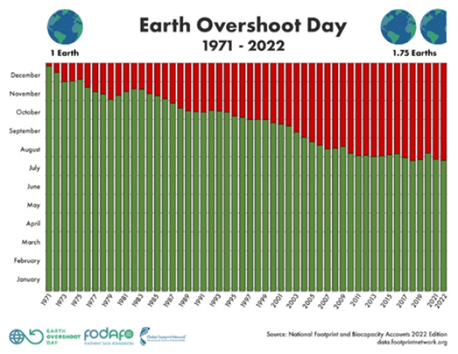
When we look at the environmental, sociocultural, and administrative consequences of the excessive growth (population and economic growth) resulting from capitalism, we see that, as a planet, we need much more efficient and sustainable production processes. Since the 1970s, when ecological concerns began to gain traction, humanity’s ecological footprint has far exceeded the Earth’s regenerative capacity and continues to do so every year. According to the latest data, Earth Overshoot Day** in 2022 occurred on 28 July, reaching a point where 1.75 planets will be needed to sustainably provide resources.
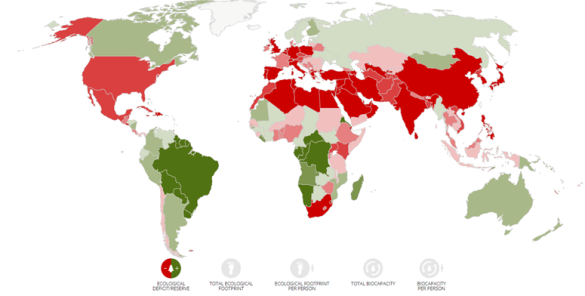
The map below shows the ecological footprint of countries, indicating how much their existing land area exceeds their biological capacity. As we can see, the Northern Hemisphere, which includes Turkey, is particularly under threat to biodiversity. According to the map, Türkiye:1977’den bu yana biyolojik kapasite açığı vermekte ve son 2018 verisine göre bu açık kişi başına 1.1 gha (global hectare***)’a düşmüştür.
Sustainable development approaches to solving problems can be categorized differently based on human-environment relations and changes in economic and political structures. While current status quo advocates argue that sustainable development can be achieved within the existing structure (business-as-usual), mainstream reformers believe this development can be achieved through certain reforms without completely abandoning the existing structure. Transformationalists, on the other hand, attribute the source of problems to economic interests and the distribution of power and believe that development can only be achieved through radical social transformation. According to status quo advocates, technological progress and the free market will provide solutions to the problems we are acutely witnessing today. Reformers, focusing on issues such as intergenerational equity, climate change, and biodiversity, emphasize the argument that operating with an environmental economic approach—in other words, technological modernization and green consumption—can save us.
Protecting the recovery process of our natural capital, which is non-substitutable, worth trillions of dollars, and provides invaluable ecological functions, is an integral part of sustainable development. We must first examine our relationship with nature, which provides us with air, water, food, and raw materials, as well as the spaces we need for rest and recovery, from an individual perspective.
At this point, we see that the technological advancements advocated by those in the status quo are not, and perhaps never will be, capable of saving us from this destruction. We can all see that we are in the midst of a radical transformation that began with individual uprisings and has led to reformist movements within corporations.
Good4Trust, an ecologically and socially just community dedicated to making the world, depleted by our current lifestyle, livable again, invites you to be a part of this transformation.
*GDP: Gross Domestic Product
** Earth Overshoot Day: The date humanity uses all the biological resources regenerated by Earth throughout the year
***Global hectare: The unit of measurement used to measure the ecological footprint of humans or activities and the biocapacity of the Earth or its regions
The 4 main elements of sustainability
Thank you to Zehra Yakut for this wonderful article. Now, there are two more points I would like to add to this article. First, the concepts of sustainability or sustainable development need to be addressed not only from an economic perspective but also from an ecological, social, and cultural perspective. In other words, there are four main elements in sustainability. The first is economic, meaning the work being done must be economically sustainable. While the business is being managed economically and made sustainable, nature must not be harmed. This is the second main element of sustainable development. Furthermore, while making the business both economically and ecologically sustainable, social injustice must be avoided, and social exploitation must be prevented. This is the third main element of sustainable development. Finally, while doing what is right economically and socially, it is also essential to protect and avoid harming cultural heritage. This is the final main element of sustainable development. I would like to emphasize this.
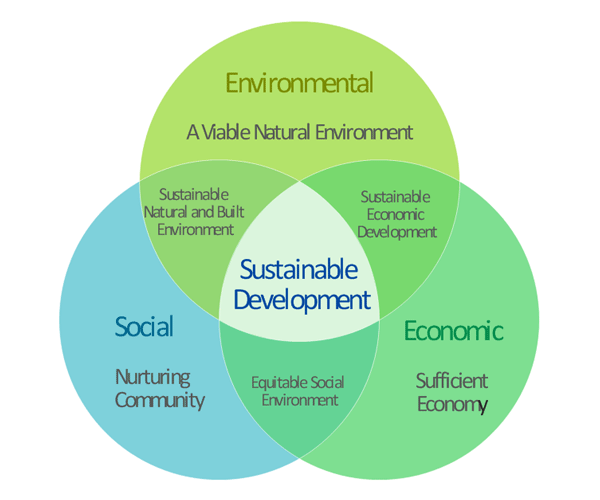
Finally, I would like to emphasize that there are many debates about how to make sustainable development possible, how to regulate the system, or how to rebuild it from the ground up. We have all experienced the economic, ecological, social, and cultural disasters that the capitalist system has caused. In my opinion, radical changes are necessary in the system.
If there were an ECO currency…
Action should be taken after every aspect of radical changes to the system has been thoroughly examined and studied. Here, I’d like to refer to the Eco Currency concept, which will provoke thought. I recommend reading Mensvoort’s work, which proposed and opened the Eco Currency hypothesis to discussion: https://www.mensvoort.com/essay/eco-currency/
The topic we’re talking about here is an imaginary currency. Imagine we had an alternative currency for environmental value. If we had an ECO currency that would express its value and pay farmers for keeping trees alive, would the rainforests still be destroyed? A suggestion for how we can connect economics and ecology.
I’m talking about how, instead of clearing the forest to make way for agricultural land, farmers in the Amazon would protect it and earn income in return.
I’ll share my thoughts on radical changes to the system later. I’ll provide clear examples to help you visualize these concepts more clearly. For example, I’ll quickly write about what needs to be done to achieve sustainable development in Turkey. See you in my next blog post…
Tag: ecology