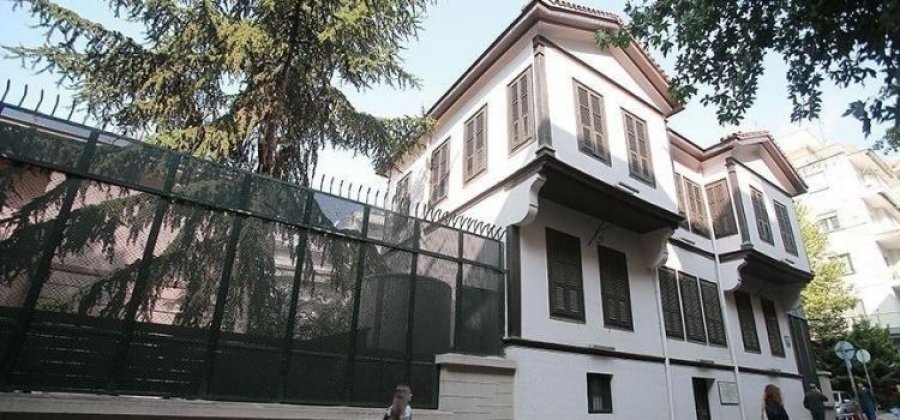
Knowing there would be holiday chaos and congestion at the borders, we flew to Thessaloniki. We rented a car and arrived directly at our hotel in the evening. The next day, the first thing we did was walk to Atatürk’s house, where he was born. We even chose our hotel within walking distance of Atatürk’s house.
We walked for about 10 minutes to visit Atatürk’s house, the highlight of our holiday, and upon arrival, we immediately headed to the main gate to enter. There was no line at the gate—to be honest, I was pleased at first glance. Following a few people ahead of us, we entered the courtyard through the security gate. As we looked around the courtyard and tried to understand the house’s structure, I also examined the tree planted by Ali Rıza Effendi, under which Atatürk played as a child, and read the plaque detailing the house’s history.
A few minutes later, we climbed the stairs to the house and, once again, entered without delay. I’d visited before. This wasn’t my first visit to the house where Mustafa Kemal Atatürk, the founder of the Republic of Turkey, was born in Thessaloniki and lived until he was seven. I’d previously visited Atatürk’s house in Greece, where I was on a summer vacation. On my first visit, we went at a normal time, before any public holidays, and the house felt almost empty. We spent as much time as we wanted inside, and I don’t recall anything bothering me.
On my first visit, I noticed that the Turkish Consulate General in Thessaloniki was located next door. After some research, I learned that the Municipality of Thessaloniki purchased Atatürk’s house in 1933 to commemorate the anniversary of Turkey’s founding and gifted it to Mustafa Kemal Atatürk. The keys to the house were handed over to the Turkish Consulate General in Thessaloniki in 1937. The house, which opened its doors to visitors as a museum in 1953, took its current form after a comprehensive restoration in 2012. During my first visit, I also saw the marble plaque on the exterior of the house that reads, “GAZİ MUSTAFA KEMAL, the great renewer of the Turkish nation and supporter of Balkan unity, was born here.”
The structure and rooms of the house
For those who have never visited Atatürk’s house, let me briefly describe it: The ground floor of the three-story building houses the “Atatürk and Children’s Room.” Models of the house’s former display are displayed in the halls on the upper floors. On the first floor, in rooms designated the “Selanik Room” and “Monastır Room,” and on the second floor, the “Istanbul Room” and “Ankara Room,” display information panels describing the cities where Atatürk lived and describing his life. The “Ankara Room” also houses a statue of Atatürk seated in an armchair from his time as President. In addition, you can see the cradle where Atatürk was born and waxworks of both Atatürk and his mother, Zübeyde Hanım.
The historic house, which is often busy, is open to visitors every day except Mondays between 10:00 am and 5:00 pm. We visited Atatürk’s house on 17 June, the second day of the holiday.
The horror of body odor
The moment I entered the house, an incredible stench of sweat overwhelmed me. The house was incredibly crowded, and the stench of that crowd was truly awful. To help you visualize, this smell, a mixture of Roquefort cheese and garlic, was even more intense than the interior of a packed IETT bus. I kept thinking, “Don’t be ridiculous, Serhan. You’re at Ata’s house. Don’t complain. Pay attention to your surroundings. Read and learn everything.” But the atmosphere wasn’t conducive to spending time reading every single text or image. First of all, every floor of the house was overcrowded. We struggled to go up or down the stairs. We didn’t even have a chance to stop and read the text because the crowd was practically engulfing you.
Like any sensitive person bothered by the smell, we quickly climbed each floor and immediately looked around before heading downstairs. We didn’t read the text; we simply checked what was on each floor and quickly got out of the house. When we stepped outside, we felt the need to breathe deeply and frequently, as if we’d held our breath for a long time before releasing it. The house, apart from the foul odor, was seriously stuffy. We quickly took a photo at the entrance and headed out into the courtyard, where we didn’t waste any time (as a large crowd was leaving the house and entering the courtyard of another house).
The surrounding areas are also problematic.
Frankly, disappointed that we hadn’t even managed to visit the house of Atatürk, the birthplace of what we consider the greatest leader of the 20th century, we sat at a nearby cafe to catch our breath. Of course, we criticized the entire experience as we sipped our coffee.
Meanwhile, the cafes outside also offered Turkish-oriented products. I don’t know about the others, but the one we were sitting in was particularly of a low standard. I think a cafe right next to Atatürk’s house (which was lined up alongside many other cafes and restaurants) should have been of a high standard, befitting his class.
In conclusion, the solution to the problems we encountered during this visit to Atatürk’s house is simple. I’m sharing the problems and suggested solutions below, particularly for the Consulate General of Thessaloniki and all relevant institutions and organizations:
1) The smell of sweat and crowds inside:
Greece is a natural destination for Turks, especially on public holidays like Eid al-Adha, and Thessaloniki is the most popular destination in Greece. Therefore, it’s necessary to take proactive precautions during public holidays, which may be crowded. The following precautions can be implemented:
a) Ventilation: Installing a portable (floor-based) air conditioner inside that doesn’t disrupt the architecture would be a practical solution.
b) Visiting order: Entering people should be lined up in groups and then admitting them section by section. For example, stopping access to the garden from the main gate after a certain number of people have accumulated in the garden, and similarly, stopping the entrance from the courtyard to the house after a certain number of people have arrived. Multiple staff are needed in the courtyard and on each floor to regulate all of this.
c) Hygiene: This is a common problem in this country, and personal hygiene should be emphasized repeatedly in all educational institutions. People should learn to shower daily, clean their armpits several times a day if necessary, and learn to use deodorant.
d) Noise: Those making excessive noise should be regularly warned by staff.
2) Poor outdoor quality:
a) Quality of space: With the initiative of the Consulate General and the support of the Thessaloniki Municipality, cafes and restaurants there should be renovated, and their standards should be raised.
b) Human quality: Experienced and high-level tour operators and guides should be given the opportunity to work in the region.
The purpose of sharing all this is to ensure that an environment worthy of Atatürk is created, and that Atatürkists can visit with high standards, commemorate him in the magnificent setting of his birthplace, and spend more time there, enjoying themselves and expanding their knowledge.
I hope the relevant public authorities read what I have written and take the necessary action.
Tag: memoir