As I begin to recount the fateful moments in my life, I’ll first go back to my university days in Montreal, Canada. One day, during my third year of university, one of my closest friends, Jesse, came to me and said the following:
- Serhan, I’ve decided to drop out of university. I’m going to start my own business.
- Why are you in such a rush?
- I mustn’t miss this internet age. Every day that passes is a significant loss for me. You should leave too, and let’s start this company together.
- I’d like to start working as soon as possible, but I have responsibilities to my family. I need to get this degree. What will you do?
- I’m going to start a web hosting company.
- I wish you success. We’ll keep in touch.
- Let’s talk again after you receive your degree.
- That’s it.
After this conversation, Jesse did exactly as he said, dropped out, and started his own web hosting company in Toronto. A year later, after graduating, I went to Toronto to visit him.
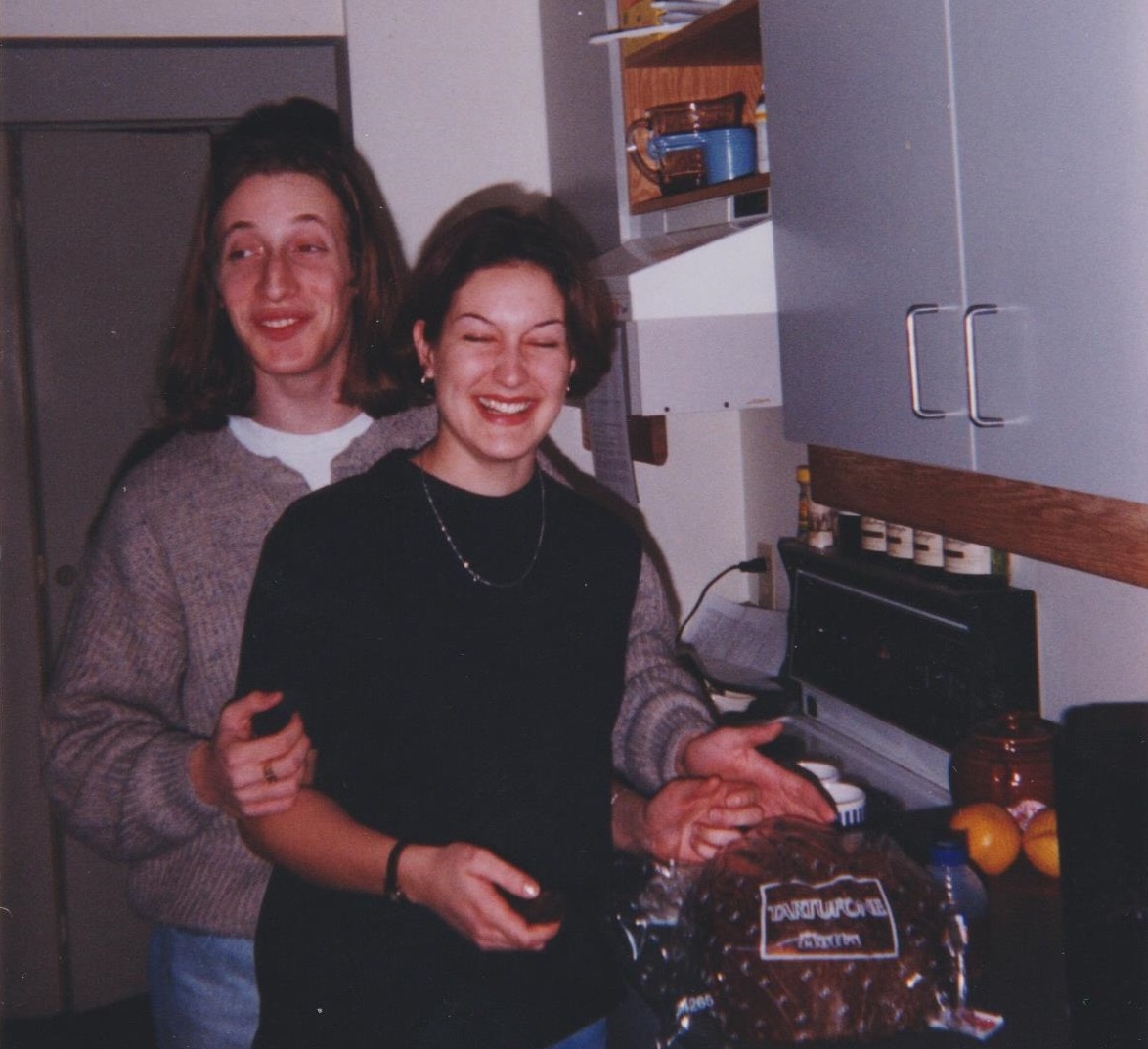
Jesse joking around with his girlfriend and us in our freshman dorm. As far as I remember, I took the picture.
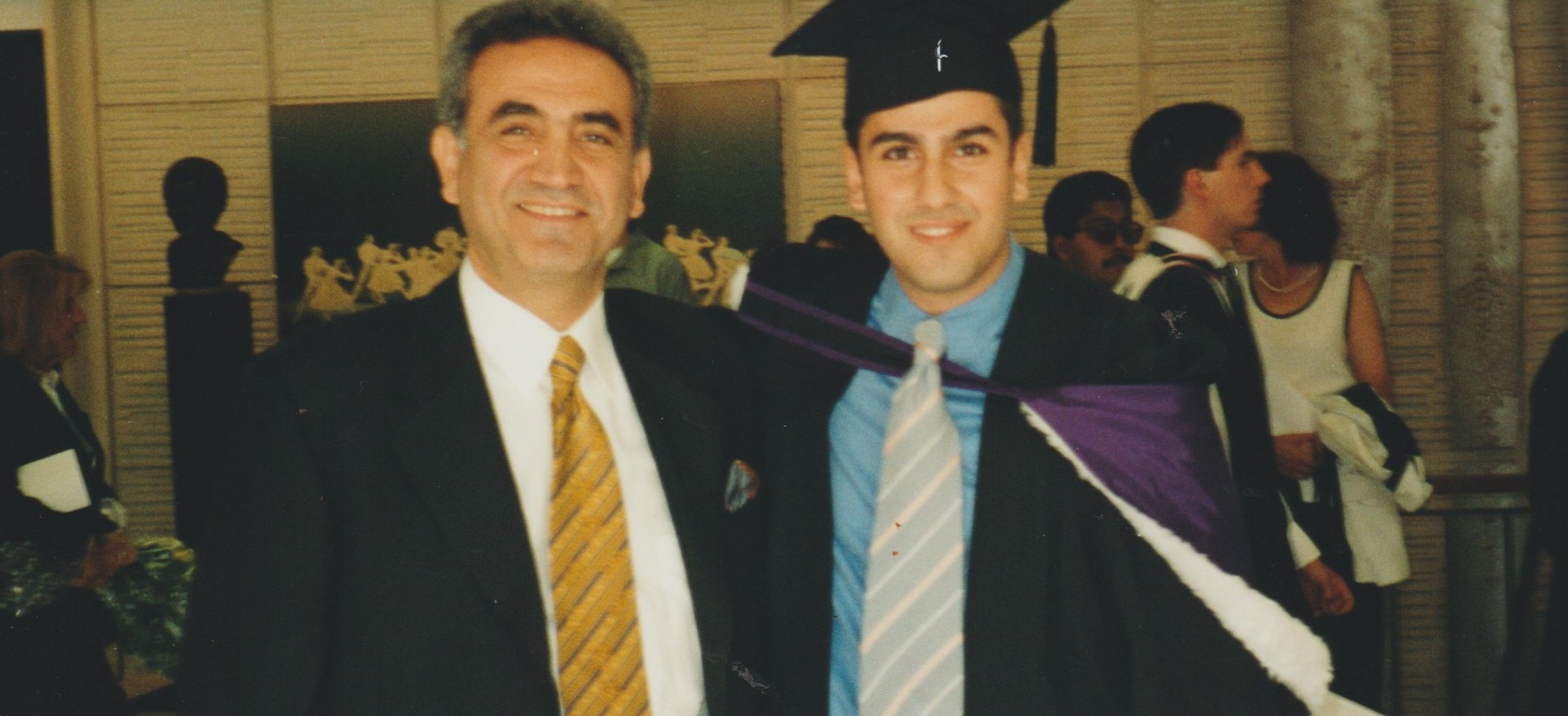
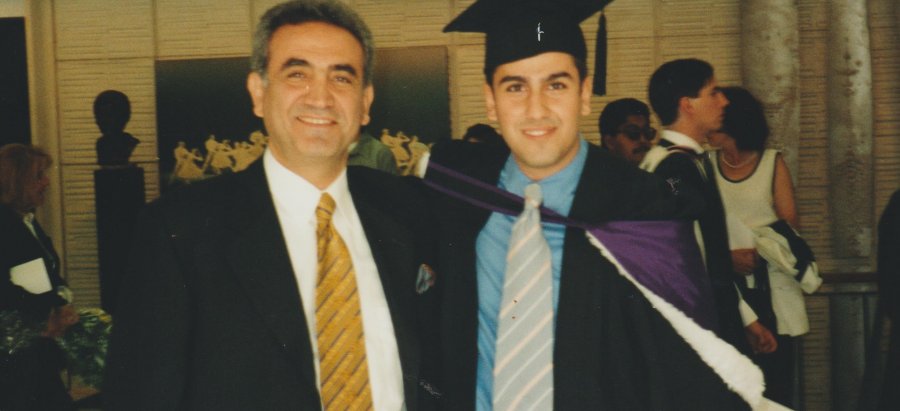
This is the picture I took with my dad right after the graduation ceremony.
He was quite pleased with his situation and began showing me around his company. The company was up and running quickly, and in just a year, the business had grown into a snowball. I was extremely pleased with this visit and decided to stay in Canada afterward. When I called my father to share my decision, the following conversation ensued:
- Dad, one of my closest friends in Canada started a web hosting company. He’s offering me a 50% partnership. I’d like to try it out.
- What is web hosting?
- It’s an internet company. It involves hosting websites online. Since the internet is just starting out, these basic services are in great need.
- What about the internet, son? Is there no work for you in Türkiye?
- There’s definitely some, but I want to try this business.
The two-hour conversation you’ve read a summary of above concluded with this:
- Son, I need you here.
- You have a lot of managers and professionals there. You don’t need me there.
- No, that’s not true. All the managers are valuable, but I need you very much, too. Work abroad for a maximum of one year, then return to Türkiye. Don’t go on too long.
He had hit me right where I was going, and with those last words, he had made me change my mind. Then I called Jesse and told him that my father and I had spoken, and we had agreed that I would work in the US for about a year and then return to Türkiye. He wished me good luck. Just as my father and I had discussed, I started working at the US headquarters of Generali, the Italian insurance company that was our partner at the time. After that, I returned to Türkiye and first completed my military service.
The Seizure of Kentbank
During our time, short-term military service was eight months. Luckily, Denizli was chosen as one of the pilot regions for conducting both recruitment and actual military service in the same location. So, I spent both my recruitment and the remainder of my military service in Denizli.
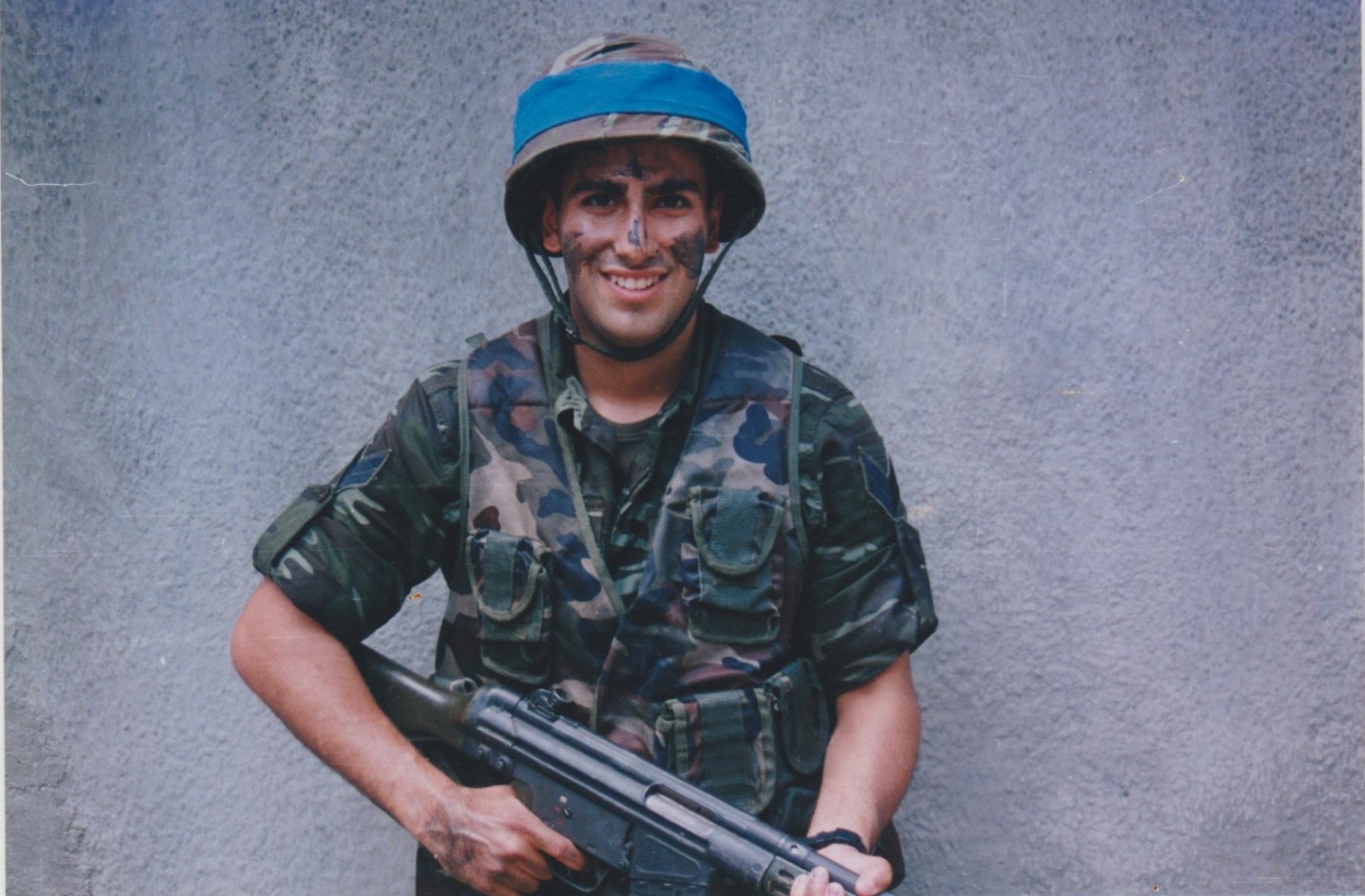
Don’t be fooled by my pose. I’ve never had any experience with guns. Outside of basic training, I’ve always been on the computer.
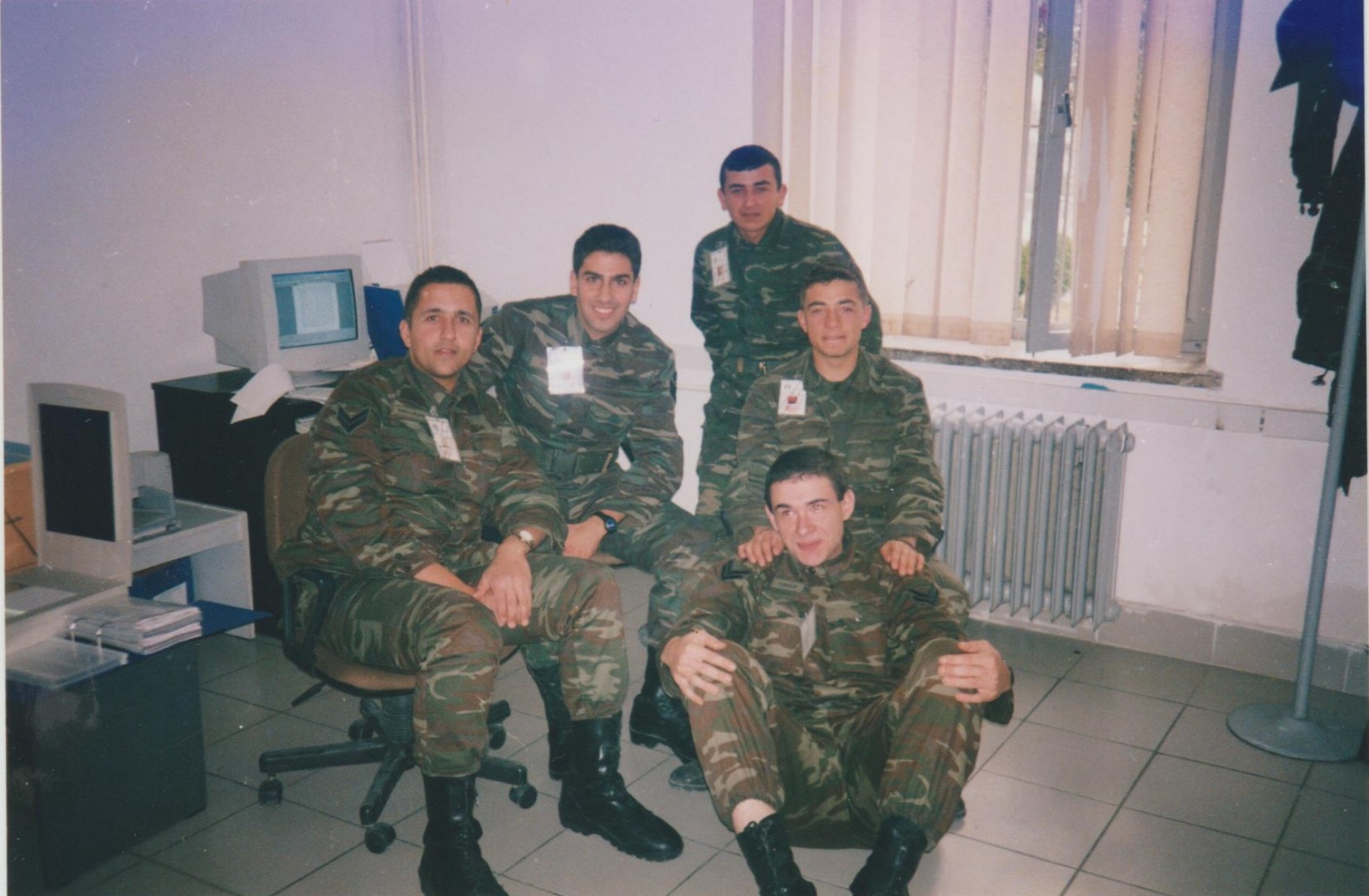
Another picture we took with friends
During my final days of military service in Denizli, serving as the orderly of the brigadier general commanding the 11th Infantry Brigade, I received a call from my mother on the morning of 11 July 2001.
- Son, did you hear?
- What?
- Unfortunately, they’ve seized Kentbank. It’s on the news now. I can’t reach Selma (my father’s assistant).
- Who seized it?
- The government.
- Okay, I’ll call you back.
Immediately after I hung up, I called my father directly. His voice sounded incredibly shaky. With considerable difficulty, he explained to me that the news was true and briefly explained some of his experiences.
After the call, I realized I needed to return to Istanbul as soon as possible to be with my men. I first went to our staff colonel at brigade headquarters and explained the situation. I was scheduled to receive my discharge the next day. He immediately called our brigade commander, who was traveling out of town. After receiving his approval, they thankfully granted me my discharge the same day. After bidding farewell to my friends in the brigade, I made my departure.
After leaving, I immediately organized my flight to Istanbul and returned the same day. Meanwhile, I canceled the three-week Amsterdam-Bodrum-Çeşme vacation I’d organized with my friends as a reward for myself after completing my military service.
That evening, I was with my family. Everyone was deeply saddened. There was an air of mourning.
Plans Changed by Circumstances
I don’t know whether to tell the story of that evening: how Cenk Divitoğlu, the general manager appointed by the Banking Regulation and Supervision Agency (BRSA) at the time, and his entourage came to my father’s office early in the morning, declared, “This is now state property,” showed him the BRSA’s decision, and settled in, or how all the bank employees called my father and the other managers and said, “We’re all in shock. We don’t understand why this happened. We’re with you no matter what.” There are so many stories on this subject, and I don’t want to depress you by telling you all about them.
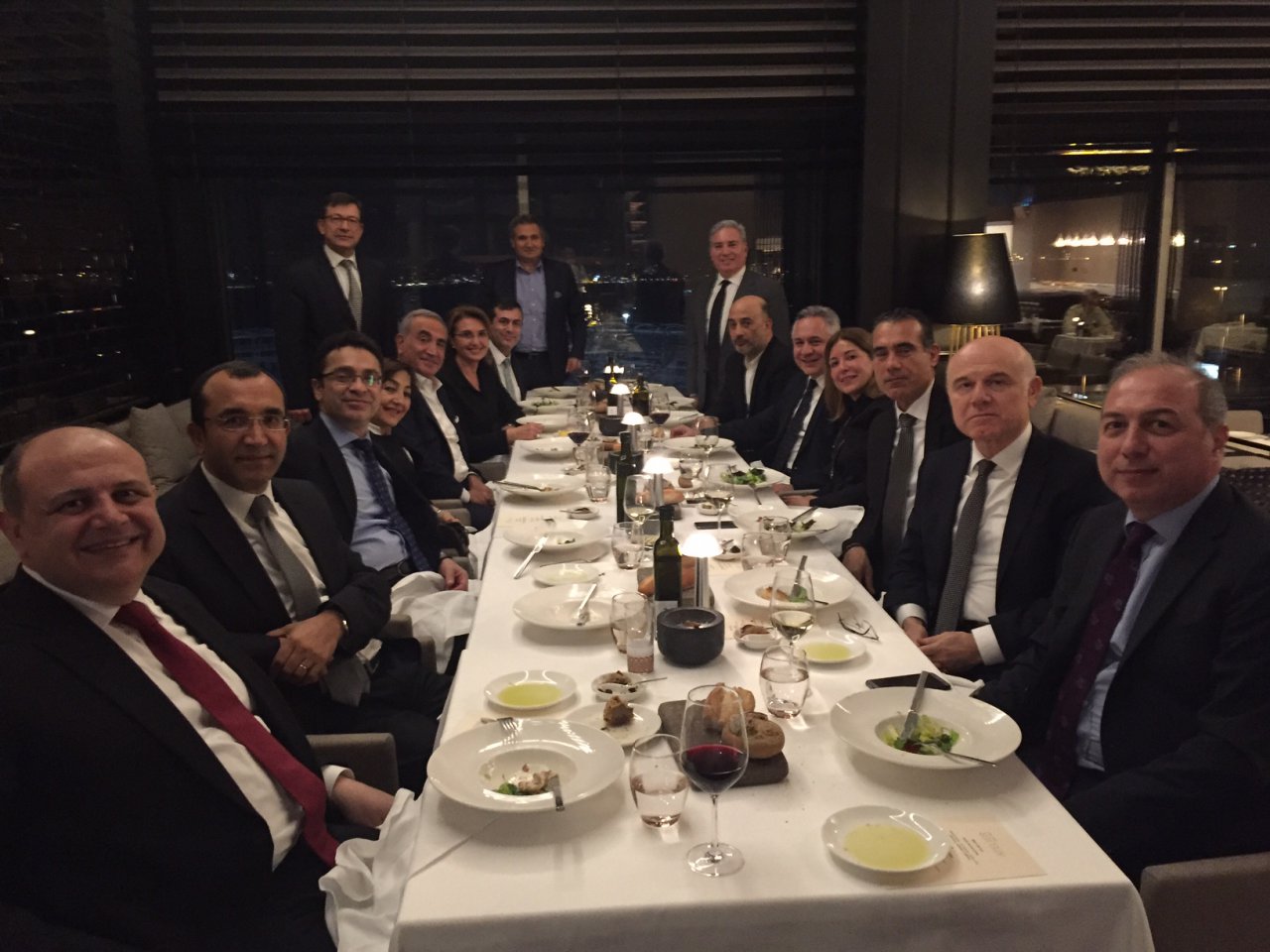
Former Kentbank employees, executives, and my father recently got together. After a night of enjoyable conversation and reminiscing, former Kentbank employees decided to hold similar get-togethers again.
To put the situation simply from my perspective, my initial goal was to become a banker. That’s why I studied finance at university. Later, Jesse convinced me to become an entrepreneur, but from the end of high school onward, I was training myself to become a banker, as my father and I discussed. After studying in Canada and working in the US, just as I was about to enter the workforce, the life I envisioned fell apart. “I have my own plans, and God has plans for me,” I thought at the time. Afterward, I let events take over.
When I arrived at the holding company, that pleasant atmosphere had completely changed. Everyone was talking tearfully, asking, “What will become of us?” Cenk Divitoğlu, the general manager assigned to Kentbank by the Banking Regulation and Supervision Agency (BRSA), said, “I don’t understand why they seized this bank. There’s a significant amount of cash in it. We took control of all the accounts the same day. Everything is very transparent.”
For those who don’t know why Kentbank was seized and what happened during that period, let me explain.
What happened before the seizure?
In February 2001, at an official meeting, then-Prime Minister Bülent Ecevit left in tears and complained to the press about then-President Ahmet Necdet Sezer. He uttered the following words: “I have never seen such behavior in my life. This person, whom I personally supported for the presidency, threw the constitutional booklet in front of me at a meeting and told me to read it. This behavior is neither befitting the office of the President, nor can I, as Prime Minister of the Republic of Türkiye, accept it.”
Following a succession of similar remarks, the most severe crisis in the history of the Republic of Türkiye erupted. The markets misread this exchange between the President and Prime Minister, and all investors immediately began withdrawing their money from Türkiye. Within a short time, the stock market crashed, and overnight interest rates soared to 7,500%. No joke; bankers know all too well what it means when overnight interest rates exceed the thousands. Financing a loan portfolio at normal rates, while securing financing at interest rates that were out of control in every sense, meant a daily loss of around $4-5 million for a bank of Kentbank’s size. As a result, the capital of all banks in Türkiye eroded, and eventually, the Banking Regulation and Supervision Agency (BRSA) stepped in.
The BRSA began sending official letters to almost all banks, saying, “Your capital has eroded; inject capital into your bank.” Kentbank, of course, was affected by this. Our situation was fundamentally different from many banks. In other words, we were a group that, after generating significant income from commercial activities, invested the proceeds in establishing a bank.

Kentbank has had some very successful projects in its time. Kentkart was one of them.
After receiving such a letter, we sent a letter to the BRSA with the following content:
“We are a strong group in terms of asset size. A significant portion of our strength comes from our real estate investments. Give us until September, and we’re moving towards a REIT (Real Estate Investment Trust, meaning all real estate assets are consolidated into a single company and a certain percentage of that company is taken public). We will inject twice the cash you requested into the bank after completing the REIT transactions.”
Worse than an economic crisis…
We had truly valuable real estate holdings. We planned to finance this crisis with a portfolio of Istanbul’s most valuable properties, such as Süzer Plaza, Bahçeşehir, and Saklıbahçe. To illustrate my point, let me quickly point out that by only offering 25% of the properties to the public, we were able to bank twice the amount requested by the BRSA. In other words, we would have overcome this crisis with 12.5% of our current assets. Furthermore, we had also transferred the general manager and relevant executives of Alarko REIT at the time. We were preparing for September in every sense.
And then what happened?
First, we received a positive response from the Banking Regulation and Supervision Agency (BRSA), saying, “We support this plan, go ahead.” Ten days later, without warning, they suddenly came back, saying, “We’ve seized your bank.” Of course, this situation reminds me of the saying in our beautiful Turkish, “what the hell is this diet, what the hell is this sauerkraut,” which is uttered when one’s actions don’t match their words.
The wheat was mixed with the chaff. While in America and Europe, the state bails out struggling and insolvent banks, here, on the contrary, a bank financed by a strong and powerful group was forcibly seized. For the record, our Kentbank bankruptcy, at the time, was about $200 million in cash.
Because we could document this entire process, we won the case we filed with the Council of State against this seizure. A total of 22 banks were seized during these crises. We were the first to win a case in the history of the Republic of Türkiye, and after us, Demirbank also won. “In other words, the Council of State ruled that the seizures of Kentbank and Demirbank were unlawful, and these decisions have been appealed.”
Kentbank was able to easily weather the crisis without burdening the public with taxes. Unfortunately, permission was denied, and in an environment where different calculations were being made, intervention was made when it could have easily weathered the crisis. Denizbank, a much smaller bank than Kentbank, which hadn’t suffered this error, was sold to a European bank for €3 billion, and Finansbank, a slightly larger bank than Kentbank, was sold to a Greek bank for €5.5 billion.
Amidst all this, a key executive said, “I love your group and your family, but I need to think about my own career,” and left the group to work as a manager at an international bank. The project that executive was pursuing was the Ritz-Carlton project. Tragically, you bring such a prominent brand to the country at that time, and just a few months before you’re due to open the hotel, all your accounts are frozen because your bank is seized.
Crisis Management Experience with the Ritz-Carlton
In one such situation, my father called me that same week and said, “Serhan, I want you to oversee the hotel project.” I told him I was a recent university graduate, lacked experience, and might encounter difficulties. He told me, “You can handle it. If you’re stuck, come to me and talk to me,” and assigned me to the Ritz-Carlton project.
Of course, the biggest problem with the hotel project was financing. All our accounts were frozen, and we were unable to pay our suppliers.
One of the first things I did was call OPIC, the US government financing agency that had provided the hotel with a $50 million loan. Because of the time difference, I waited until late in the evening, and I remember my hand shaking when I first reached for the phone. My only reassurance was that during my university years, I had come to Washington, DC, from Montreal, for two days, joined our team, and during those meetings, I met Kenneth, who was leading our project. He was a very decent man.
When I called Kenneth, he remembered me immediately. Then I got to the point. Knowing the American mindset well, I explained the events with complete transparency. Of course, explaining to an American that “our bank had been seized” wasn’t easy. Such incidents weren’t common in their country at the time. Kenneth immediately reported the situation to his superiors, and they came to Türkiye the following week to better understand the situation. After clarifying everything and developing a crisis plan, they extended us an additional loan in 13 days, a record time in OPIC history. With this additional loan, we covered all the remaining payments and opened the hotel on 6 October 2001. During this period, another event significantly impacted us. On 11 September 2001, the entire tourism sector was shaken by the planes that crashed into the Twin Towers in New York City. Türkiye was particularly hard-hit by this crisis. One day after we opened the hotel, the US invaded Afghanistan. On 10 September 2001, the hotel was 100% booked, and 40 people had placed their names on the waiting list. However, after the events of 11 September, we were forced to open the hotel with an 8% occupancy rate. We overcame this crisis by restructuring the loan.
I’d like to extend my thanks again to OPIC and its officials, who stood by us despite everything.
Meanwhile, what happened to my entrepreneur friend Jesse, whom I mentioned at the beginning of this article?
Missed and emerging opportunities…
Amidst all this, towards the end of 2001, I had the opportunity to call Jesse and chat, keeping him updated on developments. We maintained contact over the next few years. He sold 51%, then all, of his company to AT&T, valuing it at $400 million. Six months after he sold all his shares, the golden age of the internet came to an end. Suddenly, the values of the entire internet industry tumbled. The timing of every move he made was perfect. He eventually established his own fund and settled in America. To be honest, I have a regret about returning to Türkiye instead of staying in Canada. Because I might have even been able to contribute externally to the family business at the time. If I had made that move back then, I might have settled in San Francisco and continued my activities in Silicon Valley. The truth is, when you start these businesses from Türkiye, you become “our Serhan,” and your value isn’t fully appreciated. However, if I had come to Türkiye after such a successful start and operating in Silicon Valley, people would have treated me very differently from the very beginning. For some reason, unfortunately, in Türkiye, they always hold a successful businessman from abroad in higher regard than one from within. If I had come to Türkiye from Silicon Valley a long time later, I probably wouldn’t have experienced the many difficulties I’ve faced throughout my 15-year career, and I wouldn’t have struggled for years to explain myself. However, I am the same Serhan, and I will always remain the same person. Perhaps my biggest loss was not being able to realize my desire to contribute to technological advancement, which had always been close to my heart, at a very young age. I’ve always believed that technological advancement is essential for human progress. And I will continue to do my best to achieve this in the future.
Furthermore, of course, both business and personal life are like this: new opportunities or the opportunity to turn a new page constantly come your way. These processes can even drag on for a long time, as they did for me. Jesse once told me, “My door is always open to you.” That door’s openness lasted only a year or two at most. Then he moved on to another phase of his life, while I was already on a different path. Some people have such a phase, and these are once-in-a-lifetime opportunities. If you miss it, these opportunities or opportunities never come around again.
Now, I don’t really ask, “How did I make such a mistake?” Because when I look back, no matter what, I was always there for my family when they needed me most. We fought this battle together, and we sailed the ship together. Of course, most importantly, my father contracted cancer in 2003. He received treatment abroad from 2003 to 2008. I was with him from the beginning to the end of his treatment, constantly traveling back and forth from Türkiye. Thank God, he lives a healthy life today. Being in Türkiye during this time was also crucial. During this time, I fulfilled my duties both for my family and at the company to the best of my ability.
While I regret missing the internet era, I discovered two other important fields that would shape the coming years: Renewable Energy and Fintech (financial technology – mobile payments, etc.). Although I’d been emphasizing my commitment to renewable energy since 2004 and FinTech since 2007, the current climate wasn’t favorable at the time, and in other words, resolving the Kentbank issue took time. I finally managed to enter this field, albeit with some delay, through personal initiative and hard work.
On 11 July 2011, as I promised myself, after completing 10 years in the family business, resolving all the issues, and getting the ship afloat, I took the initiative to start my own business and approached my father. My first investment was in solar energy.
Today and Tomorrow
This week marks my 15th year in business. Over the past five years, I founded, expanded, and sold a solar energy company. I also launched another solar energy company, adding wind energy to its portfolio. I also founded Moka Inc. in 2014 for my dream fintech company. In addition to all this, my company, EkoCC, which operates in the call center and software sectors, continues to grow. I also have a social initiative called TİDER (Basic Needs Association), which does very beneficial work for the country. Thanks to the intense work and efforts I made during my time as honorary consul, relations between Costa Rica and Türkiye reached their highest level in history. You can find the websites of my current activities below:
EkoRE: http://www.eko.re
Moka: http://www.moka.com
EkoCC: http://www.ekocc.com
TİDER: http://www.tider.org
Costa Rica Honorary Consulate General: http://www.costaricaconsulistanbul.com
While I’ve accomplished significant work throughout this process, my current feeling is like the last calm before the storm. I dream of achieving great things in the next 2-3 years. I can say it’s just around the corner.
I don’t hold any grudges against the past; I’ve long learned my lesson from everything that has happened to us. I also strongly believe in divine justice, and despite all the adversities we’ve experienced, I believe the future will be very bright. With this motivation and good intentions, I continue to do my best.
I wanted to leave a mark on history with this article. I’ll return and reread it in a few years. I wish you all the best in the future.
I also take this opportunity to wish success to my loved ones who are starting new jobs during this period. Stay well.
Tag: memoir