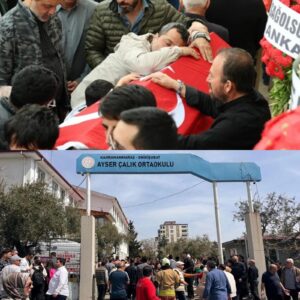
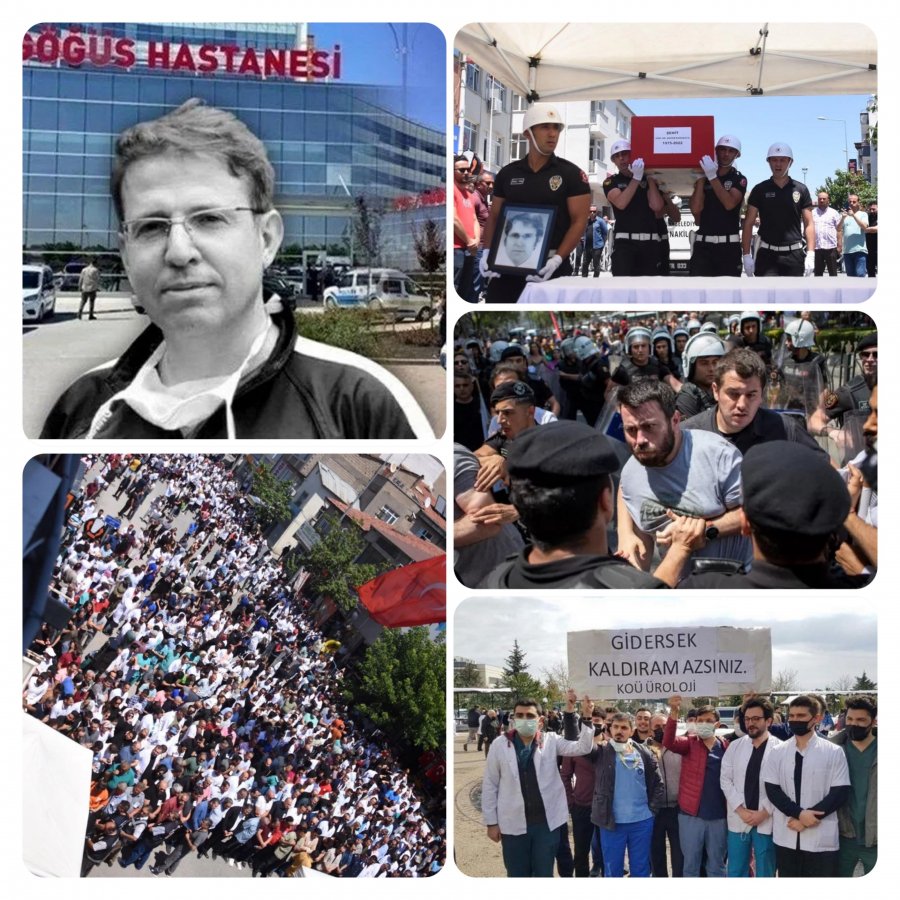
Murder suspect Hacı Mehmet Akçay, who lost his mother to an angiogram a month ago, blamed cardiologist Dr. Ekrem Karakaya for her death and murdered the accomplished doctor three days ago at around 2:20 PM.
Hacı Mehmet Akçay, 39, a security guard at Yunak State Hospital, killed the 47-year-old doctor before shooting himself in the head. Despite all efforts, both men lost their lives.
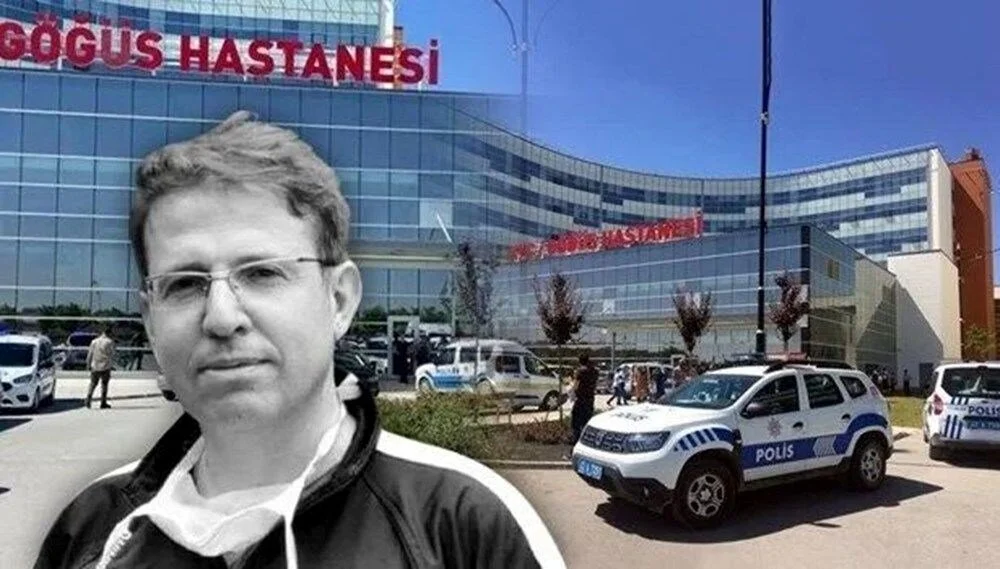
It was reported that the cardiologist was performing examinations in the outpatient clinic at the time of the incident and that hospital staff provided first aid after the shooting. The father of the murderer, who shot himself and then committed suicide, said, “I still can’t believe this happened. I would never have wanted such a thing to happen. I feel sorrier for the doctor than for my own child. He has two children. It’s beyond words.” (https://www.hurriyet.com.tr/gundem/doktor-ekrem-karakayayi-olduren-guvenlik-gorevlisinin-babasi-cocugumdan-cok-doktora-uzuluyorum-42098131)
Afterwards, Dr. Ekrem Karakaya was sent on his final journey in Kayseri: https://www.ntv.com.tr/galeri/turkiye/hastanede-oldurulen-doktor-ekrem-karakayaya-veda,7pUQfVLE50eLZa5zlf-Gag

Health Minister Fahrettin Koca was also present at the funeral, which was attended by many citizens. The Minister of Health was met with protests at the funeral: https://twitter.com/poftpmedya/status/1544996367843614721?utm_source=newsletter&utm_medium=email&utm_campaign=%F0%9F%92%8A+Sa%C4%9Fl%C4%B1kta+gaz

Police crackdown on healthcare workers
Healthcare workers in many provinces have struck work for Karakaya. Police used tear gas on healthcare workers who gathered around Çapa Medical Faculty in Istanbul and attempted to march to the Provincial Health Directorate. The police officer, who fell ill, was given first aid by the protesting healthcare workers. Police also resorted to harsh measures in other protests:https://bianet.org/bianet/saglik/264254-saglikta-siddeti-protesto-eden-doktorlara-polis-mudahalesi
Healthcare workers were protesting in many parts of Turkey, including Ankara, Bolu, Gaziantep, Kahramanmaraş, Mardin, Şırnak, Trabzon, and Van:https://www.bbc.com/turkce/haberler-turkiye-62071042?utm_source=newsletter&utm_medium=email&utm_campaign=%F0%9F%92%8A+Sa%C4%9Fl%C4%B1kta+gaz
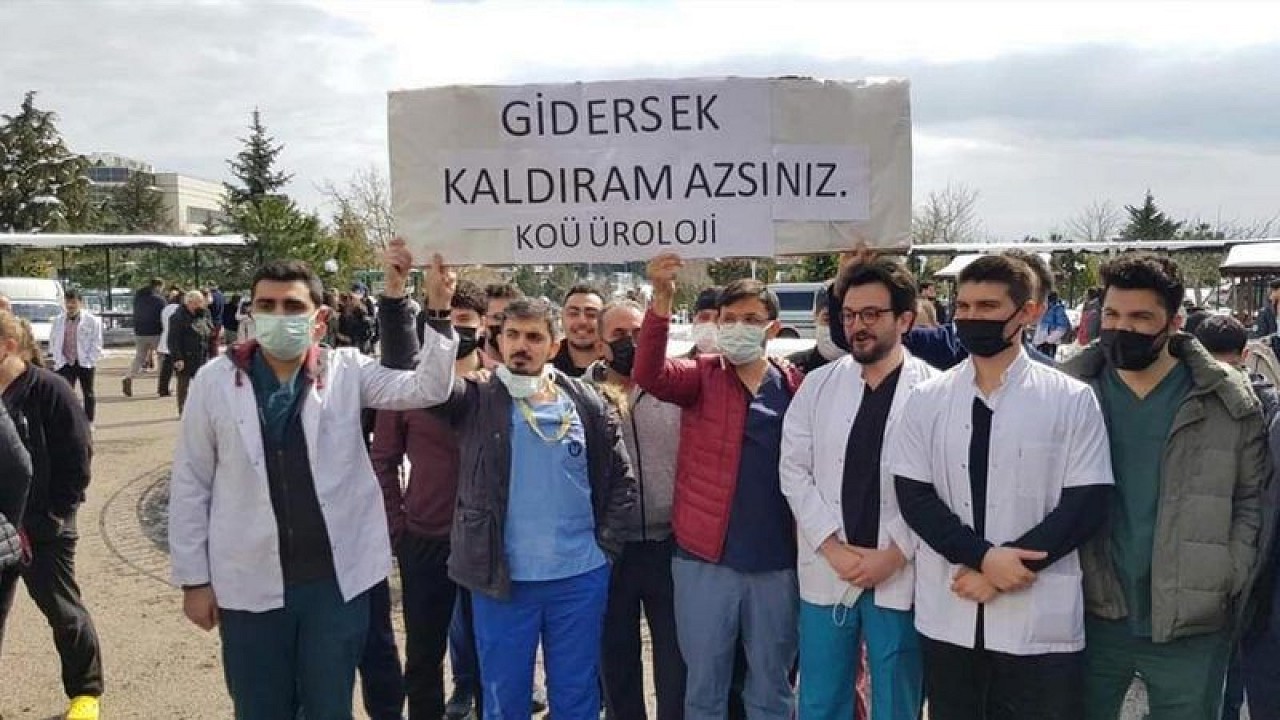
Among these healthcare workers protesting, the most striking (I must admit, I found it humorous) was the banner displayed by the Kocaeli Urology Department, which read, “If we leave, you can’t lift it.”
Despite all these nationwide protests, violence against healthcare workers continued unabated. On 6 July, Suat Bağadur, a relative of a patient attempting to register without an ID card at Istanbul Bağcılar Training and Research Hospital, assaulted healthcare worker Nurullah Çalpa. Bağadur was detained and arrested on charges of “intent to injure.”
Statement by TTB President Fincancı
A bill to prevent violence against women and healthcare workers was approved by the Turkish Grand National Assembly (TBMM) General Assembly and became law. An amendment in May included the crime of “intentional wounding” against healthcare workers within the scope of “catalogue crimes,” paving the way for the perpetrators to be held in pretrial detention. However, after this law was passed, the perpetrators of an assault in Şanlıurfa were released. The attackers were imprisoned pending trial following the Ministry of Health’s objection:https://www.milliyet.com.tr/gundem/bakan-kocadan-aciklama-sanliurfada-doktora-saldirida-yeni-karar-6781234?utm_source=newsletter&utm_medium=email&utm_campaign=%F0%9F%92%8A+Sa%C4%9Fl%C4%B1kta+gaz
TTB President Şebnem Korur Fincancı had previously emphasized the inadequacy of the proposed law. Fincancı emphasized that they had been proposing for years that violence in healthcare be included in the catalogue of crimes, but that deterrent penalties alone would not solve the problem. She said, “Violence is the result of transformation in healthcare. Therefore, unless concrete steps are taken for transformation in healthcare, preventive healthcare services are strengthened, and provoked healthcare demand is not curbed, unfortunately, there is no way to prevent violence.”https://www.evrensel.net/haber/461387/kadina-ve-saglik-calisanlarina-yonelik-siddetle-ilgili-duzenleme-tbmmde-kabul-edilerek-yasalasti?utm_source=newsletter&utm_medium=email&utm_campaign=%F0%9F%92%8A+Sa%C4%9Fl%C4%B1kta+gaz
The Bottom Line
I think we’re missing the point in all this chaos. We need to look at the bigger picture. The bigger picture says this: Everyone in this country is on edge. No matter what we’re doing, no matter what we come from, we’re collectively a bundle of nerves, and in fact, some in every segment of society are going absolutely bonkers. You’ll see this most clearly in traffic. When you’re out on the road, you’ll witness drivers plowing into each other, road rage, horn fights, and curses flying around, all of which demonstrate our extreme aggression. People are generally unhappy.
The doctors working in Kocaeli, who protested the incidents by holding banners saying, “If we leave, you can’t handle it,” know full well that Kocaeli’s provincial slogan is “Happy City,” but that it’s not exactly a happy city. This isn’t just true in Kocaeli; the whole country is a powder keg.
Some healthcare workers are at fault, too.
Let me tell you something else. I don’t think violence is just experienced by patients or their families. This violence goes both ways. Unfortunately, in our beautiful country, we also witness doctors and healthcare professionals who attribute their illness to psychopaths. I’d like to share two personal experiences with you:
In the first incident, we took my mother to a renowned cardiologist at the American Hospital to get a second opinion about a blocked artery. After all, you’re taking your mother and deciding whether she should have bypass surgery. It’s a very important decision, and you want to get the doctor’s opinion on every detail. After the doctor evaluated the angiogram results, it was time for the questions. After my mother and my uncle’s wife, Aunt Sevgül, asked their questions, I started asking my own. From the very first question, the doctor ignored me and acted as if he hadn’t heard me. I insisted on asking my question again. What would you like him to say to me? The doctor looked at me with an extremely aggressive expression and said,
“This is the second time you’ve asked me this question; I don’t have to answer yours.”
This doctor, a career doctor, spoke to me as if he were arguing with me and treated the patient and their families in a manner that violated medical ethics. Incidentally, asking him the same question twice wasn’t right either; the doctor’s explanation, in my opinion, was inadequate. I wanted to go into more detail, so I asked, but he ignored me. I asked him again for an answer, and then I got this response.
After saying this, I paused for three or five seconds. My anger surged. You’ve taken your mother, and you’re discussing a vital issue. The doctor is being disrespectful, openly displaying his aggression, and not even properly answering your questions. Then, my self-control kicked in, and I calmed myself down by saying, “Don’t be ridiculous, Serhan.” We quickly said, “Let’s get up then,” and we left.
A second example and my doctor friend’s comment:
When I went to the American Hospital with a friend about another issue, the doctor, an expert in the field, used medical jargon, so I asked, “What does this mean?” The doctor, once again, with the confidence of a well-known doctor over 60, with a career and a well-known background, said, “I’ll give the answer to your friend.” I said to myself, “There’s no need to worry…” and calmed myself down again. I told the doctor, “If you’re not going to answer, then I’ll ask my friend what that phrase means. There’s no secret here.” My friend was with me when I said these words.
These two incidents occurred within two months of each other in 2022, and I believe they constitute psychological violence perpetrated by doctors. The doctors I mentioned, and others like them, completed their studies with great effort and worked tirelessly for years, working day and night to reach the top of their profession. But they haven’t become human beings. In my opinion, there are two main criteria for being a good doctor. The first is being able to perform their profession to the best of their ability, and the second is being a human being. Both criteria are equally important to me. Because a doctor’s good treatment of their patients and their relatives, their humility, and their ability to keep their morale high are crucial for a quick recovery in some illnesses.
Now, because of what I experienced during these events, a thought and question arose in my mind: “If, at a healthcare institution like American Hospital, considered the pinnacle of the private hospital sector, the career doctors over 60 years of age, working at the top of their departments, do not know how to manage patients and are not afraid to show off their high egos everywhere and provoke patients’ relatives, then what is the situation of the doctors in other private hospitals and even in public hospitals?”
Then, when I discussed this issue with a cardiologist friend in his 40s, he said, “Man, that generation is generally like that. They’ve made us suffer a lot in our time. Unfortunately, most doctors over 60 have this “I created the small mountains” ego, and this ego is relatively less prevalent in younger generations. Also, if they’re not in a good mood and the doctor has a temperamental nature, their communication with patients or their relatives can be very poor.”
Now, let’s empathize: Let’s consider my situation and imagine the same situation happening in a public hospital with a citizen with a low education level who has difficulty with self-control. The man has brought his relatives to the hospital, is on the verge of a critical decision, risks losing his loved one, and is subjected to psychological abuse by the doctor. The patient’s relative may in turn resort to physical violence against the doctor. Let me also state this: I do not condone any form of violence. No matter what, people need to learn to control themselves

My suggested solutions
Since this is one of my classic articles, I’ll now list my suggested solutions:
1) Happiness depends on prosperity: If the root of the problem lies in the vast majority of unhappy people in our country, and if we want to reduce these mutual violence incidents in the long run, the way to do so is to ensure people are happy. This depends on our citizens not struggling to make ends meet, routinely pursuing their hobbies, and beginning to enjoy life. I’m talking about ensuring no one in our country struggles to make ends meet, and especially healthcare workers shouldn’t be thinking, “How will we make ends meet?”
2) The importance of education: Just as unhappy people are at the root of the problem, so too are uneducated people. While we all know that educated people can perpetrate psychological or physical violence, they will certainly have greater self-control and sensitivity than the uneducated. That’s why we say education is essential. Notice I say education, not training. So, as I’ve repeatedly emphasized in my past articles, education for ages 0-10 (it’s generally necessary to ensure that all children have a happy and trauma-free childhood), parent education, and educator training all demonstrate the scope I’m discussing.
3) Specific training for healthcare professionals: Doctors and all other healthcare professionals need to be provided with very specific training, such as patient psychology and how to treat patients. This training should be repeated annually. Furthermore, all healthcare professionals should undergo annual psychological testing. Those who are experiencing problems or are experiencing difficulties should be provided with periodic breaks. If they continue to experience the same problems or complaints after returning to work, the situation should be resolved, even leading to dismissal.
4) Humane working conditions for healthcare professionals: Doctors and other healthcare professionals work under high workloads, which eventually affects their mental health. As you probably know, pilots and flight attendants are entitled to a certain amount of rest time in exchange for a flight. Pilots absolutely need this time to maintain a healthy mental state, and as far as I know, all airlines respect these rest periods. They know that having well-rested and mentally sound pilots flying the plane can mean life and death for the passengers. Similarly, it’s clear that well-rested and mentally sound doctors and healthcare professionals can mean life and death for the patients. From what I’ve observed, this problem exists in private hospitals as well, but it’s incredibly severe in public hospitals. What can you expect from a doctor who sees 300 patients a day in public hospitals (I know from friends who work in public hospitals)?
Similarly, the physical condition of the hospital must be at a workable level. Every area of the hospital must be hygienic, the tools and equipment must be complete, and the supplies they will use must be fully equipped. Unfortunately, the situation in public hospitals in Turkey is deplorable. Doctors and healthcare professionals working under these difficult conditions, far below standards, can suffer great hardship and can also be mentally affected. The physical condition of our hospitals, especially public hospitals, must exceed international standards. Healthcare professionals working in high-standard environments feel good, their performance improves, and their ability to treat patients and their families appropriately increases.
5) Preventive measures: Patients, their relatives, and even all hospital staff (including security and cleaning personnel) must be strictly checked before entering the hospital for dangerous weapons such as knives, weapons, or explosives that could cause injury or even death. Anyone caught attempting to enter the hospital with these weapons must be immediately taken to the nearest police station, legal action must be taken, and they must be punished severely. Furthermore, security must be increased at every hospital for those who arrive in large numbers to demonstrate force and then attack doctors or healthcare workers. This security must be maintained 24/7, and in the event of an emergency, at least 10 security personnel must be immediately dispatched to the scene.
6) Deterrent penalties: Those who commit violence against healthcare workers must be punished in the harshest possible way. Court proceedings must be short, and decisions must be implemented immediately and without compromise.
7) A well-functioning complaint hotline: There needs to be a hotline where you can report the misconduct of doctors and all other healthcare professionals. This should be a dedicated line for healthcare, not CİMER, and managed by the Ministry of Health. This hotline should also be managed with a goal-oriented, problem-solving approach.
Unfortunately, the healthcare sector is a mirror of the country. I hope this information is helpful and the necessary steps are taken. Stay well.
Bonus: I’d like to share the graduation speech from Hacettepe University Faculty of Medicine by Dr. Kaya Avşar, one of our young, high-potential colleagues, who clearly summarizes what doctors and healthcare professionals in the healthcare sector face from the beginning of their careers:
Tag: education