
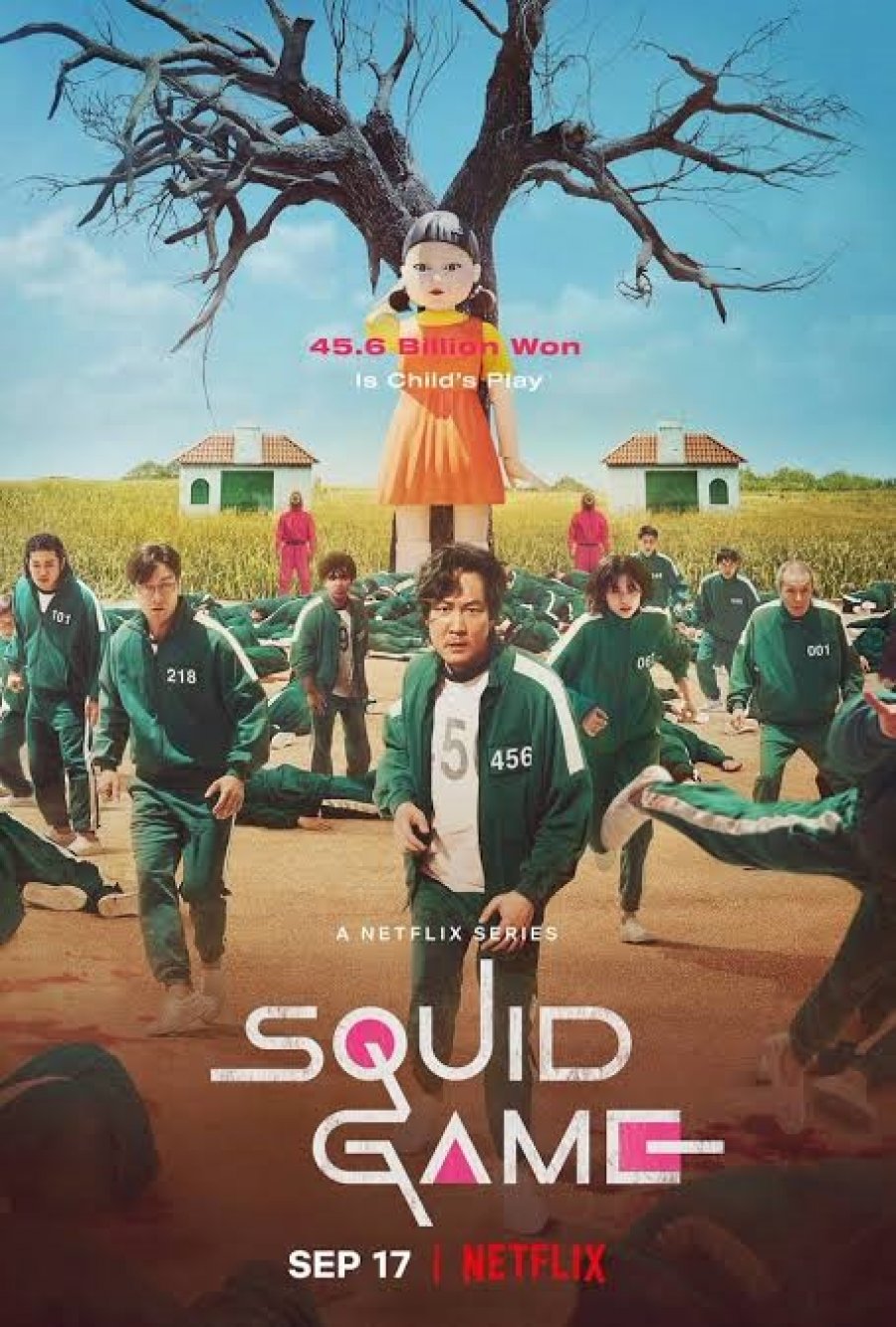
First of all, I should point out that I think it would be more beneficial to watch the series before reading this article. Alternatively, you can read this article to get some background information before watching. Those who don’t know can watch the trailer below.
The series tells the story of 456 people, deeply in debt and desperate, who are drawn to a bloody survival game show, hoping to walk away with a $39 million prize if they win six consecutive games. There’s only one problem: If they’re eliminated, they pay with their lives.
Released on 17 September, the South Korean series has been watched by 111 million users in just 28 days, dethroning Bridgerton (82 million).
The series follows the struggle of 456 desperate people competing to the death to win the $39 million prize. Contestants try to advance their way to the prize by playing various games, and are eliminated—or rather, killed—if they lose.
Games in the Series
You observe a total of seven games in the series. The first game is a game that evaluates whether the participant has the character to play the Squid Game. It’s a ‘recruitment’ game, in a sense.
Both the series’ protagonist, Seong Gi-hun, and the Korean recruiter take turns using folded pieces of paper to hit each other with their own paper. The first to flip the other over wins. In other words, it’s a competition based on origami, the art of paper folding known in Turkey. While there doesn’t seem to be much danger besides a paper cut, Gi-hun will owe 100,000 won (690 lira) for each round he loses. However, things take a turn when the dealer allows himself to be slapped instead of money. However, there seems to be no danger in this game other than being physically humiliated in public for the sake of small amounts of money. The real purpose of the game, however, is to test a person’s propensity for “humiliation,” their ambition to win, and to weed out potential candidates for the tournament.
Contestants who pass this game are entered into six games in which they fight for survival. Let me summarize these games one by one:
1) The Red Light, Green Light Game
In this game, the first in the series, a giant robot girl with ‘terminator eyes’ begins counting. As she counts, everyone moves forward, trying to cross the line ahead. When the giant robot finishes counting, the green light turns red, and everyone must stop and wait. Those who move are shot dead. Those who fail to cross the line when the timer runs out are also shot dead. Because none of the 456 players participating in the games know what they’re about to face, this game also results in the most deaths. After this game, all the players clearly grasp that death is the end of this game; their eyes are opened, and their pessimism vanishes. This game essentially says this: no more posturing, back and forth, or organization. The formula is simple: walk when told to walk and stop when told to stop.
After this game, another striking phenomenon emerges. When the players realize that death is at stake, they vote, and by a margin of just one vote, they decide to end the games. So, the number of people who decided to continue, even though they knew it meant death, was almost half.
However, everyone who returned to reality realized that their financial difficulties had become insurmountable and returned to the games one by one. With almost everyone back, the second game began.
2) Candy Mold Game
You need to remove molds consisting of four shapes: triangle, circle, star, and umbrella, using a needle within 10 minutes without breaking or damaging them. While a triangle or circle is easy, if you choose other shapes, the task becomes more difficult. If the shapes break or distort, you are eliminated from the game; in other words, the red-suited officials will shoot you dead.
Contestant 456, realizing that the candy is easy to shape when it gets wet from sweat, begins licking it off, and succeeds. Others who see him follow the same tactic. It’s clear what it takes to rise in the capitalist system.
3) Tug of War
Here we encounter a game played in almost every country. Two teams engage in a tug-of-war, and whoever can pull the rope back to a certain point wins. The Squid Game has a twist: the loser falls from a height and loses their life. While the tug-of-war may seem like a game of strength, you can win with tricks like hopping, taking three steps forward, knocking the other team down, and then starting again. Despite being perceived as the weaker team, they win the game thanks to the initial tactics of contestant #1 and a last-minute intervention by contestant #218. If we apply this game to real life, the prevailing mentality is that the best team wins, the loser loses. Tactics from an experienced team and those with the intelligence to execute them ensure victory.
4) Marble Game
The goal in this game is to choose one of several marble games and take the opposing player’s marbles. I am talking about games like odd-even and throwing marbles into a pit. Those who lose their marbles are shot by Squid Game’s staff. Here, you witness how people deceive each other when life and death are at stake. Even player 456, the show’s hero, resorts to deception when forced to do so. Nevertheless, player 218 deceives Ali, the only non-Korean player in the series who joins from the same neighborhood as him. It’s sickening.
5) Glass Bridge Game
Imagine a glass bridge on a high elevation. Some of the glass, laid side by side in two strips, is made of regular glass (which is non-durable), while others are tempered (which is durable). Tempered glass is strong enough to support the weight of two people. However, even the weight of a single person can shatter the glass. Players must guess which of the steps is made of durable glass and complete the game by crossing 18 pairs of steps. Of course, the odds are 50/50 at each step… Being behind is an advantage in this game. Because if the numbers you choose at the beginning of the game are at the top (like 1, 2, 3), you’re ahead. You can see all sorts of trickery going on here, too. 218’s pursuit of the glass master and pushing him up the final step is a metaphor for the classic mess people make in real life.
After the glass bridge game, the three protagonists face off. However, when the bridge’s glass panes are finally swept away, they seriously injure the sole North Korean female finalist.
6) Squid Game
The final and sixth game, which will determine the winner of the series, is actually a game commonly played by children in South Korea. In this multiplayer game, two teams are assigned: attack and defense. The two main objectives are to either achieve the attacking objective or destroy each other. In the series, the contestants try to fulfill these tasks at all costs.
I won’t go into detail about the ending after all this. For viewers who haven’t seen it, I can say the ending is a bit of a surprise. However, I can predict that the series will continue based on how it ends. There are loose ends, and Dong-hyuk, the series’ director and screenwriter, will want to wrap them up in future episodes.
The director’s own life is the inspiration for the series. Dong-hyuk’s own family’s situation was the source of inspiration for the series. The director recalls going through tough times after the global economic crisis in 2009: “My mother had retired from the company she worked for. I had a film I was working on, but we could not find financial support. I couldn’t work for about a year. My mother, grandmother, and I had to take out a loan from the bank.”
Trying to distract himself at comic book cafes in Seoul, Dong-hyuk explains that he read survival-themed stories like ‘Battle Royal’ and ‘Liar Game.’ “I could relate to those people desperately searching for money and success. It was a tough time in my life. I wondered if survival games like this existed, would I have joined them to earn money for my family? I thought, as a filmmaker, I could add my own touch to these kinds of stories, and I started writing the script.” So why did he create such a brutal competition that cheapens human life? The director simply answers: “Because the series operates on a simple premise: We struggle for our lives under very unfair conditions.”
It is clear he did not expect such success. While working on the project, he aimed for it to reach number one on the US charts for at least one day. However, he finds the fact that it has achieved so much success surprising: “This shows that the message I wanted to convey resonates with a global audience.”
I also recommend reading the recent interview with the series’ writer and director, Dong-hyuk, in the Guardian: https://www.theguardian.com/tv-and-radio/2021/oct/26/squid-games-creator-rich-netflix-bonus-hwang-dong-hyuk
The series’ thoughts and capitalism
Squid Games has become one of my favorite series and movies I’ve watched recently. It was the first time I’ve watched a Korean series, and I enjoyed it. However, due to the excessive number of violent scenes, I believe children of a certain age should be banned from watching. There is no rule that says children can watch a series about children’s games; on the contrary, they should not watch it because of the violent scenes. I am also pleased to see that the TV and film industry isn’t just limited to Hollywood or American series. In this world, I believe all cultures and perspectives should be reflected and shared with people living in various parts of the world. This way, our cultural richness increases, and people from different countries begin to understand each other better.
The series depicts the plight of billions of people trapped in a debt spiral by the capitalist system. That is why it broke viewing records. People who fall into this spiral, whether through their own mistakes or those of others, are practically dying. Some somehow escape, some suffer this torment throughout their lives, and some, unable to withstand the resulting pressure and stress, commit suicide. Everyone has a story in this world.
The final episode explains the widening gap between the rich and the poor, and the purpose of the games in Squid Game, with this line: “The one thing the wealthy and poor have in common is that neither enjoys life. The poor live under intense stress from this constant struggle with debt and cannot find any pleasure in it, while the wealthy have experienced all the pleasures in life, and nothing else brings them joy. So, to enjoy life again, both want to return to their childhood.”
Perhaps the way to hold on in this life is to never give up the fight, no matter what, to focus on the good in life, to avoid repeating the same mistakes, and, consequently, to sever ties with those who deceive us and cause us to fall into these situations. Let us not forget that everyone has multiple lives and various choices to choose their own path throughout their lives. The important thing is to learn from the terrible things that happen to us and to enjoy the good things.
For a happier future for our children, it is essential to adjust the capitalist system criticized by Squid Game. It’s time for capitalism to evolve into a system that prioritizes human happiness and sustainability; this change will begin in our generation.
Bonus: Let’s watch the lead actors of Squid Game appear on the Jimmy Fallon Show:
Note: While writing this article, I used a portion of Güventürk Görgülü’s analysis at https://www.diken.com.tr/squid-game-aslinda-ne-anlatiyor/. I would like to thank him.