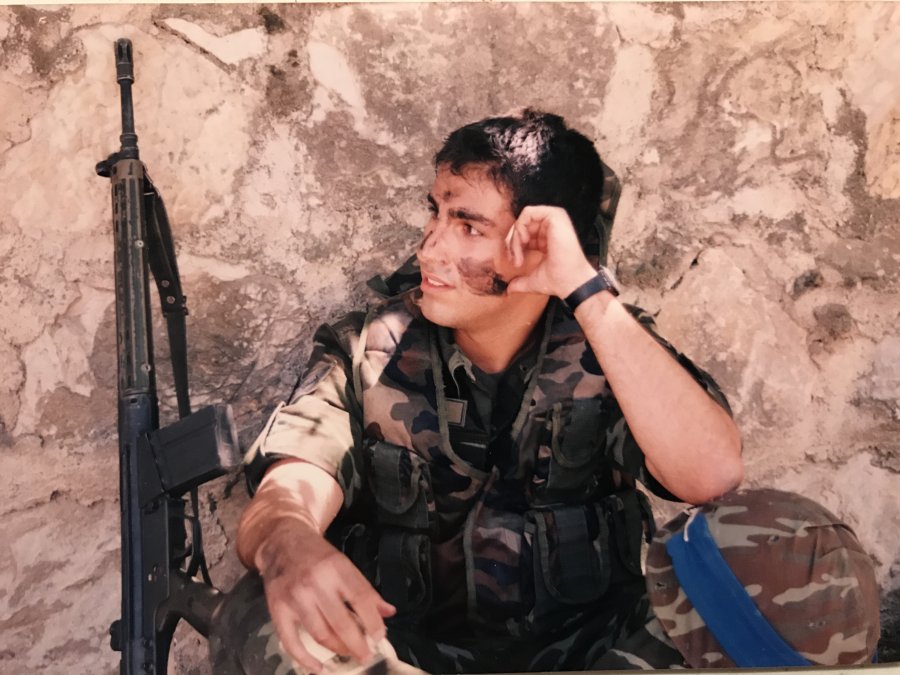
After the recruitment, everyone’s destination was clear. Some of our short-term soldiers served as drill sergeants, some as clerks, and some as officers at the Officer’s Club, working in various parts of the brigade. Some continued their military service at the Söke unit in Denizli. I was selected for the brigade headquarters, the main administrative unit of the brigade. Initially, I was assigned to the IT (Information Technologies) section of the brigade headquarters. Although I didn’t have a background in computer engineering, I was assumed to be computer-savvy, and I was assigned to the entire brigade’s information processing department. One of my closest friends was assigned to intelligence, while another became the clerk of our dormitory. In fact, because our short-term assignments were spread throughout the brigade, I had contacts everywhere. I quickly became acquainted with my colleagues in the IT department. I fell into a good circle, but it was short-lived for me.
After three weeks in the IT department, I was assigned to the command floor next to the brigade commander. There was only one general in our brigade, the brigade commander. Our brigadier general was accompanied by a staff colonel. Both were assisted by a NCO. I was assigned as his orderly. In the private sector’s parlance, I was the assistant to the assistants of the two highest-ranking officers in the brigade. They also gave me a side job teaching English. Both were jobs I could easily handle.
If a mother’s hand touched the military…
I was working in the IT department and received my leave. Initiating the leave procedure was the first thing I did as soon as I arrived. I learned and planned this during my recruitment. I had set my mind to it during the 20-day vacation I took after recruitment. The first thing I did upon returning from vacation was to start the procedures. Soldiers always go on leave, but I wanted to stay home, at least for the weekend, outside of the barracks. This wasn’t an easy procedure. First, your immediate relative, your mother or father, had to rent a house in the province where the brigade was based. They also had to register their residence in that province. There were many other tasks to be completed. No soldier could afford this. They thought they wouldn’t get the permit even if they met all the requirements. I broke that prejudice. Thankfully, my mother handled every step of the process without a single complaint. She practically moved to Denizli. Thanks to this, I was able to get home leave in three weeks. Three or four more soldiers received home leave after me.
Another request I had from my mother was about the bedding. In the ward where we were staying, all the sheets had turned brown. Don’t assume that a similar shade darkens over time. The off-white color, probably due to dirt or wear, had turned brown over time. I’m very particular about my bed, so this bedding issue really bothered me. I asked my mother to bring me a pristine white bedding set from Istanbul. My white bedding stood out like a pumpkin in the middle of the ward. But there was another problem. Everyone in the ward was stealing each other’s duvets and sheets. They would even take them off you while you were sleeping. As a precaution, I asked the barracks sergeant, and instead of making my bed in a specific order every morning, I started putting the pristine white duvet cover in my closet and locking it. Thankfully, they managed; I had no problems.
Attempted Lynching of the Barracks Rat
The theft wasn’t limited to pillows and quilts. During our seven months in the barracks, we occasionally had other minor thefts. Around the middle of my military service, I think around March, the thefts increased. Everyone was stealing something every day. Complaints about this were being voiced loudly. So I was very careful. I never left my locker unlocked. Even if I went in for a 10-second break, I’d lock it. One evening in late-March, a shout broke out in the barracks: “I’ve caught the scoundrel! Come here! You scumbag!” The entire barracks suddenly erupted in agitation. When I went in the direction of the sounds, I realized what was going on. Two or three soldiers were claiming to have caught the thief who had been stealing everyone’s belongings. They forced the person they caught to open his locker, and voila! Many people’s belongings were found. Suddenly, 20 people attacked the thief. They were about to lynch him. Initially, I was watching from the sidelines and saw this lynching attempt and intervened to stop it. Ten other people, including me, intervened to break it up. It was so crowded, the place erupted in dust, and the brawl spilled from the locker rooms into the dormitory. We finally managed to stop the lynching. We picked up the boy, his mouth and nose completely shattered, pulled him out of the crowd, and handed him over to the relevant officer. After a brief interrogation, they sent the thief directly to the disco. A disco is a term used for a holding barracks in the military. We were there in the back trying to calm down the screaming, angry soldiers whose belongings had been stolen.
Speaking of overcrowding, there were 350 of us sleeping in a 300-person barracks. Let me explain how it happened. We all slept in bunk beds. They’d joined the bunk beds together, and in some bunks, they’d put a soldier in the middle. So, they’d increase the capacity by joining two single beds and placing a third soldier in the middle. So, some joined bunks could sleep six people. I chose the upper bunk because the lower bunks got dirty very quickly. Passing soldiers were always sleeping randomly on the lower bunks. Because climbing up to the upper bunks required effort, no one in boots dared to climb up and sleep on the upper bunks. Seeing this, I chose the upper bunk for hygiene reasons. I took Serkan, a Samsun native I’d known since my training days, with me. I warned this very sympathetic friend: “We’re not letting anyone in the middle. If anyone tries, absolutely don’t let them.”
350 heads, 700 feet!
Serkan and I stuck to this principle. We didn’t let anyone in the middle. They were already asking at first, but after a while, as the ward settled into order and they got to know us, no one bothered.
We slept with the blanket between our legs to prevent stealing at night. Serkan and I had an agreement about the risk of theft. If either of us witnessed our belongings being stolen, we would react immediately. In such a crowded ward of 350 people, you had to support each other and create the environment you wanted. Thankfully, there were quite a few of our short-term soldiers in the ward, and everyone was looking out for each other in some way.
And of course, I must mention this: 350 people means 700 feet. I can’t describe the stench of those boots in the locker room just outside the barracks. Even writing these lines now makes me want to puke. But after a while, you get used to that odor. You have to, you have no choice.
Speaking of odor, as someone who showers every day, sometimes even twice, I had to adapt to my environment. During my military service, I tried to shower every day. Some days, it was impossible. I once broke a record by not showering for five days. The water would sometimes be cut off for extended periods. During a time when I couldn’t go on domestic leave, the water was cut for a whole week. I’m going crazy. I can’t shower. After all, cleanliness is a necessity for me. By the end of the fifth day, four of my friends and I decided to hose ourselves down while it was snowing outside. It was seriously cold, and we were all shivering, but we were so happy. We finally got clean. We returned to the pristine barracks. Of course, after a thorough drying, we were wrapped in blankets.
The most vulnerable time for love
Our fellow soldiers in the barracks were a real mess. Everyone was talking to their families, girlfriends, fiancées, or wives on phones, their freedoms restricted. Let me give all women a tip here: A man is at his most vulnerable during his military service. If you want to make a man fall in love with you, it’s easiest to do it while in the military. I’ve seen many examples of this. In fact, one of my closest friends in the military used to talk to his girlfriend on the phone everyday for at least an hour. In the last two months of his service, he started saying, “I’m so in love, man, I’m going to marry this girl.” I told my friend, “You’re not thinking rationally right now. The best thing for you is not to get married right after your discharge. Be friends for at least six more months and then make your decision. You’re not in the right place right now. If you make the wrong decision, it’ll be a shame for both you and the girl.” My friend would say, “You’re right.” But his obsession with marrying the girl continued to grow. He married her within two months of completing his military service. Three months after getting marriage, he started asking me, “What have I done?” He claimed he wasn’t truly in love with her but only valued her as a friend. He stayed married for another three years, worried about what would happen to her after I left. Ultimately, it was a waste of both my friend’s and his ex-wife’s time.
I’ve witnessed many similar relationships. As I said, men are extra sensitive during military service. I even encountered someone who attempted suicide while he was in the military because his ex-girlfriend was dating another guy.
By mentioning this, you might be wondering what was going on in my personal life during my military service, but as I’ve mentioned before, I don’t prefer to delve into my personal life or sensitive political topics in my blog posts. I prefer to write about interesting experiences I’ve had.
For instance, one day while I was in the army, I finished work early at brigade headquarters. I had some free time. So, I started exercising on my own. While doing push-ups, I looked up and saw two soldiers standing over me, looking at me and talking. When I asked what was going on, they told me it was the first time they’d ever encountered someone who was exercising on their own. I explained that I’d gained weight and that I was exercising to keep myself at least somewhat.
“Your military service…”
I was one of the few soldiers who gained weight during my time in the military. While all my friends lost an average of 10 kilos (some of them got into serious shape), I gained 7-8 kg. This was because we’d enter through the back door of the officers’ club, pay for the best food, like shish kebab and chicken shish. Of course, we also ate in the mess hall sometimes, but the officers’ club’s inexpensive, excellent food was too tempting. We were able to eat there for two reasons. The first being as we worked at brigade headquarters, they turned a blind eye, because we worked in the brigade’s highest-level jobs, with no time constraints. And the sergeant at the officers’ club was our short-term partner. Thankfully, he was always helpful. Imagine being constantly on the computer, not getting much exercise, and eating delicious food—of course, I gained weight.
Some of my friends who served with me still make fun of me for this. They’d start with, “Your military service…” and always take issue with my weight gain. Meanwhile, most of my friends who lost 10-15 kilos and got back into shape, just as they clung to food as if they’d survived a major famine in Africa, they regained their former weight within 3-4 months after their military service.
From bad drivers to rookie barbers
There’s a lot to be said for the series of illogicalities that occur there. For example, those pursuing careers in HR conduct interviews and tests to find qualified candidates, right? In the military, this happens randomly. For example, I witnessed this incident. A soldier chauffeured an officer, angering his commander, was sent to a barbershop, saying, “You’re not good at driving; go do some barbering.” A friend of mine was the first to get a trim from him in his new “career.” When the guy came to us after the barbershop, his hair looked so goofy, we all fell on the deck laughing. In the hands of the rookie barber, our friend was practically a Guinea pig. His hair, long in some places and very short in others, wasn’t cut; it was practically ripped out. Commander J supposedly wanted to punish the soldier who was his driver, but in reality, he punished the soldier who was shaved by him.
The long-term lens test…
This series of illogicalities wasn’t just the arbitrary actions of some well-trained officers. The real problem was the serious lack of education among most long-term soldiers in the army. Imagine a group of men who couldn’t read or write, couldn’t speak Turkish, and didn’t know any of the rules of etiquette. The material for the stories that emerged was generally derived from the behavior of these men. Let me give you another example. One evening, after finishing work, I returned to the barracks. After brushing my teeth in the bathroom, I removed my contact lenses. Just as I was placing the lens on the tip of my index finger into the lens case, I suddenly noticed, out of the corner of my eye in the mirror, that four soldiers behind me were watching me intently. I turned and said, “What’s up?” One of these four Eastern brothers asked me, “Yo, man, what’s that onion-like thing on the tip of your finger?” I smiled and said, “This is a contact lens. So, when I wear these instead of glasses, I can see far off.” Another soldier immediately jumped in, asking, “Can I wear it too?” I laughed again and said, “No, only one person can wear this. Since you’re putting it in your eye, cleanliness is very important, so I can’t give it to you. But let me show you how they are used.” After putting the contact lens back on, I started, “Look, I can see all the details of that sign over there now.” I explained how to use it and its purpose thoroughly. They enjoyed the demonstration. Another one even asked, “I wonder if I can get one of these?” I recommended he see an ophthalmologist. That wasn’t the only health-related memory I had.
Not a ward shift, but a malaria attack!
In the military, you encounter things you’d never imagine. For instance, once, after working on the computer all night, I returned to the ward early in the morning and was brushing my teeth in the bathroom when a soldier suddenly burst in and said, “Bro, help me out!” I immediately attended to him and tried to understand what was going on. His mouth was trembling, his teeth chattering. I ran to the boy and wrapped him in a quilt I’d brought from inside. “What’s wrong? Are you cold?” I asked him. “No, man, I’m having a seizure,” he said. “What sort of seizure?” I asked. Through his chattering jaw, he managed to forcefully say, “I have malaria. I’m having another seizure.” “Malaria? Does malaria still exist in Türkiye?” I expressed my surprise. “Yes, I have it,” the boy replied. “I’m from Bolu and I’ve been suffering from this for years.” His shivering was getting worse. “Hold on, I’m calling the doctor right now,” I said, and jumped up.
First, I called the duty officer to his feet. Then we brought the duty doctor from the hospital to our ward. They immediately admitted the boy to the hospital. The next morning, they told me that his seizure had stopped and that he had regained consciousness. I remember sighing to myself, “I’m another year older. Let’s see what else we’ll see.”
After all, health truly comes first. Be yourself, always appreciate your health. Stay healthy.
Tag: memoir