Firstly, I’d like to emphasize that I won’t be posting confidential information here. We all did our duty, with its pros and cons. While there were times when I was very bored, military service was a wonderful experience for me, especially in terms of getting to know my own country. In a sense, I became acquainted with the country’s DNA.
As you know, I’m also the Honorary Consul of Costa Rica. In other words, I’m the official representative of a country without an army. I wish there were no need for armies worldwide, and if it were possible to channel the funds allocated to the military into education, as is the case in Costa Rica. Thanks to this, the literacy rate there is 97%. Almost all the new generation speaks a foreign language. They’ve succeeded in creating a highly informed society. I wish the ideal model implemented by Costa Rica could be applied in our region as well. However, in the times we live in, our paradise homeland is in perhaps the most problematic region in the world. Therefore, we need to protect our army. Personally, I served my military service for eight months without complaint (the abbreviated term was eight months at the time). Therefore, my conscience is clear. Now, let’s get to my military service story…
After graduating from McGill University for four years, I worked for a while at the American headquarters of the Italian insurance company Generali. I previously wrote about this transition in my blog post, My 15-Year Work Life and Notes for the Future: http://www.serhansuzer.com/tr/15-yillik-is-hayatim-ve-gelecege-notlar
While working at Generali, I decided to join the military directly. Upon completing my time, I returned to Türkiye. A month after my return, I enlisted.
From high school memories to Denizli…
My twin brother also completed his military service during the same period. We experienced the same things everyone goes through. Baran was generally luckier than me in these matters, so he became a Marine and began his military service in Izmir, completing his compulsory military service. I was assigned to the 11th Infantry Brigade in Denizli. Within the military, each sailor, airman, or army officer has his or her own unique dynamics and spirit. Among them, the most comfortable are always the sailors, and the most hard-pressed are the army officers. That’s why the Chief of General Staff is always an army officer.
Denizli was also a curious coincidence for me. In high school, I had a wonderful trip to Pamukkale, and my schoolmates and I had a lot of fun. There were many memories etched in my mind. When it became clear I was going to Denizli again, I couldn’t help but smile as I recollected those memories.
But once I got into it, I realized that the military is a different world. Because where you serve doesn’t matter. What matters most is the character of your superior. For example, you could do your military service somewhere in Istanbul, close to home; if your superior gives you a hard time, you’ll have a miserable military service. Similarly, you could do your military service in the mountains of Hakkari, but if you have a commander and fellow soldiers you get along with, you’ll have a much better military service.
The situation was the same in Denizli. Regardless of Pamukkale, near the brigade, our entire lives were spent in the military. An interesting aspect of my military service in Denizli was that, as a pilot region, for the first time, the recruits and the main unit were in the same place. After completing my bootcamp in Denizli, I was scheduled to do my main military service either in Denizli or at a unit in nearby Söke, a district of the same province. So, we were part of a trial period. And it worked out well for me. Ultimately, I remained in Denizli, a place I was familiar with, with friends I knew.
First Feelings and Impressions
I remember the first time I entered the military base after saying goodbye to my family. The gendarmerie checked and asked, “Do you have a cellphone?” When I answered, “Yes,” they took my phone and said, “You can get it from us when you exit.”
I also remember the distinct feeling I felt when I first put on the uniform. After all, our military service wasn’t about going to war, but I still found myself thinking about my beloved grandfather, a Korean War veteran, and how proud I was of him.
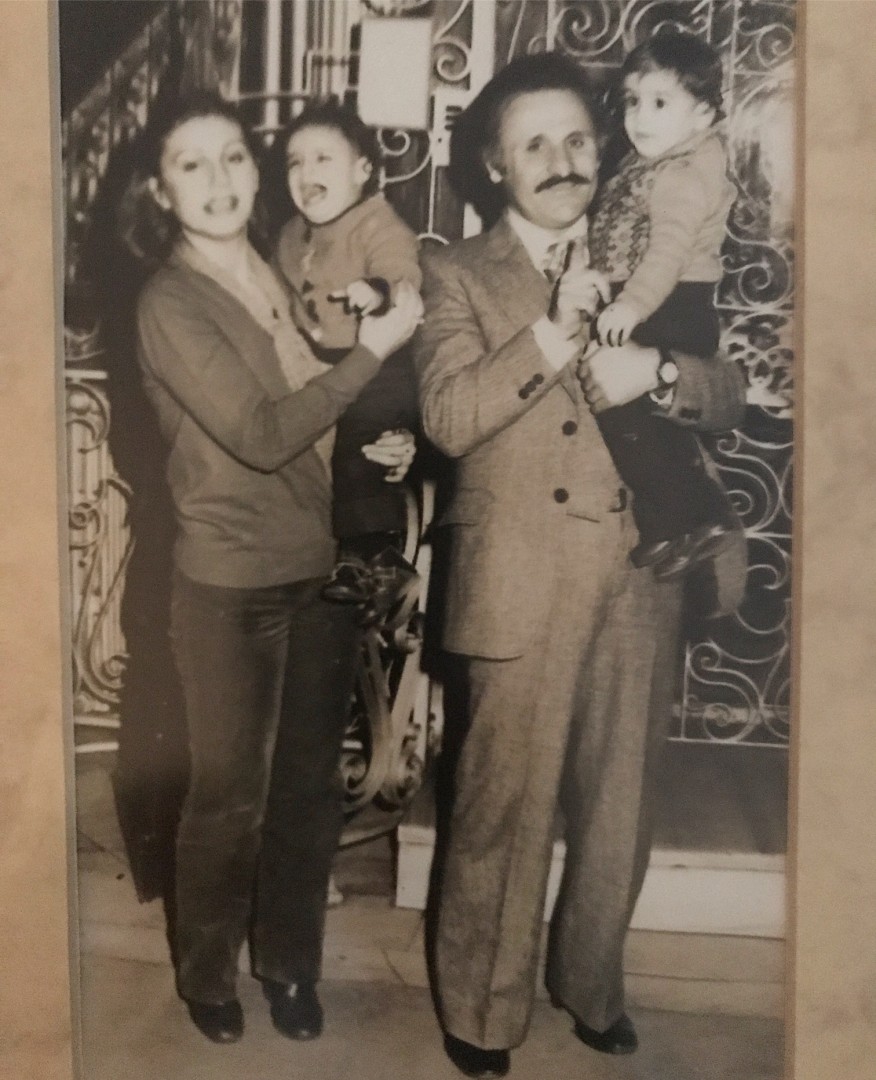
A photo of my grandfather, a Korean War veteran, with my mother and my twin brother, Baran. I’m in my grandfather’s arms. Unfortunately, we lost him to a heart attack at the age of 49. May he Rest in Peace!
During my recruitment, I had no problems with my fellow soldiers. They were all short-term university graduates, so they had a certain level of education. The same conversations everyone who joins the military had been going on in our community.
For example, there’s the classic dawn conversation. Everyone asks each other, “What time is dawn?” This is a military custom that indicates how many days remain until the end of their military service. Every 24 hours that expires, a day is subtracted from dawn. It’s also important that the number of days remaining corresponds to the license plate number of their hometown. For example, if you’re from Trabzon, there’s a special celebration on the day dawn reaches 61 (61 days before the end of your military service).
The issue of fellow countrymen in the hometown
This issue of fellow countrymen constantly arose in the military. Everyone I met would ask me, “Where are you from?” By engaging in these conversations, I finally found the perfect answer. I would ask the friend who asked this question, “Where are you from?” My father’s side is from Gaziantep, my mother’s side is from Trabzon, and because I was born and raised in Istanbul, almost everyone there was from my hometown.
In my brigade, 60% of the people I met were from the East, 20% from the Black Sea region, 10% from the Aegean and Marmara regions, and 10% from Central Anatolia and the Mediterranean region. So, for example, if someone asked me from Şanlıurfa, I’d say, “My father is from Gaziantep too.” A conversation immediately ensued, “Oh, we’re from our hometowns.” If the person asking this question was from Samsun, I’d say, “My mother is from Trabzon,” and the same conversation would follow. If they were from Istanbul or the Marmara region, I’d say I was born and raised in Istanbul. So, 90% of the people in the military were from my hometown. Sometimes, I’d get hung up on them. For example, one day, I told a friend from Bingöl, “My father is from Gaziantep,” and he said, “If you don’t talk like a local, Babo, you talk differently.” I told him I was born and raised in Istanbul.
Joking aside, I don’t believe in micro-nationalism. In my opinion, every place has good people and bad people. So, while I never enjoyed this civic-minded chatter, I enjoyed it in my own way. I’ve given many people opportunities, but throughout my life, I’ve never compromised on merit. A good person gets the job done. I don’t care where they come from, what their appearance is, or what their beliefs are. If they do their job well, are honest, and have good morals, I always want to work with that person. It’s that simple.
Raise and shine barracks!
Another thing that bothered me during my training was how we were woken up in the ward. I’m an early riser anyway. So, waking up at 6 a.m. wasn’t a big deal for me. Just as I was lifting them, two soldiers burst into the barracks and, as they roamed between the bunks at the top of their lungs, shouting, “barracks, get up, get up, get up, get up…” (Imagine the word “kak,” meaning “get up,” 20 times in a row, like a machine gun.)
You’d think, “War’s broken out, and they’re dropping bombs on us.” After two days of patience, I asked the guys who were doing it why they were lifting like this. When they replied, “It’s the norm,” I said, “Everyone here is a university graduate. Lift like a human being. Believe me, everyone will get up faster.” When other friends chimed in, the guys who did it started lifting more civilly in the following days. I usually got up without them waking me up anyway.
This kind of unnecessary harshness and rudeness was everywhere in the military. The best thing about the military for me was getting to know my countrymen. I’d heard it countless times before. I met many people who learned everything in the military, who hadn’t gone to school or had only been there for a short time. The legends I was told were true, and I was truly astonished.
Give me a cheese toast, man!
Especially over the long periods of time, I met many people who were illiterate, couldn’t speak Turkish (I’m not talking about speaking with an accent, I really couldn’t speak Turkish), didn’t know how to handle a knife and fork, had no sense of etiquette, and were prone to violence.
Some truly didn’t understand politeness, requests, or being treated like a human being. They’d been hit over their heads all their lives. You might be wondering how I managed to deal with such inexperienced individuals for so long. Let me answer right away. We had a canteen and common areas. I remember the first time I asked the canteen worker, “Can I have a cheese toast?” The man didn’t look at me. I repeated it. He still didn’t. Someone came up behind me and said, “Give me a cheese toast, man!” The boy responded immediately, saying, “Okay, man, I’ll toss it to you now.”
After seeing this, I said to myself, “Serhan, you need to stop being so polite, or you’ll starve.” Then I forced myself to be rude: “Give me a cheese toast,” I said. The canteen boy glanced at me but still didn’t respond. I thought to myself, “Oh, come on, I missed it again, you need to be more forceful and blunter.” Then I called out a third time, “Give me a cheese sandwich.” Thank God, the third time, he didn’t need any “dudes,” he said, “Okay, I’ll give it to you,” and handed me my toast. I was trying to get used to this environment. At the same time, I was thinking about how painful it was that I was trying to fit in when it should have been the exact opposite.
Soldiers getting fired up…
The canteen and its surroundings were especially interesting. It was a place where many intimate matters were discussed, and warm conversations took place. One day, I went to the canteen to buy something. Then something very odd caught my eye. I witnessed the soldiers in the front row of the theater-style seating group, leaning parallel to the floor, watching the television program, and exclaiming, “Ugh, look at these guys’ stuff, honey!” When I looked at the television screen, I couldn’t believe my eyes. On a morning program, my twin brother Baran’s then-dating model girlfriend, a popular presenter, was on the show, chatting. Both women were wearing miniskirts. That’s when I realized why the three soldiers in the front row were leaning parallel to the floor, staring at the television. It was a classic teenage conversation; they were trying to peek up the women’s skirts. They didn’t realize that because it was a television screen, the angle wouldn’t change, meaning they wouldn’t be able to see more of the view by leaning forward. And the things they were saying were outrageous. Out of respect for all women, I called out, “Pipe down, guys, pull yourself together.” The soldiers gathered.
Mess Hall Situation
Besides the canteen, the mess hall was a world apart. Before every meal, there was a meal prayer. Two soldiers, a drill sergeant, an NCO, and occasionally the relevant officer would wait at the head of the mess hall. The soldiers would line up and recite the meal prayer together.
– Praise be to God,
– May our nation live long,
– (Then one of the soldiers would shout at the top of his lungs: Attention!)
– Bon Appetit!
Everyone would shout “Thank you” in unison and be escorted to the mess hall. “Thank you,” he would then bellow, “Sağol.”
The food in the mess hall wasn’t bad. They often served ‘black lightning.’ ‘Black lightning’ is the military jargon for lentils. It didn’t pose any problems for us. Incidentally, let me clarify the military legend of alum. I can say with certainty that there was no alum in the meals.
Toilets in the Army
One day, the brigade commander visited our mess hall. He ate with us. A special table had been set up for our brigade commander. They selected five soldiers to sit at the same table with him. I was one of them. I sat directly across from the brigade commander. He had a pleasant conversation with us. Towards the end of the meal, he asked, “Any questions?” I raised my hand.
“There are Turkish-style toilets everywhere. Could we convert at least a few of them to Western-style toilets?” He asked, and everyone at the table, including our brigade commander, started laughing. When the laughter subsided, the brigade commander in our brigade explained to me that maintaining the hygiene of Western-style toilets wasn’t easy, which is why Turkish-style toilets were used. I said, “Commander, you have them installed and we’ll ensure they’re kept clean.” He then told the ADC next to him, “Take note of that.”
The commander was right. Indeed, there were many soldiers who didn’t know how to use a toilet. To illustrate the gravity of the situation, let me give you an example: some of the squat toilets were filled with stones. There were problems, especially in the toilets we used with long-term soldiers. One day, during a conversation, I asked why this was so. One of our friends replied:
“Some soldiers use stones instead of toilet paper”
When I first heard this, I thought our friend was joking. When I realized he was serious, I was shocked again, and I thought, “Wait, let’s see what else we’re going to see.”
Of course, I must emphasize this: Soldiers shouldn’t be bothered by toilets or harsh conditions. They are obligated to fulfill their duties regardless of the circumstances. Sometimes, they serve in the mountains for months under the most difficult conditions. However, in my position, I believed I could contribute with my brains, rather than my physical strength (and I was in excellent physical condition at the time). That’s why I was always at the computer in the military. Therefore, I didn’t see any problem in raising issues like toilets.
The educated incompetent
Sometimes, the fact that some soldiers had graduated from university and were well-educated surprised me. Those who weren’t involved in sports were having serious difficulties during training. There were also those who couldn’t coordinate their hands and feet, so they constantly disrupted their gait. Because of them, we had to repeat even a simple group march over and over. I remember one time a drill sergeant yelled at the guys who were experiencing this problem, “What kind of university graduate are you? You can’t even control your hands and feet!”
Two incidents during my recruitment
Amidst all these muster rounds (or census) and training, I also had some unintentional incidents. I managed to hide my identity for the first two weeks. I didn’t want to be drafted into the military under any circumstances. I always acted accordingly. But one day, a soldier approached me and asked, “Are you Serhan Süzer?” I said, “Yes, I am.” He said, “They’re calling you from the intelligence branch.” I asked, “What’s the matter? What for?” The soldier replied, “I don’t know. Our commander in intelligence is calling you. You’d better go now.” After walking a long distance from one end of the bootcamp brigade where I was recruiting to the other, where the command floor was, I arrived at the relevant commander in intelligence. He asked me questions about my identity. Finally, he asked, “Why didn’t you tell us who you were?” I told him my exact thoughts: “I want to complete my term of regular military service. I didn’t feel the need to tell you who I was,” I said. After talking for nearly an hour, I excused myself and left. I ran to the training grounds because I was late. When I arrived, a voice echoed throughout the area: “Where the hell is Serhan Süzer? Find him quickly and bring him here.” I was late for the assembly. Everyone was asking for me. As I ran to the training grounds, I immediately shouted back at the officer who had called out this, one of the highest-ranking soldiers conducting the training: “I’m here, commander!”
- Why are you late?
- They had called me from the intelligence branch, and the meeting took a long time.
- Intelligence and intelligence are none of my business. You will not be late for the assembly. If you are, you will be punished. Get me some push-ups!
After a moment of surprise, I did as he said and started doing push-ups, whereupon he shouted again: “Count!” I continued counting: “…. 4, 5, 6, …10, …. 20, …. 50.”
When I reached 50, I looked up. “Is that enough?” I asked. He looked at me with such annoyance, and shouted again, “Go!”
I continued: “51, 52, 53 … 60, … 70.”
When I reached 70, he shouted again: “Okay, enough! Get up! Get back in your seat!”
I stood up. Embarrassed, I walked back to my friends. The commander who had given this punishment turned away and started yelling at someone else. At that moment, the friends around me started whispering things to me in hushed tones, like, “Son, what are you? Can you do 70 push-ups? We’ve got Rambo amongst us and we didn’t even know it. He doesn’t look like he has any personality.” After that, my nervousness melted away. He started laughing, and I responded. “I’d go all the way to 100 if I had to,” I said.
Truly, my final years of university and the next few years were the period when I was at my physical best. I worked out hard and could lift serious weights for my size. I experienced a similar situation with a physically large friend of ours. Before the training, everyone was doing pull-ups, showing off their strength. They were lifting and lowering the soldiers around them. To provoke him, I said, “You can lift others, but the real challenge is lifting your own body weight. Can you do that?” I demonstrated the move I’d practiced and developed in high school, where you lift your own body up on the pole and stay parallel to the ground. Everyone was saying, “Wow, look at that move!” The big guy tried it too, but he couldn’t lift himself up. I teased him, “So, you’re not that strong after all,” and they asked, “Can you do that again?” I said, “Sure,” and repeated it. Just then, another shout erupted behind me: “Son, what are you doing up there? Are you a showman? Get down quick! Don’t disrupt the training routine!”
The other officer teaching had arrived. After I put my feet on the ground, he said, “Come on, showman, you’re carrying the flag today. Let’s see how you perform running with the flag.”
That day, we trained hard. We were all singing the “Yaylalar” (Highlands) march, which we sang almost every day and had become engrained in our minds. I, too, was drenched in sweat running with the flag.
Yaylalar Yaylalar!
This Yaylalar march, which I loved so much, became so ingrained in our minds that I experienced a strange event later in life: I lived in Nişantaşı for nearly 10 years and sadly moved out two months ago. My residence was right in the center of Nişantaşı. One day, while I was sleeping at 5 a.m., three friends, drunk on alcohol, were singing “Yaylalar Yaylalar” at the top of their lungs in a club called Scotch. Their voices echoed through my house. As I was sleeping, I suddenly thought, “What’s going on? Am I in the military?” “You should see it,” I said, jumping out of bed. Then I pulled the curtain aside and looked. When I saw those friends, I both laughed at my situation and grumbled a little.
The Jealousy of Those Who Stayed Short-Term
We were nearing the end of our one-month recruitment period. I’d often heard the talk of “who’ll be leaving first, who’ll be leaving later, what day is dawn?” in the military. In fact, I could tell there was a general tension between long-term soldiers and short-term soldiers. One day in the canteen, I overheard a long-term soldier talking about a short-term soldier and saying, “This one entered four months after me, and left six months ago” (in our day, long-term was 18 months). They were annoyed by short-term soldiers. And rightfully so. We experienced the same mentality when paid soldiers arrived. Our short-term soldiers started saying, “Oh, Mehmet Bey, here they are.” Within the military, they call long-term soldiers Mehmetçik, short-term soldiers Mehmet, and those who completed paid military service Mehmet Bey. After this sarcastic remark about Mehmet Bey, another friend said, “Son, are they going to complete their military service in three days? We still have seven months left.” Another added half-jokingly: “Should we take them in, beat them, and then send them off like that?” On the other hand, when I looked at those doing paid military service, I saw a curious sight. They were exaggerating amongst themselves about what they did in the name of military service. They were saying things like:
“Did you see how I saluted the commander?”
“You’ve become a soldier like a jackknife.” “Are they going to give us infantry rifles before we go?”
I remember thinking to myself when I heard these comments, “How is this even possible? It would have been better if these guys hadn’t joined the military. What a waste of resources.”
As you can see, everyone’s situation varies depending on their position.
Oath-taking Ceremony
At the end of all the training, the oath-taking ceremony arrived. The largest group of family members would be visiting me. All the soldiers were very excited. Those who know know that although Denizli is in the Aegean Sea region, it has a continental climate because it’s located inland. So, it’s hot in the summer and cold in the winter. On the day of the oath-taking ceremony, we witnessed the first snowfall of that winter. We were brought to the ceremony site two hours before the oath-taking ceremony, and by then, the final preparations had been completed. The ceremony began, and I saw my men out of the corner of my eye. I was feeling happy. First, we recited the oath of service loudly at the weapons station. Then we marched.
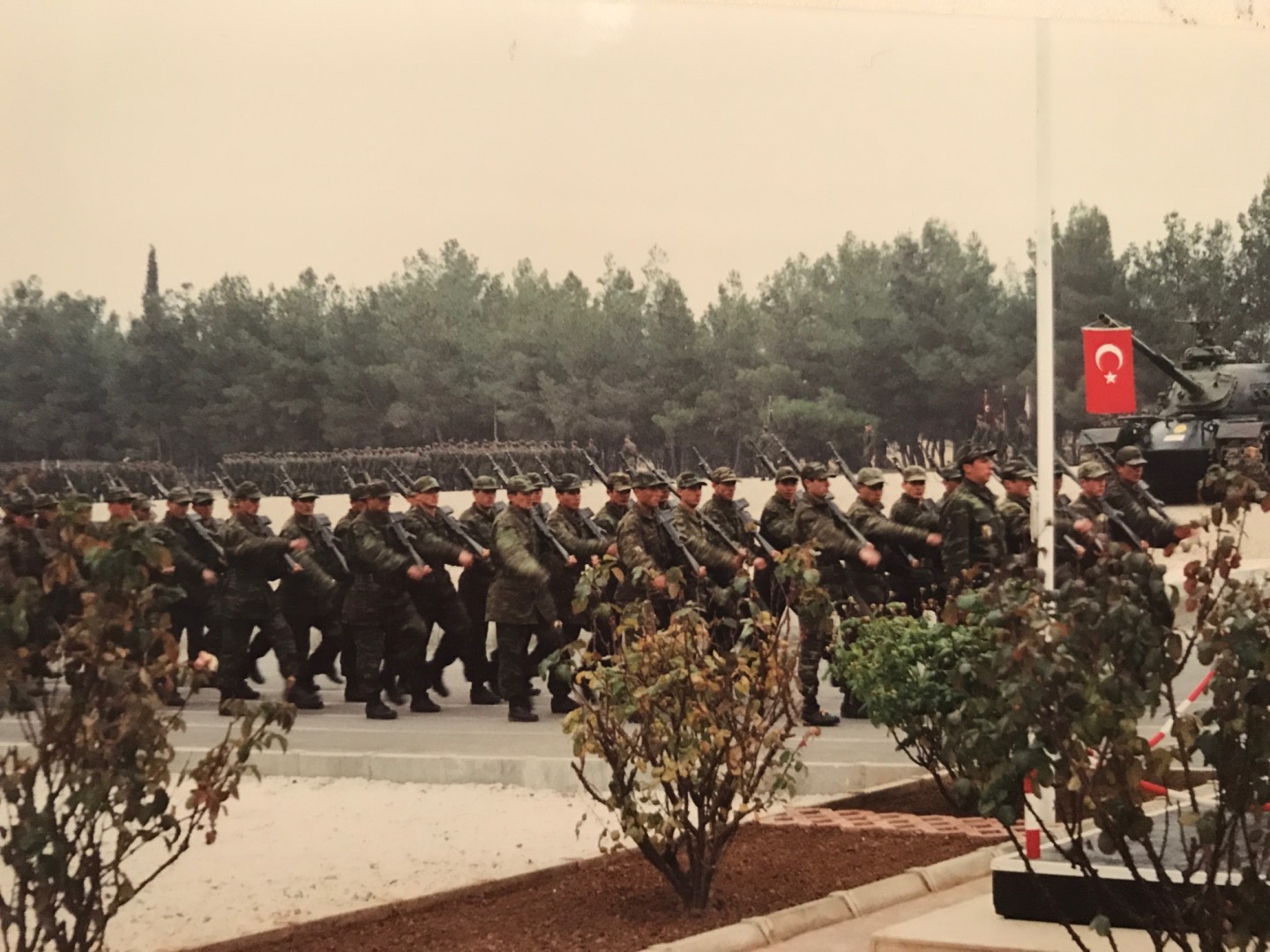
Walking through the ceremony area. I’ll give a special reward to whoever finds me in this picture 🙂
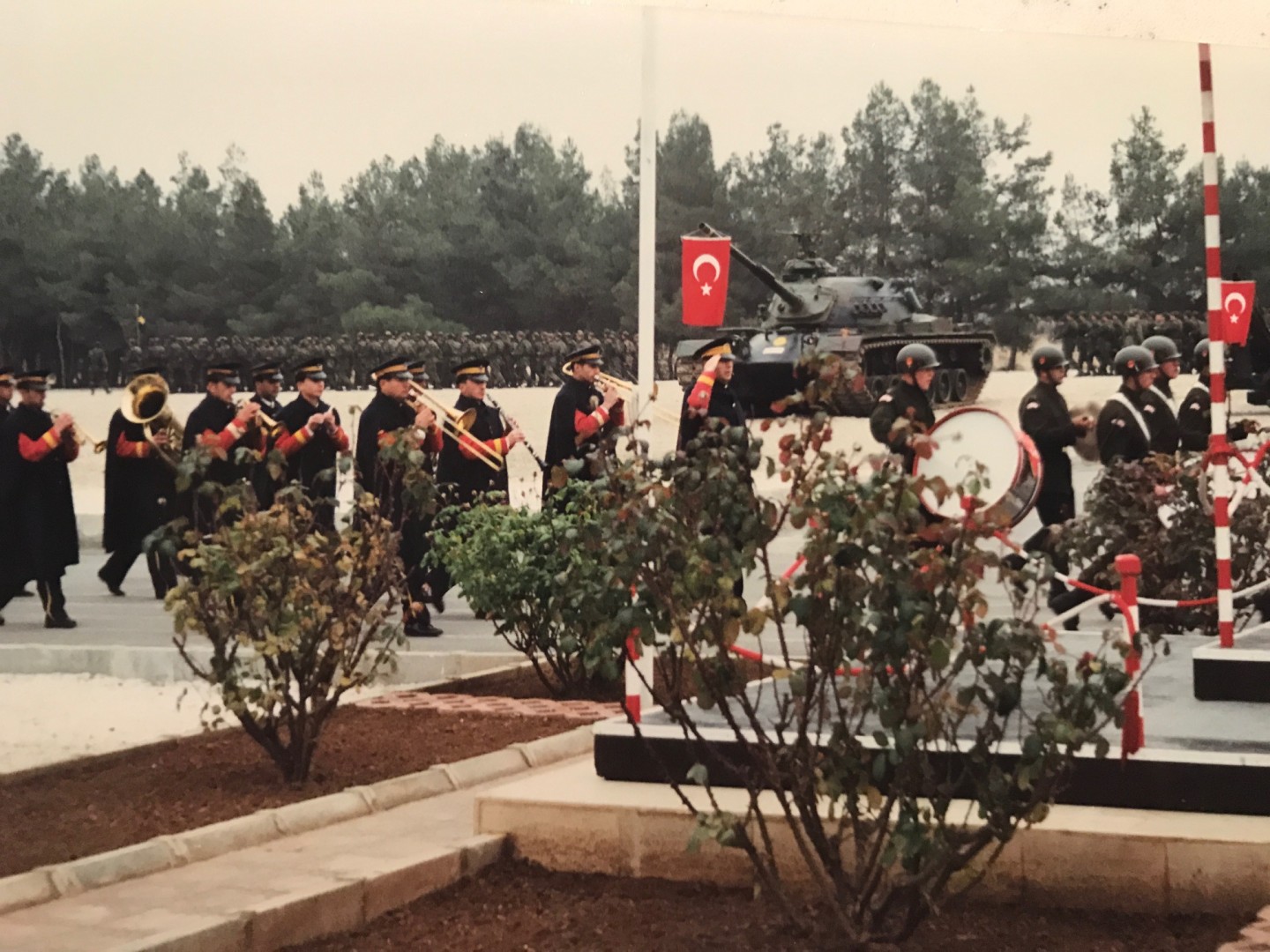
Another scene from the ceremony
As we walked to the ceremony, I kept a close eye on my family. My father’s driver, Turan Abi (may God have mercy on him; we lost him a few years ago. May he Rest in Peace), was searching for me amongst thousands of soldiers. I was laughing to myself, thinking, “How will he find me among all these soldiers in green?” As I passed them (and luckily, I was walking on their side), Turan Abi noticed me. He turned to my family and called out, “Here, there!” My friends were pointing me out to each other, saying, “There, there,” and cheering amongst themselves. As I passed them, I smiled and winked at them discreetly. This ceremony, where thousands of people officially entered the military, lasted a total of four and a half hours. It was snowing outside, but as someone who loves cold weather anyway and was so happy to see my family, it didn’t matter. I felt a chill when I went inside after the ceremony. Later, all the soldiers were reunited with their families. My grandfather, grandmother, mother, father, sister Nazlı, and other relatives were there. I immediately went over to them as we reunited with one another.
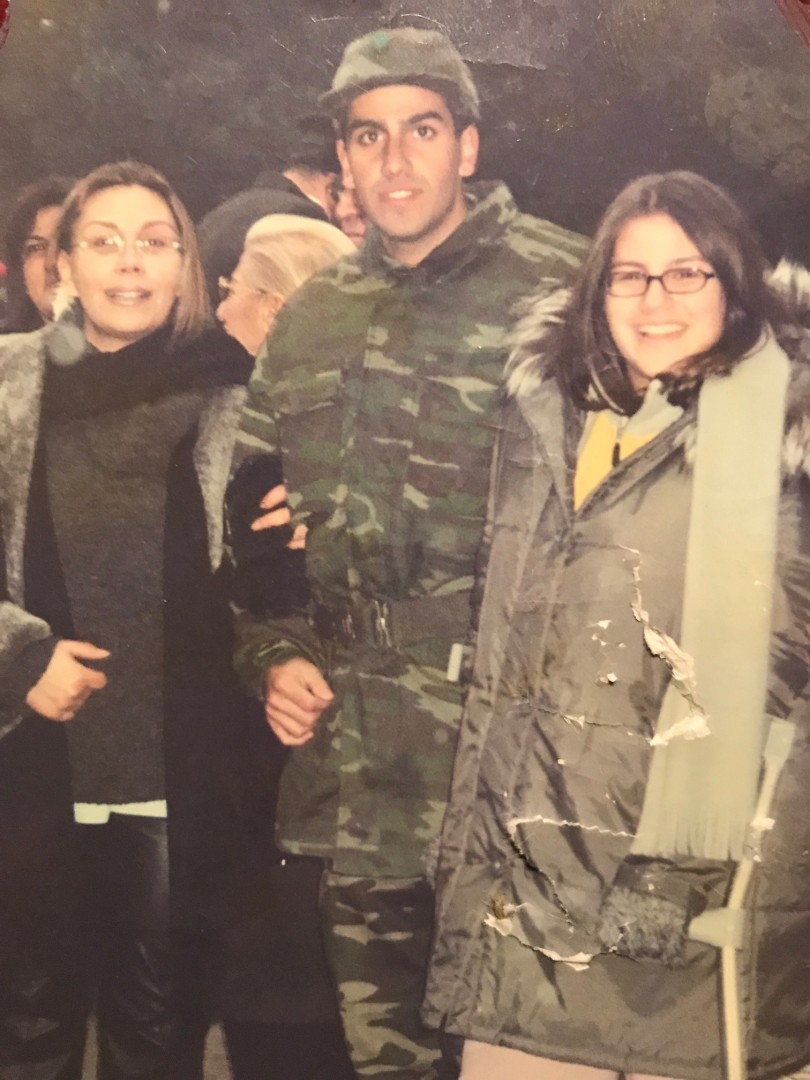
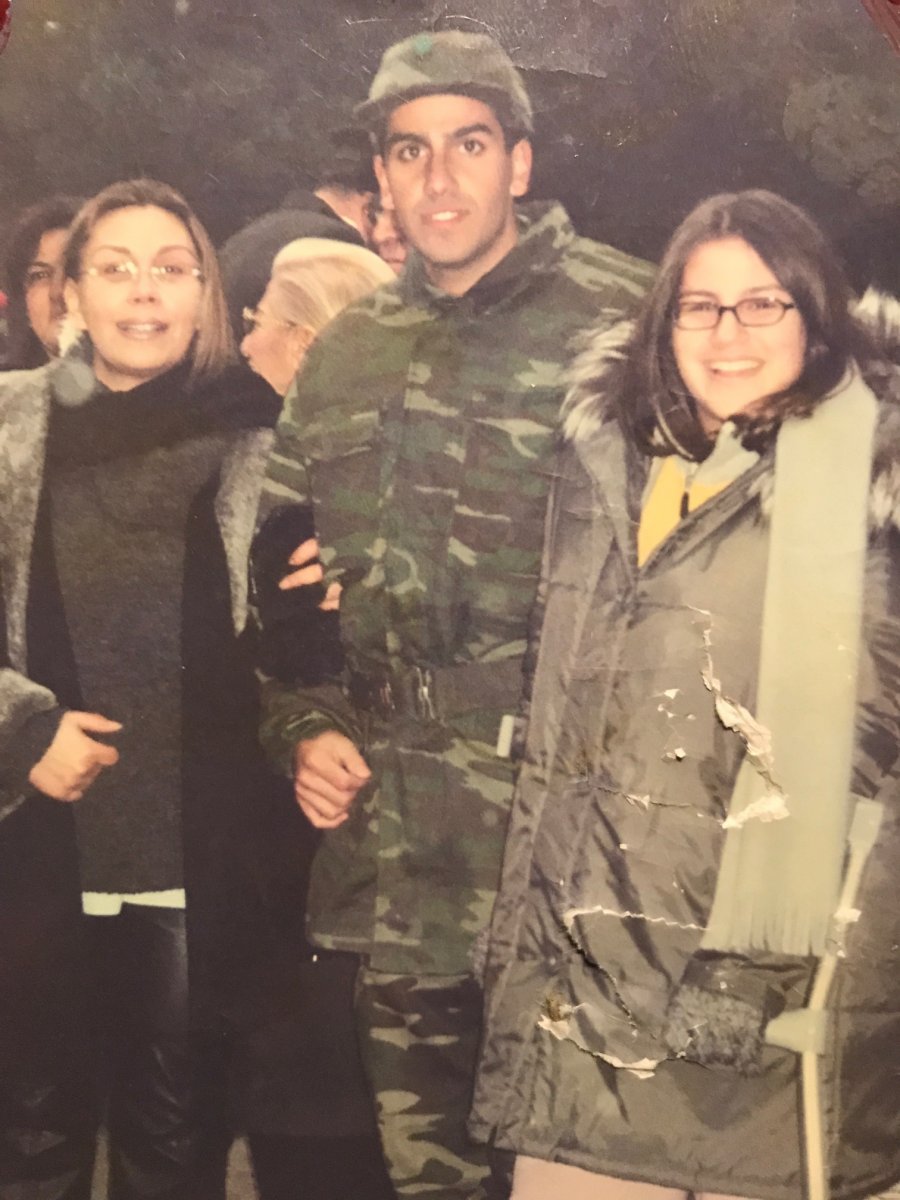
The picture we took with my mother and sister at the ceremony area
After this ceremony, I took my 20-day leave, went out, and met with my family. That same evening, we had a nice dinner and returned to Istanbul together.
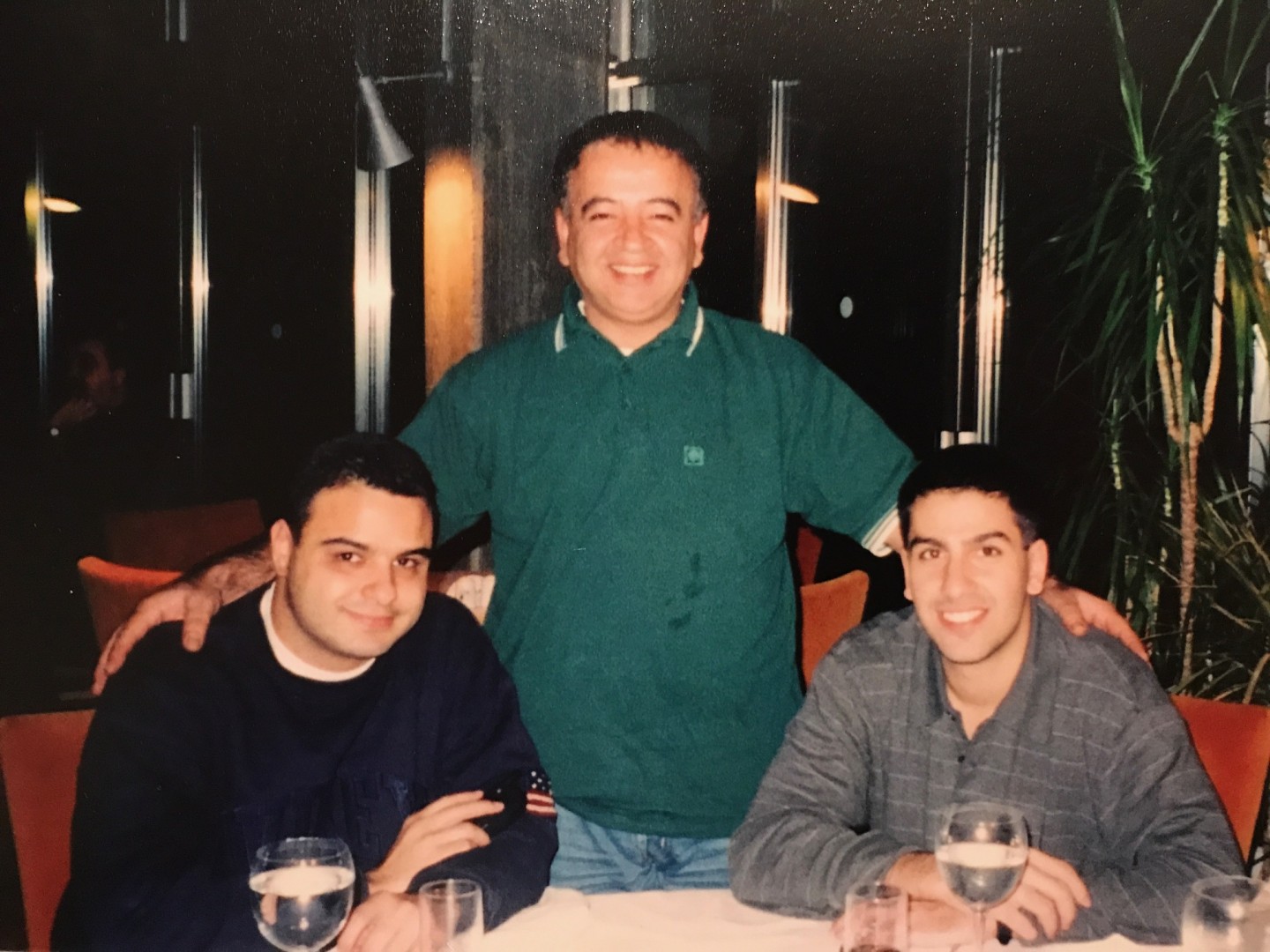
From left to right: my military buddy Eyüp, Turan Abi, and me. Having dinner together on our first evening in Denizli.
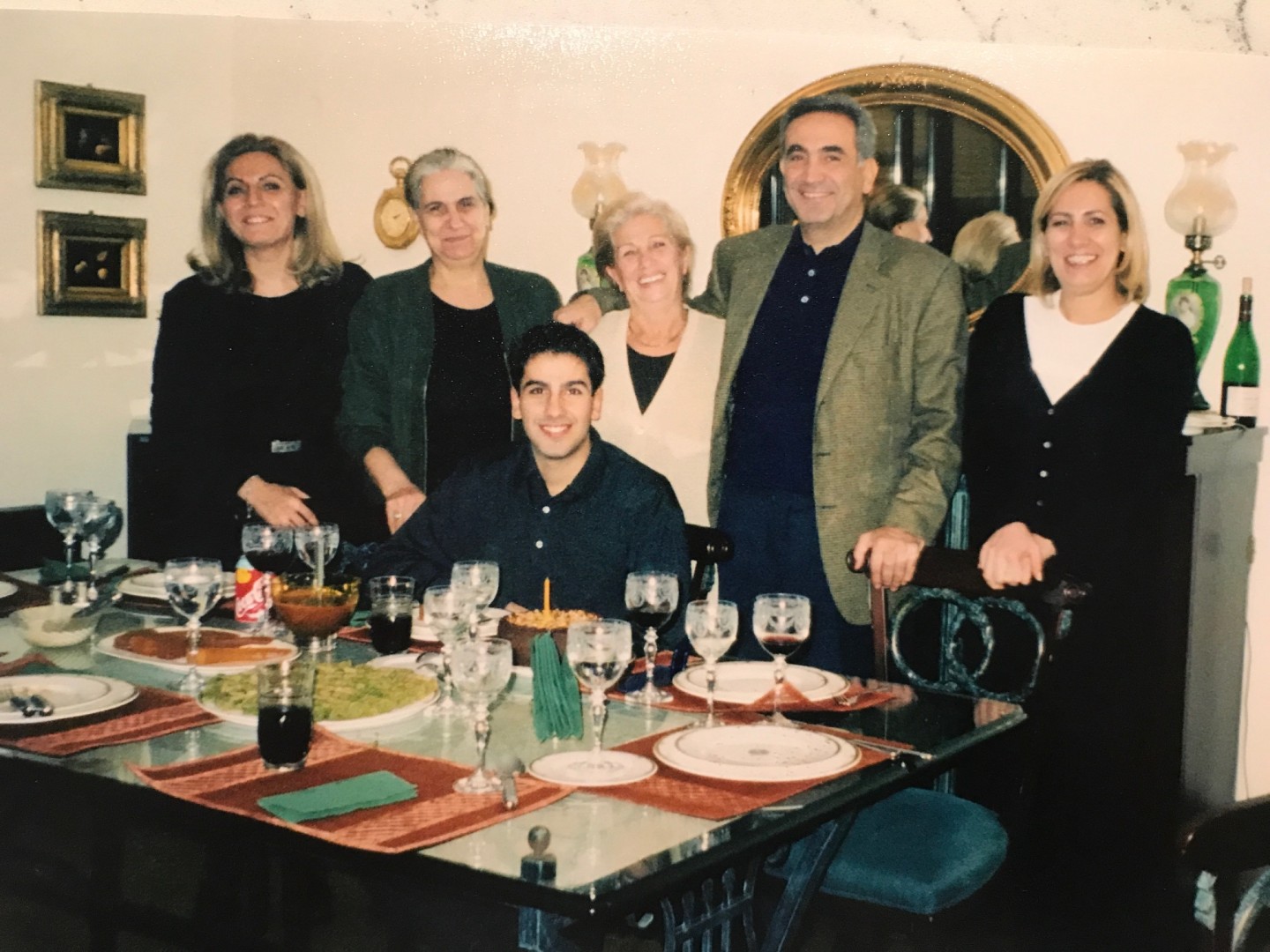
A photo taken at dinner with my family on my first evening back in Istanbul. Standing from left to right: Aunt Gülten, Aunt Cemile (my grandmother’s sister), my grandmother, my father, and my Aunt Cennet.
I had completed a significant milestone in my military service, but I still had another seven months to complete. In my next post, I’ll write about the rest of my ‘specialist’ period in the military.
Stay well.
Tags: memoir