
At a conference in the United States, I met Murat Mercan, who had become a deputy minister after holding various bureaucratic positions in the government. At that time, the burgeoning topic of solar energy came up. During the speech, Murat Mercan emphasized the importance of obtaining a “non-agricultural permit” and the need to keep solar energy away from agricultural lands. Essentially, Murat Mercan was echoing the rhetoric that everyone working in the sector was saying in unison at the time: Keep solar energy away from agricultural lands.
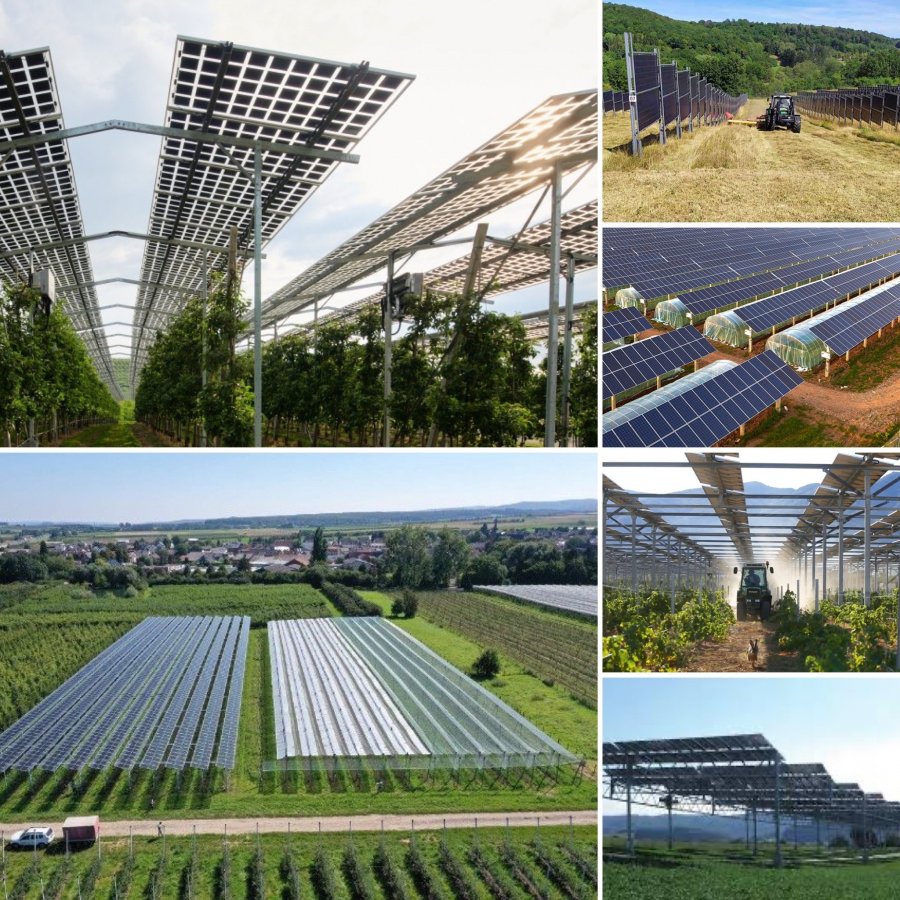
While these conversations were taking place, as someone who had dedicated considerable effort to the sector and was ready to contribute, I must admit, I was a little disheartened. I didn’t like how solar energy was being treated as such a “non-sequitur.” Then, a picture suddenly appeared in my mind. In that picture, I saw solar panels placed on a raised structure, with agriculture being carried out underneath.
Our Conversation with the Deputy Minister
As soon as I visualized this image, I began talking to Mr. Murat, and the following dialogue ensued:
– Theoretically, solar energy and agriculture could be combined.
– How could this be possible? After all, both agriculture and solar energy derive their source from the sun. Since both have the same source, you can place the solar energy system elevated and continue to cultivate underneath. The angle at which you place the solar power system and how much sunlight reaches the soil are important.
That’s an interesting idea. Is there any research on this?
I just described a concept I’ve come up with that I think is theoretically possible. Of course, it needs to be tested.
That’s a very interesting guy. (Turning to the other bureaucrats next to him) Talk to this guy and take notes on his ideas. We might need to revisit our procedures in the future.
After this conversation, I explained my concept to the people he instructed, but of course, who would do it? Such R&D needed funding, and frankly, we didn’t have the time or the additional funding to undertake such R&D in addition to the many other projects we were already doing.
The article that confirmed my prediction
A few years after this conversation, I read an article written by the Fraunhopfer Institute, which described the combination of agriculture and solar energy and the results of a 100 kW AgriPV test. I couldn’t find the article again later, but the summary was as follows:
- Overhead PV, meaning a solar power plant built on a raised structure, had PV panels arranged at a certain angle and at certain intervals.
- In this study, different agricultural crops were tested. They divided them into three categories: sun-loving, moderately sun-loving, and sun-intolerant.
- It was determined that the productivity of the moderately sun-loving and sun-intolerant agricultural crops of these three categories increased with the AgriPV model.
- It stated that this 100 kW plant could be expanded modularly, reaching the desired scale, and covering large agricultural lands with such solar power plants, demonstrating great potential. When I browse the Fraunhofer ISE Institute’s website these days, I come across a link like this. Let’s explore the history and statistics of AgriPV: https://www.ise.fraunhofer.de/en/key-topics/integrated-photovoltaics/agrivoltaics.html
Two facts about Agrivoltaics:
– Approximate global installed capacity: 14 GWp
– Approximate technical potential in Germany: 1,700 GWp
Finally, Baywa, one of Germany’s largest agricultural companies, is also in a very good position in solar energy. While I’m looking at Fraunhofer, I wanted to take a look at Baywa’s writings on AgriPV, a leading company in both agriculture and solar energy. They’ve shared important information on this topic, which is in line with this introductory article. I’ll share these again for clarity (with some additions of my own):
Both agriculture and clean energy
With AgriPV, your land fulfills two important roles simultaneously: First, preserve its original agricultural purpose, and second, produce clean energy. However, because farming is so complex, you’ll need an AgriPV solution tailored to your specific site.
Let’s share the two main AgriPV applications currently receiving the most focus:
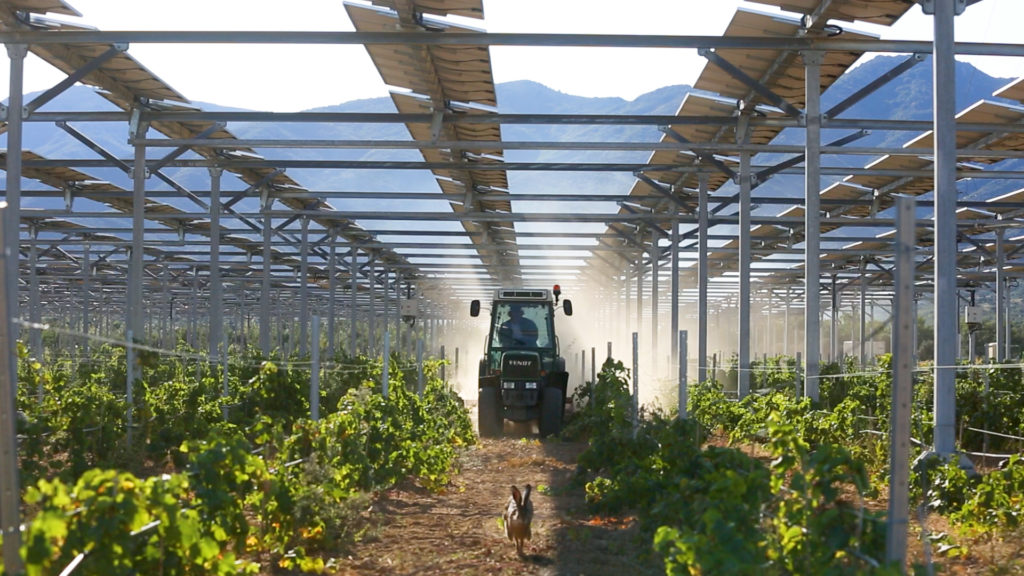
1) Overhead PV (Tepegöz PV): Agricultural crops are grown under elevated solar modules. Overhead PV utilizes elevated solar panels mounted above growing crops, such as fruits. It generates solar energy while also providing shade and protecting your crops from extreme weather conditions.
Solar panels are placed high enough to allow uninterrupted agricultural activities. Growing wires and irrigation systems can be easily and securely integrated into the module system’s infrastructure.
Even the transparency of the modules can be tailored to allow the ideal amount of light to pass through for each crop. The cooling effect of plant growth results in better energy efficiency, as solar panels produce their highest output when incoming solar radiation is at its maximum and the ambient temperature is as low as possible. Far from being an obstacle, overhead PV can bring new efficiencies to your daily operations.
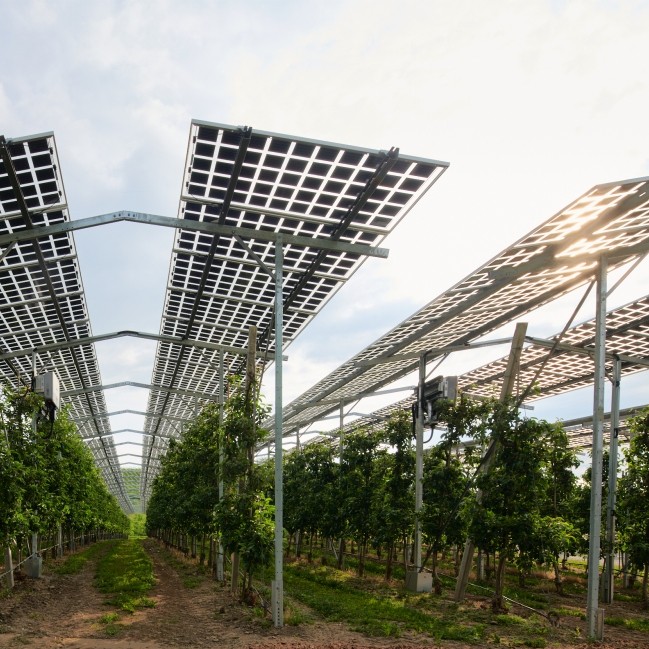
Overhead PV can completely cover crops. The panels must have a certain degree of transparency to allow sunlight to reach the ground. Another method is to install the solar panels at a certain angle to the field, allowing sunlight to reach the ground through the gaps.
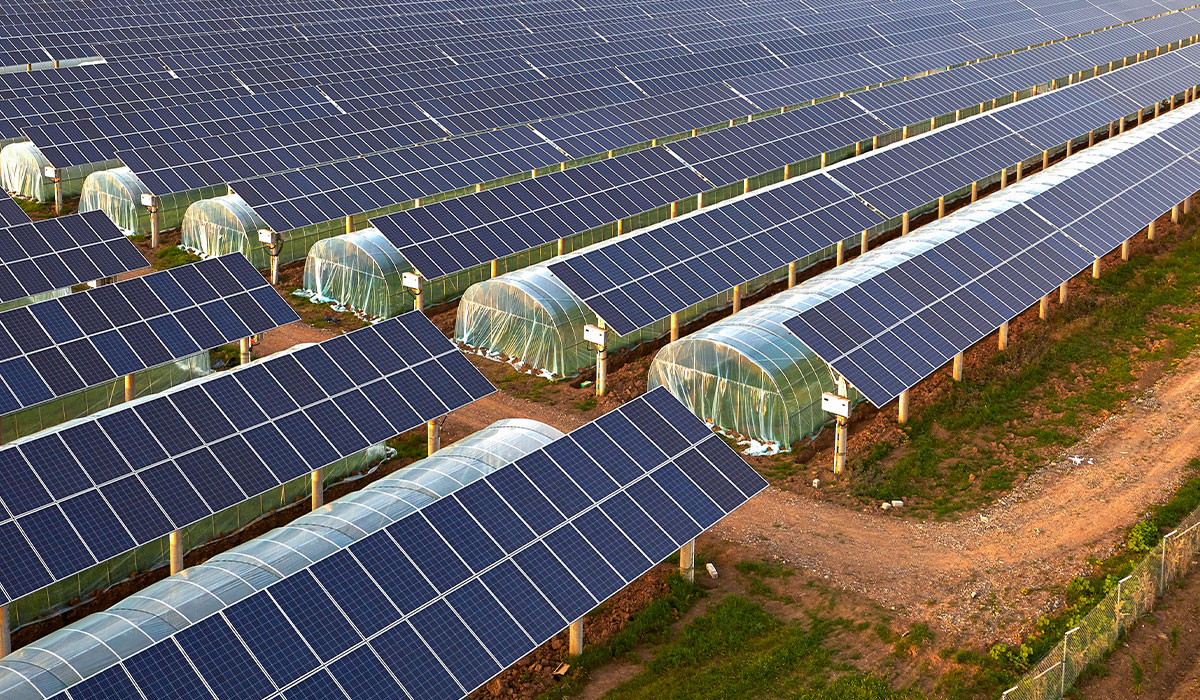
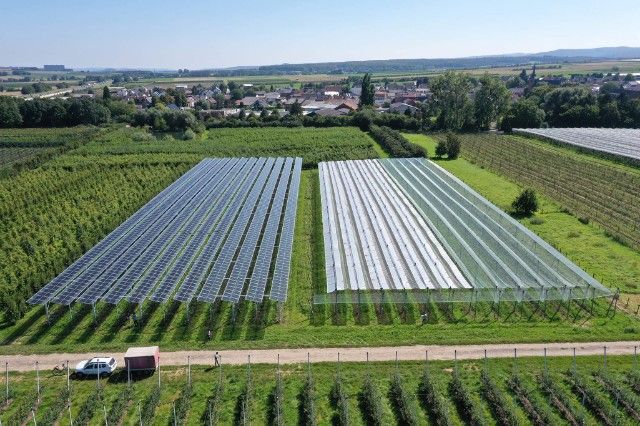
Finally, overhead PV can be used not only for traditional agriculture but also for greenhouse farming. In other words, greenhouse farming can be done using a covered methodology, with solar panels placed on a raised structure above the greenhouse. Consequently, we can integrate different agricultural and solar energy technologies.
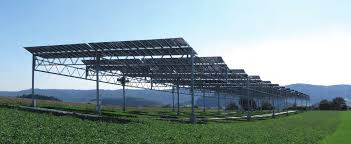
2) Interspace PV: Crops grow between widely spaced rows of modules at ground level, creating space for machinery to pass.
With global food demand expected to increase by 50% by 2050, one-third of agricultural land is at risk of degradation. Preserving fertile soil and healthy farmland for future generations has never been more important. Interspace PV is a crucial tool to help you address this ecological challenge.
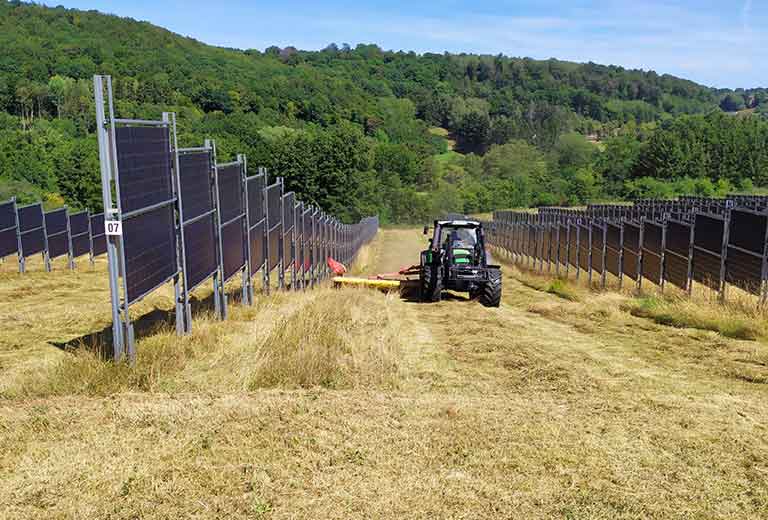
Interspace PV grows crops such as wheat and legumes between rows of modules at ground level, providing sufficient space for field machinery to pass. The Interspace PV tracking system, featuring high-performance, bifacial modules mounted on a single axis, tracks the sun from morning to evening for maximum solar efficiency throughout the day. The Interspace PV fixed-slope system design offers an ideal slope based on your country’s latitude and is the most suitable option if your field is oriented east-west. A tracking system is also preferred when the agricultural area is particularly hilly or sloping.
We can also see some models combining Interspace PV and Overhead PV. This means that solar panels can be spaced a certain distance apart, and the solar power system can be placed above the sides.
Benefits of AgriPV
1) Crop Protection: Severe or extreme weather events such as hail, storms, drought, heavy rainfall, and heat waves are becoming increasingly common. The rows of solar panels in AgriPV systems provide protection for your crops. Furthermore, the panel transparency is adapted to suit each crop and create the best possible growth conditions. This is especially beneficial for plants that cannot tolerate direct sunlight.
2) Long-term Climate Resilience: Climate change is leading to the increased use of various systems in agriculture that protect valuable crops from hail, rain, or excessive sun. These systems typically require complete replacement every five to seven years. For example, after high winds, foils and netting need to be resecured or repaired.
This can be an expensive and time-consuming task for farmers. AgriPV partially replaces short-lived materials and offers the same benefits with a longer service life. This is especially true when combined with traditional hail or rain protection systems between module rows.
3) Reduced leaf wetness periods: Semi-closed AgriPV systems allow for planting with shorter leaf wetness periods and provide better ventilation for your crop rows. In fruit production, these systems have been shown to reduce pesticide use and, consequently, improve biodiversity in fields.
4) Efficient water consumption: With an agri-PV system, you can provide your crops with the exact amount of water they need. The moderate shade provided by the panels helps prevent evaporation from the soil and reduces transpiration from the plants. Water consumption in the agricultural sector can be very high, depending on the crops you grow. AgriPV systems offer significant added value by helping to conserve water in areas with low water availability or high sunlight.
5) Large land potential: As I mentioned earlier, if AgriPV is implemented correctly, it will be possible to utilize vast agricultural land for energy production. This will provide a significant advantage in the fight against climate change.
6) More economical than rooftop PV projects with small installed capacity: Because it is spread over the land, we can say that some fixed costs are reduced as a percentage of the total cost. Therefore, the investment is lower compared to rooftop projects with small installed capacity. This is a significant advantage in terms of feasibility.
Potential Challenges
Speaking of the benefits of AgriPV, let’s also address the challenges outlined by Fraunhofer ISE:
- Reliable estimations of agricultural yields
- Optimization of plant design according to type of agriculture
- Securing agricultural production as the main use for agricultural products when combined with animal husbandry
- Reliable estimations of agricultural yields
- Optimization of plant design according to type of agriculture
- Securing agricultural production as the main use for agricultural products when combined with animal husbandry
Exponentially Increasing Agrivoltaic Power
Following this briefing from Fraunhofer, let’s also look at the statistics they provided:
Agrivoltaic technology has developed very dynamically in recent years and is available in almost all regions of the world. Installed agrivoltaic power, which was approximately 5 MWp in 2012, has increased exponentially, reaching 2.9 MWp in 2018 and exceeding approximately 14 GWp in 2021. The national financing programs of some industrialized countries have been instrumental in this increase. For example: Japan (since 2013), China (approximately 2014), France (since 2017), the US (since 2018), and most recently, South Korea.
As a result, those in the solar energy sector will now need to develop their projects by carefully analyzing the globally accepted AgriPV model. We hope that all projects in the fight against climate change will accelerate and new models will be evaluated.
Tag: education