Right from the start, I felt that certain elements in the attention-grabbing and well-meaning videos didn’t fully align with the true purpose of the campaign. Fun has its limits…
The campaign was originally launched by a few international celebrities to raise awareness of ALS and to collect donations. It quickly became a global phenomenon, with millions of people from hundreds of countries filming and sharing their own videos.
I doubt even the original organizers could have foreseen how widespread this campaign would become. But because of its structure, its simplicity, and how easy it was to film and post a video—and with endless streams of new videos being shared across major social media platforms—it was inevitable that the campaign would reach the masses. This served yet another testament to the power of social media.
I believe the campaign has been successful in raising awareness for ALS, and I sincerely congratulate everyone who contributed with genuine intention.
However, there were two aspects that bothered me from the start. First, some people seemed to misunderstand the campaign, treating it merely as an excuse to film fun videos of themselves dumping ice water on their heads—losing sight of the actual goal, in my opinion.
Second, we were experiencing one of the driest years in human history—2014—and watching all that water being wasted disturbed me from the very first video I saw. While I don’t see water poured into soil as a serious issue, imagining millions of people each dumping a whole bucket of water did bother me.
So, I decided to act by creating a video that would reflect my thoughts. I shared the idea with people close to me, and after contacting the production company “4951,” we shot the video the following Saturday.
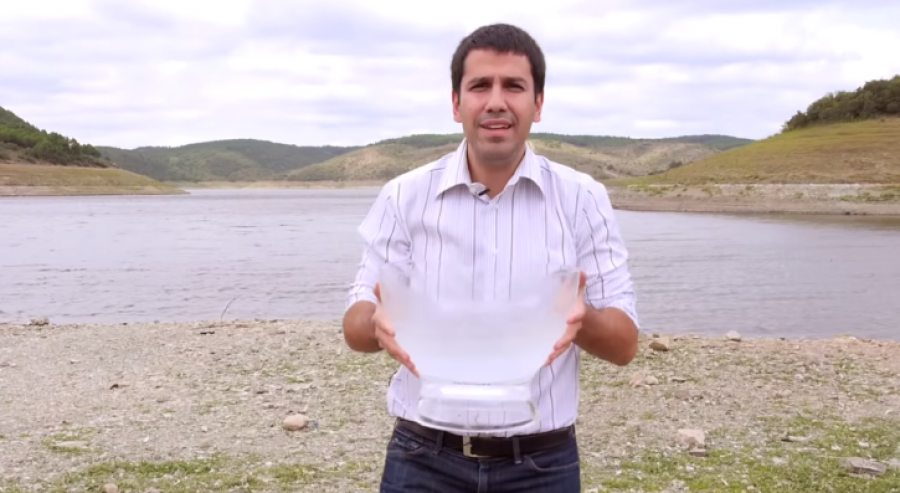
We began filming at the Alibeyköy Dam Lake. Unlike the videos filmed at the ALS/MND Association, I had pre-planned the script. We sourced the ice bucket and some additional ice from a tank at the Ritz-Carlton Hotel. Then, along with the 4951 team, we headed to the dam to start filming. I used the lines I had already prepared. I must admit, filming around the dam was challenging. It was an extremely windy day. Every time I tried to speak, a strong gust of wind would distort the mic levels. Constant interruptions like “Hold on, cut, let’s go back and start over” disrupted my focus. That’s why I’ve always been better at live broadcasts. When no one interferes, and I forget there’s a camera, everything flows smoothly. For instance, you can check out Artı 1 TV’s live broadcast of the “Green Economy” program hosted by Celal Toprak, whom I joined on 9 September 2014.
After wrapping up filming at the dam, we headed to the ALS/MND Association. We had arranged to meet with İsmail Gökçek, the president of the association—Turkey’s only official ALS organization—on Saturday afternoon. My main goal was to create a video that would provide real support to ALS patients and reflect that mission. But I also had some lingering questions. I found answers to those once we arrived at the association, and the storyline naturally came together.
It was a pleasure meeting Mr. İsmail and his wife. First, we had a conversation where I asked how we could be of help. He told me that since the start of the campaign, they had raised 840,000 TL in donations, but that wasn’t enough. Their goal was to raise 15 million TL to open seven clinics in seven cities. They wanted to start with one in Istanbul and then expand to other regions. I told them I would personally donate 10,000 TL and do everything I could to support the campaign through our filming.
Once I understood the need, I called in the production crew. I explained that our aim with the video was to steer the campaign toward opening seven clinics in seven cities —and stated that clearly at the start of the video. From that point, everything unfolded naturally, and we captured some lovely candid moments while chatting with Mr. İsmail.
For those unfamiliar, here’s a brief explanation of what ALS is (quoted from Wikipedia):
“Amyotrophic Lateral Sclerosis (ALS) is a disease resulting from the loss of motor neurons in the central nervous system, specifically in the spinal cord and brainstem.
The loss of these neurons leads to muscle weakness and atrophy. In some cases, both upper and lower motor neurons are affected. Mental functions and memory typically remain intact.
Muscle weakness can begin in the hands, legs, mouth/throat area, or tongue, and progressively spreads. When it affects the bulbar region, it can cause difficulties in speech and swallowing, and in advanced stages, may result in respiratory failure. It is most commonly seen in adults aged 40–50 and slightly more often in men. The incidence is around 1–1.5 per 100,000.
Patients require ongoing care due to loss of movement, speech difficulties, and breathing issues.”
ALS became etched in the memory of the Turkish public after Sedat Balkanlı, who played for Galatasaray and Fenerbahçe, and İsmail Gökçek, formerly of Trabzonspor, were diagnosed with the disease. Sedat, a central figure in defense and known for his headers, was diagnosed in 1997 and sadly passed away in 2009.
As for İsmail Gökçek: born in 1963 in Sivas, he was transferred from Bakırköyspor to Trabzonspor in June 1988, during coach Werner Biskup’s tenure. He was a core player in his first two seasons and retired in the 1998–99 season at the age of 35.
After retiring, he served as assistant coach to Giray Bulak at Sakaryaspor. During this time, he began to experience muscle twitching, numbness in his fingertips, and speech difficulties—leading to his ALS diagnosis.
In 2001, together with his wife Adalet Gökçek, Şükran Balkanlı (Sedat’s wife), and seven others, he founded the ALS-MND Association. He continues to serve as its president and lives with his wife and two children in Istanbul’s Ataköy district.
Living with the disease for 15 years, using a ventilator to breathe and a computer to communicate, İsmail’s biggest source of strength has been his wife Adalet. In today’s world where relationships have become superficial, I must express my deep respect for her unwavering commitment—truly living the vow “in sickness and in health.”
While chatting with the ever sympathetic and warm İsmail, I asked him a few questions:
- Serhan Süzer (HSS): “My mother’s side is from Trabzon too, İsmail Bey. So, I know you well.”
Adalet Hanım: “Actually, we’re originally from Sivas, but since İsmail spent most of his career in Trabzon, people think he’s from there—and we’re happy to be known as Trabzonites now. Trabzonspor is our life.”
HSS: “Doesn’t matter. My father’s father is from Malatya—close to Sivas. But I’m always proud of my Trabzon heritage. As they say: ‘Everywhere is Trabzon,’ right?”
(They both smiled.)
Adalet Hanım: “Yes, everywhere is Trabzon for us.”
HSS: “How many ALS patients are there in Turkey?”
İG: “Around 6,000–7,000.”
HSS: “Are they spread across the country or concentrated in certain areas?”
İG: “They’re everywhere. That’s why we want to open seven clinics in seven cities. But the highest percentage is in Istanbul.”
HSS: “Is ALS genetic or acquired later?”
İG: “There are both genetic and non-genetic cases. It’s not all hereditary.”
HSS: “How long have you had it?”
İG: “15 years.”
HSS: “How was it first diagnosed?”
İG: “One year after I retired and started coaching under Giray Bulak.”
HSS: “When was the association founded?”
İG: “In 2001.”
HSS: “So, two years after your diagnosis.”
İG: “Yes, there was a need. No one knew what ALS was.”
HSS: “You did the right thing. Thank you.”
İG: “Thank you.”
HSS (pointing at a picture): “Isn’t this Sedat, who played for both Galatasaray and Fenerbahçe?”
İG: “Yes, that’s Sedat. Sadly, we lost him.”
HSS: “My condolences.”
HSS: “The association is called ALS-MNH. I understand ALS, but what does MNH mean?”
İG: “It’s the same disease. ALS stands for ‘Amyotrophic Lateral Sclerosis,’ while MNH is ‘Motor Neuron Disease’—MND in English. Americans use ALS; the British use MNH. It’s just a labelling difference.”
HSS: “Is there no cure for ALS?”
İG: “Unfortunately, not yet. Research is ongoing worldwide, but no cure has been found yet.”
HSS: “That’s why R&D support is vital. I hope a cure comes soon.”
İG: “Let’s hope. Right now, the only thing we can do is provide good care. That’s why we need clinics.”
HSS: “I’ll do everything I can to help, İsmail Bey. Do you have a match you’ll never forget?”
İG: “Yes—our matches against Lyon and Barcelona. We beat them in the early ’90s.”
HSS: “That’s an incredible achievement. Congrats.”
İG: “Thank you. Such victories were rare back then. I’m proud of those games.”
Then he motioned to me with his eyes to come closer. I did, and he indicated I should look at the computer. Using a sensor on his forehead, he played a video of the Trabzonspor vs. Lyon match goals. I’ll never forget the pride on his face. I congratulated him for his contributions to Turkish football. “Respect to you,” I said and took my seat. After the chat, his wife asked if I’d like to become a member of the association. I happily said yes and filled out the form.
I’d like to share with you the video we shot for the ALS Ice Bucket Challenge, compiled from all the experiences I’ve described above.
I hope you enjoy it.
Honestly, I’m very pleased with how it turned out. I’d like to thank Serkan Koç, Burak Kum, İhsan Ezer, and Ahmet Mahir Kar from 4951 Productions for their efforts.
Beyond my own satisfaction, I received overwhelmingly positive feedback. The video was even shown as an example during the Digital Health Conference among all the campaign videos. Thanks to Sinem for sharing that proud moment with me. Here’s a shot from the conference:
Finally, I want to say this: in the world of tomorrow, all opinion leaders—from businesspeople to politicians, top-level bureaucrats to NGO leaders—must work sincerely for the benefit of society. Fun has its place, but feeling useful and working for the betterment of humanity is the greatest reward of all. I invite everyone to take part in that effort—and while doing so, don’t forget to enjoy life and always appreciate the value of your health.
Tags: health