
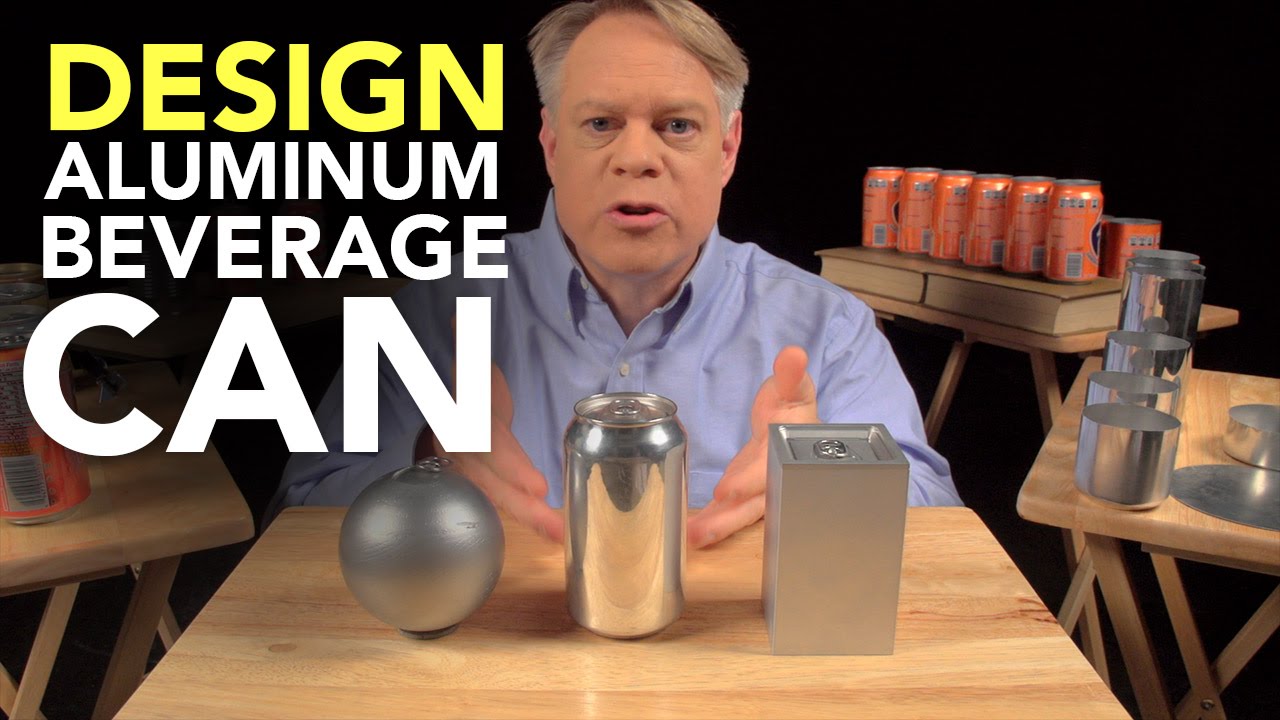
The video “The Ingenious Design of the Aluminum Beverage Can” (https://www.youtube.com/watch?v=hUhisi2FBuw) , created by Bill Hammack (aka “The Engineer Guy”), explains why the aluminum beverage can is designed this way. In other words, he explains why a cylindrical shape is used, why the top is “dome”-shaped, and how the tab works like a lever.
The video highlights parts like the opening tab and the seam (clamp) through production line footage, diagrams, and slow motion. Visual clarity facilitates understanding of engineering design. The presenter broadens the viewer’s understanding of design and simple engineering by revealing the engineering behind an object we use constantly in our daily lives.
Features such as pressure resistance and manufacturing constraints are highlighted, explaining how the can must withstand internal pressure (soda pressure) and how manufacturing processes (roll forming, double seaming) affect its shape and cost.
This video aims to present the engineering behind an ordinary object to a broad audience in an understandable, engaging, and educational way. For lay viewers, clear visuals and compelling narrative reveal the true engineering behind a common yet ubiquitous object.
Now, let’s get to the content. The video explains how aluminum cans arrived in their current form and the underlying logic as follows:
1) Why is a can cylindrical?
Engineering Reason: Pressure Distribution
- Soda cans must withstand an internal pressure of approximately 2–3 atmospheres.
- The cylindrical shape distributes this pressure evenly across the wall and prevents the formation of weak points.
- If it were a square (box-shaped) structure, stress concentration would occur at the corners, and the walls would have to be made much thicker.
- Therefore, a cylinder provides the highest strength with the least amount of material.
Manufacturing Reason: Simplicity and Efficiency
- Cylinders can be easily manufactured from flat aluminum sheets using processes called “deep drawing” and “ironing.”
- These processes allow for seamless, smooth-surfaced, and uniformly thick cans.
2) Why are the top and bottom different?
Dome bottom (outward-curved bottom):
- A flat bottom would bulge outward under internal pressure.
- The dome-shaped base distributes pressure more evenly and is much more durable.
- This allows engineers to achieve the same durability by using less aluminum.
This results in both material savings and cost advantages.
Flat Top (But Actually Slightly Concave)
- The top of the box must be able to support the loads of transportation and stacking.
- Therefore:
– It is reinforced with a corner curl.
– It is connected to the body with a double seam.
- Furthermore, the top surface is not actually completely flat; it is slightly concave. This increases resistance to internal pressure.
3) Why is the body thin and the top thick?
- The box body is very thin—sometimes as thin as a human hair (about 0.1 mm).
- This saves material.
- However, the top is thicker because:
– The opening ring and the hole (score line) are located here.
– The double seam is located here.
– It must withstand the pressure changes that occur during opening.
This means a structure that is reinforced where needed and lightweight elsewhere.
4) The miracle of the double seam
- Did you know that the lid is attached to the body not by welding, but by mechanical interlocking?
- The body curl and the lid flange are wrapped and pressed together.
- This creates a six-layer, airtight seam.
- This method:
– Enables high-speed production of up to 2,000 cans per minute.
– Is leak-proof.
– And is fully recyclable (no adhesives or plastic).
5) Pull tab engineering
The old problem (before the 1970s): The breakaway rings on the first cans caused environmental pollution and injuries.
The new solution:
- The “stay-on tab” works on a lever principle:
– When you lift the ring, it presses the rear end against the score line.
– The force is concentrated at this line, and the aluminum breaks easily.
– It doesn’t break from the ring—it’s safe and environmentally friendly.
- This is a perfect example of the principle of first-class leverage.
6) Material and Production Optimization
The can consists of two parts:
1) Body + Base: Made from a single piece of aluminum by drawing.
2) Lid: Produced as a separate, thicker piece and assembled later.
- This design:
– Speeds up production.
– Reduces waste.
– Makes it fully recyclable.
- Every improvement since the 1960s has saved a few milligrams of aluminum per can, representing thousands of tons of savings annually.
7) Environmental and Economic Efficiency
- Today’s cans weigh only about 13 grams, while steel cans from the 1950s weighed 85 grams.
- Using recycled aluminum consumes 95% less energy than producing new aluminum.
- Therefore, the design: It strikes a perfect balance between durability, cost, manufacturability, and sustainability.
Summary: Why This Form Was Chosen
| Design Feature | Engineering Purpose | Benefits Achieved |
|---|---|---|
| Cylindrical Body | Evenly distributes pressure | Maximum durability with minimal material |
| Dome Base | Structural strength | Pressure-resistant, less metal |
| Thick Top | Reinforcement and opening mechanism | Safe, stackable structure |
| Thin Walls | Material savings | Lightweight and economical |
| Double Stitching | Mechanical connection | Leak-proof, fast production, recyclable |
| Fixed Opening Ring | Lever principle | Easy opening, safe, and environmentally friendly |
My favorite points and basic engineering principles discussed in the video
Stress distribution: The cylindrical shape increases durability by evenly distributing internal pressure (carbonation). This is a fundamental mechanical design principle.
Material efficiency: The dome base and thin walls demonstrate that geometry can maintain durability while reducing material usage.
Lever mechanics: The opening ring example provides a practical example of the premium lever principle.
Manufacturing integration: Double seam demonstrates the precision of mass production. It represents the intersection of design and manufacturability.
Sustainability: While the video focuses on mechanical design, it indirectly explains why aluminum cans dominate beverage packaging: They are lightweight, infinitely recyclable, and energy-efficient during the recycling process.
Design Evolution: Can design has evolved over the years, from steel to aluminum, from pull-tabs to eco-friendly stay-on tabs. The video also allows us to appreciate the evolution of this design ethic.
Conclusion
Bill Hammack’s main message is:
“Beauty in engineering comes from optimization, not ornamentation.”
The aluminum beverage can is an example of perfection, every curve and every micron calculated. Every detail is in perfect harmony with the principles of physics, economics, production, and sustainability.
This video transforms the ordinary object, the aluminum can, into a case study of elegant and optimized engineering. It teaches us that great design is not about innovation or luxury, but about improving the ordinary until it reaches perfect efficiency. I really enjoyed this video. Let’s not forget: there is no magic, there is engineering!