Today, as we face a severe economic crisis, I needn’t emphasize the importance of guiding young people in our country toward employment opportunities that will provide them with a bright future. For this, the necessary infrastructure must be established. First and foremost, young people must receive vocational and technical training and become a skilled workforce. This will allow them to create a skilled and technically equipped workforce, enabling them to find work opportunities in a wide variety of sectors, particularly in industry, technology, IT, and service sectors, in the sectors they dream of.
The importance of two-year technical programs at vocational high schools or universities can be explained as follows: Matching companies in different sectors with vocational high schools offering training in their respective fields is a sound model, both to increase young people’s employability and to contribute to the development of the qualified human resources businesses need. However, this goal can only be achieved through sound planning and close collaboration. Any incompatibility between the employer and the educational institution can lead to disruption, and ultimately, the young people will sffer the consequences.
From the university experience to vocational high school
Unfortunately, I have a similar story. From past articles, my readers know that we implemented our wind farm in the Babalı neighborhood of Kocaeli’s Kandıra provincial district with considerable difficulty. Last year, around this time, after much effort, we identified a vocational high school with the necessary young people to train. I’m not revealing its name right now; those who search can find it, but since I don’t intend to be a source of information, I don’t want to directly mention it.
After all, we had a bad experience with a two-year technical program at a university operating in the region. We visited, made presentations, but despite all our efforts, we were faced with the response, “We can’t find any interns willing to work at your powerplant.” I couldn’t understand how the managers and instructors in the department were unwilling to intern at a power plant for a career that could be a blessing for children. Either the instructors had a problem, or the students.
“Who are you looking for, sir?”
“We have an appointment with the principal. How can we get to his office?”
“The principal’s office is in the other building. You’ll need to go through there to reach the other building’s garden, and from there, you’ll need to walk to the building.”
After this explanation, I was about to set off, when the boy rejoined and added:
“Let me show you the way. It’s a long way, you might get confused.”
Indeed, the student accompanied us and brought us to the principal’s office. The way was long and complicated, but thanks to the kid, we reached the principal’s office without any difficulty. I was impressed by the student’s attitude. I thanked him and, without hesitation, asked him if he would be interested in an internship in the wind industry. When he showed interest, I asked his name. Then I went inside. His assistant immediately took me to the principal’s office.
When we met with the principal, our assessment proved correct. The department we were interested in was “Electrical Installations and Distribution” in the “Electrical and Electronic Technology” field. The principal had also summoned the head of the relevant department. I was pleased to meet this person, who handled matters like an idealistic instructor, and my overall feeling was, “Okay, this is the job, I’ve found the right place.” During the meeting, I told the principal that we prioritize student character as well as student quality, and I gave the example of the boy who had brought me to the principal’s office. I even gave him his name. Although I vaguely remembered his name, the department head identified him.
A protocol decision and much more…
At that meeting, the final decision was, “Let’s sign a protocol.” This protocol stipulates that each year, the high school will refer students of their choice with good character and academic achievement, or students who are hardworking and have potential. After completing summer internships with these students, we will offer job opportunities to those we find suitable. With their acceptance, we will not only provide them with a new career but also provide them with comprehensive training to ensure they are qualified to work in the wind energy sector from the very beginning. The principal was receptive to our suggestion and asked if we could teach a course on wind energy at their school or prepare a lesson for them. I replied, “We’ll do whatever we can to support you.” I asked, “Would you like to send the protocol first, or should we?” and the principal replied, “We’ll send it.”
We concluded the meeting, thinking we’d agreed on everything, and took the following photo after the meeting, leaving the school. Since my goal isn’t to profile or denigrate anyone, I’m not mentioning the names of either the school or the principal here. My main purpose in writing this article is to identify a serious problem in our country.
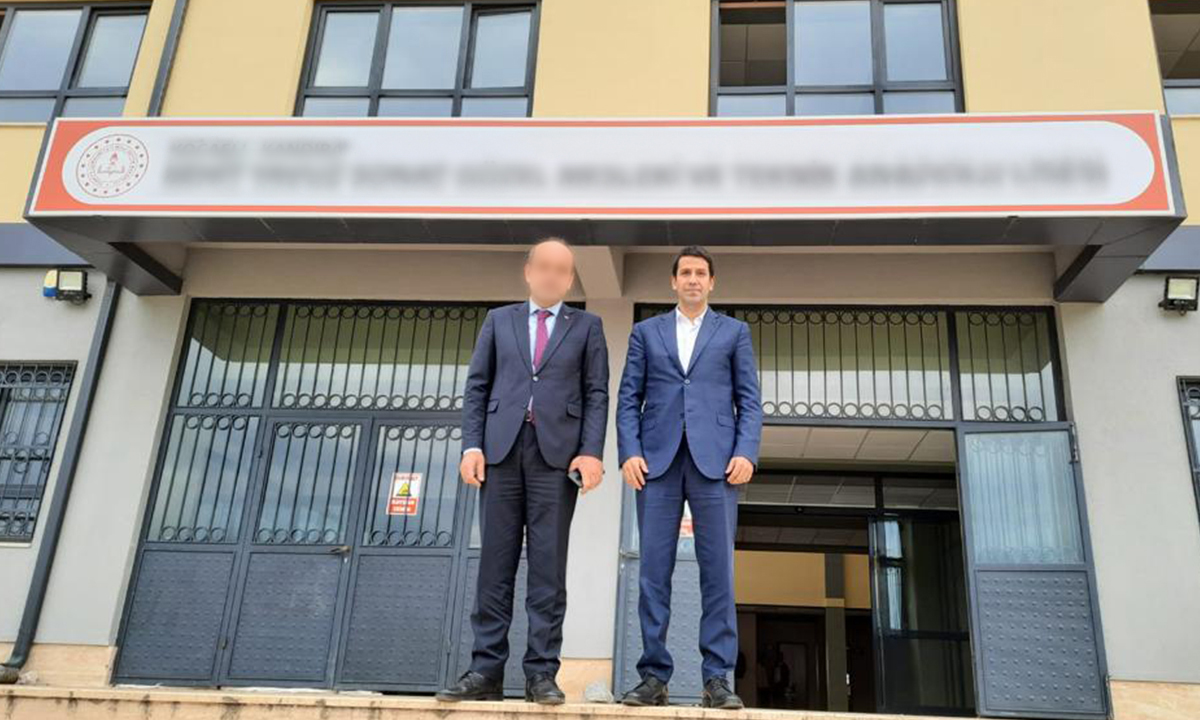
After the school visit, we spent weeks trying to obtain the first protocol. Over a month later, the high school principal sent us the first draft of the protocol. We responded to him within two weeks. Ultimately, the high school principal kept us busy for eight or nine months with the protocol, and in the end, he never responded to the final version, and we never received final confirmation. I called him repeatedly, sent messages, and tried to get someone to intervene. To no avail. Finally, we gave up.
Why hinder young people?
We offer hundreds of students at our school an opportunity to explain renewable energy in detail, an opportunity that could change the future of at least a few of them every year. Even if they don’t get an internship, they can develop a vision for the sector and the jobs they can do. So why?
I can’t answer that either. He kept telling me about the permission he would receive from the Ministry of National Education. I don’t know if he was truly stuck there, or if his own inadequacies or some inherent character traits caused him to neglect such an important and fundamental duty.
Let me answer the question I posed in the title based on my own experience: Are vocational high schools in Turkey managed as if they were a national concern?
In my experience, the answer is “Unfortunately, no.” I’m sure there are valuable young people who graduate from vocational high schools and could achieve great things, but this poor management is hindering their path.
Meanwhile, I’m also sure there are well-managed vocational high schools, but I think they’re now a minority.
To those who ask, “Isn’t there a solution to this problem?” my answer is, “Of course there is.” But for that, I need to write a series of blog posts. Because the real problem lies in our education system in general. As we celebrate the Centenary of our Republic, this is, unfortunately, the situation with vocational high schools, youth employment, and the education system in our country.
Tag: education