
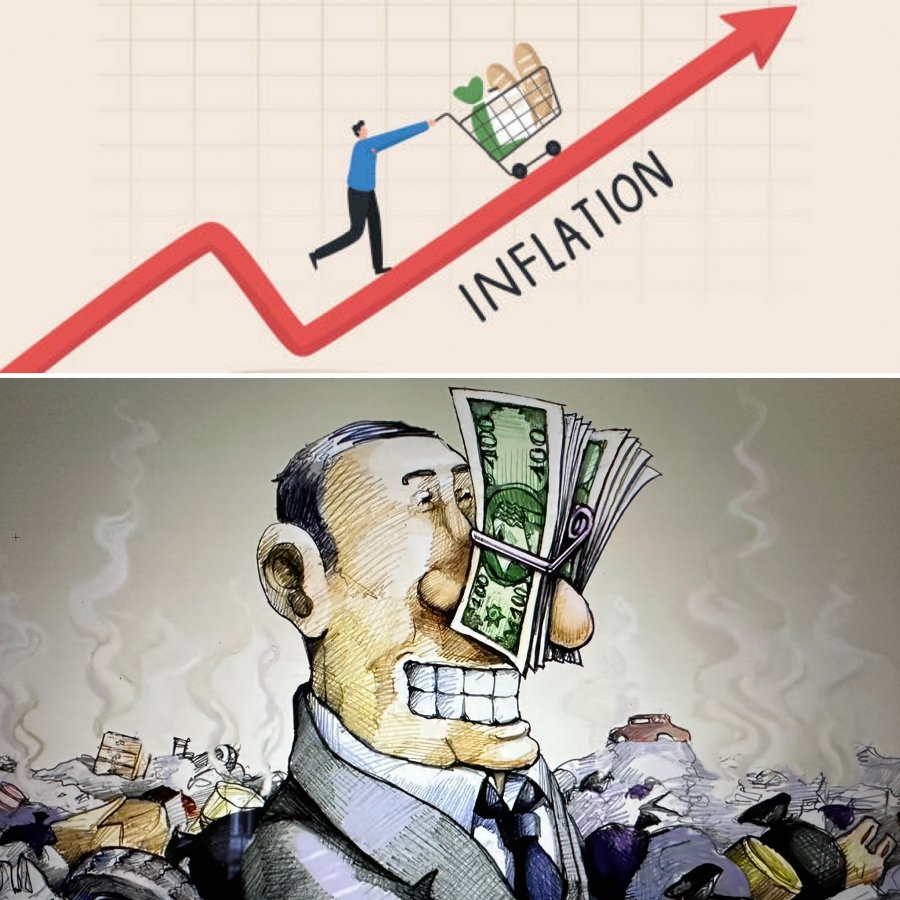
Maybe I’ve been influenced by the steady stream of negative news we’ve been bombarded with lately in our country, but this idea struck me during one of my internal brainstorming sessions. I asked myself, “How can I sum up this environment we’re living in with a single word?” Then it came to me: why not combine “corruption” and “inflation”? The word corruption translates into Turkish as yolsuzluk, yozlaşma, or bozulma. In this case, it’s the sense of decay or moral degradation that fits best—especially the term moral corruption. When you fuse that with inflation, you get Corrupflation—an environment that has deteriorated (morally) because of inflation.
I also considered how to express this term in Turkish but couldn’t find a combination that worked as well. Since enflasyon itself is a loanword from inflation, I think we can adapt Corrupflation into Turkish as korapflasyon, in the same spirit.
Severe Breakdown of Business Ethics
In our Corrupflation-ridden country, official figures report inflation over 50%, but we all know the real number is much higher. The reckless behavior of business owners—constantly raising prices without hesitation or using inflation as a pretext to push profit margins sky-high—shows just how deeply business ethics have eroded.
This climate reminds me of what I witnessed in Venezuela. During the 14 years I served as Honorary Consul of Costa Rica (from January 2008 to December 2021), I worked closely with a wonderful colleague of Venezuelan origin named Ninoska. Around four or five years ago, we had a conversation about this very issue. She said that Turkey reminded her of her home country and that she saw the same warning signs of collapse. “I hope Turkey gets back on its feet,” she said, “so it doesn’t fall into the kind of desperate situation many Venezuelans now face.” She gave examples: “perpetually rising prices and uncontrollable inflation, people trying to scam or deceive one another, a spike in crime, an increase in angry and unhappy individuals, and a general descent into ‘jungle rules’ where survival overrides decency.” In my view, Venezuela’s collapse—despite its natural wealth, stunning nature, and amazing people—was the result of Hugo Chávez’s successor, Nicolás Maduro, continuing to run the country with similar authoritarian instincts. Once public trust in government collapses, the whole system begins to unravel.
As for our own country, Turkey is clearly following in Venezuela’s footsteps. Not a day goes by without some shocking news about prices. A recent incident shared by Selim Zafer Ellialtı, owner of Suvla Wines, perfectly illustrates what we’re dealing with. I’ll quote from a piece by Vahap Munyar, a well-known economic journalist in Turkey, published on the Ekonomim website. You can read the full article here: https://www.ekonomim.com/kose-yazisi/260-liraya-sattigimiz-sarabi-restoranda-3-bin-300-liraya-ictik/762093
They Drank Their Own Wine—at an Outrageous Price
Selim Zafer Ellialtı, founder of Suvla Wines, went out for dinner one evening with his wife and business partner, Pınar Ellialtı. They ordered one of their own wines at the restaurant.
When the check arrived, he glanced at the itemized bill—and was shocked to see the price of their own wine:
– 3,300 lira…
He didn’t protest; he paid the bill. But the 3,300 lira price tag for his own wine gnawed at him.
The next morning, he asked his marketing team to check how much they had sold that wine to the restaurant for:
– See how much we sold our “K………” wine to that place for.
The team got back to him quickly:
– It looks like we sold that wine to the restaurant for 260 lira.
He sighed, lamenting:
– We understand that high inflation has distorted pricing behavior. But marking up a bottle of wine 11–12 times its wholesale cost? That’s unheard of anywhere in the world…
Selim Zafer Ellialtı’s words reflect exactly how many of us feel. The distortion in pricing behavior is a clear indicator of moral decay. We can see this kind of behavior—born out of Corrupflation—in many restaurants.
That said, restaurants also deserve to have their voices heard. Many are struggling under the burden of rising costs. Employees are constantly demanding pay raises (understandably so, since they too are grappling with the cost of living), input prices are constantly climbing, and overheads like rent keep going up. This creates a vicious cycle where restaurants feel forced to hike their prices. But in managing this crisis, many restaurants have completely lost control. It’s as if the jungle law rules the market now—a desperate fight for survival.
But Corrupflation isn’t limited to price increases. We see it in other ways too. For example, to cut costs, some restaurants substitute cheaper ingredients for the ones they claim to use in their dishes.
What the Köfteci Yusuf Incident Reveals
The recent scandal involving Köfteci Yusuf, a major Turkish meatball chain, is now known nationwide. For my foreign readers who may not be familiar, here’s a summary of the incident (you can read the full report here: https://www.haberler.com/haberler/kofteci-yusuf-ta-domuz-eti-olayi-ne-kofteci-17911027-haberi/
During inspections conducted by the Ministry of Agriculture and Forestry in February and March, traces of pork were found in some samples taken from Köfteci Yusuf locations. Specifically, samples were collected from cooked meatballs and beef döner: 300 grams from the meatballs and 400 grams from the döner. Lab reports confirmed the presence of pork in both products.
For several days, the chain and its owner Yusuf Akkaş remained silent. Then, the company issued a public statement. They claimed that several technical errors occurred during the sampling process, stating:
“These errors rendered the test results inaccurate. Once the legal process concludes, we will share all the technical details with the public. During subsequent on-site inspections by provincial and district agricultural authorities, no issues were found. In fact, our production facility was deemed hygienic and compliant with regulations.”
(See https://gazeteoksijen.com/ekonomi/kofteci-yusuftan-domuz-eti-aciklamasi-bu-is-sonuna-kadar-gidilerek-aydinlatilsin-225127). After the official statement, Yusuf Akkaş released a YouTube video defending himself. In the video, he spoke about commercial and political matters and urged people to approach the issue with conscience. Describing himself and his team as “moral, hard-working people,” Akkaş responded to the accusations by saying, “They picked the wrong guy to mess with. God’s shadow is enough for everything. Something good will come out of this evil.”
Attempts to dodge responsibility with conspiracy theories
Honestly, I don’t know if any good will come out of this mess, but I can tell you one thing—I’m not eating at Köfteci Yusuf again. Meatballs are already a risky dish; you can throw anything into the mix and people won’t notice. So, in a setting where you need to be extra cautious, if samples are found to contain pork, I believe that’s true.
In Turkey, it has become a tradition among wrongdoers—both individuals and institutions—to deflect blame by pinning the issue on a conspiracy theory or some shadowy organization. They shift the focus by talking around the actual problem, distracting the public, and before long, no one even remembers what caused the issue in the first place. This has become a standard form of manipulation. Or they simply rely on the notoriously short memory of the public and hope everyone forgets. That’s likely what will happen with the Köfteci Yusuf scandal—it will fade away in a country like Turkey, just like the Burger King scandal did. (I covered that in my blog post titled “The Rotten Meat Scandal and the 2024 ‘Know What You’re Eating!’ Campaign”: https://www.serhansuzer.com/tr/2010daki-bozuk-et-skandali-ve-2024teki-ne-yedigini-bil-kampanyasi) The Köfteci Yusuf story will also vanish into the collective amnesia of our nation.
Shrinkflation: When downsizing fuels inflation
Now let’s talk about another shady practice restaurants that have adopted to cut input costs: downsizing portions. Lately, have you noticed that items at fast food restaurants—burgers, fries, etc.—seem smaller than usual? I have. I won’t name names, but I’ve seen it at several places I’ve eaten at. The burgers had shrunk by at least 30%, and the number of fries was practically cut in half. Having worked in this industry for many years, I can easily spot it. But I’m sure even people with no connection to the sector can clearly tell that their burgers, fries, and other portions have gotten significantly smaller.
These businesses want to maintain profit margins by quietly shrinking product sizes instead of raising prices outright. The technical term for this is “shrinkflation” (See: https://en.wikipedia.org/wiki/Shrinkflation).
To all those who keep jacking up prices, sneak pork or questionable substitutes into food just to cut costs or shrink their portions—we leave them to God. We know they’re struggling to stay afloat, but part of me wants to say, “If this is how you plan to survive, then maybe you shouldn’t survive at all.” Rather than violating basic ethical principles, it would be better for them to close their restaurants with dignity and honor. After all, those who exit the sector honorably may one day find a chance to reopen, and because they left a good impression, customers will come back. But those who resort to deception, even if they manage to survive for a while, will never earn true customer loyalty.
My Tough Proposals for Solutions
Now let’s turn to how this corapflation environment can be fixed. First, I have to say that fixing it will not be easy. However, if the right steps are taken, things can fall back into place and prosperity can be restored in the country. In my view:
1) The most critical factor is public trust.
There’s a slippery ground we all feel under our feet in this country. We constantly live with the sense that we haven’t hit rock bottom yet, and there’s still further to fall. The key issue here is how the current government is managing the country and whether the public trusts those in power. If that trust is fundamentally shaken, a country inevitably ends up in an uncontrollable inflationary environment. So, either the current government must reinvent itself from the ground up and show that it will take a truly different approach, or a new government must take over and demonstrate that it will implement genuine reforms to ease the economy.
2) The most important economic goal is to make ends meet.
That is, as a country, Turkey must stop running a growing current account deficit and instead begin generating a surplus. This can be achieved in a very clear way: cut spending and increase revenue. Since this is my field, let me give a specific example—if we were to stop importing energy and instead focus on domestic resources, transitioning to 100% renewable energy, Turkey could begin posting current account surpluses as early as next year. Of course, I would add that unnecessary public spending must also be slashed. I’ll elaborate on a detailed recipe for exiting the economic crisis in another blog post.
3) Avoid cosmetic solutions.
At the time, when the current government dropped six zeros from the Turkish lira, they framed it as a major victory. Supporters of the government bragged about it for years, praising the move endlessly. But those of us who understand economics even a little saw it for what it was—a superficial maneuver. Such rebranding only works when backed by solid economic fundamentals. Otherwise, inflation returns, and those dropped zeros start creeping back onto the currency.
I’ve never agreed with the narrative that the Turkish economy is well-managed. In fact, let me go further: I believe that outside of Atatürk’s 15-year administration, the Republic of Turkey’s economy has never truly been well-managed. Each new government somehow managed to make things worse than the previous one.
I like to speak with data. I cannot recall a single period when Turkey consistently posted a current account surplus. Some periods saw a reduction in the deficit; others saw it increase. But a deficit was always there. Especially in the last 20 years, despite all available opportunities, the current account deficit grew even more. So don’t try to sell me on the story that Turkey used to manage its economy well. The facts are clear. Turning a deficit into a surplus—i.e., ensuring that national income exceeds national expenditure—is not that difficult in my opinion. What’s needed is crystal clear. The key is for governments to come to power that truly, sincerely put the country’s interests first.
4) Price controls. If trust in the ruling government is re-established and the economy begins to recover, another essential step to eradicate inflation at its root is price control. Now, I too am a supporter of liberal economics and free markets. However, these mechanisms only function properly in countries where ethical standards are high and there’s no moral decay. In countries like ours, where there’s rot at the core, at least for a time, we need to proceed with oversight and enforcement—otherwise, that rot will continue to spread throughout the system.
Once public trust is rebuilt and the economy starts to stabilize, I believe it would be wise—just as was done in the past, either drop more zeros from the currency or introduce a new currency unit, like what developed countries do, that offers better price visibility. In fact, with a more progressive approach, eliminating paper currency altogether and switching to a fully digital Turkish currency would be a very sound move. Once this new digital currency becomes widely adopted across the country, it would be the right time to implement strict price controls. To prevent excessive price hikes and profiteering, even a cap on profit margins could be introduced.
For instance, using Suvla again as an example: A restaurant trying to sell a bottle of wine it bought for 260 TL at 3,300 TL—a markup of more than 11-12 times—should face severe penalties, potentially even closure. There should be a rule: for alcoholic beverages, for example, a maximum of 100% markup on input costs should be allowed. So, if a wine costs 260 TL, the most it can be sold for is 520 TL—not 3,300 TL as in Suvla’s case. Let me emphasize; restaurants that engage in under-the-table sales or violate this rule by setting exorbitant prices should be shut down after a single warning—no second chances. These price controls should be applied across all sectors and monitored continuously. And of course, in digital transactions, there’s no room for such black-market practices. Because everything takes place in the digital realm, especially with the help of artificial intelligence, those who break the rules can be quickly identified and dealt with accordingly.
Curious readers sometimes ask me, “Why do you write about these things?” My answer is very clear: Because I, too, want to live in an environment we all deserve and long for. That’s all.
Tag: memoir