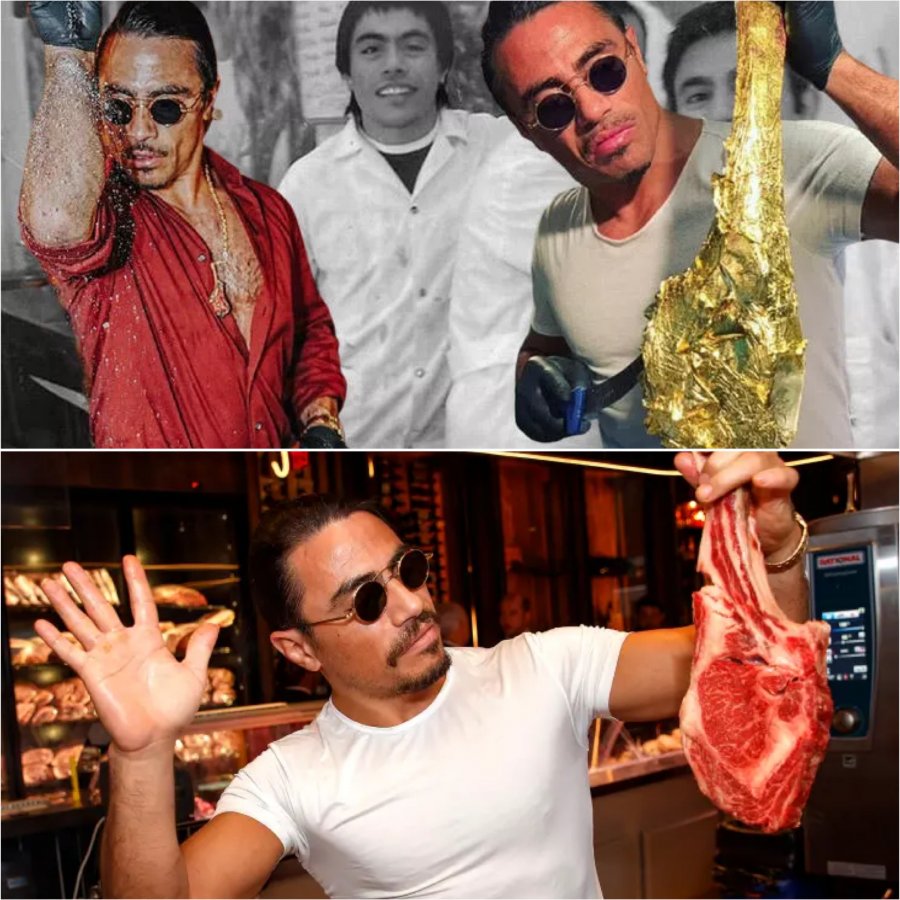
I’ve been to Nusret twice. The first time, I went to his old restaurant in Etiler after an upstart Turkish businessman invited my father. The inviter was full of praise for Nusret. He wasn’t famous yet at the time, but he was working tirelessly as a successful restaurateur.
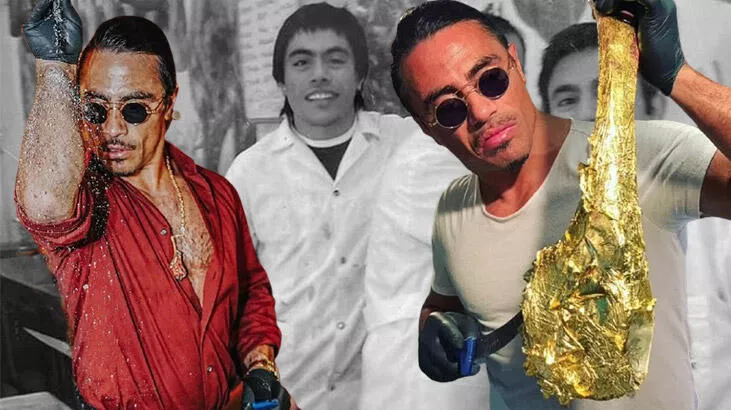
The second time, the year his new restaurant in Etiler opened, an Azerbaijani businessman, probably to show me off, took me to Nusret. After ordering more meat than we could possibly eat, and trying to serve it with a forced show, in true Azeri style, we finally arrived at dessert. The waiter and I had the following conversation:
- What’s for dessert?
- We have wonderful baklava, which I can recommend. And it’s from İmam Çağdaş, from Gaziantep.
- Good. I’m from Gaziantep too. I know baklava. Then I’ll have a carrot stick. (Addressing my Azeri friend) Would you like some baklava too?
- (In an Azeri accent) I’d like that.
- Then let’s get a carrot stick of baklava for both me and my friend. When the baklava arrives, I’ll know if it’s from İmam Çağdaş, that’s how it is. (They tried to trick us by saying İmam Çağdaş baklava at a fish restaurant in Bodrum. After insisting we were from Gaziantep and that this wasn’t İmam Çağdaş’s baklava, and we argued, the waiter who had tricked us resisted for a long time but eventually admitted the mistake. The guy had literally put baklava from somewhere else into the İmam Çağdaş baklava box and was brazenly showing it to us. That’s why I said that.)
- (Laughing) Oh no.
Murdering the baklava in the name of “preparing”!
The waiter brought the baklava. There were also scoops of ice cream. There seemed to be no problem. Then he said, “Shall I prepare it?” I couldn’t help but ask, “What are you going to prepare?” Without answering, the man placed two plates of baklava side by side, splitting them in half, so that the top of the baklava touched the plate. He placed the ice cream inside, placed the bottom of the baklava on top of the ice cream (thus, the baklava started to sit upside down). Then he pressed down twice, and then placed the plates in front of us, saying, “There, it’s ready.”
I stared at him, my mouth agape. When he smiled at me with the air of someone who’s accomplished something great and said, “Enjoy your meal,” I couldn’t resist.
- What did you just do?
- I prepared the baklava.
- What are you preparing the baklava for? It’s already ready! You’ve practically violated my beautiful baklava.
- (Laughing) God forgive me, sir. It’s better this way.
- If I wanted to eat ice cream and baklava, I could have eaten the ice cream right there with the baklava. It’s not right for you to turn the baklava upside down and press the best part, the top, against the plate. It’s against good manners. Don’t ever do something like that again. It’s shameful.
After being told this, I didn’t press the issue too much, so as not to offend the friend sitting across from me who had invited me to dinner.
Imam Çağdaş is also getting tons of complaints
Months after this incident, I ended up in Gaziantep for solar energy projects. After a busy workday, I went to İmam Çağdaş. Burhan Çağdaş, the owner of İmam Çağdaş, came to our table with his son. He is İmam Çağdaş’s son and the second generation. He had started employing his son in the business, the third generation. The first moment he sat down at our table, he brought up my grandfather:
- We loved the late Hasan Süzer very much. He used to come to our old shop all the time.
- We miss my grandfather very much, too. Did he know your father well?
- Yes, he knew my father well at first, and then my father introduced me to him. Above all, his friendship was wonderful. He was a special man.
- Thank you. Did he come to this new shop too?
- Yes, he came a few times, but his main location was our old restaurant, and his shop was nearby.
- I was glad to hear that.
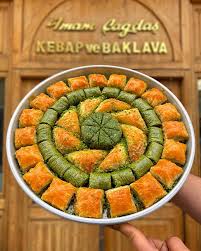
Then, as we were bringing up the topic, I brought up what happened at Nusret this time:
- Do you send baklava to Nusret in Istanbul?
- Yes, we do; they order a lot.
- Do you know what they do with your baklava there? I’ve experienced it once.
- Yes, we’ve come across this matter from many sources. People from Antep who eat baklava there have called us repeatedly to complain. We’ve called Nusret each time to warn them, but they don’t listen.
- If they don’t listen, then stop offering baklava. There’s a certain etiquette to eating baklava, and serious effort goes into making it.
- You’re right. We’ll see what happens. We’ll probably continue to warn them.
Innovation is one thing, disrespect for the product is another.
The phrase “There’s a significant amount of effort involved in making it” was, in my opinion, the most crucial part of this conversation. I say this as someone who knows how labor-intensive it is to make baklava. Rolling out the dough thinly, rolling it out one by one, then layering and baking it is incredibly labor-intensive. Rolling the baklava that way and having the labor-intensive, layered top crushed on the plate is no less than a slap in the face of people from Gaziantep.
I understand that. We want to breathe new life into baklava and baklava-like desserts (pistachio, walnut, hazelnut baklavas, şöbiyet, kadayıf, künefe, etc.). Let’s innovate. Oh, my goodness.
Then, during the production process, you develop all kinds of versions of baklava and its derivatives, and during production, you launch different products: chocolate, peanut butter, ice cream (there are also different ice cream varieties), tahini/molasses, etc. You then offer these different variants to consumers as new products.
The restaurant thinks it’s trendy to open the inside of the baklava, add ice cream, and then crush the baklava upside down, as if it was doing something cool. It’s not innovating, it’s not adding any value. It’s nothing but a display of disrespect for the producer’s labor.
Other restaurants, seeing this popularity, have followed suit. Recently, I went to another kebab shop in Etiler. The waiter there asked me, “Should I prepare the baklava?” I snapped, “Don’t you dare; baklava needs to be eaten with etiquette.” The waiter then asked, “Let me guess, you’re from Gaziantep, right?” I told him, “Yes, I’m from the birthplace of baklava, Gaziantep. Don’t be disrespectful,” and dropped the subject.
No jokes about Nimet.
Of course, the baklava issue is just one example. The real issue is making a big deal out of food. I cannot accept these cheap actions that diminish our own culture in the name of being a showman and entertaining people.
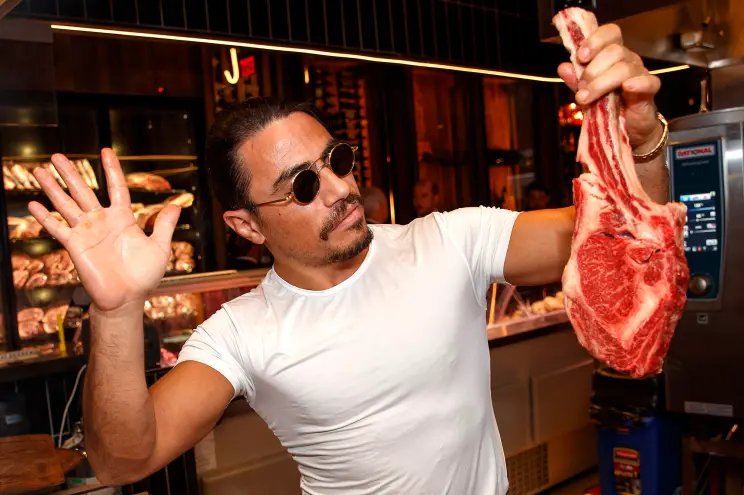
Videos of Nusret spanking meat, making strange movements while cutting meat, and making various antics about food may be attracting attention on social media. These antics may even make Nusret the most followed person on social media in Turkey. It doesn’t matter to me. After all, people from all over the world who want to see interesting and different things can become your followers. This doesn’t prove that your content adds value. If the goal is popularity, people can follow both the good and the bad. Creating content that adds value to life and promotes human development is important. Here’s footage of Nusret in America, a result of this corrupt popular culture, filming his own social media (a family tragedy almost occurred here):
Of course, Turkish culture also has a place for respecting food. We even pick up a piece of bread that falls on the ground by kissing it, placing it on our forehead, and putting it away. Similarly, in our culture, we respect and give thanks for our blessings. We still have families who recite a prayer of gratitude before eating.
A similar example is respecting water. I always say: “Water is life.” In my opinion, the water bucket campaign, once conducted to raise awareness for ALS, was also a global disrespect for water. Back then (I think it was 2014), we witnessed videos of hundreds of thousands of people pouring buckets of water or ice over their heads. Most of this spilled water ended up being wasted and wasted on concrete floors and other unrelated areas. I shot this video to both draw attention to this water waste and to help ALS campaigns truly find their place:
If you’d like to read more, you can also read the blog post I wrote about this topic. https://www.serhansuzer.com/tr/als-buz-kovasi-kampanyasi
This video I shot was chosen as the best campaign at a medical congress in Istanbul (I learned about it after a friend who attended that congress informed me). I think it sends the right message that they chose mine as the best among all the campaigns for the benefit of people suffering from serious illnesses like ALS. I’m truly honored.
We must not forget the harsh realities of life.
Making jokes about basic needs like food, water, sanitation, clothing, and shelter is not a skill; it’s even disrespectful to humanity. While people may be drawn to images they find interesting and entertaining, such as the ice bucket campaign or the high engagement with Nusret’s videos, we must remind everyone of the realities of life:
If we look at the United Nations’ data from two years ago (2020), the number of people suffering from hunger was 690 million. However, no change has been observed in the general trend. If we reinterpret the hunger data back to 2000, we can reach the same conclusion: This chronic hunger curve, which had been slowly declining for decades, has slowly climbed since 2014 and continues to rise (see:https://www.unicef.org/turkiye/bas%C4%B1n-b%C3%BCltenleri/bm-raporu-uyar%C4%B1yor-d%C3%BCnyada-her-ge%C3%A7en-g%C3%BCn-a%C3%A7l%C4%B1k-%C3%A7eken-insan-say%C4%B1s%C4%B1-artarken-ve-k%C3%B6t%C3%BC)
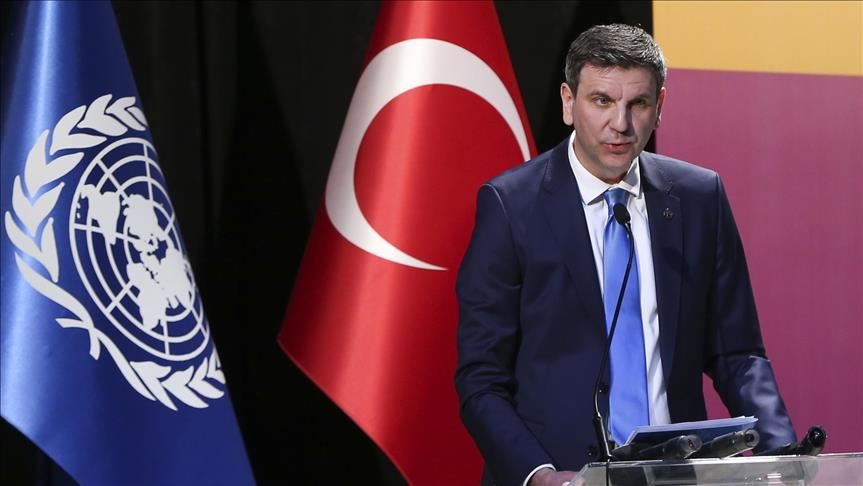
Viorel Gutu, UN FAO Subregional Coordinator for Central Asia and Representative to Turkey
Excerpts from the World Food Day Concept Note
I am sharing excerpts from the concept note written in May for World Food Day by Viorel Gutu, the Food and Agriculture Organization of the United Nations (FAO) Subregional Coordinator for Central Asia and Representative to Turkey:
– World Food Day, which began in May to facilitate the timely planning of national campaigns and promotional activities, addresses the many challenges we face today, including extreme poverty and all forms of malnutrition, conflicts, climate change, inequalities, and the economic impact of the COVID-19 pandemic. It calls for global solidarity to leave no one behind. The 2030 Agenda and the Sustainable Development Goals must be implemented everywhere, for everyone. Transforming agriculture-food systems for better production, better nutrition, a better environment, and a better life is the key to achieving progress for all.
– Leave no one behind. While we have made progress toward building a better world, too many people have been left behind, unable to benefit from human development, innovation, or economic growth.
– Millions of people around the world face a high risk of food insecurity because they cannot afford healthy food. But ending hunger and malnutrition is not just about supply. Today, enough food is produced to feed everyone in the world. The challenge is access and availability, which are increasingly hindered by numerous challenges, including the COVID-19 pandemic, conflict, climate change, inequality, rising prices, and international tensions. People around the world are suffering from a domino effect of challenges that recognize no borders.
– 75% of poor and food-insecure people worldwide depend on agriculture and natural resources for their livelihoods. They are often the most affected by natural and man-made disasters and frequently discriminated against because of their gender, ethnicity, or status. Access to education, finance, innovation, and technology is a challenge for them.
– Nonetheless we are all interconnected. Today, in a globalized world, our economies, cultures, and populations are increasingly interdependent. Some of us are more vulnerable than others depending on who we are or where we live, but the truth is, we are all vulnerable. When even one person is left behind, the chain is broken. This impacts not only their life but also ours. Take, for example, the war in Ukraine, a leading global producer and exporter of crops and agricultural products. The conflict is causing immense hardship and displacement for local populations, and its impacts on global food security are already being felt. The dramatic increase in the prices of wheat, corn, barley, and fertilizer is pushing already fragile countries into crisis.
– We need global solutions more than ever to address global crises. We need sustainable and holistic solutions that consider long-term development, foster inclusive economic growth, address inequalities, and build greater resilience. We must make sufficient, nutritious food accessible and available to all.
The Importance of Local and Decentralized Solutions
I agree with the content of this concept note in Viorel Gutu’s post. However, I would also like to add some additional content:
– Global solutions alone are not enough to address global crises. Local solutions can also address a significant majority of problems.
– Based on on-site production and on-site consumption in accordance with distributed systems, and instead of centralization, establishing distributed systems will bring relief to humanity and add dynamism to cumbersome systems.
– Ensuring everyone can meet their basic needs within a certain periphery will prevent hunger and ensure food security.
– In this sense, I recommend you follow, be a part of, and even support Good4Trust: http://www.good4trust.org
In conclusion:
1) It’s important to be grateful when we can meet our basic needs, such as food, water, hygiene, clothing, and shelter. Let’s not forget that the inflation, climate crisis, and wars we are experiencing today will further deepen the crisis of not being able to meet our basic needs. This is not a joke. It’s real. If we haven’t learned anything from the hyperinflation we are experiencing today, what I mean will be much clearer in 10 years when we have no water in our taps.
2) We must avoid using basic needs as advertising material. It’s also important to warn those who are fooling around with basic necessities and remind them that this is no joke.
3) It’s important for everyone to establish a distributed system in their immediate area to meet their basic needs. You could start by growing tomatoes, eggplants, watermelons, etc. in a nearby garden. Or you can install a rooftop solar power system to generate your own electricity (within your means).
4) Supporting your immediate community is important to addressing world hunger. You can start by helping your neighbors, your neighborhood, or your town.
5) How we manage waste is also crucial. We must adhere to certain rules in life, such as feeding restaurant food waste to animals and continuously recycling water.
Please heed what I said above. I’m sad to say this, but we need to be prepared for a world with increasingly challenging problems, proactively consider how to solve them, and act. Take care.
Bonus: Nusret’s image in America is so bad that even Saturday Night Live (SNL), known as the go-to comedy show by mainstream media, aired the following sketch, which seriously mocked Nusret. Don’t let anyone tell me that “there’s no such thing as good or bad publicity” or “the guy does a lot of work, the rest is history.” In my opinion, Nusret has created a negative prejudice in developed countries against young Turkish chefs with promising futures who could work internationally.