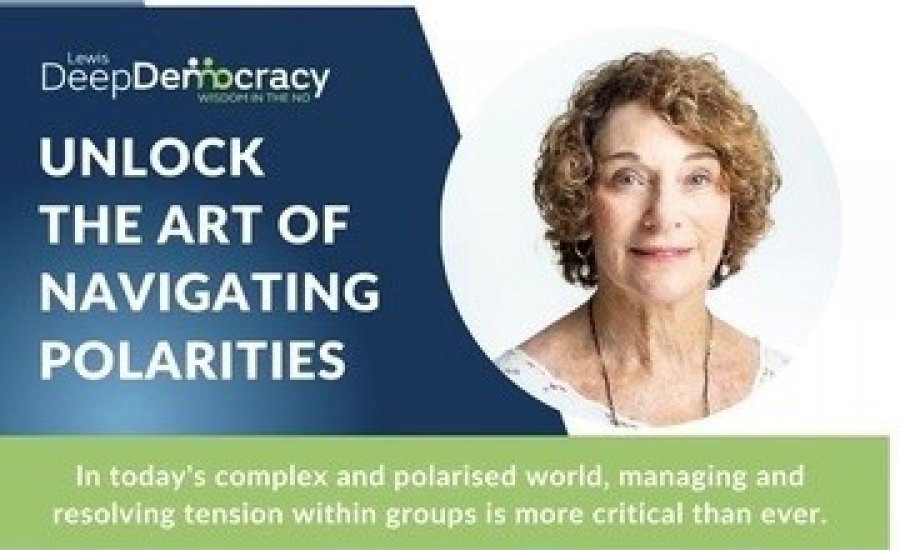
Thanks to the BMW Foundation, when they announced the Deep Democracy training offered by Myrna Lewis, I was curious to read its content. In summary (you can find the description at https://www.lewisdeepdemocracy.com/): The Lewis Deep Democracy method provides a powerful yet easy-to-learn training that can be adapted to a wide variety of life situations. When I read that learning it will help you incorporate all perspectives and become adept at recognizing and resolving tension and conflict, I decided to take the training. Because in today’s world, we witness tension, conflict, violence, and human unhappiness everywhere. I wanted to learn how we can use this method to address problems, at least in our own immediate environment. And of course, the resume of Myrna Lewis, who will be teaching the training, caught my attention. First, let’s get to know Lewis:
Who is Myrna Lewis?
Myrna is a leading thinker and practitioner in the fields of transformational leadership and facilitation. Along with her late husband, Gregory Lewis, she is the co-founder of the Lewis Deep Democracy Method. The method in question: They developed their methods while helping transform a South African public services organization from an organization driven by apartheid into one adapting to the country’s new democracy. Myrna holds a master’s degree in clinical psychology. Myrna consults locally and internationally on complex issues arising from personal, social, and political change, diversity, and minority issues. Myrna received a 2001 Ashoka Fellowship from the Washington-based Ashoka Foundation. In 2006, the United Nations recognized Deep Democracy as one of Africa’s 80 leading innovations. In 2008, Myrna was a finalist for the South African Businesswomen of the Year award. She is a mother of two and a grandmother of four.
The Method’s Origins in Challenging Circumstances
Now, let’s briefly introduce you to Lewis’s management: It’s a method born during the transition from apartheid to new democracy in South Africa. This method, developed to address the serious conflicts that arose during the transition from apartheid, a period of racial discrimination in favor of whites, to new democracy, caught my attention because I was in South Africa in 2010. I was able to observe firsthand how much anger the Black people there viewed white people with. This training excited me because I believed that the method used to deal with these problems could be the path to resolving all conflicts in the world.
The Lewis Deep Democracy method was developed by psychologists Myrna and Greg Lewis and was inspired by Arnold Mindell’s Process-Oriented Psychology. It transitioned from traditional Newtonian thought to quantum thought and psychological theories related to cutting-edge technology.
Let’s hear an introduction to the Lewis methodology in his own words: https://www.youtube.com/watch?v=s138yQxhuHI&t=2s
Introduction to the Method
Let’s share some introductory information about Myrna Lewis’s Deep Democracy techniques:
- Harness the emotional currents and wisdom of a group.
- Recognize and overcome resistance to decision-making.
- Hear all voices in the group.
- Elicit differing opinions.
- Step confidently into tension and navigate it.
- Gain buy-in to decisions and change.
- Every environment where people are present is essentially an energy field. It’s up to everyone to influence this energy field, either positively or negatively.
- To solve problems, listen to each person’s side of the argument and then try to empathize and understand.
- In conflicts arising from differing arguments, the middle person, or those acting neutrally, is a significant figure, and it’s up to them to solve the problems.
- To transform conflict into an opportunity for growth, a very different outcome may emerge than the one everyone feels is right and wants to achieve. This different outcome from what everyone else believes can create a great opportunity for growth and development.
- Tension and conflict get a bad rap; But these are opportunities for transformation.
- Those who oppose everything are also important figures. Listen carefully to what they say. The solution may lie in their words and the issues they raise.
Some basic principles
Now, to better visualize, I’d like to share a TED Talk by Myrna Lewis with content similar to this training we received: https://www.youtube.com/watch?v=FsFz1H447kk
Let’s take a look at the content of Myrna Lewis’s “U+Me Let’s Talk” process, designed to enable you to confront enemies, resolve conflict, improve your relationships, and achieve personal growth:
- Everyone’s opinion matters.
- We need to try to hear all opinions.
- Once you can put aside your hatred for the person you’re in conflict with, you can begin the path to conflict resolution.
- Before engaging in conflict resolution, you need to establish “Safety Rules.” Similarly, in the Deep Democracy training, it was shared that we should establish safety rules before engaging in discussion.
First step: Reach an agreement and establish safety rules.
Second step: Have both parties spill their guts at once.
Third step: Embrace whatever comes to the forefront.
Last step: Make your decision based on whatever comes to the forefront.
No one has a monopoly on being right.
Now, let’s review some of the elements we learned in our training and emphasized in this TED Talk:
1) Everyone can be right in their own way, but no one has a monopoly on being right. In other words, there is no single truth or single right path.
2) You have to fight for peace. In other words, to resolve conflict, you have to confront problems and discuss everything.
3) As I move towards conflict resolution, I will try to see the blind spots that others see but I don’t. This is an opportunity for growth, transformation, and reaching a better position. I will grow, the person I’m in conflict with will grow, and the relationship will grow. I want to end my article with Mryna Lewis’s final sentence from this speech:
If you solve your own problems at home, you can solve them anywhere and make this world a more livable and beautiful place.
Tag: education