
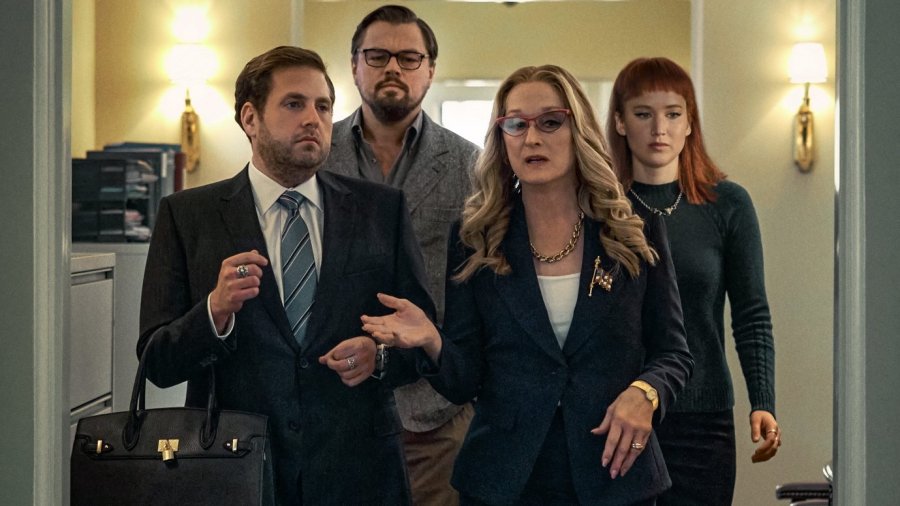
When I first saw the trailer for this film, I remember wondering who else the cast should be. Leonardo Di Caprio, Jennifer Lawrence, Meryl Streep, Cate Blanchett, Jonah Hill, Mark Rylance, Rob Morgan, Tyler Perry, Ron Perlman, Timothée Chalamet… I’d been curious about this film ever since and finally got the chance to see it on a plane. Sometimes, movies with such a star cast can be disappointing. “Don’t Look Up” had the opposite effect on me. All the actors in the film really showed off their talents, proving their talents. Their performances were truly impressive. Adam McCay’s brilliant script, about catastrophes that could bring about the end of humanity, is brought to the screen with a well-directed narrative that leaves you captivated from the beginning to the end by this satirical and satirical science fiction film.
“Don’t Look Up” tells the story of two astronomers working to warn people that a giant asteroid will destroy the planet. Humanity faces grave danger. A comet the size of Mount Everest is rapidly approaching Earth, and the resulting collision will cause Earth’s destruction. This discovery, made by astronomy graduate student Kate Dibiasky, will lead to humanity’s salvation. Kate and Dr. Randall Mindy decide to embark on a media tour to warn humanity of the impending danger, and they face a series of misfortunes.
Ignoring Instead of Fear
The film’s main character, astronomy graduate student Kate Dibiasky, is played by Jennifer Lawrence, and her mentor, Dr. Randall Mindy, is played by Leonardo Di Caprio. This comet, the size of Mount Everest, approaching Earth at breakneck speed and poised to bring about the end of both the planet and humanity, is named after Dibiasky, its discoverer. While one wishes to leave a legacy, and it’s an honor for an astronomer to name a comet after him, it’s ironic that this comet is a source of fear for everyone and is poised to destroy humanity. Although calling it “horror element” isn’t quite right, because it should be, this film brilliantly explores the theme of ignorance and evasion, a deeply peculiar trait of human nature. The complete disregard for Kate Dibiasky and Dr. Randall Mindy, who alerted the appropriate authorities when the comet was first discovered, is one of the film’s most compelling points. Credit must also go to Meryl Streep, who portrays American President Orlean, and Jonah Hill, who portrays her spoiled, vain, and pathetic son, Jason Orlean, whose performances are breathtaking. Scientists, with their unwavering evidence proclaiming the end of the world, are only concerned with re-election, their votes, their image, and the next invitation they’ll attend. While one finds Meryl Streep’s insensitivity repulsive, one also wants to slap her son. This highlights the nepotism, selfishness, and contempt we see in America and many other countries, as well as those family members who believe themselves powerful simply because of their kinship, despite having no credibility or qualifications, and who belittle those who have earned their positions. Can you tell who’s criticizing here?
Meryl Streep is a complete parody of Donald Trump. Jonah Hill, on the other hand, represents members of the Trump family, like his daughter, who were placed in undeserved positions in the White House and positions beyond their authority. Even the red Republican Party hats that read “Make America Great” from the Trump campaign are present in this film. The hats are red again, but this time they read “Don’t Look Up.” Why? Because the leader is advising his blindly ignorant and hooligan voters to bury their heads in the sand. The simplest way to do this is to encourage them to look up and live as if the impending disaster isn’t happening. Of course, by the end of the film, the highly polarized presidential supporters realize they’ve been deceived, but… I won’t go into the rest; I’ll just describe the ending.
Who does a tech billionaire represent?
Of course, the biggest supporter of Meryl Streep’s campaign and the source of her money is Sir Peter Isherwell, a tech billionaire played by Mark Rylance, aptly for today’s times. This character also preoccupied me greatly during and after watching. His flaws and the real-life influences made me think. Incidentally, I believe this is precisely the greatest achievement of a film, book, playing, in other words, any narrative that contains a story, regardless of medium: to make the audience think and enrich their perspective.
Returning to Sir Peter Isherwell, his most distinctive trait is that he’s a robotic man devoid of emotion, a virtual sociopath. Almost like Siri comes to life, he never shows any signs of emotion, and we never see any human elevation, fear, or sadness. He also has an “I know best” attitude, looks down on others, and is utterly devoid of ethical values. Furthermore, his social interactions are extremely weak and awkward. When one thinks of who this tech billionaire represents, one inevitably thinks of Elon Musk, for his launch of a space shuttle. However, in terms of selfishness and lack of ethical values, there are also hints of Jezz Bezos and Mark Zuckerberg. Richard Branson, with his ‘Sir’ title and showmanlike personality, also features in this character. Finally, Apple CEO Tim Cook was cited for his lackluster delivery. The reason Peter Isherwell is one of the most prominent characters in the film is, of course, the fact that tech billionaires are so talked about around the world. Here’s a great article explaining this: https://www.vox.com/recode/22356742/billionaires-amazon-jeff-bezos-rich-philanthropy-coronavirus-election
Who cares about harsh realities when there are cat videos?
This character structure is also criticized in the film. Just as the comet that will bring about the end of the world is about to explode, Sir Peter Isherwell steps in and, claiming the comet contains valuable minerals, imposes on the president and relevant officials that the priority should be to dismantle it and convert this mineral resource into economic value. They end an operation that has already begun for this personal gain.
Cate Blanchett’s news anchor, Brie Evantee, is a character we encounter within the corrupt system. This woman, whose career has been in the news and who has a vast audience, only cares about her appearance and the popularity of her content. To put it in the film’s satirical tone: who wants to hear bad news? With cat videos and celebrity scandals, why would a disaster report lose ratings? Is telling the truth her job?
Besides the many subtle disguises, another element I appreciated about this film is its portrayal of women and men. For example, Jennifer Lawrence, who first discovered the disaster, does what needs to be done and relays it to her superior, Leonardo DiCaprio. However, Leonardo DiCaprio’s character can’t handle the stress; his palms are sweaty, and he can’t speak up. Jennifer Lawrence, on the other hand, is more energetic, so to speak, and raises bloody hell live on air. I was quite pleased that Jennifer Lawrence’s character is successful in her job, more forthright and powerful than her boss. Of course, society can’t handle this frankness.
My only criticism of the film is that, while it’s an American production, Americans place themselves at the center of the world in a classic way, showing that all countries are relying on them for this disaster that will destroy the world. I don’t think, God forbid, if we were to face such a disaster, other countries with billions of people wouldn’t be able to pull the plug. There would be a collective response. Of course, it’s a movie, we say, and move on.
They also criticized the American system from various perspectives. For example, the astronomers who went to the White House to announce the disaster that would bring the end of the world couldn’t meet with the president on the first day, and while waiting all day for the meeting, they witnessed unnecessary fanfare like birthday celebrations inside. This suggests that the White House is preoccupied with unnecessary tasks. Or, the fact that a high-ranking Pentagon official accompanying them during this wait paid the astronomers to buy free snacks from the kitchen criticizes the corruption of the most powerful US institutions through bribery.
System Critique: 3 Messages
Of course, this film, which both criticizes and subtly mocks, touches on all the problematic elements of the system we live in. In fact, the film essentially aims to say this: When we face a problem that could bring about the end of humanity, such as a climate crisis, viruses, or nuclear war, all the players in our system may fail due to corruption, there may be no planet left, and humanity may end. To address the flawed components of the system:
1) Politicians in our countries, especially the United States, may attempt to exploit the problem for their own political gain instead of addressing it.
2) The media, while supposed to address the issue objectively, may mislead people by exacerbating and deepening it out of concern for ratings or vested interests.
3) In this chaotic environment, people may engage in serious debate and conflict, ultimately leading to serious polarization in society. This polarization may make it impossible to find a common solution to the problem.
Ultimately, the message is that only the voice of science should be heeded to understand and prevent disasters like climate crisis, viruses, nuclear disasters, and so on, which could bring about the end of humanity.
Speaking personally, I’m dedicated to developing and implementing technology and business models that solve potential problems for humanity, especially climate change, following the lead of science. I’m doing everything I can to realize my projects.
I’ll share with you our future sustainability projects. Stay well.
Tag: education