
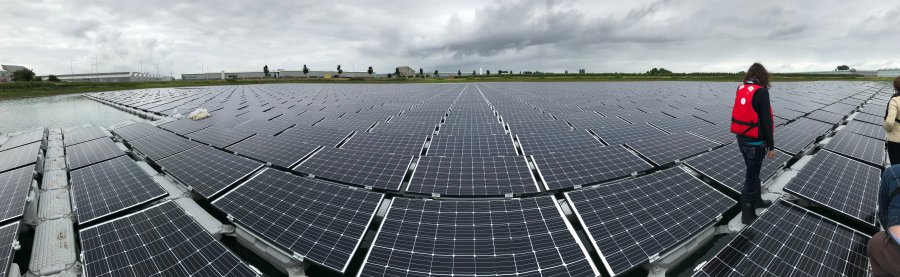
These systems, which I can briefly refer to as “Floating Solar Power Plants,” are known in English as “Floating Solar Energy Systems,” or simply “Floating Solar.”
Because I want to address this topic from many different perspectives, I’m going to dedicate two articles to floating solar power plants. This first article will be more of an introduction. I will introduce you to the concept and provide comprehensive assessments of floating solar power plants. In the second article, I will delve into the technicalities of the process and provide more details on this aspect.
The most important element of the energy revolution, the “replacement of fossil fuels with renewable energy,” continues unabated. Thanks to the rapidly expanding greenhouse gas reduction and climate policies supported by nearly all countries worldwide, solar energy technologies, along with wind energy, are leading the way toward eliminating fossil fuels. The image below demonstrates this trend, which has been ongoing since the beginning of the 21st century.
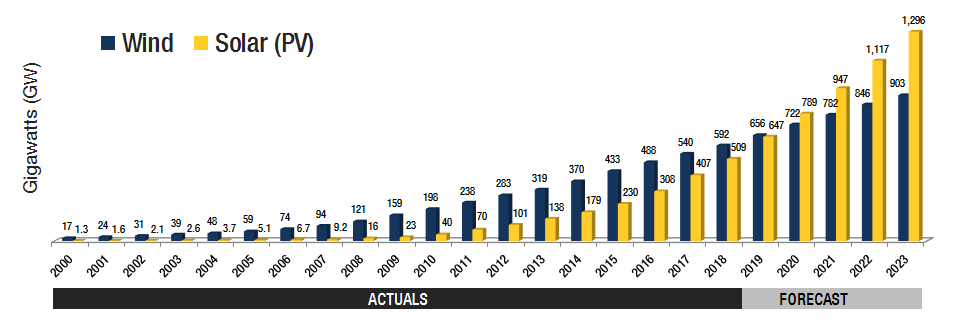
Source: Forecast International’s Energy Portal: http://www.fi-powerweb.com/Renewable-Energy.html
The increasing prevalence of solar energy installations is inevitable. Because solar energy has the technology and equipment to support both centralized and distributed systems. In this sense, solar energy installations are rapidly increasing in both power plants and rooftop installations that provide on-site production and consumption.
On the other hand, we are also witnessing many different models beyond the traditional power plants and rooftop applications. In this article, I will highlight floating solar power plants, which are gaining popularity in the sector and whose installations are rapidly spreading.
While the history of solar panels dates back nearly a century, floating solar power plants have only been in use for a little over a decade. More specifically, the first commercial floating solar power plant was installed in a vineyard in California, USA, in 2006. While other floating solar power plants were installed in Japan, France, and India that same year, these were all experimental systems.
The purpose of the system, installed over an irrigation canal in a California vineyard, was to expand the existing ground-mounted solar panel system without sacrificing acreage for grapes. This solar-powered system, completed by installing 1,000 floating panels with a total output of 175 kW, eliminated the vineyard’s energy consumption. Moreover, by planting additional grapes on three acres of land that would normally be covered with solar panels, an annual wine yield of $150,000 was achieved.
Incentive-Driven Expansion
Although the first commercial prototype was launched in 2006, almost no other floating solar panel systems were installed until 2013. However, after the 2011 Fukushima disaster in Japan, the Feed-in-Tariff (FIT) mechanism was implemented in 2012, and floating solar power plant installations began to proliferate, with other countries offering similar incentives. At the time, the FIT for floating solar power plants in Japan was an astronomical 53.4 cents/kWh, and by the end of 2013, only 45 new installations had been completed in Japan alone. From 2013 to the present, the installed capacity of floating solar power plants has continued to grow exponentially. For example, in 2013, 1.18 MW was installed globally, this number rose to 4.9 MW in 2014, 34.6 MW in 2015, 53 MW in 2016, and as of September 2018, the total floating solar power plant capacity worldwide reached 1.1 GW. (Solar Energy Research Institute of Singapore SERIS)
While the rapid expansion of floating solar power plants stemmed from incentive mechanisms offered by countries, the rapid decline in turnkey solar power system prices, and the ever-increasing efficiency of PV panels, the fact that they offer advantages unparalleled by any other solar power system was also a significant factor. Creating new space by utilizing water surfaces that might otherwise be considered unused, and converting vast areas such as dams, seabeds, lakes, and water channels into solar energy, offered significant advantages.
Advantages of Floating Solar Power Plants
For example, as I just mentioned, Japan, an island nation with a surface area of 377,973 km2, is home to a population of over 125 million. This means that space is limited. With the growing awareness of renewable energy after the Fukushima disaster, it’s natural for Japan, as an island nation, to prioritize floating power plants. Utilizing the Pacific Ocean, which surrounds the Japanese islands, as additional land for floating solar power plants makes perfect sense.
Furthermore, by shielding an area covered with floating solar panels from sunlight, evaporation on that surface can be reduced by up to 80%. This allows for slower water levels in dams, increased water flow through irrigation channels, and additional energy for water treatment plants. Another key feature of this system is that the capacity factor of a floating solar panel system (using the same technology) is 7.6% to 13.5% higher than that of a solar power system installed elsewhere on land. (Young-Kwan Choi, 2014) This is because the panels operate more efficiently at lower temperatures and because water acts as a natural coolant.
Other advantages of floating solar power plants include lower investment costs due to the absence of expropriation costs. They block sunlight, reducing algae growth in stagnant waters, keeping the water clean. Their modular structure and eliminating the need for a foundation allow for faster installation.
Disadvantages are minor
Besides all these features, this system also has some minor disadvantages. For example, because floating equipment is much more exposed to hydraulic and weather conditions than other solar systems, electricity production is somewhat more unstable. Furthermore, even though floating equipment is made of durable and environmentally friendly materials, water can erode the system over time, shortening its lifespan. There are also differences between the effects of saltwater and freshwater, with offshore installations experiencing a higher rate of wear and tear.
Finally, depending on its location, it can interfere with some fishing and transportation activities. However, this is relative. In other words, any floating power plant can be bypassed under normal circumstances.
These disadvantages are mere trifles when considering its advantages. Installation on water increases panel efficiency, saves space, and prevents water evaporation, thus offering significant advantages in every respect.
The largest floating solar power plant to be officially approved and begin supplying electricity to the grid was built in Anhui, a former coal-producing region in China, by the government-owned CECEP. The system has a total installed capacity of 70 MW and was implemented in collaboration with French company Ciel-et-Terre, the world’s largest floating solar panel technology and EPC company.
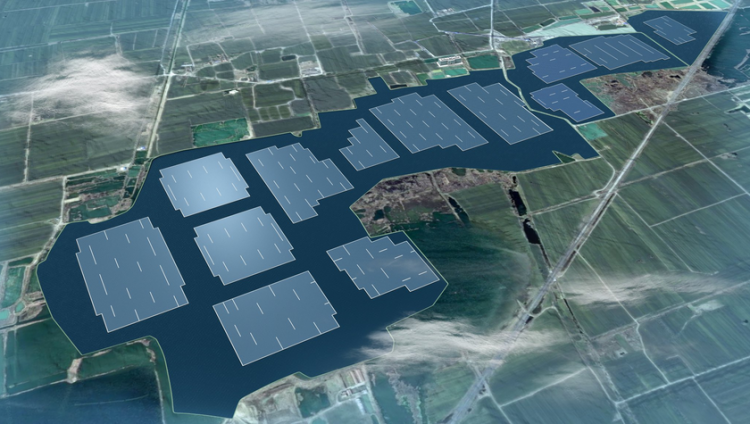
70 MWp floating power plant complex in China: CECEP
Meanwhile, a floating solar power plant with an installed capacity of 150 MW is being built in the same reservoir by the Chinese company Three Gorges New Energy, and a portion of it has already been connected to the grid. Upon completion, Three Gorges New Energy will own the world’s largest floating solar panel system.
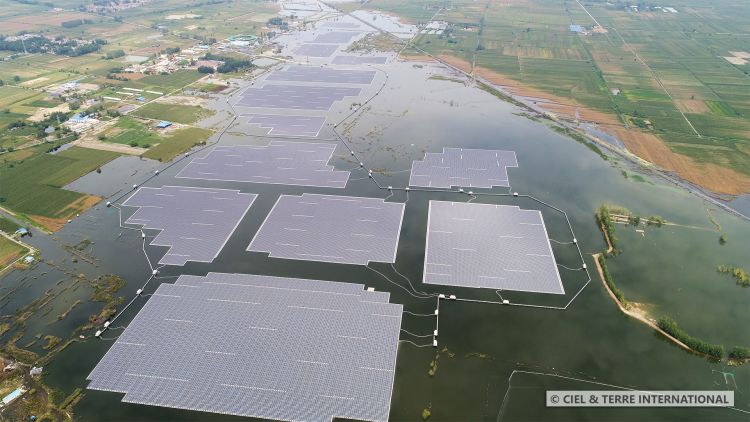
Floating power plant being built on the Three Gorges Dam in Anhui, China
We are also witnessing successful initiatives in our country, as an example of floating power plants. The young company TYT (Clean Creative Technologies) is leading the way in this area. It’s worth getting to know this company, founded by Barış Arıcı, Cemil Cihan Özalevli, and Bilal Taşçı, members of the Young Guru Academy (YGA) leadership team, and confidently progressing with installations in various locations across Turkey: https://www.tyt.com.tr/
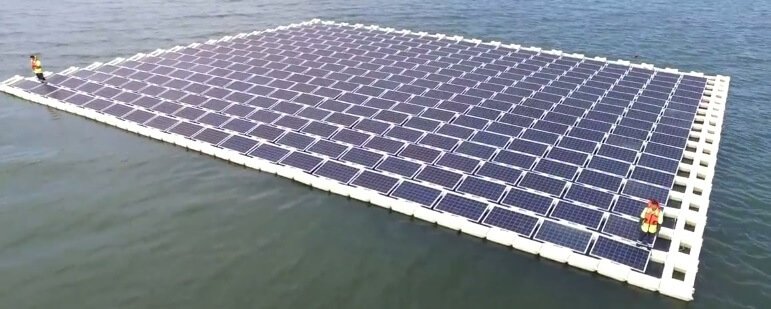
Image of the floating power plant built by TYT on Lake Büyükçekmece in Istanbul for the Istanbul Metropolitan Municipality (IMM).
I’m personally very pleased with the work and success of these young people with good character and a desire to make a difference. Good luck, young people!
The rise of floating solar power plants, which I mentioned only gained momentum after 2013 despite officially launching in 2006, looks set to continue. According to a market analysis by Credence Research, the floating solar power plant market value in 2016 was only $0.16 billion, and this figure will reach $1.6 billion by 2022. This means the floating solar power plant market will continue to grow at an annual rate of 113.9% every year. The pace and duration of this growth will depend on future policies, our pace of technological advancement, and our desire to transition away from fossil fuels. I hope this is the best for our country and all countries.
Hybrid regulations are expected to be enacted in our country soon. The sector expects the regulations to be issued this year. If they are implemented, we are likely to observe a significant increase in hybrid hydropower plants. All the best.
The increased use of floating power plants and many other renewable energy models is critical to leaving a world free of climate change concerns for future generations.
See you in my next technical article on floating solar power plants. Stay well.
References
- https://www.pv-tech.org/news/worlds-largest-floating-solar-plant-connected-in-china
- https://www.worldbank.org/en/news/press-release/2018/10/30/floating-solar-opens-new-horizons-for-renewable-energy
- https://www.researchgate.net/publication/321461989_The_global_evolution_of_floating_solar_PV
Tag: energy