
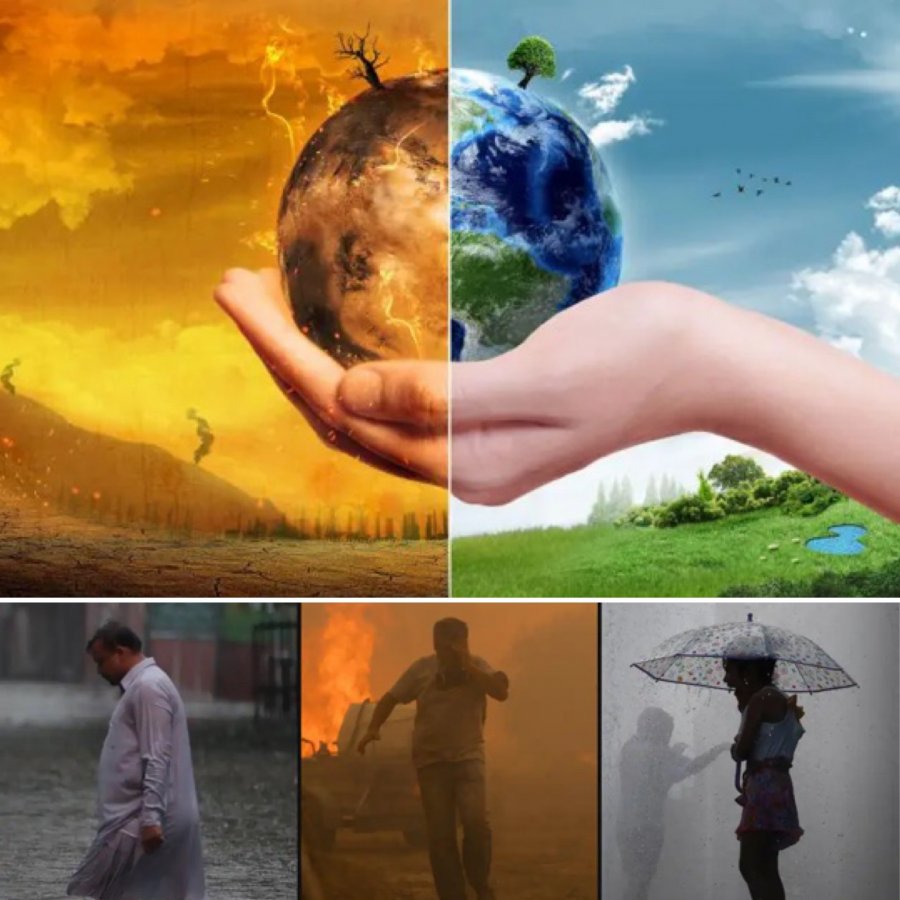
This is actually a very long and detailed article. I’ve addressed this topic many times in the past. In this article, I’ll summarize it more for ease of reading. First, if you haven’t read the previous article, I recommend reading it at https://www.serhansuzer.com/tr/sicak-cok-sicak-daha-da-sicak-olacak . In that article, I made observations about the global boiling point. Let me also briefly share with you the news that June and July were the hottest months on record, so we can refresh your knowledge:
June 2023:
I’m sharing the news item titled “World’s Hottest June” published in Ekosfer:
https://www.instagram.com/p/CujJ5CvA8IC/?igshid=MTc4MmM1YmI2Ng%3D%3D
News Spotlight: We’ve left behind the world’s hottest June. According to data from the Copernicus Climate Change Service, the surface air temperature in June 2023 was half a degree Celsius above the average for the period 1991-2020. The warmest Junes in history have always occurred in recent years, with the previous record being set in 2019. The recent and consistent breaking of these records is a concrete indicator that the Earth is gradually warming.
July 2023:
I’m sharing the news article titled “July may be the hottest month in 120,000 years” published in Popular Science Turkey:
https://www.instagram.com/p/CvsduJhNo-L/?igshid=MTc4MmM1YmI2Ng%3D%3D
News Spotlight: Scientists’ calculations indicate that July 2023 will be the hottest month on record, and the hottest month humanity has ever experienced will likely be July 2023. Two weeks ago, the United Nations’ World Meteorological Organization (WMO) and the European Union’s Copernicus Climate Change Service announced that July’s temperatures surpassed record levels.
Such records track average air temperatures worldwide. According to a UN report, the average temperature in the first 23 days of July reached 16.95°C, surpassing the previous record of 16.63°C set in July 2019. These records date back to 1940, but many scientists believe the latest readings are almost certainly the warmest in the last 120,000 years. These values, based on data collected from coral reefs, deep-sea sediment cores, and tree rings, paint a picture of past climates.
I also first wrote about what needed to be done to reverse climate change in 2012. I also recommend reading this article: https://www.serhansuzer.com/tr/insanoglu-dogadaki-dengeyi-yeniden-nasil-saglayip-gelecegini-teminat-altina-alabilir . Let’s briefly recall the 12 points in this article. I’ll add some to these points where I deem necessary and list my additional points later:
1) Adjusting the capitalist system
A capitalist system based solely on consumption can be considered the primary cause of climate change in our world, considering the growing population and the limited resources on Earth. The current capitalist system needs to be changed and modified for a sustainable life. I will write about this in detail later.
2) Providing 100% of our energy needs from renewable energy sources
This issue is beyond debate. I wrote this 11 years ago. I’ve been saying this for over 20 years. The world’s entire energy needs should be met by renewable energy. The only problem here is that countries avoid taking responsibility and set very distant targets like 2050. These targets need to be pushed back to 2030 or earlier. Politicians, as usual, are shirking their responsibilities and workload. Some are simply too clever and have limited vision.
3) Energy Efficiency
The ideal model is clear. We need to optimize our energy consumption through energy efficiency (by changing our technology and consumption habits) and meet this minimized need with renewable energy.
4) Using Fossil Fuels as Raw Materials
We need to stop using fossil fuels as an energy source as soon as possible. The model is simple and perhaps more profitable for those with fossil fuel resources. Oil needs to be used in the petrochemical sector (to produce plastics, etc.—not disposable plastic, but plastic that will be continuously recycled and reused), and natural gas needs to be used in fertilizer or hydrogen/carbon production.
I’ll add this to my 2012 article because technology and my knowledge are evolving: This is a new technology. Hydrogen should be produced from natural gas and used as an energy source (providing a base load) (burning it produces water vapor), while carbon dioxide should be used as a raw material in sectors where it is needed (such as the soda industry). In other words, instead of burning natural gas and increasing carbon emissions, it is possible to separate it and produce hydrogen, a carbon-neutral energy source, and use the carbon as a raw material.
5) Completely revamping urban planning and buildings
It is possible to design and build urban planning and buildings in a completely sustainable manner. Beyond discussing self-sufficient net-zero (or even net-negative) buildings, I plan to act in the future. We will all see the results.
6) Transitioning vehicles to solely solar-electric
I would like to add this point. Small and medium-sized vehicles with relatively low energy requirements, such as cars, minibuses, and trains, will soon be solar-electric (i.e., they will not only be electric but will also have solar cells onboard). Heavy vehicles such as buses, trucks, ships, and airplanes will also be hydrogen-powered/solar-electric. Hydrogen will be considered a storage element, and heavy vehicles with high energy needs and therefore high storage requirements will also be powered by hydrogen in addition to batteries. When needed, the hydrogen in the hydrogen tank will be burned by a fuel cell and converted back into electricity to meet the need.
7) Environmental Awareness Education
Beyond providing environmental awareness education to everyone from kindergarten to doctoral students, I believe it is necessary to provide environmental awareness education to everyone of all ages. This training must be repeated at regular intervals.
8) Everything used must be integrated into the natural cycle and made sustainable.
We need to teach people that everything produced must be recycled into the natural cycle, and we need to make the necessary technologies available for this purpose. Let me give you an example: Technologies for utilizing our organic waste, just like refrigerators, should be in every home. People should be encouraged to recycle their organic waste.
9) Population growth must first be halted, then gradually reduced.
I stand by this statement. A topic I’ve been raising for years is now being discussed more frequently. Let me illustrate with a news article titled “We’re Consuming 1.7 Earths” that I came across on Ekosphere’s Instagram page on 2 August:
Today is Earth Overshoot Day. As of 2 August, we’ve exhausted the resources the Earth has provided us for a year. The Earth won’t have the chance to replenish the natural resources we’ve consumed for the rest of the year. We must reduce consumption and protect the planet.
The Earth’s capacity to replenish the natural resources consumed in a year is certain. Yet, we live as if there were 1.75 Earths. According to data from the Global Footprint Network, we are living on borrowed resources from the future from now on (See: https://www.instagram.com/p/CvcO-MHrxi5/?img_index=1 ).
I want to add one more thing to all these statements. If population growth cannot be stopped, migration to other planets must be facilitated. Projects that will enable humanity to migrate to other planets as soon as possible, starting with Mars, must be created and encouraged.
10) Reducing paper use as much as possible and increasing plantations
I have been saying for years that everything will be digitalized. In fact, paper money will disappear. As a concrete step towards this goal, I founded Moka, one of Turkey’s first fintech companies. I sold it to İş Bankası in 2021 and made a successful debut. All forms of paper, including banknotes, will disappear; everything will be digital, that’s for sure. Furthermore, I emphasize the need to plant trees and other plants to absorb carbon from the atmosphere. I’m not talking about simply planting trees or plants. I’m talking about planting billions of trees and various types of plants across a certain geography. Only this way can we quickly reduce carbon emissions to normal levels.
I have one more thing to add to all this talk. New technologies that absorb carbon like trees have emerged. We need to extract carbon with this specialized equipment and use it as raw materials for specific sectors.
11) Exploring the Universe and Exploiting the Blessings of Space
After a certain period, the entire world will cease to be used as a vast mining field. Instead of riddling our planet with holes, we will focus on the ore in space. Those who pioneer this field and possess technology will achieve significant wealth.
12) Full Support for R&D from the Public and Private Sectors
The importance of technology is obvious. R&D will be addressed not only by government institutions but also by all private sectors and even NGOs, and all of humanity will engage in a collective effort to improve their work. In fact, teamwork will be played in various sectors worldwide.
In addition to some additions I’ve made to these 12 points, I’d like to add three more:
13) Creating a protective shield for the Earth, like the ozone layer.
If we assume that the impact of solar radiation will continue to increase, the worst scenario here is that, in addition to the evaporation of water on land due to global warming, the sea will begin to evaporate, and this vapor, already escaping into the atmosphere, will leak into space if there is a leak. If Mars once had water and the planet dried out, all countries must work together to create that shield that will protect our Earth. The first task of this protective shield can be thought of as creating a mechanism that will allow us to control the increasing solar radiation that initiated the global boiling period and even generate energy from it.
14) Dealing with viruses, bacteria, and fungi.
As the weather warms and the glaciers melt, it’s not surprising that we will encounter new viruses, bacteria, and fungi. To prevent such a nightmare scenario, the necessary scientific studies must be initiated immediately to eradicate, if necessary, viruses, bacteria, and fungi. Numerous studies are currently being conducted in many different countries, but these are completely insufficient in both quality and quantity. In other words, even at this current stage, we are losing the battle against viruses, bacteria (which are becoming more resistant to antibiotics), and fungi. If even worse emerges in the future, we will be devastated; this could even threaten humanity’s very existence. Now, some readers will question how this relates to climate change. I want to remind them that viruses, bacteria, and fungi are not the cause, but the result. Therefore, when climate change occurs, we will need to combat not only its causes but also its consequences. We must take precautions now.
15) Preventing abnormalities in our seas (including oceans)
Special studies need to be conducted for our seas, which are constantly warming, rising, and whose oxygen levels are decreasing due to climate change. We need to consider how to stop the melting of glaciers, how to prevent pollution and warming in the seas, and how to increase oxygen levels in the seas. We need to consider these and implement them one by one. Let me give you an example of what can be done: We can start by shutting down nuclear power plants that heat the sea and pollute industries.
Of course, there will be many more items to add to these 15 points. I will update this over time. I call on all relevant institutions, organizations, and authorities (including the private sector and NGOs) to take action to ensure that the things I’ve written here begin to be implemented without delay.
Tag: education