
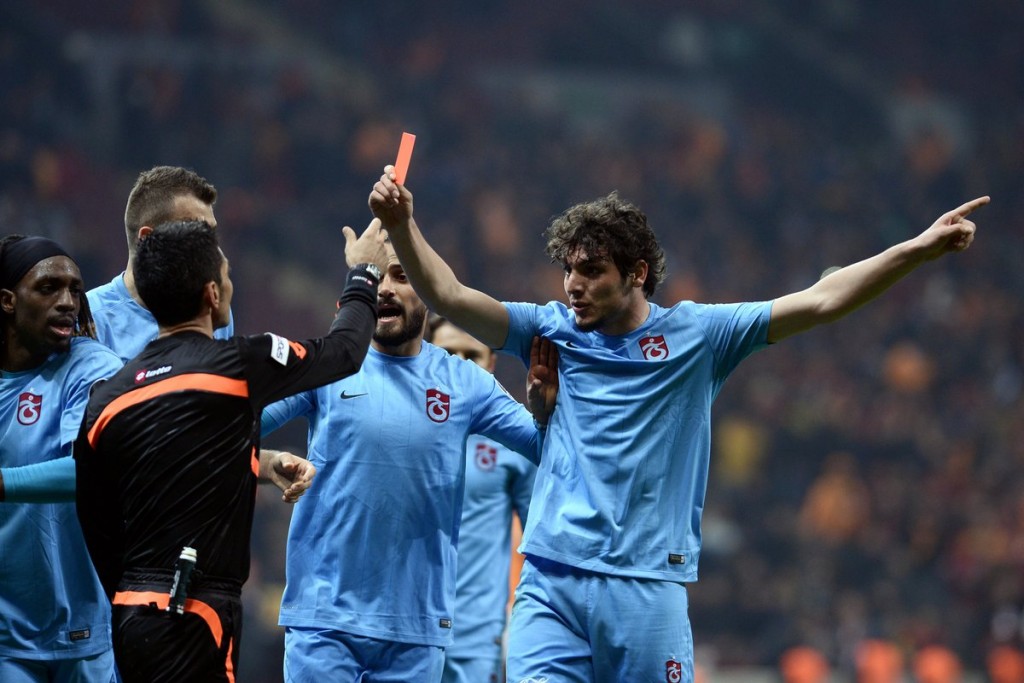
For those who don’t know, let me explain right away. The soccer player you see in this photo is Salih Dursun, a licensed player for Galatasaray. This season, he was loaned to Trabzonspor. In the second half of a game against his former team, Galatasaray, he made headlines when he snatched the red card from the referee who had sent him off, held it up to the referee’s face, and pointed toward the sideline, effectively telling him to “get out.” Some people even went so far as to suggest erecting a statue of him in Trabzon for “standing tall against referee injustice.”
As a Galatasaray fan and someone whose mother’s family is from Trabzon, you’d think I would have a soft spot for Salih Dursun, right?
Quite the opposite. I have no liking for him at all. In fact, I think he should quit soccer at a young age because of this irresponsible stunt. Why?
Because soccer is a stage, and millions of people are watching you. Everything you do influences society—either for better or worse. And in my view, Salih Dursun’s action set a bad example for the public. Even worse, instead of being condemned for this wrong move, he was celebrated by a large portion of society, praised as a hero, and even carried on people’s shoulders.
Here’s what that really means: soccer players and aspiring players received the message that “even if you make such an unsportsmanlike move, you can still be hailed as a hero.” That is completely wrong. Actions like this can encourage more attacks on referees. Our soccer, which already has more than enough fighting, brawls, and disputes, urgently needs to be cleansed of such behavior.
If you are a professional soccer player, you are obliged to follow the rules of the game. Even if every single whistle the referee blows is wrong, you still must act according to the rules. And the rules say: “On the field, whatever the referee says goes.”
It’s not just Salih Dursun. There are many other players out there who frequently engage in this kind of problematic behavior—players known for their aggression, who constantly stir up controversy and fuel tension between sides. I can quickly give examples from the “big three” clubs.
Let’s start with my own team, Galatasaray, and Melo, who’s a real troublemaker. Constantly picking fights, causing disputes, and stirring up arguments.
Frankly, I was quite pleased when he transferred to Inter, because—as we’ve always said—he was a player whose conduct was against the spirit of sport. He even took his aggression so far that, after a training session, he beat up his teammate Riera in the locker room. And how did Galatasaray’s management react? They swept the incident under the rug, worried that “the championship might slip away,” and kept playing Melo. In my opinion, this was a disgrace for Turkish soccer and for the club’s administrators. If only they had terminated Melo’s contract that very day and thrown him off the team; even if we had lost the championship, I would have been prouder of my club. I don’t share the views of those Galatasaray fans who idolize Melo and support him no matter what. What’s the excuse? That he’s a “warrior.” But is “warrior” supposed to mean starting fights on the field, or battling through soccer itself? Some say his antics “fired up” the team. To those who think that way, I ask: Does Galatasaray really need fights and brawls to be fired up? Is this the method of a club that has been in competition for over a century, that prides itself on the spirit of Metin Oktay, and that has raised thousands of athletes that it should be using to motivate its players? To me, Melo’s damage to the spirit of sport and to Galatasaray far outweighed any benefit he provided.
Other bad examples include Fenerbahçe’s goalkeeper Volkan Demirel, Emre Belözoğlu (now playing for Başakşehir), and Beşiktaş’s İbrahim Toraman (now at Sivasspor).
Especially İbrahim Toraman. Since it was reported in the press, I can write about it here: İbrahim Toraman’s wife, Eylem Yıldız, filed for divorce, claiming he had physically assaulted her.
You can read the news articles published in Hürriyet at the link below:
http://www.hurriyet.com.tr/eylem-toramandan-esi-ibrahim-toramana-agir-suclama-40062059
http://www.hurriyet.com.tr/eylem-yildiz-gordugu-siddeti-canli-yayinda-anlatti-40065267
I know Eylem personally. I’m also acquainted with her family. She’s a good person—straightforward and genuine. She grew up in Germany, and I can even say her German is better than her Turkish. She’s well-educated and works as a lawyer. That’s about all I can tell you about her. When I heard she was marrying İbrahim Toraman, I remember saying, “May God help her. İbrahim is very aggressive and is always looking for a fight. On top of that, there’s a clear gap in their educational backgrounds.” Unfortunately, I wasn’t wrong about that either. I hope from here on she can build a new life she deserves. As for İbrahim Toraman, he continues to play for Sivasspor. In my opinion, a man who raises his hand to a woman—let alone the mother of his child—is no man at all. He is a bad example to society, and for that reason, I believe he should retire from soccer.
Unfortunately, there has always been a fascination with bad characters in our society. In school, hardworking students are mocked as “nerds,” while students who aren’t successful in class—or even lack the mental discipline to succeed—are labeled “cool” because of their mischievous nature. In soccer, players and commentators who constantly stir up conflict and fights are held in high regard. These are just a few examples of the same mentality.
It’s high time for this mindset to change. Atatürk put it perfectly when he said, “I like the athlete who is smart, agile, and virtuous.” In my opinion, that is exactly how it should be.
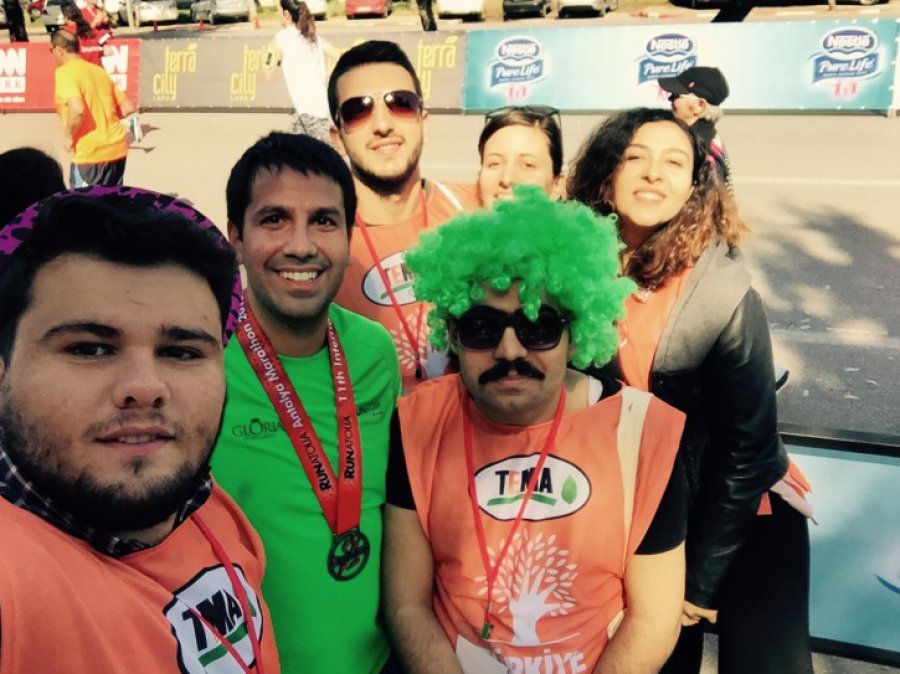
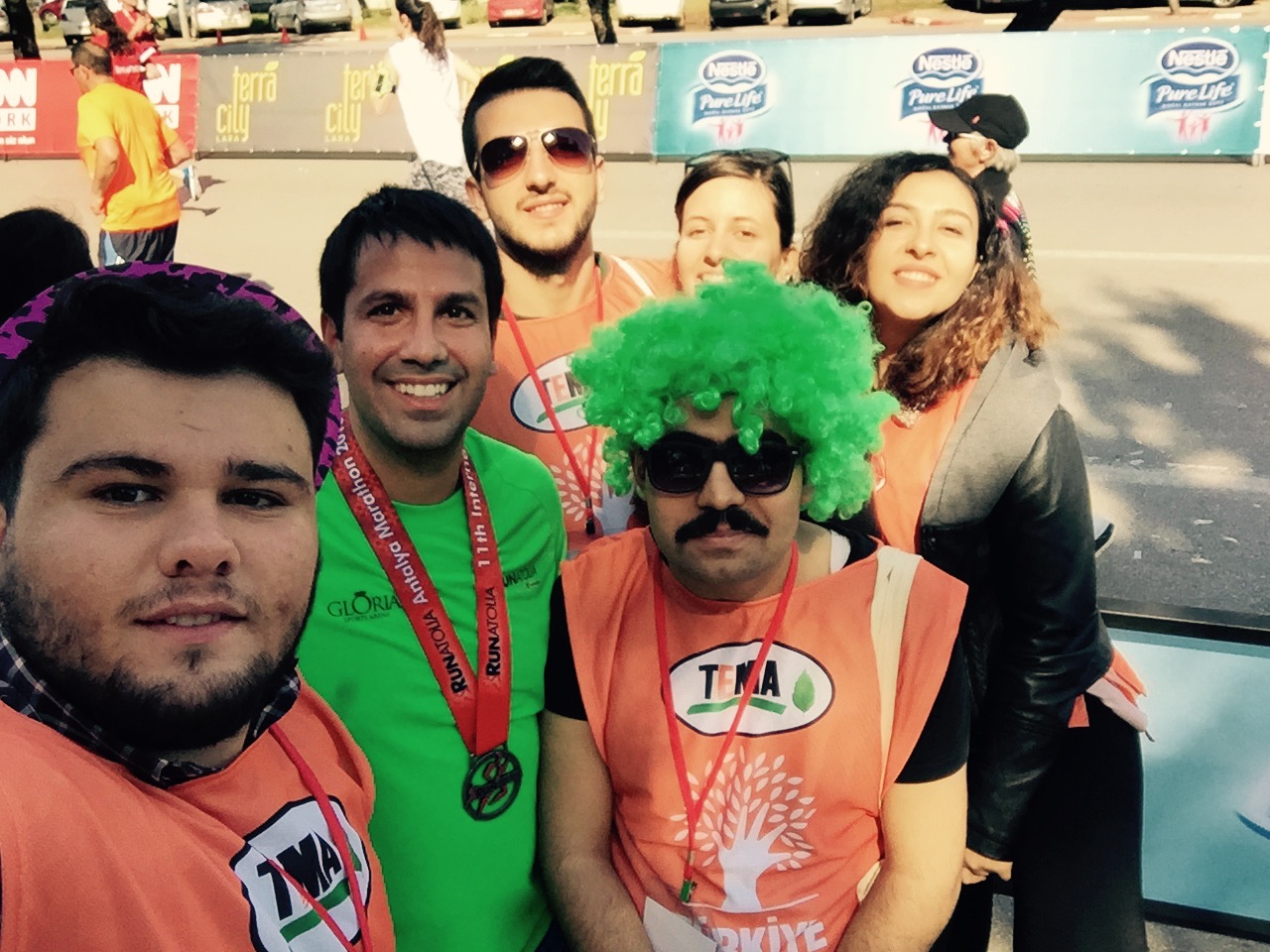
To illustrate what sports should really be about, let me tell you about the Antalya Run (Runatolia) I participated in last weekend. When I ran into my high school physical education teacher, Bülent Hoca, at the Eurasia Marathon, he asked me, “Are you running in Antalya this year?” I told him I had run in Antalya two years ago but hadn’t yet made any plans this year. He then said, “Why don’t you come with us?” Bülent now heads the Spa and Fitness division at Swissotel Istanbul. So when he said, “Why don’t you come with us?” what he really meant was, “Why don’t you come with the Swissotel group?” Smiling, I asked him, “How would you feel about having someone from The Ritz-Carlton in your group?” He laughed and said, “We’d welcome it.” And so, last Saturday morning, after giving a talk at Eskişehir Anadolu University, I took the train to Ankara, then flew to Antalya. That evening, my old army buddy and longtime friend Ozan met me at the airport. We spent the night catching up over coffee at Ülkü Cafe. I’ll admit, after enjoying a delicious slice of trileçe the night before the race, I felt more than ready to run. ☺ On Sunday morning, I joined the race with a group comprised of Swissotel executives and their clients.

The run, with its pre- and post-race activities, felt like a true festival. People had come to have fun, to benefit (hundreds of people participated in the run on behalf of civil society), and to get some real exercise.



This is precisely where sports should be. Sports is not just about winning. Sports is not, and should not be, a battle for dominance. Those who perceive it this way are gravely mistaken.

Let me give you another example from the same race to illustrate what an athlete should be like.
Throughout the 10 K run, I kept checking my watch to pace myself and made sure to maintain a steady rhythm. I ran each kilometer in about five minutes. During the race, I came across a sports announcer I recognized, wearing a CNN Türk T-shirt. From the 3rd to the 8th kilometer, we essentially ran together—sometimes passing each other, sometimes side by side. Then, at the 8th kilometer, something remarkable happened. I’m not exaggerating—someone I estimated to be over 70 years old passed us. Just when I was thinking my pace was perfectly fine, seeing him run past made me think, This won’t do, I’d better pick it up. I sped up and caught up with him. Judging from his clothes and steady breathing, I guessed that this 70-something gentleman was a former athlete. When I reached him, I couldn’t help saying, “Well done!” and shook his hand. We continued running together. Since I hadn’t trained, I had already started feeling fatigued after the 6th kilometer, and by the time there were only 800 meters left, the signs of exhaustion were much more obvious. The 70-year-old man running beside me noticed I was running out of steam and said, “Come on, get your breath together—we’re almost at the finish.” His words gave me a sudden burst of energy. In an instant, the tired Serhan was gone, replaced by a runner with renewed strength, and I broke into a sprint. Running at 12 km/h, I suddenly accelerated to 15 km/h, overtook six or seven people ahead of me, and finished the race in just under 50 minutes. Without losing any momentum, I headed straight back to the hotel and, that afternoon, even made a site visit to our project in Kaş, Antalya.
What I’m getting at is that the true spirit of an athlete was embodied by that 70-year-old gentleman—a man who had never given up sports his entire life, who could put many young people to shame, and who motivated those around him. This is what real sportsmanship is about: as in the case of the Antalya Run, it’s about truly engaging in sport, contributing to society, and also having fun and enjoying yourself in the process.
In the past, I’ve written about ways to solve the problem of sports being perceived solely as winning and overpowering the opponent. You can find the link to that article below:
http://www.serhansuzer.com/2015/04/23/turkiyede-sporun-kendi-ozuyle-imtihani/#more-1391
In conclusion, the solution lies in education—parent education, training the trainers, and taking the education of children and young people much more seriously.
Personally, I try to do my part as much as I can. What exactly am I doing? You’ll have to wait for my next article to find out.
So long for now.
Tag: sports