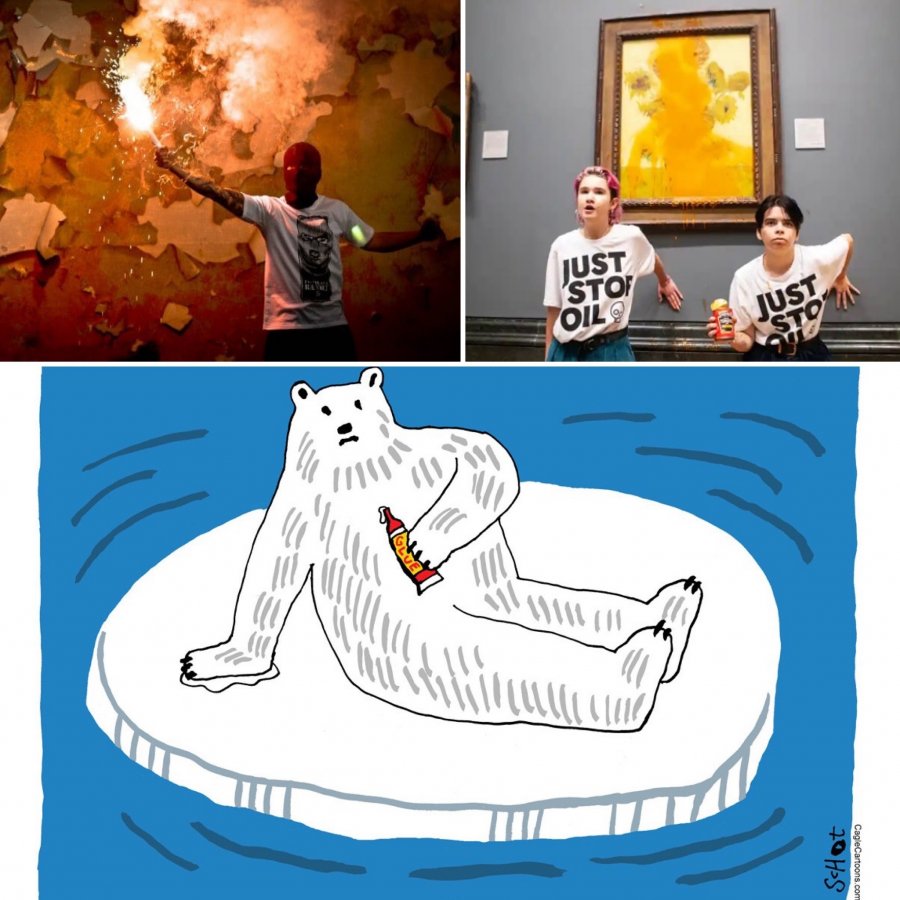
In recent months, we have witnessed numerous shocking acts, such as splashing paint on artworks and sticking oneself to the frame of a painting. Security officers then put an end to this classic act of vandalism (vandalism, or vandalism as a movement, is the act of intentionally and deliberately damaging personal or public property, vehicles, or products), seizing the protesters and initiating legal action against them. The protest, the slogans chanted, the security officers’ intervention (sometimes harsh, sometimes persuasive), and the removal of protesters from the scene have become commonplace and distressing. Here are some examples of these actions we’ve witnessed recently, which are, as the saying goes, “making a splash” to draw attention to the cause of climate change:
Some actions by “Just Stop Oil,” a coalition of groups working together to ensure the government commits to ending new licenses for the exploration, development, and production of fossil fuels in the UK: https://www.instagram.com/reel/ClOHdjCIe3_/?igshid=MDJmNzVkMjY
Another example is the video of one activist throwing black liquid on Gustav Klimt’s famous “Death and Life” at the Leopold Museum in Austria, while another attaches himself to it: https://www.instagram.com/reel/ClB4rfaJ9KP/?igshid=MDJmNzVkMjY
Interesting statement from ICOM
While all these absurd protests were taking place, last month ICOM (International Council of Museums) I was personally surprised by its statement titled “Museums and Climate Activism:”
https://icom.museum/en/news/icom-statement-climate-activism/
ICOM’s message, which you can read at the link above, summarizes the following points:
- ICOM wishes museums to be seen as allies in combating the shared threat of climate change.
- ICOM reminds us that we need bold action to reduce carbon emissions and global warming.
- We must act together and collectively for our planet, because solving the climate problem is impossible without transforming our world.
What more could have been said?
Here, they’ve taken a more neutral stance and said, “We also support the fight against climate change,” but I would have expected them to at least say the following:
Damaging these works of art, which are cultural heritage, or pretending to do so (almost all the paintings have protective glass) is a form of violence. Such acts of violence have no place in art, which fosters human development and heals the human spirit. As the council, we fully support the fight against climate change, but we emphasize that these protests against fossil fuel use must be carried out using non-violent methods that garner the support of the entire arts community.
We could give many other examples of these incidents. This is the case of a climate activist who climbed onto a table and glued himself to it during a talk show. After this act, which I found absurd, the program’s moderator went to a commercial break and removed the top of the table where the activist was sitting (they later removed the activist by turning the table sideways). The program resumed after the commercial break: https://www.ndtv.com/world-news/video-climate-activist-glues-himself-to-table-during-talk-show-3468256
Proposal to join forces
Let me share some examples from my own experience. I’ve been supporting major environmental organizations since the 1990s. I received a call one day in the early 2000s from an environmental organization that has undertaken significant work worldwide, let me keep its name (I’ll call it FSTK). The conversation went something like this:
– Good afternoon. I’m calling from FSTK. My name is “…” Next week, we will chain ourselves to the “…” Bridge to protest the “…” environmental disaster. Would you like to join us?
– Thank you for the invitation, but I don’t think such a protest would be successful. Besides, I prefer not to be involved in such actions. Could you try other ways to protect this environmental disaster? Or couldn’t you think of actions that would highlight proposed solutions to fix this problem?
– What? We’re trying to attract the attention of decision-makers and the public with these actions.
– You can also attract attention in other ways. Also, if you chain yourself to the “…” Bridge, you’re likely to be arrested. You’ll be harmed and you’ll be distracted from what really needs to be done in this environmental case.
– What is the real need to be done?
– You can take actions to support renewable energy. You can make an extra effort to publicize the consequences of this environmental disaster (such as carbon emissions).
– These actions will not yield any results.
– If you stand behind them, they will. Anyway, I won’t hold you back any longer. I wish you success in your endeavors, but I want to reiterate: You might receive the opposite reaction because of such harsh actions. I urge you, one last time, to act with a focus that will encourage what needs to be done. Good luck.
– Thank you, I will convey these comments to the management.
Being perceived as wrong when you’re right
Ultimately, this action took place, and unfortunately, we had to watch as the friends who chained themselves to the bridge were taken into custody by the police. The public reaction (I asked everyone from taxi drivers to supermarket employees about this incident back then) was, “Why are these people doing such ridiculous things? Don’t they have other things to do? They’re damaging public property. Should I listen to the kids who chained themselves to the bridge, or to credible businesspeople or politicians?”
But the young people were right. Being young already suffers from the difficulty of having their words heard, but with this action, instead of the public taking notice and reacting to them, they have drawn the opposite reaction and damaged such an important environmental cause.
A ridiculous coal power plant project
I experienced the exact opposite of this in the 2010s. One of Turkey’s major holding companies was hell-bent on building a coal power plant on one of the Black Sea’s idyllic beaches. I remember lamenting to myself when they first launched this coal power plant, “They’re talking nonsense! Does this holding company even need such a coal power plant?” Not long after, a few months later, a close friend of mine, the Turkey director of an international environmental organization, called me about this, and we had the following conversation:
– Serhan, “…” Holding is planning a very large-capacity coal power plant in the Black Sea. They’ll be importing coal from Russia. Did you know?
– I read it in the newspapers.
– Just so you know, there will be major protests about this. International environmental organizations aside, the local people don’t want such a coal power plant because it will destroy their natural environment. Everyone is in contact, and small protests have begun, but this will grow significantly. Do you have a chance to know the owner of this “…” Holding? It occurred to me that maybe you could talk to them while the road is still open and talk them out of it. These incidents would seriously harm their other businesses, as there’s been a huge backlash against this project, both nationally and locally.
—Of course, I’d be happy to talk to them, but frankly, I don’t think I can talk them out of it. Still, I’ll try.
After sincerely saying “I’ll try” to my friend, who I knew wasn’t joking about this, I called the owner of the holding, “…”, who was also my father’s friend. Because we’d met as a family and he personally valued me, Mr. “…” gave me an appointment five days later.
Meetings with the Board of Directors and Energy Group Chairs
During the meeting, I explained the issue very quickly, in an introduction, body, and conclusion format. In short, I explained that they needed to abandon this project; otherwise, not only would the energy business be negatively impacted, but the resulting environment would also create a serious negative perception, and their other businesses would suffer as well. I sincerely had two goals in this meeting. First, to stop the coal power plant that would cause this environmental disaster. Second, to prevent further harm to this family, for whom I personally sympathize. My father’s friend, Mr. “…”, listened attentively for 45 minutes, thanking me at the end and asking me to have the same conversation with the energy group presidents. He explained that he was the decision-maker on this matter and referred me to him. A few days later, I met with the energy group president.
The problem was this: The head of the energy group, a close relative of the holding company’s chairman, had a “more royalist attitude than the king.” With a “I know the energy business very well” mentality (and as one of the first to initiate solar energy in Turkey, I can say he didn’t know the sector well and lacked a vision), he said, “These protests don’t matter; they’re here today, gone tomorrow. We will build this project, which will contribute significantly to the Turkish economy.” I tried to explain to him that it would cause significant damage to both the energy business and the entire holding company. I advised him to focus on solar and wind energy instead of coal-fired power plants. He wouldn’t even listen to what I said. This obsessive and egotistical energy group president had already made up his mind and gave the impression that he was meeting with me just to avoid embarrassing his boss.
The negative consequences of this false insistence
The meeting ended in great disappointment for me. Frankly, I didn’t expect a positive outcome, but I also didn’t expect such a single-minded, insistent approach to the coal plant, saying, “We’ll do it under any circumstances.” After the meeting, I called my friend, the director of an international NGO, and said, “I met with the holding company’s chairman of the board and then the head of its energy group, but nothing positive came of it.” Personally, I was upset because a situation had been created that would harm many people under any circumstances, and I couldn’t prevent it. My friend, the NGO director, calmly replied, “They know. We won’t let them build this coal plant, and the reputation of their other companies will also be seriously damaged.”
And it happened exactly as he predicted. The coal plant wasn’t built after months of protests. Everyone supported these protests. Most importantly, the local people protesting were supported by all regional, local, national, and international NGOs. In fact, the protest campaigns, which were carried out using the classic advertising style of this holding company’s nationally recognized company, were generating significant buzz on social media. This large holding company suffered significant losses from this, and a year or two after the events, they pulled their socks off and publicly announced the cancellation of the project. The damage was done to their reputation. This was because both this patron, who was admired throughout Turkey, and his brands/products, consumed throughout Turkey, suffered a significant loss of prestige.
I was forced to observe these events from the outside. My conscience was clear. I had done more than my share. I only remember reacting by saying, “They’ve disgraced themselves because of these brainless executives.”
Confusion of Different Platforms
Another type of protest often confused with environmental protests is about “not consuming animal products.” I encounter this issue frequently. One day, I was giving a speech at Eskişehir Anadolu University. The entire lecture hall was packed. While I was speaking to hundreds of bright students about renewable energy and climate change, we moved on to a question-and-answer session. A student among them, a relatively new university student (freshman or sophomore), took the first floor and asked me whether the farts emitted by cows were the primary cause of climate change and emphasized the importance of not eating animal products. I told him that whether we eat animal products was a topic that needed to be discussed in terms of animal rights, but that the primary and by far the most important cause of climate change was meeting our energy needs with fossil fuels (I underlined and explained the main points of my presentation again). The student picked up his Turkish guitar and continued talking, and our discussion lasted about 10 minutes. He told me about a documentary and insisted that I watch it. He repeated that the documentary said that the farts emitted by cows (he was talking about cow farts, as you know) were the primary cause of climate change. I told the student that I would watch the documentary, but that my opinion would not change; I explained that all fossil fuel-based energy used in homes, industry, hospitals, offices, cars, ships, airplanes, and for all kinds of needs is the main cause of climate change. I explained that there is a technological solution to the gases emitted by cows, and that all organic waste, such as cows, small and large livestock, chickens, and plant waste, can be utilized in biogas plants and converted into energy and fertilizer. I also explained that cow gas can be used by clothing or a specially designed barn and converted back into energy. The boy was confused and had nothing to say. However, when he insisted on what he was saying with the uncompromising attitude I’ve seen in many other fanatics, and started repeating the same things, this time louder, the other students intervened and silenced the boy with a verbal warning.
Readers who would like to receive more up-to-date information on this topic can read the Breakthrough Agenda Report published in 2022 by the IEA (International Energy Agency), IRENA (International Renewable Energy Agency), and the United Nations Climate Change High-Level Champions at the link Breakthrough Agenda Report 2022 – Analysis – IEA. You can also read a summary of this report in the World Economic Forum article titled “25 Ways Heavy Industry Can Get to Net Zero”: Heavy industries can get to net zero if they collaborate more | World Economic Forum (weforum.org)
The Paradoxical Coexistence of Idealism and Fanaticism
In short, I believe that vegan and vegetarian campaigns should discuss not eating meat and other animal products from an animal rights perspective, but that the emphasis on its importance in combating climate change is misplaced. I think two different issues are being confused here. If we’re going to discuss the farts cows emit, then let’s also discuss the farts human beings emit. There are 8 billion people, and the population is constantly growing. Is the real problem the farts cows emit, or the ever-increasing human population and the resulting ever-increasing demand for food and energy? We need to sit down and talk straight. Furthermore, vegans shouldn’t judge people who consume animal products, nor should people who consume animal products judge vegans. In fact, they should respect each other.
The activist who planned to chain himself to a bridge and invited me along, the student obsessed with cow farts, the activists who splashed black ink, tomato soup, and all sorts of other colored liquids on artwork, the activists who glue themselves to artworks and even to the desk of a live broadcast—they all have one thing in common: idealistic fanaticism. In other words, it’s a tendency to go to extremes and harm those around them in the name of their ideals and what they believe to be right. While idealism and fanaticism should be diametrically opposed, we often encounter a combination of the two.
Understanding the Importance of Gray Areas in Life
Unfortunately, life is like that. Not everything is black and white. We need to consider many shades of gray in our assessments and be patient in doing the right thing and ensuring it’s done. We can transform these individuals, who may be very intelligent and well-educated, but who engage in fanaticism for their ideals, so that they can become truly beneficial to society. To do this, we need to provide them with therapy and explain life at a frequency they understand. We can achieve this by connecting them with mentors they admire and can perceive as role models.
Of course, we also need role models to guide everyone in the world. In my opinion, most of those who pose as role models today are useless and can mislead society. These bright young people need role models and mentors in every sense. The society and environment we live in today unfortunately suppresses the few people capable of doing this and prevents them from coming to the forefront. On the contrary, these people must be supported in every way possible and ensure that they come to the fore. Meanwhile, this problem isn’t just a problem for Turkey; it’s a problem for the entire world.
Tag: economy