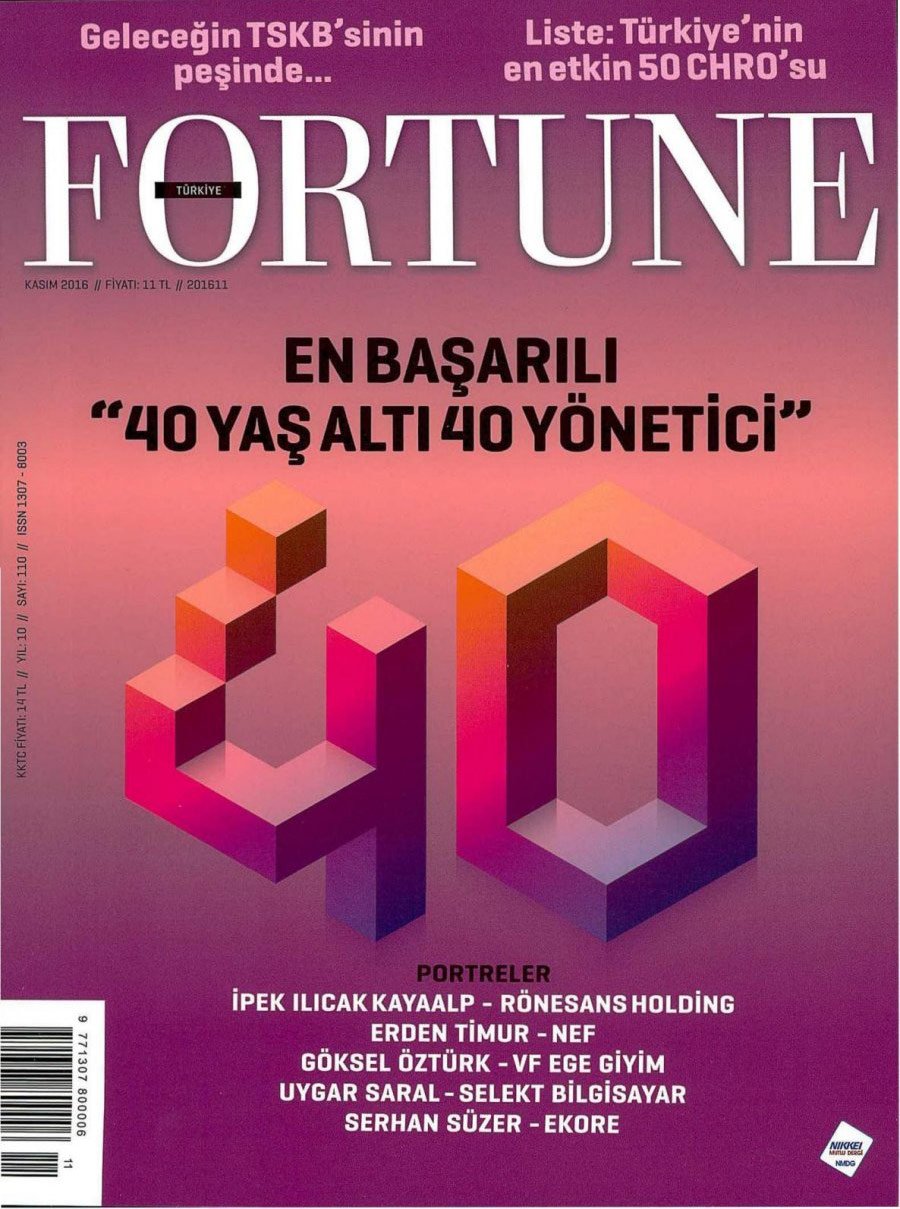
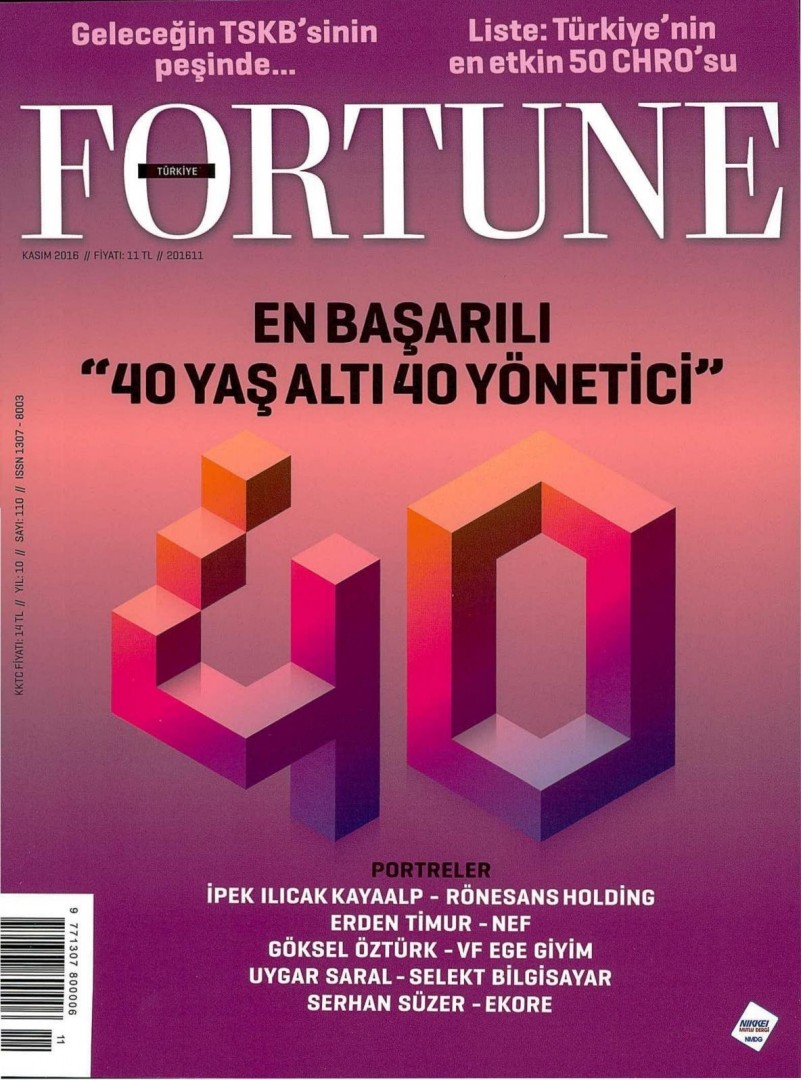
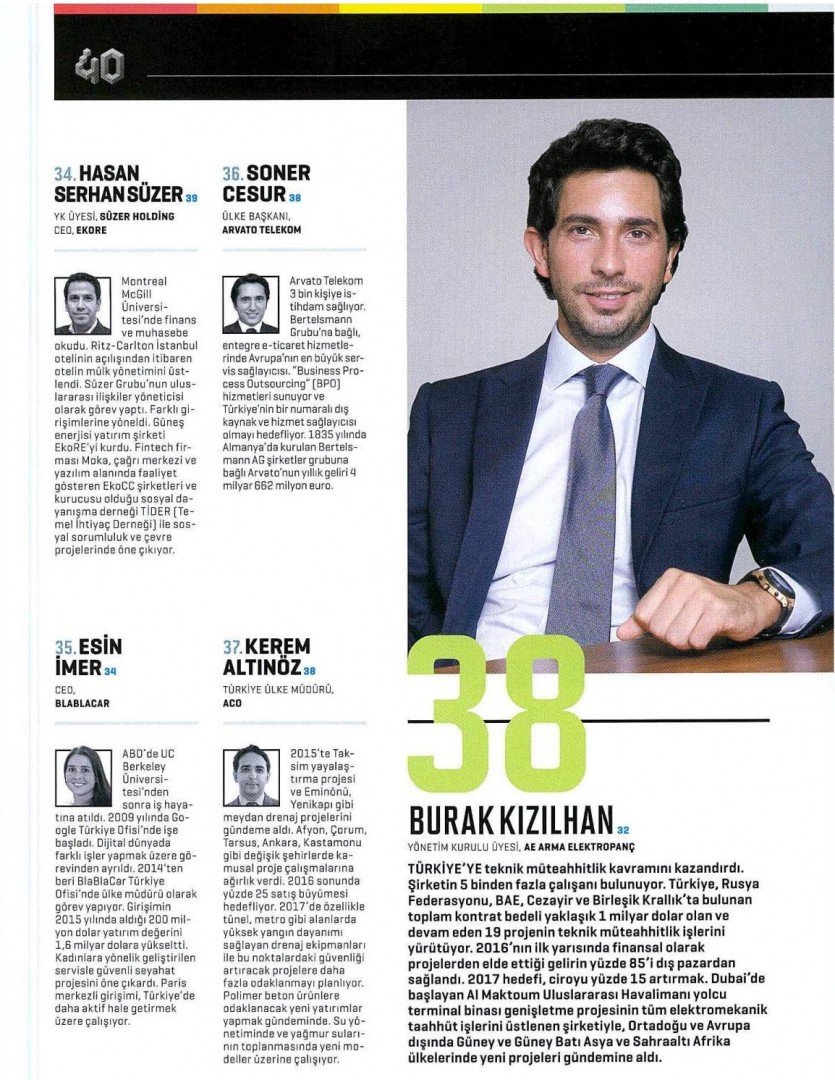
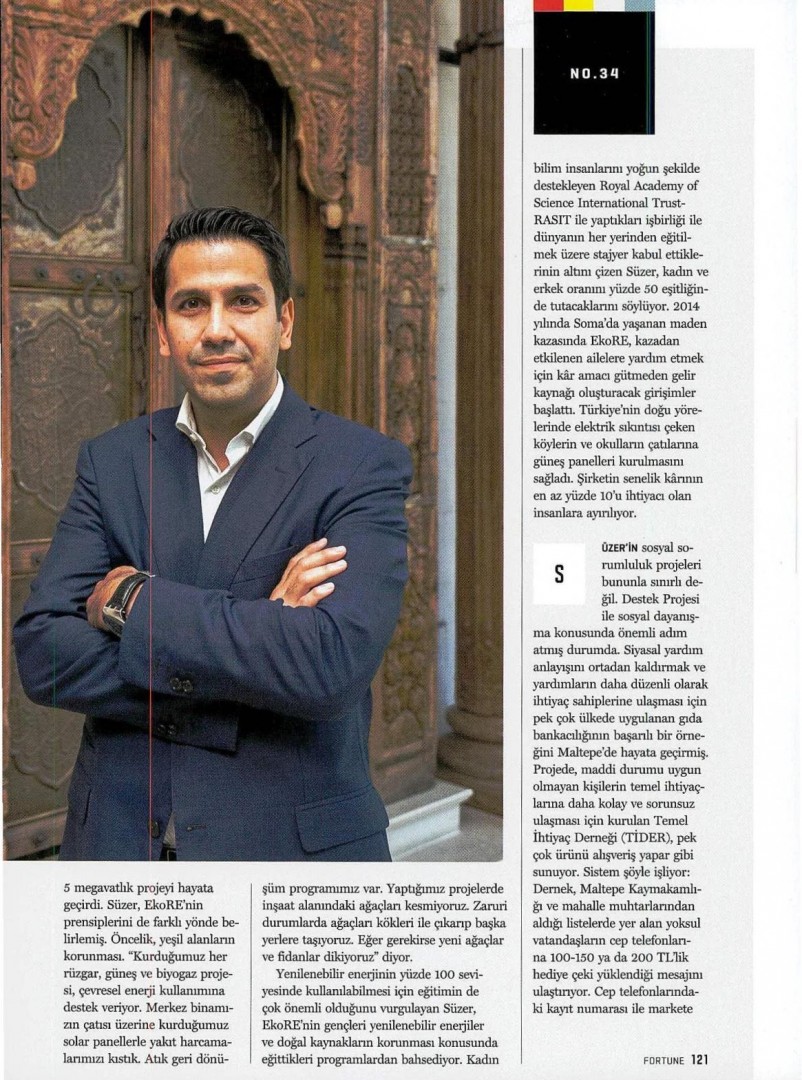
As you can read above, last month’s issue of Fortune Türkiye magazine published a list of the 40 most successful executives under 40. The story of my inclusion on this list and the subsequent interview with me goes back a long way. Mahinur Hanım, from the PR agency we work for, had been insisting for two years that Fortune wanted to interview me and include me in theie ‘Under 40’ list. I repeatedly stated that I didn’t believe in such lists and that inclusion didn’t seem meaningful to me and kept postponing the interview until next year.
The same topic popped up again during a phone conversation last month. The magazine had once again requested an interview, and I was just about to postpone it for obvious reasons when Mahinur Hanım highlighted two unique points about this year. First, this time, Fortune’s headquarters in the US had specifically named me and requested an interview. According to her, my business acumen, my sustainability work, and my NGO work had caught their attention, and they envisioned an exemplary interview. Being noticed all the way from America was both humbling and surprising. Mahinur Hanım suggested that this might be partly due to my recent international speaking engagements, but the important thing was that I was being followed globally. The second reason she added, specific to this year, made me laugh a little on the phone. She was hinting that I was 39, reminding me that this might be my last year on the under-40 list.
For a better planet…
At Mahinur Hanım’s insistence and the reasonable justifications she offered, I outlined a few important conditions and said I would grant the interview if they agreed to them. Fortune accepted my terms. Our interview took place at the Ritz-Carlton Hotel. Şule Hanım, who conducted the interview, was a very thorough journalist. It was an easy interview for me. The only thing was the time constraint. We also struggled with the photos (taking photos has always been my least favorite part of interviews).
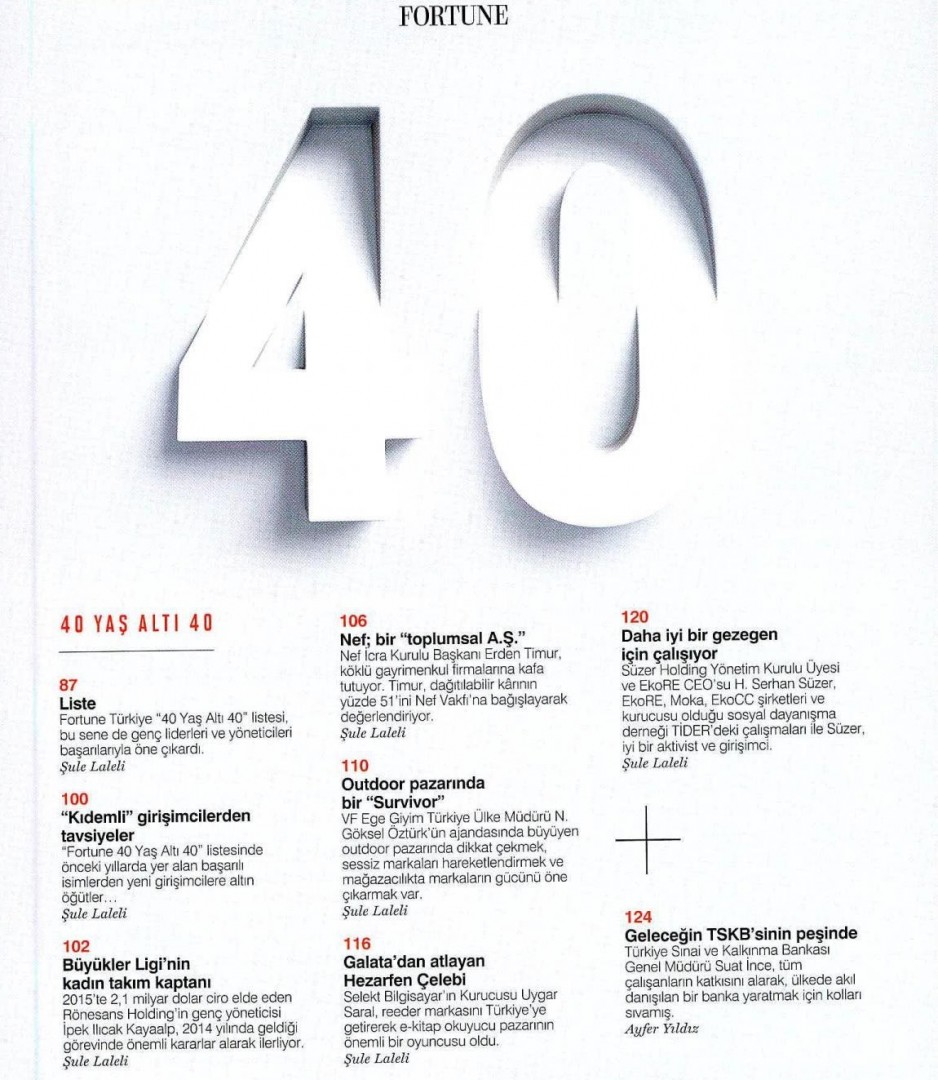
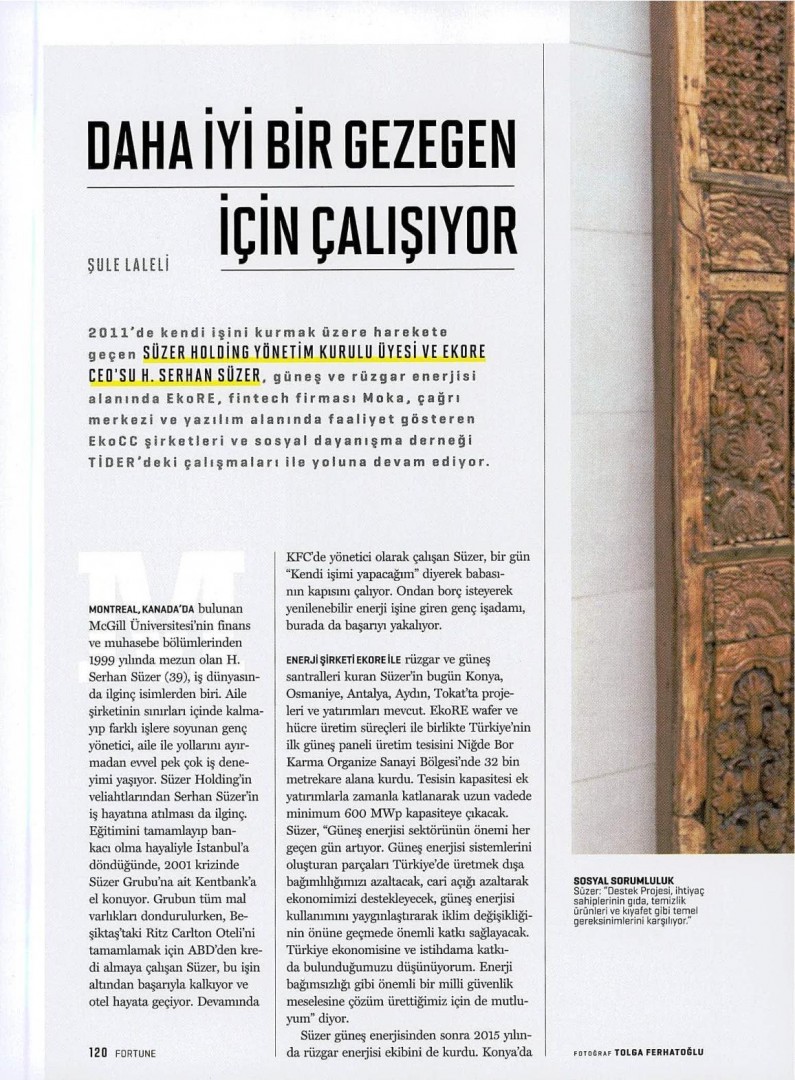
I found the published article generally positive. I particularly liked the title: “Working for a better planet,” which subtly reflected my identity and goals. Fortune magazine included the interview with me on its cover and in the “Contents” section on the back cover. Thus, my first Fortune interview came to fruition.
However, there were some problems in the article stemming from the lack of sufficient attention to certain points I specifically emphasized. I’d like to share these with you.
Clichés that overshadow effort
One of the prerequisites I outlined before the interview was that the professional life I’ve built, working diligently on the path I’ve charted for myself, would not be defined by the Süzer Group. Despite this, my primary title in the article’s lead was listed as “Member of the Board of Directors of Süzer Holding.” However, this is, first and foremost, false. I voluntarily resigned from the Süzer Holding board years ago. As I’ve made clear, I have no affiliation with Süzer Holding beyond the shares my father gave me, and I’m certainly not on active duty. Furthermore, aside from the inaccuracies in the information, this is an unfair error that could underestimate the value I’ve created through great efforts to achieve the goals I set many years ago. Add to this the cliché “one of Süzer Holding’s heirs,” which I find deeply irritating, and I think my reaction will be better understood.
Despite emphasizing the correct information, when I asked the magazine staff how these phrases could be used, I was told that the problem stemmed from some last-minute additions by the editor. Mistakes are always made, and I don’t want to exaggerate them. However, I must say that these frequent errors, based on prejudices and clichés, remind me of my initial reservations.
My real motivation now stems from the fact that I’m starting to see the results of my efforts over the last five years. One example is our 5 MW Konya Kulu project, which we launched in October. Here’s our video on this topic:
Konya Kulu Project Video https://www.youtube.com/watch?v=Fys0WSUkXk8&t=11s
Another problematic sentence in the interview was used when discussing the Basic Needs Association (TIDER). There’s a phrase like “eliminating the concept of political aid,” but I actually argued that it would be more appropriate for municipalities to spend their budgets on infrastructure investments, which is their primary responsibility, rather than purchasing products and conducting aid efforts, and that aid efforts should be carried out by NGOs. Such shifts in meaning on such sensitive issues are unacceptable.
The sentence, “I was researching whether we could do what the Foodbank, headquartered in Chicago, does,” is also incorrect. I told the following story verbatim in the interview: “When I was a manager at KFC and Pizza Hut, we were researching what social responsibility projects we could implement. At the time, a dinner was held in honor of Bob Horney, the founding president of the Global Foodbanking Network, and many food companies attended. Being a quick decision-maker, I raised my hand 15 minutes after hearing Horney explain the food banking model and explained that we wanted to be in this business. Later, we established the Food Banking Association with 7-8 food companies.” The abbreviation was probably used out of space, but it changed the meaning of what I was saying.
Technical subtleties are confusing
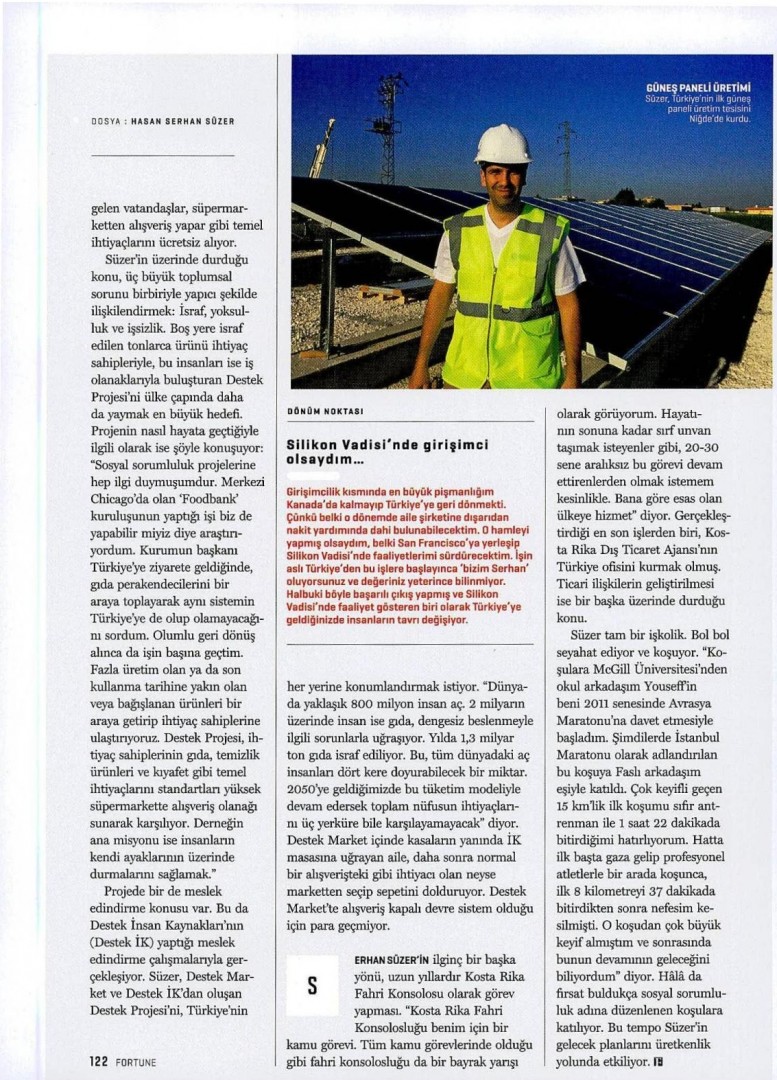
The phrase “Türkiye’s first solar panel production facility” on the photo of EkoRE’s Niğde project is unfortunately also incorrect. There are more than 20 panel factories in Türkiye, but all of them handle module production and, as it’s commonly known, assembly (the final process). Ours is a system that not only handles modules but also the previous process, namely cell production, and even wafer production before that. In other words, it will be the product with the highest domestic content rate in Türkiye. I explained all of this during the interview. It might have been confusing because it’s a technical topic. We also haven’t even built the factory yet. We’ll be producing our first panels in 2018. This is a long-term project.
It would have been nice to mention Moka and EkoCC in a few sentences. Moka is on its way to becoming a major fintech company. EkoCC will soon become a significant call center. They don’t just produce call centers; they also produce software. Both companies have put in a lot of effort. I understand the space constraints, but mentioning only EkoRE, TIDER, and my position as Honorary Consulate of Costa Rica doesn’t fully reflect my efforts.
Also, journalists generally don’t want to share their interviews. However, because I delve into a lot of technical details, typos and misunderstandings are bound to occur during the transcription of the interview. I don’t expect anyone to master these tasks in an hour, and I don’t want to be unfair about that. However, I believe that interviews, especially those that address technical topics, should be shared with the interviewers before publication, and any errors should be corrected.
The ‘Goodness’ Criteria for Success
Ultimately, being on this list is a good thing. It shows that our work is being recognized. Being among the most successful executives, in my opinion, is more valuable than being on the rich club list. I’m grateful for that. As I mentioned above, I hope mistakes are a thing of the past.
On the other hand, while it’s nice to be on such lists, I think the real criteria for success and wealth are different. Having developed human values and being appreciated in these areas is much more valuable.
For example, I always try to convey to our employees that it’s possible and right to be both a good professional and a good person. In my opinion, the criteria for being a good professional are: diligence, self-confidence, systematicity, proactivity, representing your company in the best possible way, teamwork, practicality, and high motivation. In my opinion, the criteria for being a good person are; honesty, reliability, conscientiousness and loyalty, helpfulness, altruism, and sincerity (in other words, being one inside and out).
I want to see the right blend of these criteria in my entire team, both good people and good professionals. The Needs Map, a sister organization of our Basic Needs Association, beautifully summarizes what I try to convey to my close circle and colleagues. I’d like to share it with you: https://onedio.com/haber/yureginin-derinliklerinde-iyilik-isigini-hic-sondurmeyenlerin-12-genel-ozelligi-742372
My birthday and my true success
After all this, I’d like to take a step back from work and touch on my birthday, which I celebrated last weekend. This year, I decided to celebrate 4-5 days before my birthday and invited about 100 friends I feel close to. I had another list of 300 people who were close to me, but I only managed to invite 100 people on short notice. For my next 40th birthday, I’ll probably be able to invite all my close friends. My twin, Baran, will probably be celebrating our 40th as well.
Since the attendance rate for these kinds of events or gatherings in a place like Istanbul is typically around 1 in 3, my assistant, Aysun, asked me when making the reservation if a down payment for 30 people would be sufficient. She was right. Generally, if you invite 90 people, only 30 will show up due to traffic, children, illness, and travel. But I told my assistant that 50 people could come, and she should adjust the reservation accordingly.
But I invited about 100 people, and they reacted quickly, and 70 people showed up for my birthday party two or three days later. Some even made excuses. The venue 360 Istanbul was confused about where to place our guests. At first, they extended the existing tables. Then, realizing that wasn’t enough, they squeezed in extra tables and chairs. This was a nice problem for me to deal with. I caught up with friends I hadn’t seen in a while.
I’m sharing the birthday video below to give you an idea:
Birthday video: https://www.instagram.com/p/BNUT8OSh3uaOLUMB0M9IIhrObbRt0GslHZLco00/
What I’m trying to say is this, money has never been my priority. Doing the job right, exceeding expectations, setting an example, and valuing people are much more important to me. Now, we’ve already started making money. Now, things are starting to snowball. If I can achieve my vision, I have no doubt I’ll be on Fortune’s Global list within the next 5-10 years.
In this case, they will likely come from the US for interviews in the future. Signs of this are already starting to show up. I was personally invited to the United Nations for the official signing ceremony of the Paris Agreement. I have also spoken on sustainability and renewable energy in various countries, including the US, Canada, Brazil, Austria, and France, on behalf of important organizations like the UN and Crans Montana.
This month, as part of the event ‘24 Hours of Reality: The Road Forward,’ I’ll be addressing sustainability and renewable energy live from Paris on Tuesday, 6 December at 5:00 PM Turkish time. In the same session, former US Vice President Al Gore, who launched the Climate Reality initiative, will speak about Türkiye before me. Those interested can follow my speech at http://www.24hoursofreality.org. #SustainableLife. I would also like to thank Ergem for providing me with a reference for this event. Being recognized not only in Türkiye but also internationally is a harbinger of the global achievements we will undertake in the future.
The fact that so many people showed up to my birthday party on such short notice, and the mutual respect we shared, is my greatest achievement and enrichment. In other words, being chosen as a winner is wonderful, but achieving success despite all the challenges without abandoning goodness and certain principles is the most beautiful. The rest is just details.
Tag: energy