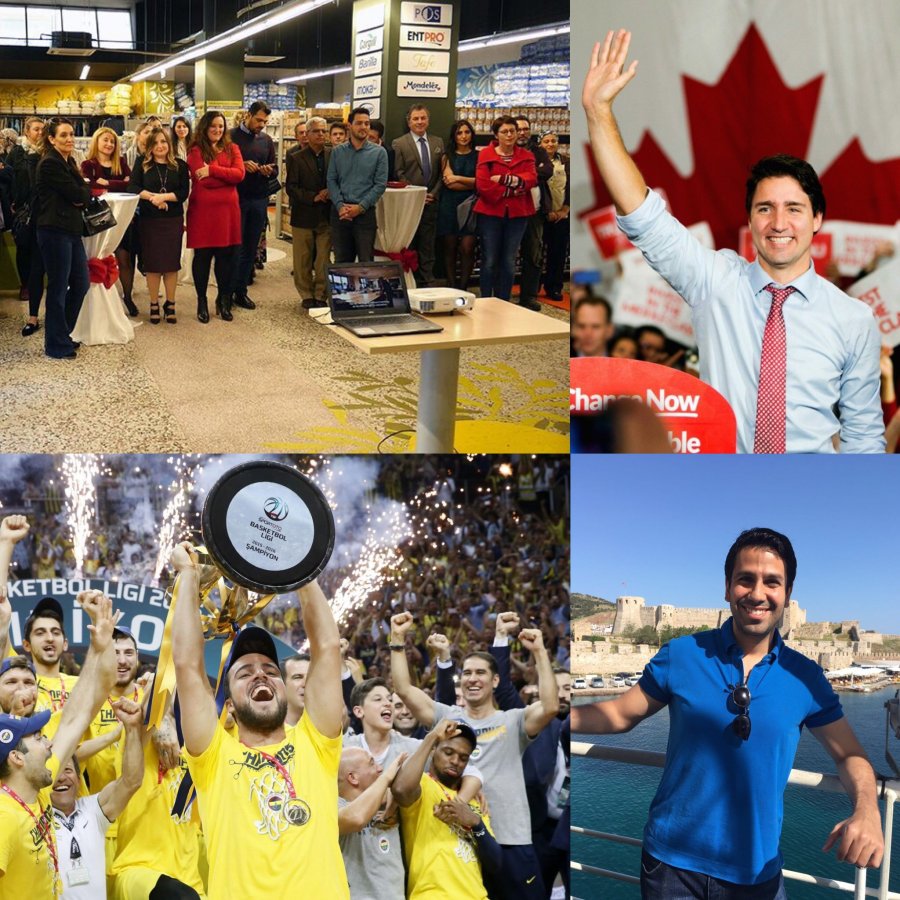
- Which team do you support in Türkiye? Do you support any teams abroad?
My favorite team in Türkiye is Galatasaray. I’m also a member of Galatasaray Club. Naturally, I always support Galatasaray in all sports. Since I consider Beşiktaş a sister team, I support them in all sports except Galatasaray games. Furthermore, since my mother is from Trabzon, I support Trabzonspor; since my father’s side is from Gaziantep, I also support Gaziantep; and since Denizli is where I completed my military service, I support Denizlispor, also outside of Galatasaray games. I also remain neutral when these teams play against each other.
Besides these, I have a strong admiration for Anadolu Efes in basketball and Eczacıbaşı in volleyball. I also support Turkish teams (including Fenerbahçe) in international games, regardless of their club (don’t say, “Well, that’s perfectly normal,” there are many team fans in Türkiye who would do the opposite). Here are the soccer teams I support abroad:
Liverpool in England, Roma in Italy, Real Madrid in Spain (normally, due to competitive spirit, I don’t have positive feelings towards the biggest rival, but I also have great affection for Barcelona), Sporting Lisbon in Portugal, Bayern Munich and Red Bull Leipzig in Germany, Marseille in France, Saprissa in Costa Rica, and Boca Juniors in Argentina.
In basketball, I support the Chicago Bulls in the NBA. Also, since I went to university in Montreal, I support the Montreal Canadiens in ice hockey and the Montreal Impact in the North American Soccer League (MLS). Don’t say, “How many teams do you have?” That’s what happens when you’re a sports fan and a global citizen. 🙂
- How did your career, which began in banking, lead to renewable energy?
Since I was little, I’ve had a goal of becoming a banker. I can say that my family’s business also plays a role in this. At the time, Kentbank was our family’s bank. That’s why I chose to study finance and accounting at my university in Canada.
I graduated from university and worked for a while at the American headquarters of the Italian insurance company Generali. Then I returned home and joined the military. The day I completed my military service; our bank was seized. Legal proceedings then began. Of course, my career plans completely changed. At that time, I made a promise to myself: If everything went well, and after 10 years, the problems had been resolved and our family business had begun to grow again, I would leave and start working on the projects that were close to my heart.
I first started in the family business by opening the Ritz-Carlton Hotel. Over the next 10 years, I held various positions, including investment director for the hotel, project director for the Coca-Cola Iraq project, general manager of Süzer Holding, and CEO of KFC and Pizza Hut Türkiye. Ten years later, as I promised myself, I knocked on my father’s door and told him I wanted to leave the family business and pursue a career that was close to my heart. After three or four months of persuasion, I reached an agreement with my father and, with the loan I received from him, invested first in solar energy technology.
- It’s called the energy source of the future. Has the future arrived? Is it possible for solar energy to replace oil and similar resources today?
Solar energy is no longer the source of the future. It’s the source of the present. In other words, instead of saying solar energy is the future, we need to say it’s here. From now on, as humankind, we need to change our perception of how we can benefit more from these opportunities.
Fossil fuels like oil and natural gas should not normally be burned. These are important resources for us. By burning fossil fuels to generate energy, we deplete our resources, pollute nature, and cause climate change. Instead, we need to use these natural resources for production. In other words, we need to use oil for petrochemicals (recyclable plastic, etc.) and natural gas for fertilizer production. Future generations will say of us, “How wrong our ancestors were in the past.” They will think, “They not only made the world we live in more uninhabitable (due to climate change) but also depleted our natural resources.”
- Recently, prominent startups like Markafoni and Bukoli have closed their doors. Why is this happening?
I am one of those who understand the difficulties entrepreneurs face. I can imagine the conditions these companies operate under and the challenges they face. I will write a detailed analysis on this topic in the future. For now, let me state that these closures will continue and list the main reasons below (this list can, of course, be expanded):
- The Turkish economy is going through difficult times.
- They are constantly struggling to make ends meet, in other words, their cash burn rate cannot be reduced.
- The main investor has a low tolerance threshold for a promising business and withdraws support prematurely.
- The financial sector is unable to provide sufficient support to the real sector, its processes are excessively delayed, or it creates serious challenges.
- They insist on wrong business models and are resistant to change.
- These startups are not sufficiently flexible and dynamic, and they cannot make quick decisions.
- The three fundamental pillars of a business are finance, sales & marketing, and operations. When any one of these three pillars fails, the established business will experience serious difficulties after a certain period. It is necessary to manage these pillars effectively.
- As the heir to Süzer Holding, why are you so stressed? Enjoy yourself.
I’m having fun anyway. I’m having fun while I’m working. When I reach a certain age, I want to look back and say, “I’m so glad I did this work and started these ventures and social initiatives.” That’s why I do my best in business. If I can manage to make it to the weekend, I try to dedicate at least one day of my business trips to exploring the region I’m in.
On the other hand, I’m incredibly annoyed by the word ‘heir.’ I’d like to reiterate a paragraph I wrote about this in my blog post entitled An Adventure-Filled Benefit Concert (http://www.serhansuzer.com/tr/macera-dolu-bir-yardim-konseri) :
Last week, during an interview, I was asked, “Do you organize balls and concerts, like socialites, for the associations you’re involved in?”
Of course, the word ‘socialite’ in this question is quite telling. It’s a manifestation of the ‘envy of the rich’ we can’t seem to shake from our vocabulary. ‘Socialite’ is a word that reinforces the idea that “why are these incompetent people rich, and why are they squandering their money so much? What unnecessary pursuits do they engage in?” Like ‘socialite,’ there are other words with negative connotations. For example, the word ‘heiress’ is used to refer to spoiled children who are essentially incompetent, only able to achieve their goals thanks to their fathers, and who often misuse money. And no matter what I do, I can’t stop this word ‘heir’ from being used in interviews. I’ve been referred to as ‘heir’ in print, on television, and even at a conference I attended last week. Using these terms naturally attracts attention and boosts ratings. However, considering that I’ve been running my own ventures independently of the family business for the past five and a half years and have created significant value with my teammates, calling me ‘heir’ is both misinformed and disgraceful. I get goosebumps when I hear prejudiced and unrealistic adjectives like ‘heir’ and ‘socialite,’ which are diametrically opposed to my own way of thinking.
I’d also like to share my philosophy with you. No one chooses their place of birth, their parents, their family, the language they speak, etc., at birth. We all have a starting point in life. Some are rich, some are poor, some are born into a loving family, some are broken. What matters isn’t how you’re born. What matters is how much you invest in it after birth. In other words, the difference between where you were born and where you die. This difference shouldn’t necessarily be measured in terms of earning money. Some people become wonderful mothers and raise three children who are good for their country and humanity. This person has lived a very positive life. Some have served as directors of an NGO and made significant contributions to humanity. This person is also very positive. Some spend their money on their own pleasures and misuse it. This person has lived a decidedly negative life. Others, on the contrary, have always used their power and money for the development of humanity and their families. This person is also positive.
Based on this philosophy, I want to emphasize that I’m doing my best to live a positive life. Some may still not understand this, but those who share my perspective know exactly what I mean.
- What are your thoughts on Trump’s recent statement, “We’re withdrawing from the Paris Agreement”?
I had a friend who made very negative comments about Trump when he was first elected. I cautiously told them: “Let’s wait a minute. Let’s not jump to conclusions. Perhaps he’ll surprise everyone in a positive way. At this point, I see that my hopes weren’t true. Personally, the credit I gave Trump ended with his statement, “We’re withdrawing from the Paris Agreement.”
Trump has caused and will continue to cause great harm to our planet by denying climate change and reinforcing America’s fossil fuel-oriented policies. Let’s not forget that America, along with China, is one of the two largest polluters in the world in terms of carbon emissions. We hoped this would change because the atmosphere they pollute belongs to all of us, all of humanity, and nature. Those who cause harm in this way will go down in the dark annals of history.
- Conversely, do you have any thoughts on Canadian Prime Minister Trudeau?
Unlike Trump, Justin Trudeau is a promising politician. It’s a source of pride for me that he graduated from my university (McGill University).
However, if I were speaking to Justin today, I would give him this advice:
Dear Justin, you are the pride of every McGill student I know. A leader like you allows us to look to the future with hope. But please, don’t take actions that will undermine this. Don’t be one of those hypocritical politicians we’re used to. While delivering the most passionate speeches about climate change, steer the fossil fuel industry, which has built a large industry from Canada’s famous oil sands, in the right direction (Canada is the 6th largest oil producer in the world). A fossil fuel is a fossil fuel. Don’t burn it and pollute our atmosphere. Fossil fuel is, in fact, an important resource. Use technology to convert this raw material into value-added products (like petrochemicals) and sell them (all of these products should be recyclable). This way, you can both take the most important steps against climate change and intelligently increase the country’s economic inputs.
- Why are you so prominent in these institutions and organizations you are responsible for?
Why are you constantly engaging in your own PR? On the contrary, I want all the initiatives and social enterprises I launch to stand on their own two feet and maintain their own identities. In my ventures that achieve this, I first transition from executive management to my board roles, and then, when I see that we’ve achieved full institutionalization in the long term, I may withdraw entirely.
Thank God, we’re not doing badly in this current period; we’re achieving our goals one by one, but a little more time is needed for both the institutionalization process and the financials to reach our desired level. We have big dreams.
The companies and the association I’m responsible for need me. I’m ready to do whatever it takes, to make any sacrifices necessary. While I don’t particularly enjoy it, this also includes being prominent through the press. Because in Türkiye, people eventually ask, “Who’s behind this?” Furthermore, colleagues in the press often focus on well-known figures or high-rating figures to get the word out.
My greatest wish is for our association and the companies I’ve founded to exist under their own names in the future and be appreciated by everyone. Of course, as we go beyond our dreams, I want to see two very important values for me, ‘Respect’ and ‘Loyalty,’ from the employees and stakeholders of these organizations.
- Should food banking be handled by NGOs or municipalities?
As in all developed countries, food banking should be handled by NGOs. Food banking institutions should be impartial, transparent, honest, and sustainable.
By having NGOs handle these tasks, municipalities’ budgets will be more manageable. After all, NGOs can provide in-kind donations for products that the public pays for. However, the existence of municipalities cannot be ignored. Municipalities should focus on their core business: infrastructure investments. They can also provide contributions such as physical location and transportation to NGOs operating food banks.
In fact, the burden of social assistance tools like food banking is very heavy. All players, primarily NGOs, who should take the lead, then municipalities and other public institutions, and the private sector, must work together.
- What can the private sector contribute to food banking?
The private sector can contribute to food banking by donating. This could be a cash donation or an in-kind donation (product donation). They can also contribute with different and creative models. For example, as an original idea, they could assume the payroll burden of some professionals working at an NGO. I believe all private sector players can develop creative mechanisms beyond traditional in-kind and cash donations to support the challenging missions of NGOs striving to make our world a better place to live. They just must want it.
Tag: economy