
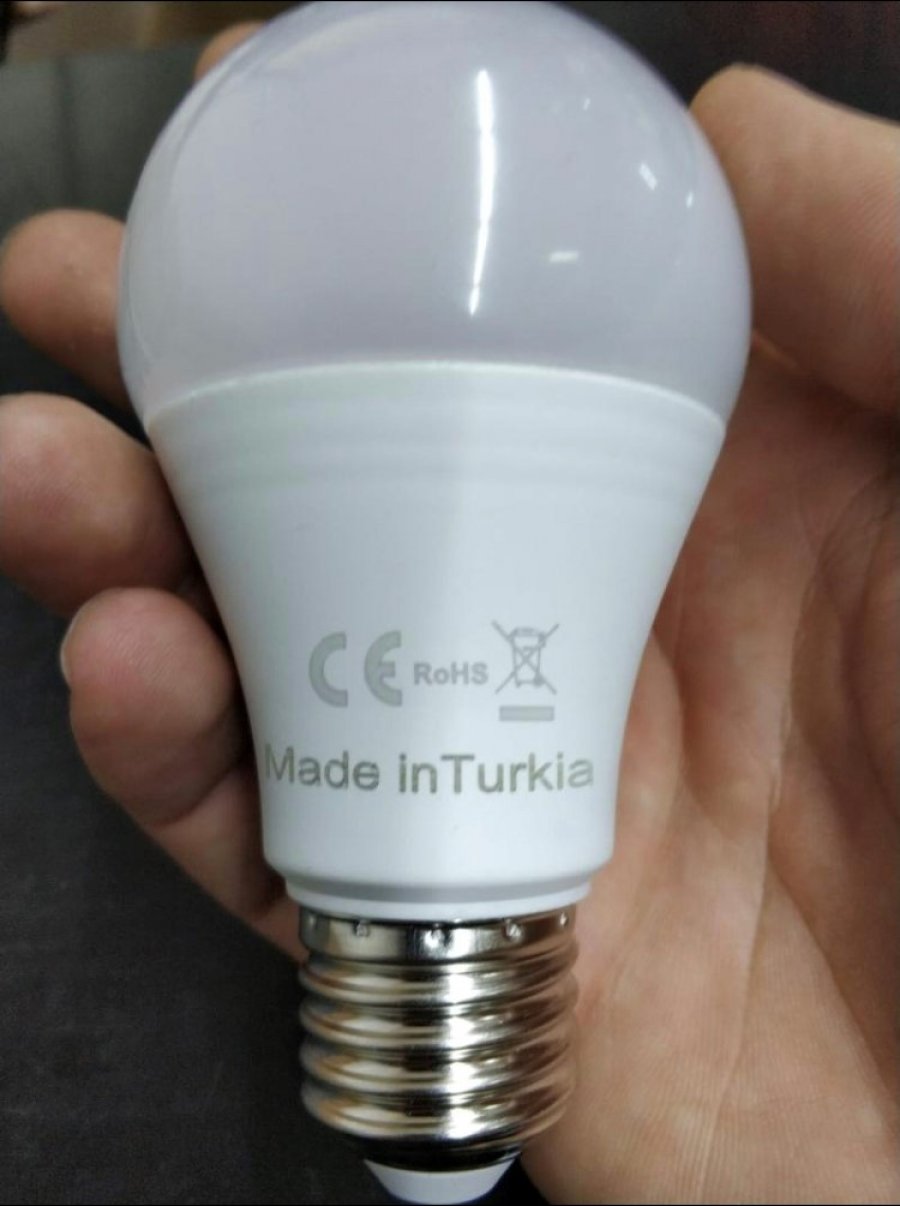
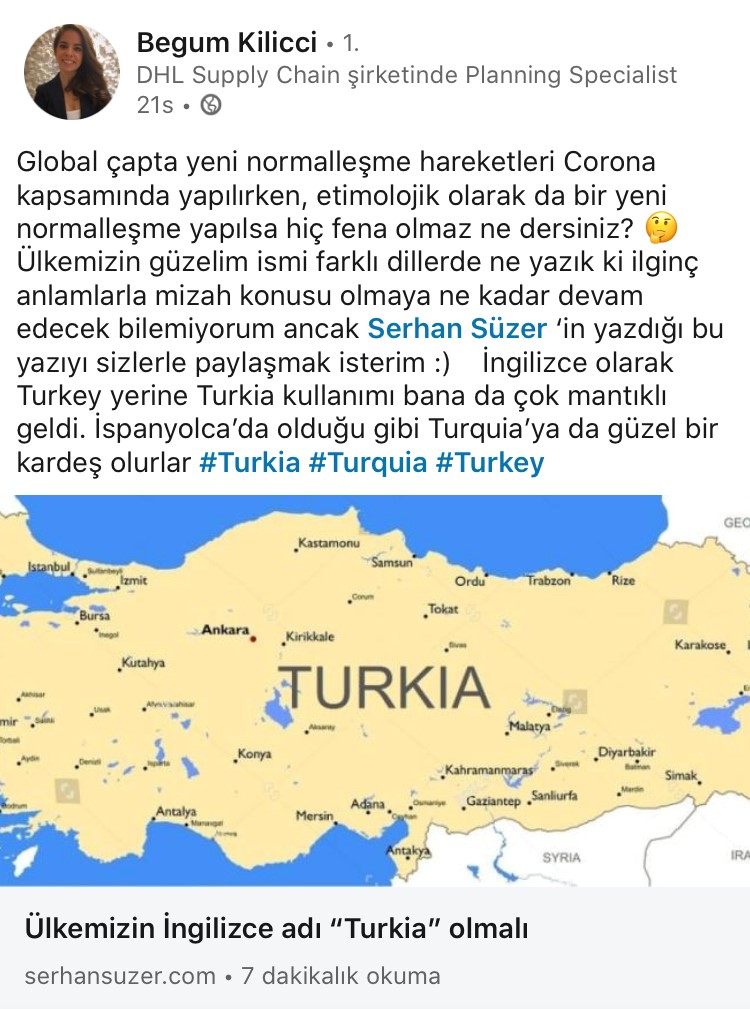
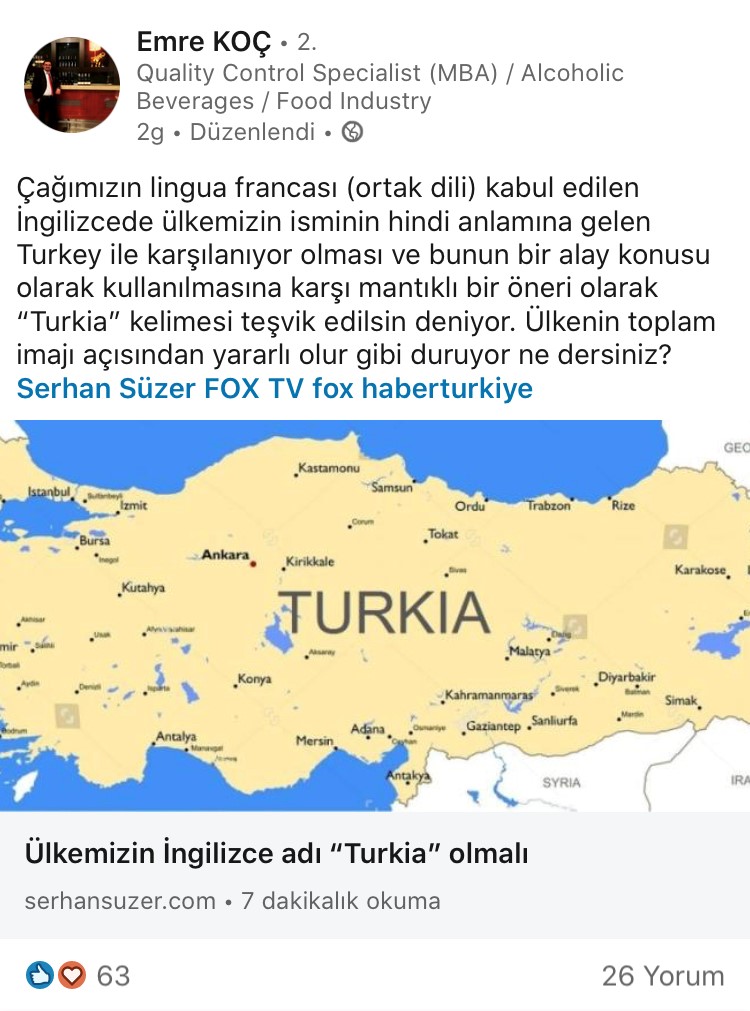
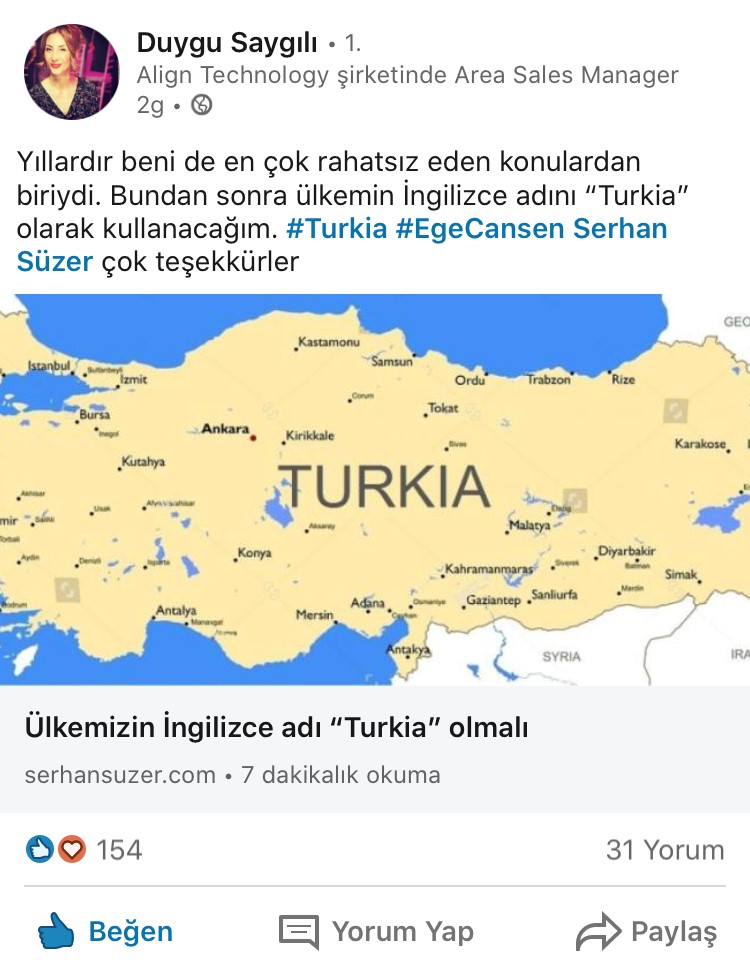
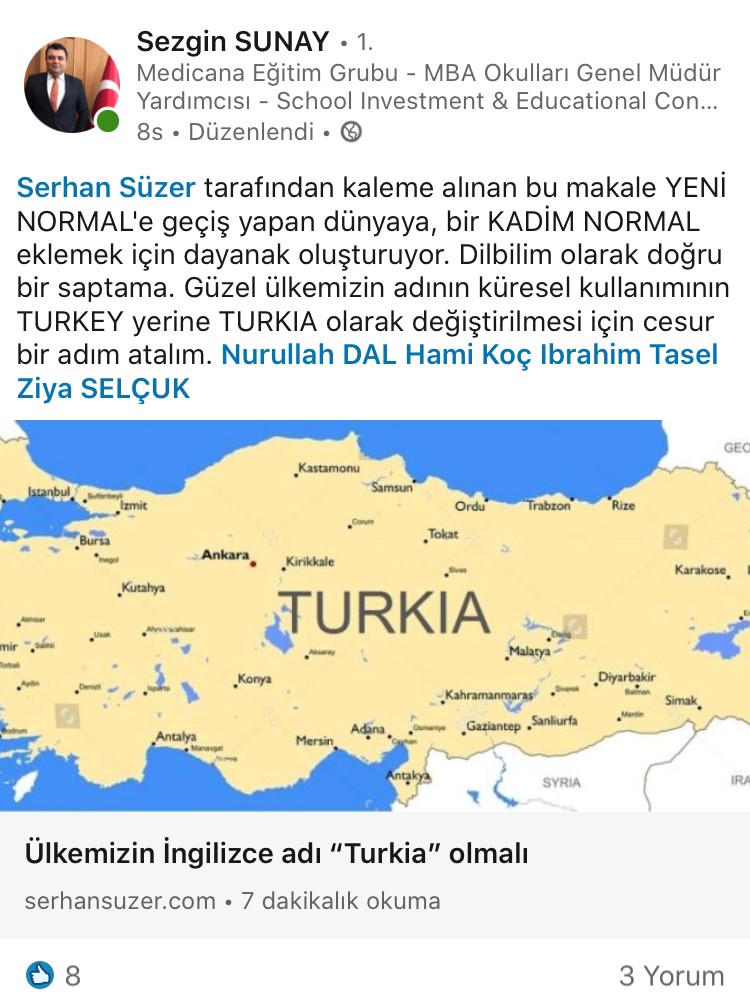
We’re still at the beginning of the campaign I launched last year. One day, everyone will use the English term ‘Turkia.’ First, let me provide a link to the article I wrote on this topic: https://www.serhansuzer.com/tr/ulkemizin-ingilizce-adi-turkia-olmali
I’m sharing the most crucial part of this article, which explains the topic logically, as a reminder:
The majority of countries end in -ia.
The -ia suffix in English is the equivalent of the -istan suffix in Turkish. So, when you add -ia to the end of a nation or ethnicity, you define ‘its country.’ For example, Bulgaria means ‘the country of the Bulgarians,’ and Malaysia means ‘the country of the Malays.’ This is true all over the world. I could give you many more examples:
Albania, Algeria, Armenia, Australia, Austria, Bosnia, Bulgaria, Croatia, Estonia, Georgia, India, Indonesia, North Macedonia, Malaysia, Mongolia, Nigeria, Romania, Russia, Saudi Arabia, Serbia, Syria, and many more countries I can’t list here. The most recent addition to the list of countries whose names end in ‘ia’ is ‘Czechia,’ or the Czech Republic. If they managed to impose ‘Czechia’ over ‘Czech Republic’ at length, why can’t we?
Turkia also defines itself as ‘Turkish country.’ Some might say, ‘We are global citizens and oppose having a name based on ethnicity define a specific region,’ or others might say, ‘In Turkey, there are more than 70 ethnicities besides Turks, such as Kurds, Circassians, and Bosnians. It wouldn’t be right to call it a ‘Turkish country only.’ I partially agree with these criticisms. That said, there’s also another truth: when this country was founded from the ashes in 1923, and even before that, the Ottoman Empire, which had ruled these lands for centuries, and before that, the Seljuks and many other Turkish principalities, had called these lands their home and owned them. If we consider the tendency of the majority ethnic groups in the world to append their names to ‘-ia,’ and if we accept the fact that the official language in these lands is Turkish, we can determine the appropriateness of calling our country ‘Turkia’ instead of ‘Turkey,’ which is often mocked.
Furthermore, Basque, the language that directly writes ‘Turkia’ and pronounces it as it is, is the language of their own. Apart from the Basques living in northern Spain, in many Latin-based languages, Turkey is pronounced ‘Turkia,’ only with slightly different spellings. For instance, in Spanish, Turkey is written ‘Turquia,’ and in Italian, ‘Turchia,’ but both are pronounced ‘Turkia.’
After this article, I received overwhelmingly positive feedback. I received overwhelming support from everyone who has traveled and seen the world, is fluent in at least one foreign language, has travel experience, and has no complexes. Essentially, all our global citizens with some discernment were expressing the absurdity of pronouncing our country’s name ‘turkey’ or ‘turkeye.’
Of course, there was also criticism. Some of these people went overboard. In fact, because I suffer from this situation, I even wrote an article about these strange criticisms. I’m sharing the link to it as a reminder: https://www.serhansuzer.com/tr/egitimli-kesimin-yetersizligi-ve-kisilik-sorunlari
We can generally categorize the criticisms I receive under three main headings. I’ll categorize those making these criticisms to give a clearer picture:
1) Status Quo Supporters
These status quo supporters say, “Let’s leave the name Turkey as it is, why are you even bothering with it? I’ll continue calling it ‘Turkey.’” Even in my close circle, there are status quo supporters. I don’t even discuss this issue with them anymore. In fact, as I shared in the article I linked above, some go even further and make the following comments (you can find my responses to them below):
– Let them call us ‘Turkey,’ so what? Will that affect our brand value?
It does. Why do we identify with an animal that is often described as a noisy animal and mocked in Western culture?
You can continue to call your own country a turkey, but that’s your problem, but I don’t want my country called a turkey. I don’t want anything that could be used to mock my homeland and my people. It’s that simple.
– And the fact that you think ‘turkey’ when you say ‘Turkey’ is your problem. Are we supposed to deal with so many problems in our country?
Yes, this is one of the problems we will be dealing with. While we strive to solve our country’s problems, we also need to change the most fundamental thing: our country’s English name (which has become the global language in our time).
– Let’s reach such a level of development that the British would be surprised to hear us call it a turkey.
Let’s both increase our level of development and be called by a respectful, pleasant-sounding name. These are two different things. However, let’s understand that the name we use also has an impact on people and things.
2) Racists
I also came across the following comments. Why should we use the terms the Greeks and Arabs gave us?
There are those in our country who harbor hostility towards those from these two neighboring regions, with whom we have lived for centuries on the same land. Everyone is bound by their own prejudices and negative opinions. First, I want to emphasize this: While each country may have a general characteristic, individuals within those countries can have different characters and mindsets. Even within the same family, very different characters can emerge. Therefore, we can say that the mindset that Arabs are this or Greeks are that is incorrect. There are both good and bad people everywhere. In fact, we cannot say that everyone is 100% good or 100% bad. A good person is someone whose good qualities predominate. For this reason, I reject blind fanaticism. I invite everyone to respect universal values.
Of course, the word ‘Turkia’ must be interpreted correctly.
For one thing, Arabs write in Arabic, and Greeks use the Greek alphabet; neither uses the Latin alphabet. Therefore, although the pronunciation is the same, you will not see the word ‘Turkia’ written in Latin letters in either Greek or Arabic.
The only language that writes ‘Turkia’ in their own language is Basque. It is known that the Basques, who live in northern Spain, originally originated in our region, the Caucasus (my grandmother is of Circassian descent, so I’m interested in this topic). Besides Basque, in many Latin-based languages, Turkey is pronounced ‘Turkia,’ but the spelling is slightly different. For example, Spanish is ‘Turquia,’ Italian is ‘Turchia,’ but both are pronounced ‘Turkia.’ In other words, just like Arabs and Greeks, Italians and Spaniards say Turkia, but they write differently, and the spelling doesn’t make any sense to us. However, because Spanish and Italian use the Latin alphabet, you can immediately understand that “’Turquia’ or ‘Turchia’ is pronounced ‘Turkia.’
3) Locals who haven’t understood the world
Among those criticizing, the vast majority say ‘Türkiye’ should be used instead of ‘Turkia.’ This demonstrates that a significant number of our citizens have failed to rise above their local beliefs. The saddest part is that these people are closed to interpretations other than their own, and therefore unable to develop their own worldview.
First and foremost, while we like the word ‘Turkey,’ it means nothing to foreigners. They can’t even pronounce it. Just write ‘Türkiye’ in front of a foreigner (especially a native English speaker) and ask them to read it. I’ve tried it on many foreign friends before and let me tell you what happens: strange pronunciations like ‘Turkay, Törkay’ emerge.
English is a different language, and you must choose a word that fits its foundation and nature. The letter ‘Ü’ doesn’t exist in English (not only doesn’t exist as a letter, but native English speakers can’t pronounce it; they can only say ‘u’ instead of ‘ü’).
I’ll also reiterate a rule of English that I’ve mentioned many times before: The suffix -ia in English is the equivalent of the suffix -istan in Turkish. So, when you add -ia to the end of a nation or ethnicity, you define ‘its country.’ For example, Estonia means ‘Eston’s country,’ and Russia means ‘Russian’s country.’ This is the case all over the world.
To illustrate this category, I’m sharing one of the comments (anonymous) below, made with the confidence born of ignorance:
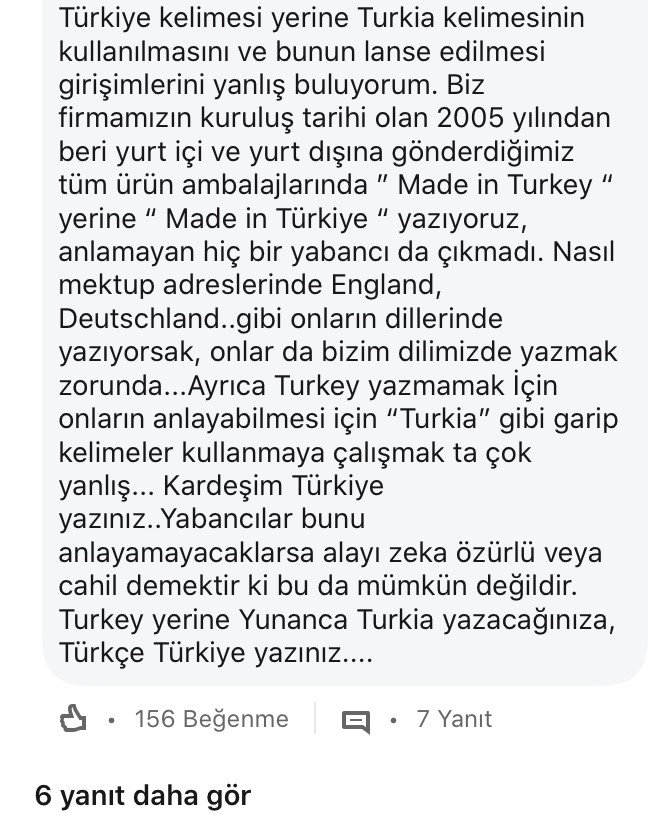
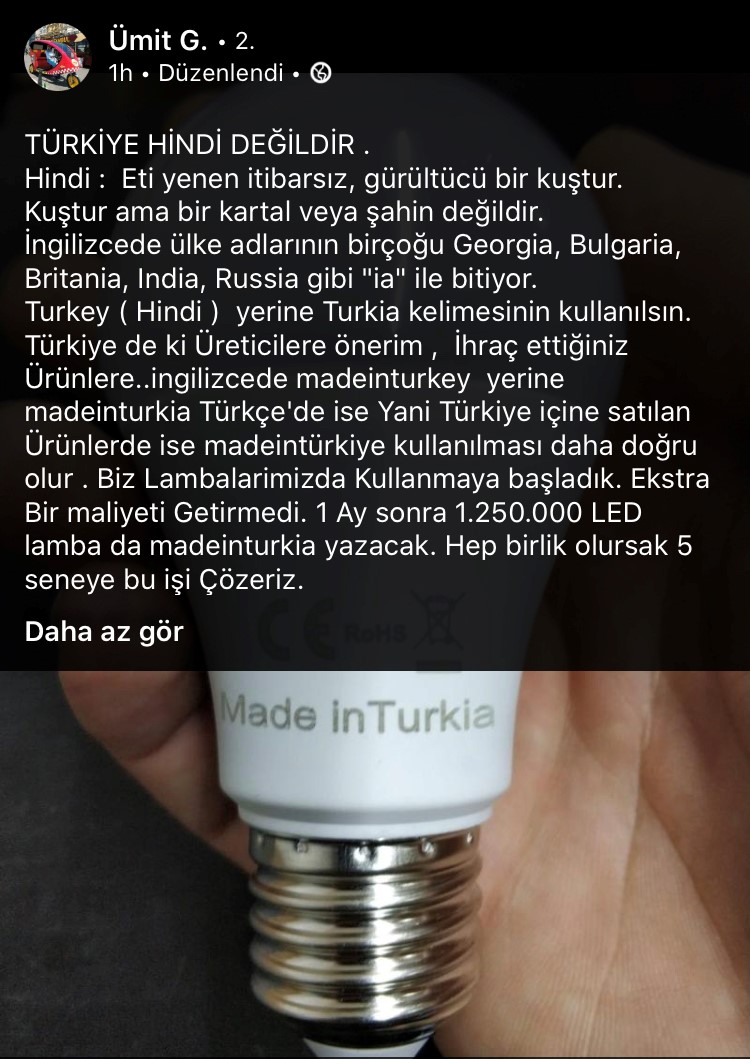
The person who wrote this comment falls into both the racist group I mentioned above and the local group that hasn’t understood the world. It should be said to him: ‘Made in’ is English. Since English is the global language, you’ll invariably find ‘Made in’ on product labels. You can’t mix words from different languages into a label written in English. In other words, you can’t write ‘Made in Turkey.’ You write ‘Türk Malı’ (Made in Turkey). Or, instead of ‘Made in Deutschland,’ you write ‘Hergestellt in Deutschland.’
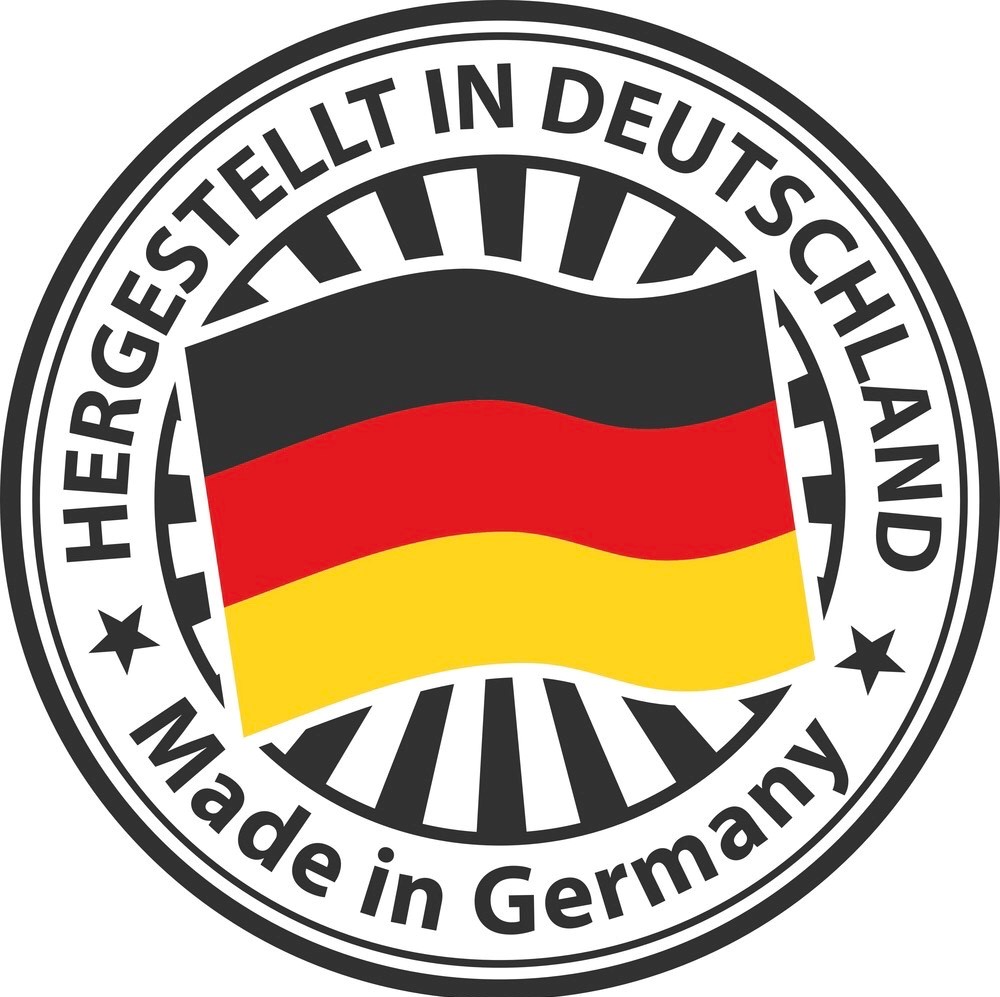
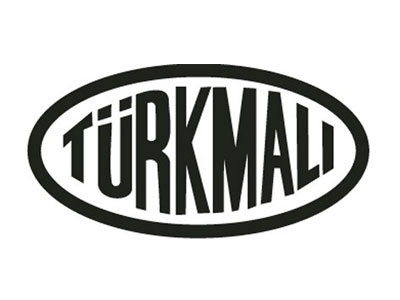
Not only does this person not fully grasp English, but he also adds a Greek-hating streak to his comment. As I commented above, Greeks write in their own alphabet, not in the Latin alphabet, as ‘Turkia.’ What if they called us ‘Turkia,’ as dozens of other countries do in their own languages? What a shame.
Moreover, Greeks call themselves ‘Hellas,’ and the Japanese call themselves ‘Nippon.’ You won’t hear any of these expressions in English. Did I make myself clear?
Ultimately, all these criticisms and comments have a point. I believe that those who are global citizens, have a good command of English, read without prejudice, and value linguistics will understand and support what I write. In this sense, I extend my heartfelt thanks to those who supported my ‘Turkia’ Campaign. We’ll all make history together.
And those who don’t support me are no problem. In my lifetime, we’ll all witness the English name of our country change to ‘Turkia.’ I believe this wholeheartedly. As the one who lit the extinguished fuse of this cause and launched the initial campaign to bring it to fruition, I’ll be proud of this.
Tag: culture