Roberto Fragomeno, a lecturer at the University of Costa Rica, was accompanied on the panel by our ambassador, Marcelo Varela-Erasheva. I’ve summarized the discussions from this over two-hour panel, and I’ve included sections in italics where I’ve adapted the discussions to my own country and environment.
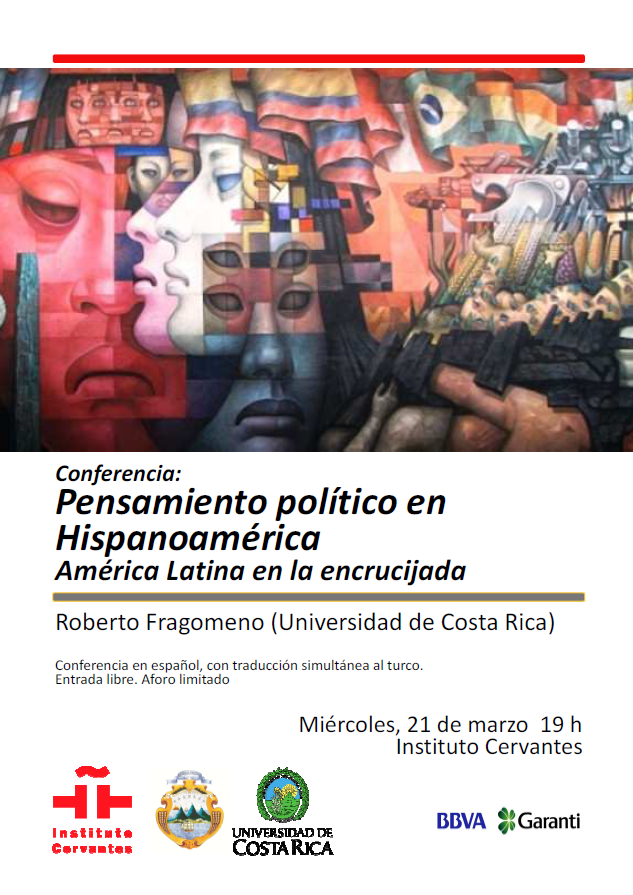
Conference brochure
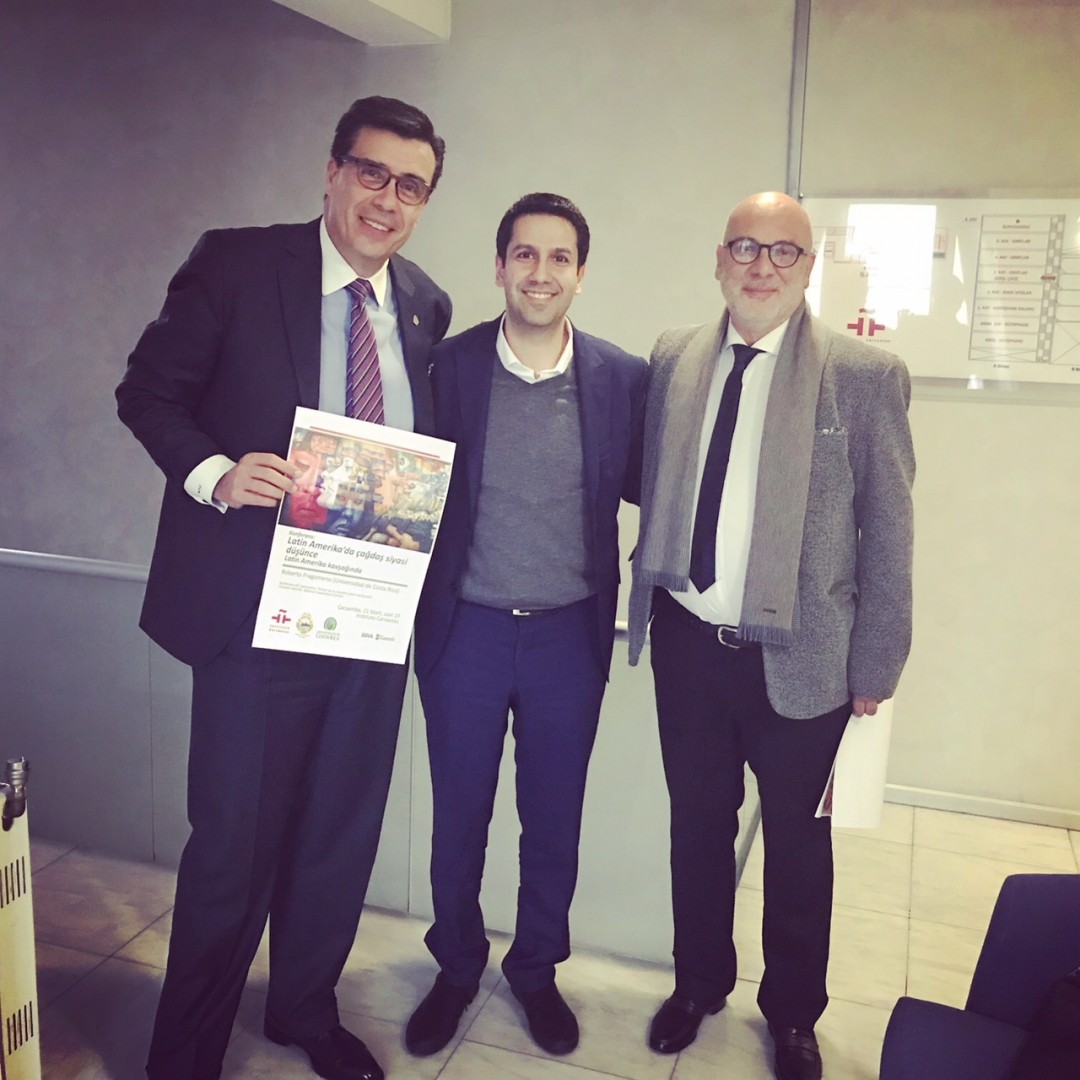
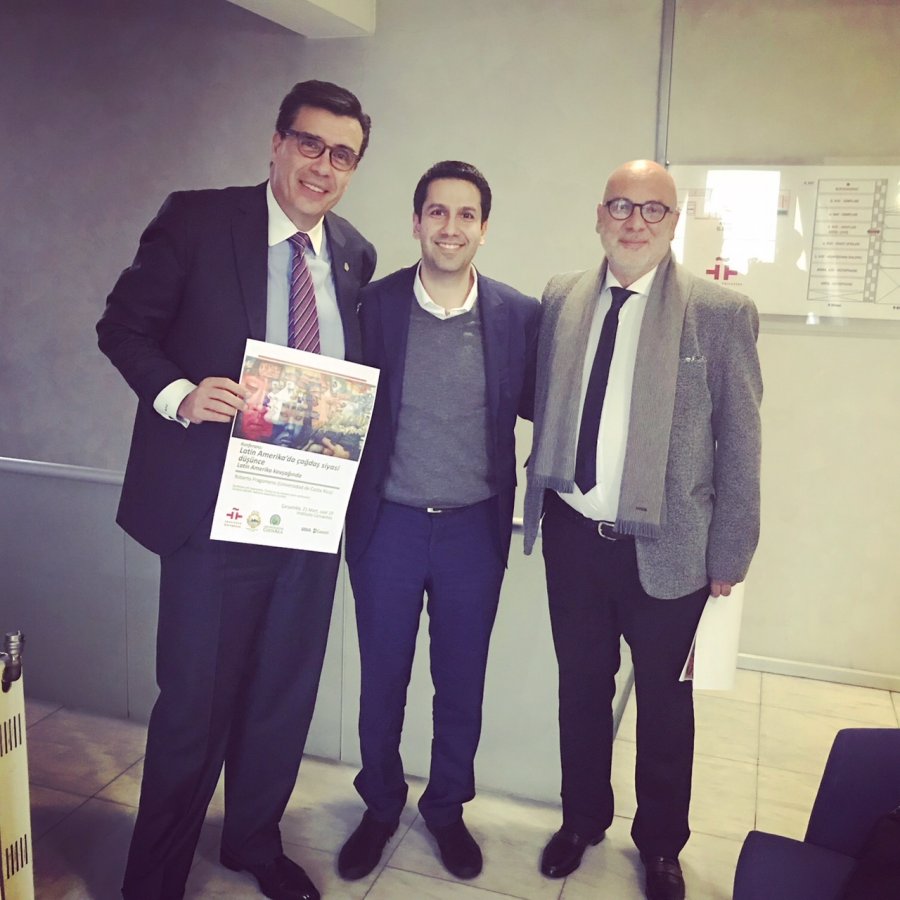
A photo we took with the ambassador and the speaker minutes before the speech. From left to right: Costa Rican Ambassador Marcelo Varela-Erasheva, me, and the speaker, Roberto Fragomeno.
Summary of the Ambassador’s Presentation: Speaker Fragomeno was born in Argentina but has lived in Costa Rica for 29 years and understands our worldview and our region very well. So, we asked him to share his analysis, thoughts, and perspective with us. What is happening politically in Latin America? What are Latin American countries currently experiencing, facing unexpected circumstances?
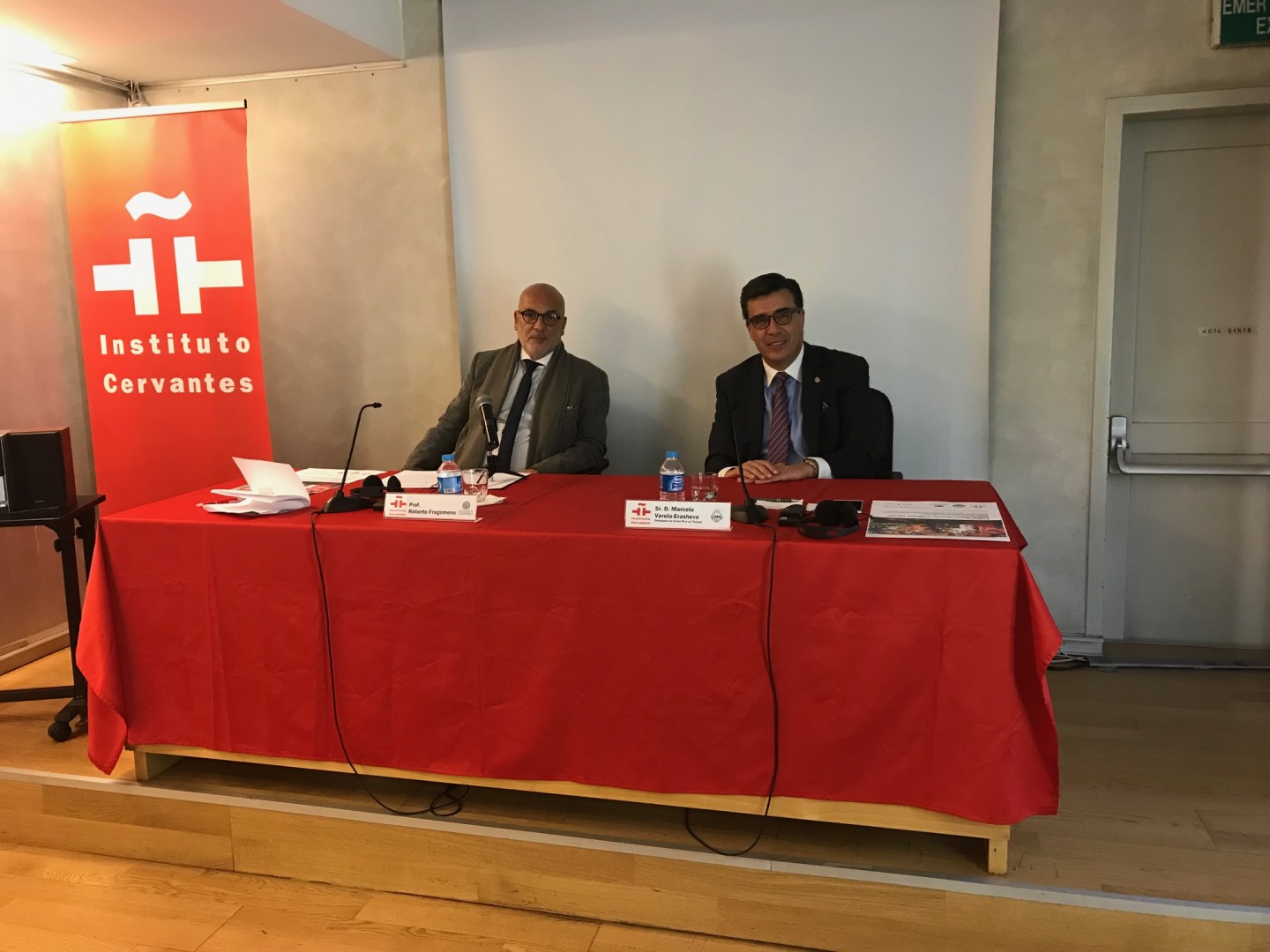
Panel of speakers. Speaker Fragomeno on the left, Ambassador Varela on the right
Roberto Fragomeno’s Speech: (I will include my own comments, using italics, under each topic. My goal is to provide you with more in-depth information by comparing Latin America with our own country and region):
When discussing Latin America, I avoid a narrow national perspective. For example, I acknowledge and understand that identities like Mexican or Argentinian are created over time, but here we are talking about uniting across these differences in an idea, without any distinction. This idea is the Latin American idea, and it’s not a concrete reality; on the contrary, it’s a project.
Narrow nationalism is rampant in our country. I first encountered micro-nationalism, a similar concept, during my time in the military. Everyone’s first question after my first and last name was where I was from. I was truly fed up with these questions, but I found the right leadership to adapt. If someone asked, “Where are you from?” I’d ask, “Where are you actually from?” If they said somewhere east or south, I’d say, “I’m from Gaziantep” (my father is from Gaziantep); if they said somewhere from the Black Sea region, I’d say, “I’m from Trabzon” (my mother is from Trabzon); and if they said somewhere west, I’d say, “I was born and raised in Istanbul.” To me, what matters isn’t where you come from, but your character, your intellect, and your conscience. This applies not just to Türkiye, but to people from all countries. The rest is just a detail.
A plundered culture
- Western invaders, believing our first indigenous peoples to be savages, inflicted harm upon them, committing massacres, plunder, and genocide. 90% of our people died in the first century of our continent’s discovery. We can trace the traces of this immense destruction, which occurred in just one century, in the works of Bartolomé de las Casas (1484-1566), where we see the cultural heritage of our ancestors destroyed and humiliated, and our wisdom ignored through these barbaric methods of ‘civilization.’ Yet, in many respects, the knowledge held in these lands was far more advanced than that of Europe at the same time. For instance, the Mayans had learned that we were in a heliocentric system and that our Earth was one of the planets orbiting it long before Westerners, who discovered this through the Copernican revolution. A legacy of Latin American history, stretching back 10,000 years, has been virtually destroyed by the traumatic impact of the West in the last 500 years.
This trauma continues to unfold in our region. I hope Western countries will abandon their desire to dominate others and see that we all share a single world, encompassing diverse riches, and that all countries, nations, and peoples must strive to raise the standard of humanity through teamwork. In other words, we must put aside our strife and begin working together for the well-being of all humanity.
Solutions and values of the past
- Pre-Columbian cultures on our continent laid the groundwork for solutions to the global crises we face today. Today’s economic crises stem fundamentally from overproduction, which in turn triggers political and military crises due to depleted resources. Amidst the potential creation of new resources and strategic challenges, we are also facing a technological revolution, bringing with it a monumental transformation. These developments also create crises in various areas, particularly the environment, which poses a threat to life on the planet.
We’re constantly experiencing crises in our own country. Unfortunately, we’ve become accustomed to it. The environmental crisis is the worst of these, in my opinion.
- Pre-Columbian peoples, before colonialism had even begun, ensured the existence and prosperity of their own people. Their language lacked the word ‘poor,’ and they possessed profound social values: cooperation, solidarity, and reciprocity were fundamental, with no room for competitive approaches or egotistical individualism, where everyone pursued only their own interests. These values from our past also form the foundation of today’s Latin American project.
Where are those advanced civilizations in Anatolia, the cradle of civilization? We carry the genetic, historical, and social codes of our ancestors of diverse origins who founded civilizations in this region. Therefore, I believe Türkiye will once again reach the level of advanced civilization and become one of the countries leading the way for human progress.
Colonialism and independence
- On the other hand, I avoid including Spain, Portugal, or the US in the ideological or cultural context of Latin America. I don’t say this solely from a local perspective; it’s clear that Latin America cannot be discussed without considering our pre-colonial past. But it’s also impossible to conceive of Latin America without reference to the US’s constant intervention. For me, Latin America is a cyclical idea, a constant conflict and struggle, where phenomena and focuses from both pre- and post-colonial eras constantly encounter and intertwine. However, this is not a synthesis. The idea of Latin America, from its birth to its growth and development, existed as an idea and project of independence, and it cannot be considered separately from this concept.
The colonial powers attempted to do the same here but were unsuccessful. Because the Ottoman Empire halted their expansion eastward (they even lost territory as far as Vienna), they turned their attention to the ocean and Africa.
The power of being a hybrid
- I emphasized earlier that I don’t adopt a solely local perspective. Yes, of course, there’s a pre-colonial legacy, as well as an intellectual history of Latin America in the 16th, 17th, and 18th centuries. Furthermore, we cannot evaluate Latin American history without considering the influences of Spain and Portugal. Therefore, I need to clarify my position and my arguments. In my view, Latin America should be defined as hybrid, and the goal of independence I mentioned should be considered a hybrid project. At this point, I want to emphasize that I use the term ‘Latinos’ purely for shorthand, and that I intend it to encompass a wide range of peoples and communities that have interacted with each other.
Everywhere is now hybrid. Türkiye is said to have over 70 ethnic groups of origin. This is a good thing, because the more people mix and interbreed, the stronger their genetics. A child generally inherits the strengths of both parents.
- Argentinian writer Jorge Luis Borges wrote a story about two religious friends who fight against the divergence of Christianity. Despite their shared efforts, the division between them leads to religious conflict. One friend champions his own interpretation, while the other vehemently opposes it. Ultimately, this opposition leads to one friend being declared a heretic and sentenced to be burned at the stake. In a twist of fate, the other friend dies in a fire years later.
Similar events and conflicts have occurred in our country. This is why sects and even religious orders emerged. Everyone forged their own path, and today people profess their allegiance to a religion, sect, or religious order like they support a football team. Ultimately, conflict is inevitable. I hope one day all people will understand that diversity and differing perspectives are inherently enriching.
The need to transform capitalism
- An important issue being discussed in Latin America is the spread of capitalism, which originated in Europe and has influenced Latin American thought.
This issue concerns the entire world. In my opinion, the capitalist system will undergo significant changes and transformations in the future. Because the world’s resources can no longer sustain a system built on constant consumption. We are making the world we live in uninhabitable. The problems are clear. I wrote an article about this a few years ago. I’d like to remind you again: http://www.serhansuzer.com/tr/enerji-ve-cevre-dunya-nereye-gidiyor
What needs to be done is also clear. I also wrote an article about this: http://www.serhansuzer.com/tr/insanoglu-dogadaki-dengeyi-yeniden-nasil-saglayip-gelecegini-teminat-altina-alabilir
- We learn about events in Türkiye or Senegal through North American or French news agencies—places far removed from our own situation. This flow of information runs parallel to the second globalization. I say ‘second’ because Latin America was born by merging into a world system. In the first, Iberian conquerors globalized our own raw materials, bringing their languages (Spanish, Portuguese) and religions (anti-Reformation Catholicism).
What do you call the right words? Of course, the irony of this speech is that he was saying these words at the Cervantes Institute, which has made it its mission to spread Spanish throughout the world.
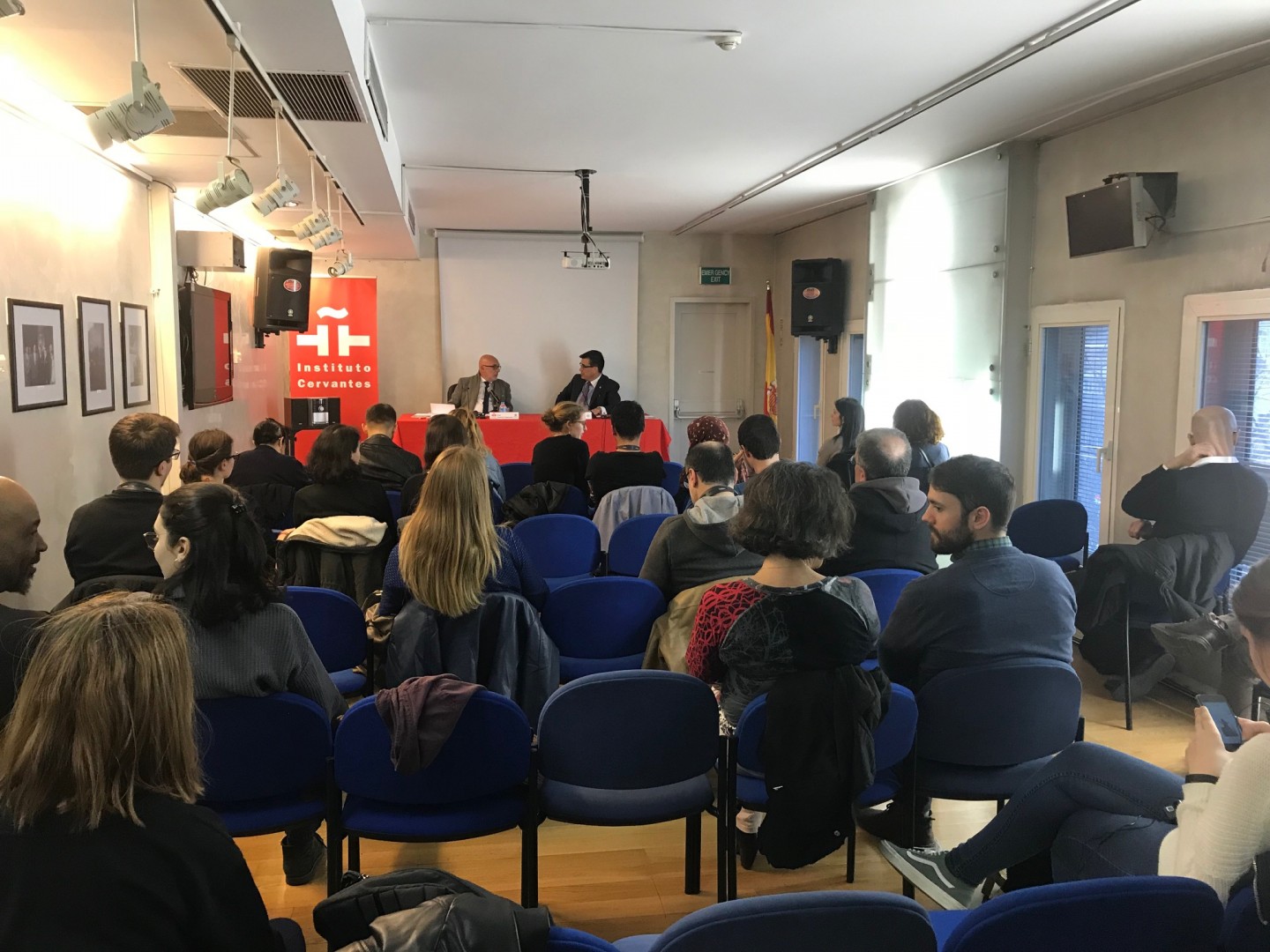
A shot from the conference hall
- Latin America used to be an exporter of raw materials but has become an importer of manufactured goods. Value-creating production is now out of Latin America’s hands and more vulnerable to the crises that follow the implementation of the neoliberal project.
The same problem exists in Türkiye. We can’t produce any value-added products. Our hazelnuts have made Nutella a global brand. We, however, are struggling to sell hazelnuts we produce under difficult conditions at tight margins.
The influence of Russia and Turkish TV series
- Few in Latin America are aware that Russia possesses international reserve potential, a robust financial structure, plays an influential role in both gas politics and global oil, and possesses agricultural potential. Russia’s influence on the global map raises concerns in the US and Europe. President Putin has been the defining figure of the 21st century until now. This demonstrates the end of unipolarity.
We’re nearing the end of gas policy. Russia must also take a position on renewable energy.
- Aside from Türkiye’s booming economy and Venezuela’s role as a supplier to this oil-consuming country, Latin Americans’ only understanding of Türkiye is based on its visuals, in other words, its television industry. I can say that the most-watched series in Latin America (even surpassing those from the US) are Turkish series. I’m not sure Latin American women identify with the heroines in these series, but I can confirm that our people enjoy watching them. Impossible love stories, marked by moral conflict, align with our traditional understanding of suffering.
Turkish series have achieved what no one else has. They’ve made an incredible contribution to the country’s promotion, and they continue to do so. Turkish series are breaking rating records in Latin America, the Middle East, Russia, and many other countries. Oh, and if only these series didn’t have long stares and slow dialogue. I personally can’t watch Turkish series because of the slow pace. Can an episode last three hours? What a shame for this nation. This is, of course, my personal opinion.
The importance of democratic institutions and regionalism
- (Response to a question about Uruguay) Uruguay is the most secular country in Latin America and has the highest human development index. Uruguay has two large neighbors, Argentina and Brazil, both noisy and chaotic. Therefore, Uruguay must be a calm neighbor. They know when to pause to reflect, and we are grateful for that. However, I cannot answer the question of what needs to be done, because this is a matter for Uruguayan intellectuals to analyze and evaluate by reflecting on their own history. If you don’t need history, then you’re not thinking. Therefore, I would like to invite anyone thinking about the future to look back and not forget our history. Let’s especially look at the unspoken, hidden areas of our history. This is the duty of the thinking person. Furthermore, I am always in favor of strengthening democratic institutions. Democratic and republican institutions are crucial to avoiding a repeat of the chaos of a few decades ago, and social change must be achieved through democratic institutions, not outside them.
As he said, Uruguay is one of the exemplary countries in Latin America. I also agree with his approach of looking to the past to develop future strategies. This applies not only to countries but also to people. People must embrace their past, learn the necessary lessons, and take steps towards the future accordingly.
- My opinion is that Latin America should initiate the process of regional integration. I wouldn’t recommend developing a closed-off development project for any Latin American country, including Brazil, the largest economy, followed by Mexico. In my opinion, Latin America’s development process depends on regionalization, so I don’t think abandoning trade with the US would be beneficial. Rather than severing ties with the US, they need to break free from its dominance. The problem isn’t the US itself, but rather their dependence on it. Therefore, approaches based on isolation from the US would be unfair to countries like Mexico. Because there are approximately 30 million Mexicans in the US, there is considerable cultural interaction. Mexicans are also a significant part of US culture. I believe that if any regional integration is to occur, Brazil and Mexico must take responsibility and lead the process. And of course, democratic processes must be successfully implemented.
I also support regional development. As Türkiye, we need to integrate with Central Asia, Eastern Europe, the Middle East, and Africa and exponentially increase our economic influence there. Hispanics (people of Latin American descent) make up over 20% of the US population. Knowing Spanish has served me well in the US for years. In fact, one of the jokes about this is that Latin Americans describe Miami as the closest Latin American city to the US. You can even see signs at Miami gas stations saying “We speak English.” Spanish has become a language spoken by 500 million people in 22 countries. Personally, I’m proud to have learned Spanish in the past.
Two opposite behaviors with the same reason
- A professor once told a story: When someone in a Latin American park threw their trash on the ground after eating, he asked them why they did so, and they responded, “Because it’s public property.” But in England, no one throws their trash on the ground, so why? The answer remains the same: “Because it’s public property.” This example demonstrates how different our understanding of public life is from that of other cultures. Institutions and organizations, both in the public and private sectors, must be mindful of this, and the groups that manage companies must do their utmost to ensure positive transformation.
That’s true. Latin Americans are very similar to us, in both good and bad ways. Unfortunately, a large majority of us lack that awareness. In other words, they see no harm in throwing garbage on the ground. The education system needs to be completely addressed. The education of parents and educators is especially crucial. I believe that government employees should be comprised of the most qualified individuals in the country.
***
Bilateral promotional mission
Following the conference’s main address, Cervantes’ cultural director, Miguel Grajales, took the floor. He thanked all the speakers. Our ambassador then took the final word and delivered a eloquent and concluding speech. Although the event lasted over two hours, most attendees stayed until the end and actively participated. It was a successful event.
It’s inevitable that we’re working together with a community of people so like us across the ocean. As I mentioned in my last article, as Honorary Consul of Costa Rica, I strive to explain and promote their strengths and vibrant culture in our country as much as I can. Of course, this is a two-way street. Similarly, we will be presenting our culture in Costa Rica. I will share the details of this later.
Finally, as I mentioned in my last article, there has been a change in the Turkish representation of Procomer (Costa Rican foreign trade agency). Ali Natour, who has served in this position for two years, passed the baton to Ferhat Değer this week. I wished Ali success in his new life in my last article. I wish Ferhat success in his new career as well.
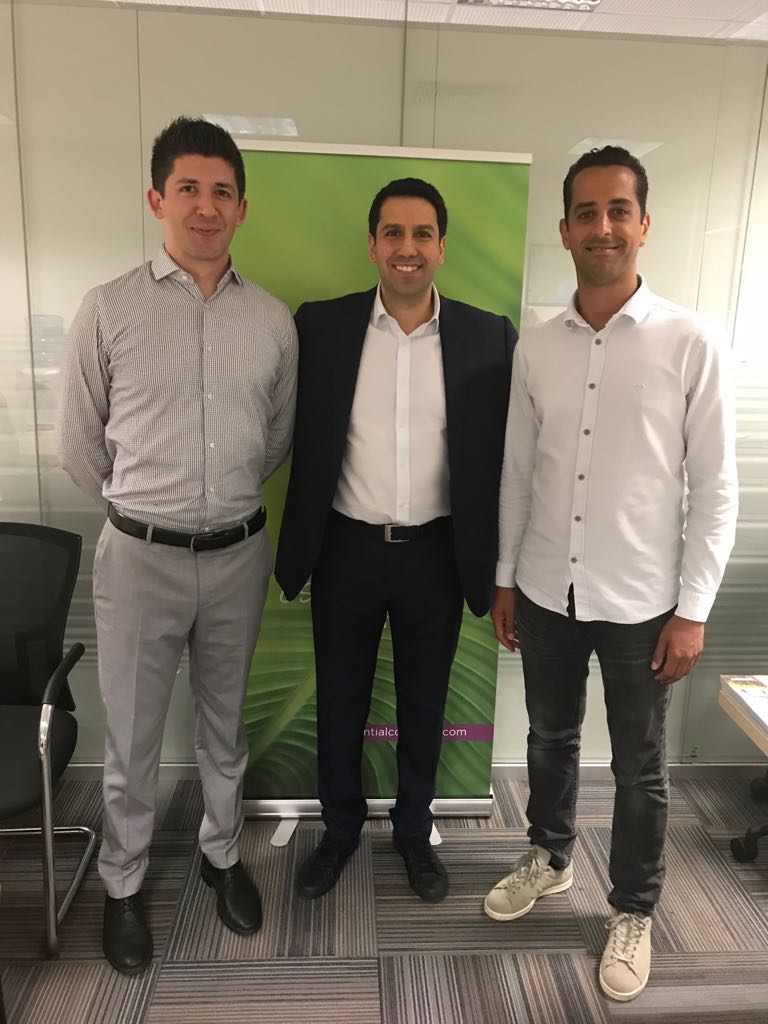
From left to right: Ferhat Değer, me, Ali Natour
I’d like to end my article with a wonderful video promoting Costa Rica. You can find the video at the end of this article. Those interested in visiting this beautiful country can visit our Honorary Consulate website for more information. Our address is: http://www.costaricaconsulistanbul.com
Anyone with any questions can contact us using the contact information on our website.
Pura Vida!