
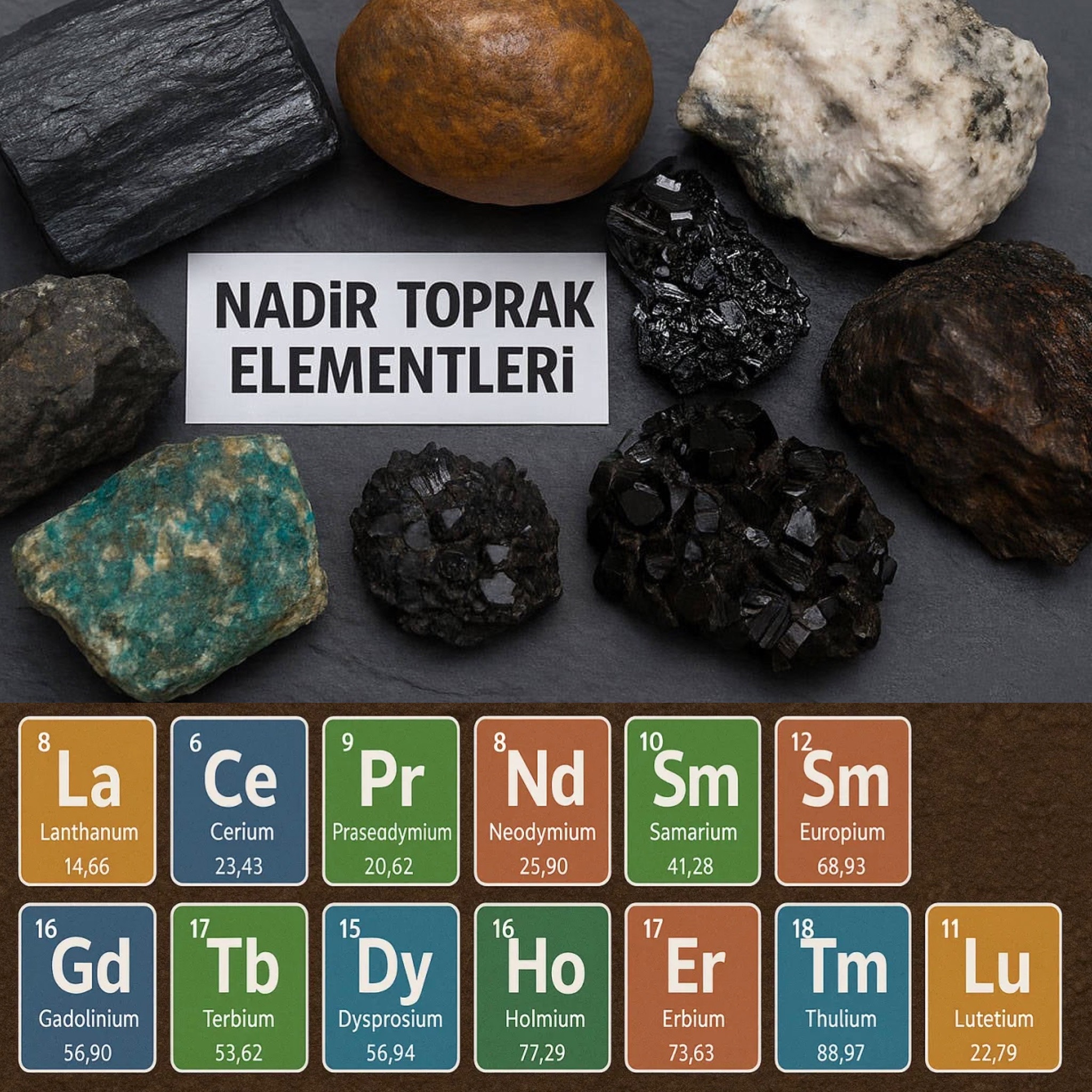
Before evaluating rare earth elements (REEs) from a geopolitical perspective, let’s understand what they are. Afterward, I will briefly discuss REEs from different perspectives.
Overview
Rare Earth Elements (REEs) are a total of 17 metallic elements, consisting of scandium and yttrium, along with the 15 lanthanide elements essential to modern life. They are not truly “rare” geologically; however, they are economically difficult to extract and refine. Here is a short list of REEs:
Light Rare Earth Materials (LREEs): La, Ce, Pr, Nd, Pm, Sm, Eu
Heavy Rare Earth Materials (HREEs): Gd, Tb, Dy, Ho, Er, Tm, Yb, Lu, and Yttrium (Y)
REEs form the basis of many fields, from smartphones and satellites to renewable energy systems and defense technologies.
Key Features
- They possess exceptional magnetic, luminescent, and catalytic properties.
- They are critical to the clean energy, electronics, and defense sectors.
- They are found in minerals such as bastnaesite, monazite, and xenotime.
- They require complex chemical refining processes for purity and separation.
Global Supply and Geopolitics
China refines more than 80% of the global supply—creating a strategically significant vulnerability. Countries such as the US, Japan, and Australia are developing new mining and recycling initiatives to secure their supply chains and reduce dependence on China.
Sustainability and Future Outlook
- Environmental impacts from mining and refining are driving the need for cleaner processes.
- Research into recycling and rare earth-free magnet technologies is growing rapidly.
- The rapid rise of the electric vehicle (EV) and renewable energy sectors will dramatically increase demand.
Conclusion
Rare earth materials are the “hidden enablers” of the global economy, enabling clean energy, advanced computing/electronics, and defense technologies. Ensuring sustainable and diversified access to these elements is critical for global stability and innovation in the 21st century.
Now, let’s explore this topic in more detail from a geopolitical perspective:
As I mentioned earlier, rare earth elements (REEs) are geopolitically important because they feed the “critical nerve endings” of the modern economy, and their supply is concentrated in very few countries. Briefly, the reasons are as follows:
1) An indispensable input for strategic technologies
Without REEs, many high-technology technologies would either not be produced at all or their performance would be significantly reduced. Therefore, they are not only a commercial but also a national security issue for countries.
- Defense: Radars, sonars, guidance systems, precision lasers, night vision, jet engine components.
- Aerospace: Lightweight and powerful magnets, alloys, and sensors.
- Digital economy: Smartphones, fiber optics, data centers, semiconductors.
- Clean energy transition: Wind turbine magnets (Nd, Dy), electric vehicle motors, battery components.
Conclusion: REE access = Technological superiority and deterrence.
2) Supply chain dependent on a few countries
What really exacerbates geopolitics is “concentration rather than scarcity.”
- Extraction and especially refining/separation capacity is concentrated in a few centers worldwide.
- This allows for geopolitical pressure to be exerted through tools such as price, export quotas, licensing, and logistics.
Conclusion: For dependent countries, this poses a strategic vulnerability, similar to energy dependence.
3) The race for clean energy and EVs has made REEs the “new oil”
As the world moves toward carbon neutrality, wind, solar, storage, and electric vehicles are growing rapidly. This growth is multiplying the demand for REEs.
- Rare earth magnets used in wind and EV motors are critical for efficiency.
- Rising demand makes supply security even more strategic.
Conclusion: REEs are the bottleneck of the green transformation.
4) Price and supply shocks can affect the global economy.
Export restrictions or geopolitical crises in a country can directly slow down:
- EV production plans
- Wind turbine projects
- Defense industry procurement.
Conclusion: The REE market is highly sensitive to macroeconomic and geopolitical fluctuations.
5) The “country of origin” gains power not only through mining but also through technology.
The value of REEs is not solely derived from mining; separation, metallurgy, magnet production, and advanced materials R&D are the most profitable and strategic parts of the chain.
- Countries leading in these technologies determine the added value and standards.
- Other countries remain dependent on technology transfer or imports.
Conclusion: The REE chain means economic power + technological dominance.
To summarize the issue from a geopolitical perspective, rare earth elements are geopolitically very important because:
1) They are critical for defense, digital, and green technologies.
2) Supply and refining are concentrated in a few countries.
3) The race for renewable energy and EVs (Electric Vehicles) has driven up demand.
4) Supply shocks can halt global projects.
5) The technological part of the chain affects the global distribution of power.
To better convey this point, I would like to share the rare earth elements (REE) geopolitical risk-opportunity matrix for the years 2025–2035, both globally and for Türkiye, below:
1) Global Risk–Opportunity Matrix
| Area | Major Risks | Major Opportunities | Expected 10-Year Trend |
| Supply Concentration: | Concentration of refining/separation capacity in a few countries → risk of political pressure, quotas, embargoes | Supply diversification through new mining/refining investments; strategic partnerships | Diversification will increase, but dependency will remain in the short term |
| Clean Energy & EV Demand | Wind–EV growth rapidly increases REE demand → price shocks, project delays | Strategic revenue for producer countries, similar to “new oil”; green industry leadership | Strong demand growth, especially along the Nd–Dy–Tb axis
|
| Supply Chain Fragility | Mining → refining → magnet/alloy chains dependent on single choke points | New regional chains with “friend-shoring/near-shoring”
|
Regional chaining and stock policies become widespread |
| Technology & IP (Intellectual Property) | Monopoly in magnet, alloy, advanced ceramic, catalyst technologies → license dependency | Countries developing new technologies determine added value and standards | Technology race accelerates, R&D becomes critical
|
| Environmental/Social Pressures | Mining and chemical separation pose serious environmental risks; local resistance → permit delays | “Clean refining” and ESG-compliant production provide a competitive advantage | ESG pressure increases, dirty production shifts/decreases
|
| Recycling & Substitution | Demand for certain REEs may decrease if substitution technologies accelerate | Urban mining (electronic waste), new value chain with magnet recycling | Recycling is growing rapidly, but full substitution is difficult |
2) Risk–Opportunity Matrix for Türkiye
| Area | Risks for Türkiye | Opportunities for Türkiye | Strategic Move Proposal
|
| External Dependency | Dependence on REE imports in high-technology production → cost/supply risk | Long-term contracts with countries that diversify supply | Multiple supply agreements + stock mechanism
|
| Local Resource Potential | Delay in exploration/exploitation investments; Lack of refining know-how | REE potential in Türkiye, especially in and around Eskişehir-Beylikova → strategic advantage | MTA-university-private sector joint exploration/operation
|
| Refining & Separation | Mine does not produce added value unless refined → raw material trap | Opportunity to become a regional refining hub (closeness to the EU) | Pilot refining plant + technology transfer JV |
| Magnet/Advanced Materials Production | Technology gap in NdFeB magnet and alloy production | Domestic magnet production for wind, EV, and defense industries offers significant added value | Domestic magnet pipeline + defense/EV purchase guarantee
|
| Green Transformation Industry | REE price shocks may slow wind/EV investments | Türkiye’s wind-solar-BESS growth will create a REE-based industrial ecosystem | REE-focused green industry clusters |
| Recycling (Urban Mining) General Strategy | Insufficient e-waste collection/separation infrastructure | New domestic sources of e-waste and old magnet recycling | Regulation + incentives for e-waste recycling
|
The geopolitical winners in REEs will not only be those who extract the minerals; they will also be the countries that are involved in refining, producing magnets/advanced materials, and managing recycling. The opportunity for Türkiye lies in linking the pipeline of domestic resources, refining, magnet production, and recycling to the same strategy.
In my opinion, what needs to be done globally regarding rare earths?
What should be done to minimize interstate disputes regarding rare earths? Three key actions come to mind:
1) Countries possessing these elements should be encouraged to share with other countries.
2) Countries with technological, economic, security, and geopolitical dominance should focus on developing countries with much weaker resources, rather than exploiting them. For example, instead of immediately shipping rare earths back to their home countries for processing, programs should be established to create employment in countries that also possess these minerals, ensuring that these minerals are processed into at least semi-finished products and exported. To establish this infrastructure, all necessary steps must be taken in terms of education, investment, and technical know-how, and these vulnerable countries must be supported economically and socially.
3) Superpower countries and unions such as the US, China, Europe, and Russia must avoid actions that would undermine global cooperation and peace, instead focusing on cooperation among themselves and striving to grow the economy together and ensure global prosperity.
4) States and the private sector that process and transform rare earths into technology must act within a sustainability framework. For example, recycling facilities must be installed at the end of the entire supply chain. Furthermore, in terms of social sustainability, the technology and system used for extracting these minerals must be organized in a way that complies with human rights and ensures the well-being of people.
5) The crucial point is the development of humanity and the provision of an environment where all living beings on Earth can live comfortably and enjoy a good life. Therefore, the primary goal should be the continuous development of technologies using these rare earths. For example, technologies that will enable human space travel must be pursued through the collaboration of all states and companies operating in the sector.
Ultimately, models and technologies must be developed to utilize rare earths for the benefit of all humanity. In my opinion, this situation will continue for some time. Perhaps 5-10 generations from now, space mining will begin, and even further, space mining will develop to such an extent that we will no longer need to dig up the Earth and deplete its resources. This is also crucial for sustainability, and let’s not forget the fact that we must take good care of our Earth, no matter what the circumstances. Currently, there is only one Earth for humans to inhabit, and even if we move on to other planets in the future, we must always remember that Earth was humanity’s starting point, and this legacy must be preserved.