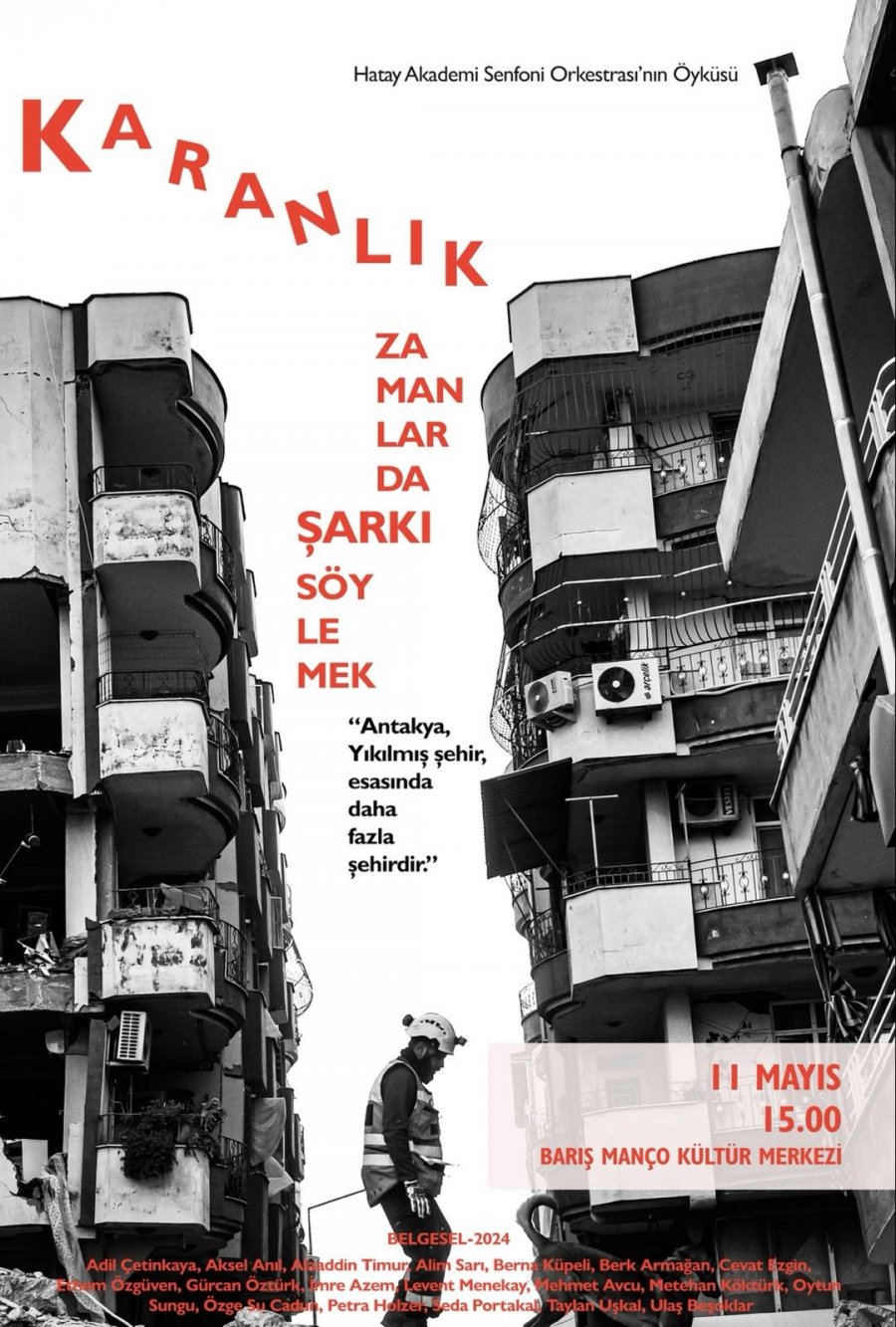
On Saturday, 11 May, at the invitation of documentary filmmaker Ethem Özgüven and his wife, Petra Holzer, I had the opportunity to watch the documentary “Singing in Dark Times,” which tells the story of the Hatay Academy Symphony Orchestra (HAO), which somehow managed to hold on to life after the 6 February 2023 earthquakes that nearly destroyed an entire city.
I call this a stroke of luck because this 42-minute documentary delicately explores a subject I hold dear. The documentary was screened at the Barış Manço Cultural Center in Kadıköy on 11 May as the final film of the 19th International Workers’ Film Festival, which opened on 1 May. One of the points emphasized in the pre-documentary discussions was that the Workers’ Film Festival is presented to the audience without sponsorship, without competition, and free of charge. Of course, this collaborative event is organized by individuals and supporting and organizing institutions. I must emphasize this point. Interested readers may have missed the screening program, which you can read at https://www.iff.org.tr/_files/ugd/25b760_f2da9c5550f746deb88468efde108e7a.pdf . However, you can follow developments for the next Workers’ Film Festival on their website: https://www.iff.org.tr/festivalprogrami
My sensitivity to disasters
Those who regularly read my blog know this. I started blogging because of the 2011 Van Earthquake and our experiences in its aftermath. Here is my first official blog post: https://www.serhansuzer.com/tr/bir-depremin-ardindan
In the following years, I wrote many articles about earthquakes and other disasters in Turkey, addressing this topic repeatedly.
Immediately after the 6 February 2023 earthquakes, I wrote an article titled “This time, the earthquake hit my father’s homeland hard:” https://www.serhansuzer.com/tr/deprem-bu-kez-baba-yurdunu-fena-vurdu
In my next article, because I was fed up again, I posted another blog post titled “Building buildings to protect people” as a recommendation: https://www.serhansuzer.com/tr/binalarin-insanlari-korumak-icin-yapilmasi
So, as you can see, I am deeply sensitive about disasters, especially earthquakes. In addition to my sensitivity, the 6 February 2023 earthquake, whose epicenters occurred in my father’s hometown of Gaziantep and Kahramanmaraş last year, caused devastating loss of life and property in the areas where many of our friends and acquaintances lived. Important cities like Antakya, in particular, were largely destroyed. Tens of thousands of our people lost their lives.
HAO’s Approach, the Subject of the Documentary
It’s a fact that all the losses, especially the irreversible loss of life, have left the people of the region with a profound trauma that they will carry with them throughout their lives. To overcome this trauma, the locals have chosen different methods. Some have moved to another city, either within Turkey or abroad, to change their location, while others have continued to practice their art because it is good for their souls and to raise the spirits of the local people.
HAO is among those who bravely stayed in the region and declared, “This is our homeland, we’re not going anywhere.” Ethem Özgüven and the entire production team documented their experience, bringing us the full scope of the disaster, the people trying to hold on to life during those dark days, and the works of artists who are a glimmer of hope and a harbinger of brighter days. To help you visualize, I’m sharing the trailer for the documentary “Singing in Dark Times”:
Getting to Know the Orchestra
After the documentary premiered last Saturday, the Hatay Academy Orchestra (HAO) took the stage to comment on the documentary and answer questions. Meanwhile, I posed two questions. Before we delve into these questions and the documentary’s content, let’s get to know the Hatay Academy Symphony Orchestra (taken from their website: https://hataysenfoniorkestrasi.com/index.php/hakkimizda/ ):
The Hatay Academy Orchestra set out with the ideal of transforming culture and art in its own region. It was founded in 2019 to ensure that this ancient land, known worldwide for its cultural richness, also holds its rightful place in terms of cultural and artistic formations, activities, ideas, and schools. Operating under the Hatay Symphony Orchestra Culture and Arts Association (HSO), the Hatay Academy Orchestra is Hatay’s first and only symphonic orchestra. The orchestra members are all conservatory graduates, students, and music teachers. It operates in conjunction with the Hatay Polyphonic Choir, established within the Hatay Academy Orchestra. Since its inception, it has organized various concerts, projects, training programs, and workshops, and has established children’s choirs and orchestras with the goal of transforming the core. They continued to network with institutions and organizations in various cities, such as Çukurova University State Conservatory and İzmir Mahal Aura, and carried out joint projects. They also participated in projects supported by Culture Civic, Kültür İçin Alan, and A.B. Sivil Düşün.
Raising Hope…
After watching the documentary, the HAO artists and documentary film crew took the stage and shared their experiences and feelings about the 6 February earthquakes. You can read similar content on the HAO website:
Hatay was one of the provinces most affected by the 6 February 2023 earthquake. All districts of Hatay suffered significant damage, and the ancient city was completely destroyed. Orchestra members Abdurrahman Düzgün, soprano Cansu Çilingir, viola player Büşra Kırkıcı, and double bass player Ali Yılmaz lost their lives. Most of the surviving members were pulled from the rubble hours later, losing their loved ones. Their homes were destroyed. The vast majority of the instruments that accompanied the orchestra through thick and thin, bearing the traces of the orchestra members, each believed to possess a soul, were lost under the rubble. All the orchestra members, except the orchestra’s founder/conductor, were forced to flee their city.
The Hatay Academy Orchestra takes its name from the Antioch Academy, founded by Libanius, who lived in Antioch in the 4th century. Just as thinkers, scientists, and students from around the world came to study at the time, the Hatay Academy Orchestra aims to be a haven for art for scientists, artists, intellectuals, and students. The Hatay Academy Orchestra defines itself as a transformational movement in the field of culture and art. It’s no coincidence that its logo is the silkworm. The silkworm spins its own cocoon. It enters the cocoon as an insect and transforms within it, eventually becoming a butterfly and flying from it. Art is also a process of self-creation. Like a silkworm, the artists of the Hatay Academy Orchestra aim to spin their own cocoon, develop themselves, transform within it, and ultimately become a butterfly, ultimately flying to create other transformations. The Hatay Academy Orchestra, like the angels mentioned by their fellow countryman Libanius, wants to descend to Antakya, to have a say in how the new city to be built is built in accordance with Antakya’s history, architecture, and spirit, to weave a new life through culture and art, to point to the suffering experienced through art, to keep memories alive, to leave a mark on history… And on the path to a new life to be built, they want to give birth to “hope”…
A reference to Brecht’s famous quote
The phrase “Singing in the Dark Times,” which gives the documentary its title, was first uttered by Bertold Brecht. Brecht, in his time, described the HAO situation perfectly: “Will there be singing in the dark times? Of course, there will be singing, about the dark times.” After watching the documentary, the orchestra’s founder and conductor, Ali Uğur, reiterated his words on stage and answered most of the questions himself. You can read Ali Uğur’s brief biography at https://mahalaura.com/ali-ugur/ .
Incidentally, let’s also include the description of this documentary on HAO’s own website:
The train we need to emergency brake.
Antakya.
A ruined city is, in fact, more of a city.
Perhaps the city is what remains after the buildings, streets, and memories that hold the city together are buried under the rubble. Perhaps a “voice” will gather all this rubble and bring it together. The Hatay Academy Symphony Orchestra has set out to do just that.
This “high-speed train,” which is hurtling ever faster toward disaster, has one rail called the “state of emergency,” the other “debris.” This train has passed through the earthquake station and is now moving faster.
Today, we are on this train, which we must all emergency brake on, stop, to transform. Hatay artists are standing in solidarity for this. A year has passed, and they have transformed our pain into something bearable, endurable. Without them, this pain would be unbearable.
I would also like to emphasize that Ethem Özgüven, who produced and directed the documentary, also served as the festival coordinator of the Bozcaada International Ecological Documentary Festival, and his wife, Petra Holzer, served as the festival director.
Emotional speeches and questions
I would also like to emphasize that, both during the documentary and in the speeches given by the HAO members who appeared on stage after the screening, they consistently expressed their grief at the loss of orchestra members Abdurrahman Düzgün (percussionist), Cansu Çilingir (soprano), Büşra Kırkıcı (violist), and Ali Yılmaz (double bassist). One of the most telling statements was, “At first, they were able to recognize the city among the ruins. But now the second wave is hitting, because those ruins are gone, and they can’t recognize the neighborhoods where they grew up.” After completing such an emotionally charged documentary and the subsequent conversations, I was able to pose the following two questions (I’m briefly sharing the questions and answers):
- One of the most impactful parts of the documentary is the natural and peaceful atmosphere in various German cities you visited for concerts after the earthquake, and the images of destruction, pain, and drama in Hatay shown immediately afterward. This comparison clearly illustrates the difference. Could you share your thoughts on what the orchestra members who went to Germany at the time felt about this?
We all felt a little strange in Germany after the earthquake, especially in the first few days. We were able to catch our breath, but none of us considered not returning. In fact, after a certain day, we all felt we missed Hatay terribly and started talking about what we would do in Hatay when we returned. It took us a few days in Germany to get over the initial shock.
- Did any politicians contact you after the earthquake?
We weren’t contacted by politicians, but the Governor was very supportive. Thankfully, he paved the way for us in every way.
I recommend my dear readers to watch this documentary and, if possible, attend a concert by the Hatay Academy Symphony Orchestra. You can also support the orchestra by visiting their website and donating to the orchestra: https://fonzip.com/hatayakademiorkestrasi/genel-bagis
Note: I’d also like to share the credits for this wonderful documentary. I’d also like to congratulate everyone involved. Thank you for your efforts.
Documentary Crew
Director: Ethem Özgüven
Assistant Director: Adil Çetinkaya
Director of Photography: Adil Çetinkaya, Ulaş Beşoklar
Camera Support: Ali Cem Doğan, Berkay Aydın, Can Ataseven, Erkal Tülek, İlker Mutlu, Kader Çetintaş, Mehmet Ünler, Salih Temiz, Ufuk Aldemir
Camera: Adil Çetinkaya, Aksel Anıl, Berna Küpeli, Berk Armağan, Cevat Ezgin, Gürcan Öztürk, İmre Azem, Mehmet Avcu, Özge Su Cadun
Editing: Adil Çetinkaya, Aksel Anıl, Berk Armağan, Ege Davrak, Ulaş Beşoklar
Sound: Levent Menekay
Subtitles: Eceworx, Oytun Sungu
Credits: Taylan Uşkal, Alim Sarı
Photographs: Ulaş Beşkoklar
Texts: Aslı Odman Tuğçe Tezer
Poster design: Dilek Gürsoy, Seda Portakal
Social Media Team: Ahmetcan Öğüncü, Selin Bozkurt, Adil Çetinkaya
Producers: Petra Holzer, Ulaş Beşoklar, Ethem Özgüven
Tag: memoir