While we were in Niğde for solar energy and biogas projects, an official at the governor’s office told us he had acquaintances in Şanlıurfa who were unable to irrigate their farmland because of the region’s electricity shortage. They were interested in solar energy and had reached out to him about it.
As you know, electricity loss and theft is a serious problem in our eastern regions. The local utility company there, Dicle EDAŞ (DEDAŞ), unable to curb this loss and theft, has in many places shut down transformer stations. This leaves everyone—whether they steal electricity or not—without power. In other words, the innocent suffer along with the guilty. Don’t get me wrong, I’m not saying this approach is completely wrong. But because of overly strict measures, local people face serious problems, and still, the rate of loss and theft remains above acceptable levels.
When there’s no electricity, pumps can’t run, and underground water can’t be drawn for agricultural irrigation. As a result, in the scorching summer heat of 2014 alone, 150,000 hectares of farmland were lost and crops were destroyed.
I told him we were always open to such requests, that we had never done a solar-powered agricultural irrigation project before, but that from an engineering standpoint, it wouldn’t be difficult for us to pull off. On our next visit, he introduced us to farmers from Urfa.
After meeting with a group of young Urfa farmers in Niğde, we gathered the necessary information and stayed in touch. Once we had compiled all the data, our team traveled to the actual site, in the Akçakale district of Şanlıurfa on the Syrian border, for a preliminary inspection. After completing all assessments, we wrapped up the engineering and planning within a week.
We carried out this project in close cooperation with the German company Lorentz. If I had to describe Lorentz pumps, I’d call them the Mercedes or BMW of irrigation, which is slightly expensive, but top quality and high performance. For the solar panels, we used products from Jinko, a Chinese company ranked among the world’s top five in sales volume. These days, even German companies use Chinese panels in their projects when the price–performance ratio makes sense.
Since the pump we selected for the project was DC-powered, we didn’t need an inverter. We sourced the construction materials and cables locally. As always, we did all calculations and planning with zero tolerance for error.
Once preparations were complete, we presented the project details to the Urfa farmers, discussed how they could finance it, and referred them directly to two or three banks in Istanbul. They ultimately decided on Garanti Bank. Once the bank made the payment, we moved forward with implementation. Since we anticipated extreme heat from the second half of April onward—and irrigation would have to start by then—we were essentially racing against time.
The result? You can watch the related video below.
Thanks to our efforts, we established a 65-kW solar power plant covering 850 m². The electricity produced runs a 30-kW pump capable of drawing 1,200 tons of water per day from 80 meters underground. We delivered this integrated system to the Urfa farmers. 110 acres can be irrigated solely using solar energy. Because irrigation is done during the day, there was no need for a battery system.
Another noteworthy aspect of this project is that the 30-kW Lorentz pump we used is the largest single pump of its category in Türkiye, making this the largest agricultural irrigation project of its kind in the country.
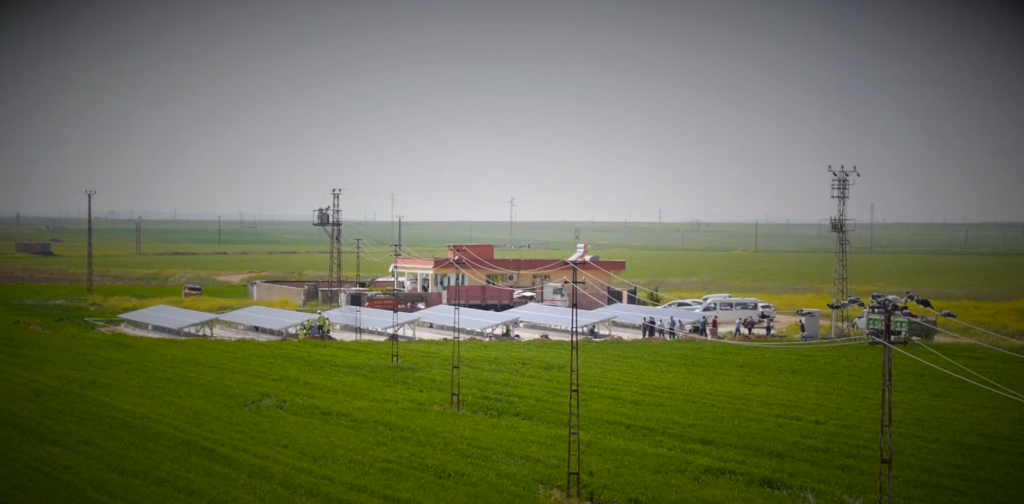
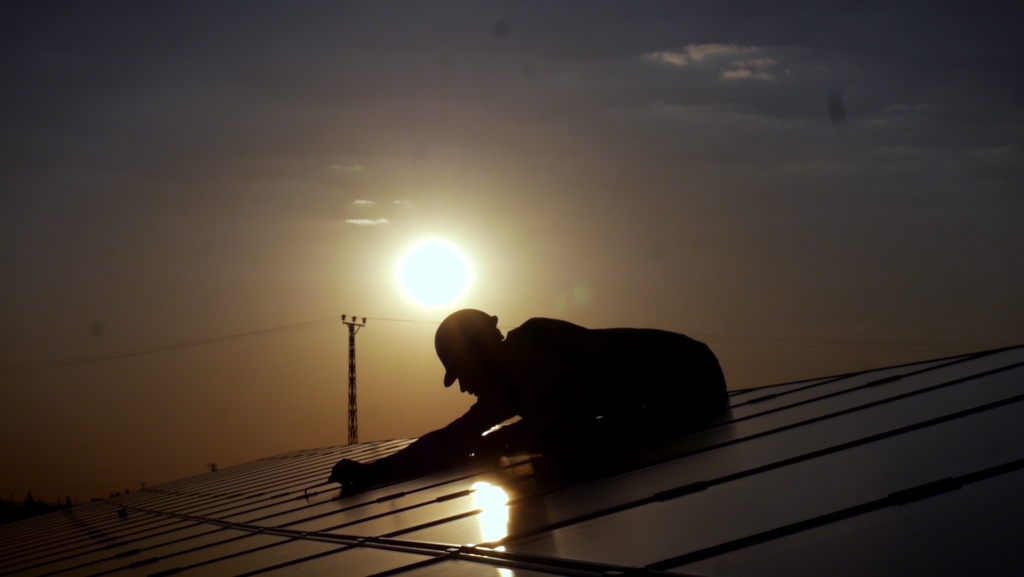
After four days of non-stop work, we completed the installation. Since the sun was setting when we finished at 6:45 p.m. on Sunday, we waited until the next morning to test the system.
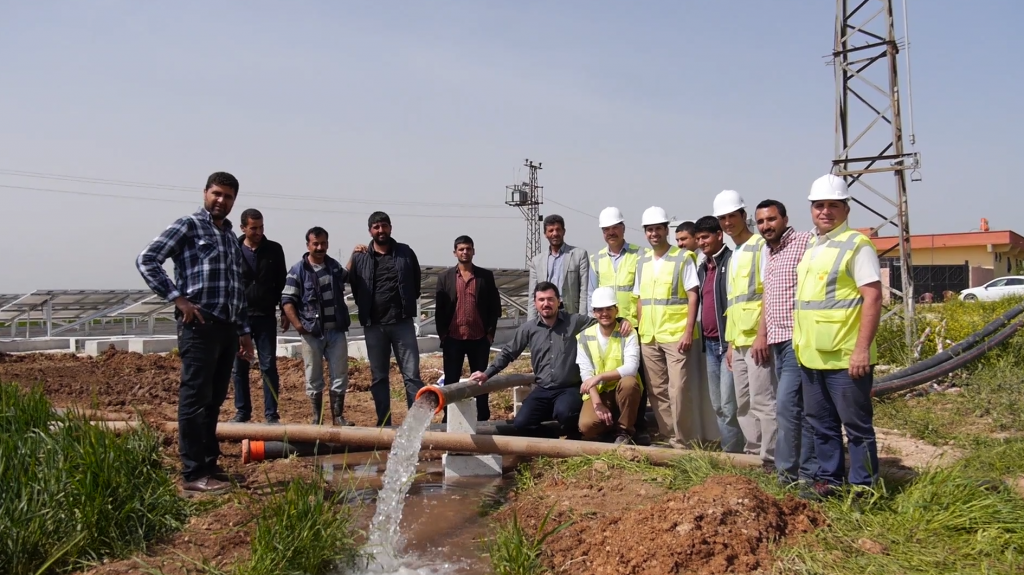
At 9:00 a.m., when we switched it on and saw the water flowing, we all felt an incredible sense of pride and joy. The water pressure was so high that I remember telling the landowners, “You should integrate a drip irrigation system at the outlet to make efficient use of this water.” Two weeks later, we held the official opening ceremony with the governor of Şanlıurfa in attendance.
We’re pleased to see that this system has inspired many others. Since installing it, we’ve received—and continue to receive—requests from all over. We have even set up an agricultural irrigation division within our company. Many farmers, agricultural cooperatives, irrigation unions, municipalities, and district governorates across Türkiye—a country rich in agriculture—are showing interest in generating their own electricity off-grid.
This kind of system not only enables farmers to irrigate but also supports mechanisms that allow them to grow high-value crops like cotton, which fetch good prices in the market. I take great satisfaction in this work, and seeing the results of such projects motivates me even more.
In my next article, I’ll share another project that inspires me in a similar way: the rural development project that the Basic Needs Association (TIDER), of which I am the founding president, implemented in the village of Yırca in Soma.
Tag: ecology