
The 32° C. temperature recorded in Norway this June was the highest temperature ever recorded within the Arctic Circle. Temperatures also peaked this month in European and North African countries. From France to Austria, Norway to Tunisia, new temperature records were broken in Europe and North Africa in June. Temperatures reached 42° C. in France, 49° C. in Tunisia, 35° C. in Poland, and 37° C. in Germany. Spain broke its 20-year record with 44° C. this month, while Italy began experiencing its worst drought in 200 years. Experts warned that extreme weather events will continue this month and urged everyone to be prepared for disasters such as forest fires, floods, and storms. To read the detailed news, please visit https://www.ntv.com.tr/galeri/dunya/avrupada-haziran-ayinin-sicaklik-rekorlari-kirildi,1dnj9FZv60OodF6Xa6s0pA?utm_source=newsletter&utm_medium=email&utm_campaign=%F0%9F%92%8A+Harca+harca+bitmez .
The situation is no different in Turkey. Last July, the temperature record in Turkey was broken with 49.1° C. measured in Cizre. Here’s the related news: https://www.sozcu.com.tr/2021/gundem/turkiyenin-sicaklik-rekoru-kirilmisti-sokaklar-bos-kaldi-6549623/?gclid=CjwKCAjw_ISWBhBkEiwAdqxb9plJBf81xCrodiZvkgEeqH0Po5GxDXNo5BeRWfDkceEa_Hx8YT0EPxoC4AQQAvD_BwE
I fear this record will rise even further in the coming years, surpassing 50° C. This means that even a country like Turkey, which is considered moderately warm in terms of global temperatures, will experience temperatures of 50° C. This will bring with it a series of disasters, from rapid water evaporation to forest fires, making life difficult.
We are not helpless against the climate crisis
We seem to have entered a dead end regarding the climate, but are we truly helpless as humanity?
No, we’re not. There’s still a solution. While its impact is slowly taking hold, there are things we need to do without delay to eliminate this climate crisis. This fight may last for generations, but we need to start doing what we need to do as soon as possible.
I wrote the first comprehensive article on this topic exactly 10 years ago, in 2012, under the title “How can humanity restore balance in nature and secure its future?”: https://www.serhansuzer.com/tr/insanoglu-dogadaki-dengeyi-yeniden-nasil-saglayip-gelecegini-teminat-altina-alabilir
I also addressed one of the most important points here under the title “Meeting 100% of our energy needs from renewable energy sources.” Since the sun is the source of everything (the wind is also the source of the sun. Wind is created by heat exchange, and the sun provides heat exchange), let’s first look at solar energy.
Let’s start with some good news. According to a study conducted by Solar Power Europe, installed solar power capacity has reached the ‘terawatt’ (TW) level worldwide. In other words, the total installed capacity of solar power plants has surpassed 1 terawatt, or 1 million MW. This is great news, but it’s never enough. Installed capacity needs to reach tens of millions of MW so we can generate all the energy we need from the sun, storing any excess energy for use when the sun isn’t shining. Of course, let’s not forget other renewable energy sources like wind, geothermal, bioenergy, wave, current, and so on. However, solar energy will always be at the forefront.
So, if you ask what the status of the solar energy sector in Turkey is, I can say that while there is progress, we are still lagging behind.
Our production is still less than 1% of the world’s
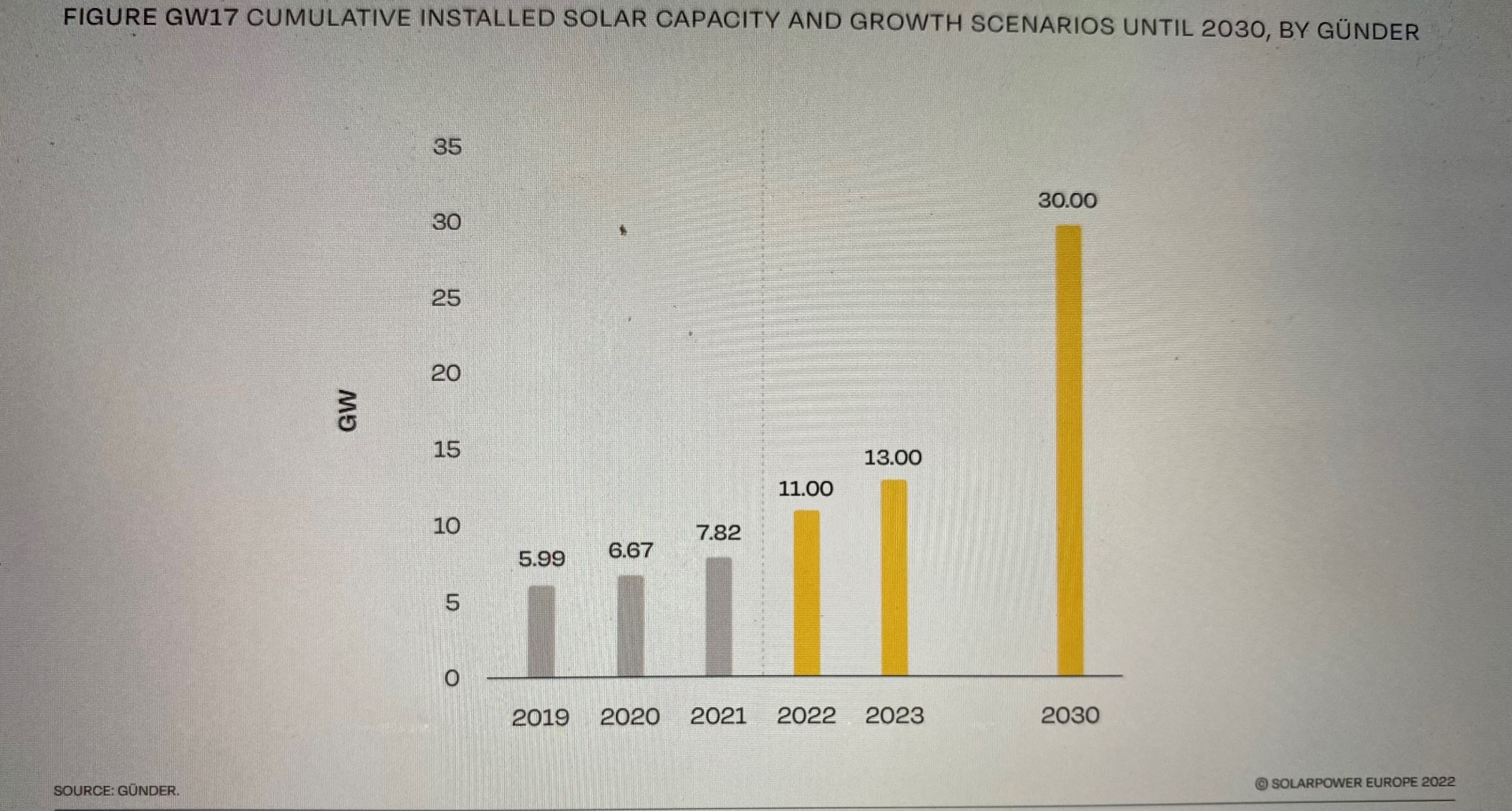
Turkey’s installed solar power capacity, currently 8.3 gigawatts (GW), or 8,300 MW, is estimated to exceed 30 gigawatts by 2030, thanks to rooftop and field projects. In Turkey, where the average daily sunshine duration is 7.5 hours, the potential for rooftop solar power plants is estimated at 20 gigawatts. According to information compiled from GÜNDER and SolarPower Europe reports, the “terawatt era” of solar power began in May when global installed solar power capacity reached 1 terawatt.
Although Turkey’s 8.3 GW (i.e., 0.83% of total installed capacity) is less than the global capacity of 1,000 GW (1 terawatt) (imagine, it’s not even 1%), I believe Turkey will rapidly increase its capacity and take its rightful place in the world. First of all, I believe Turkey’s 8.3 GW installed capacity can easily be increased to 100 GW. This means we can install 10-15 times more than the current installed capacity.

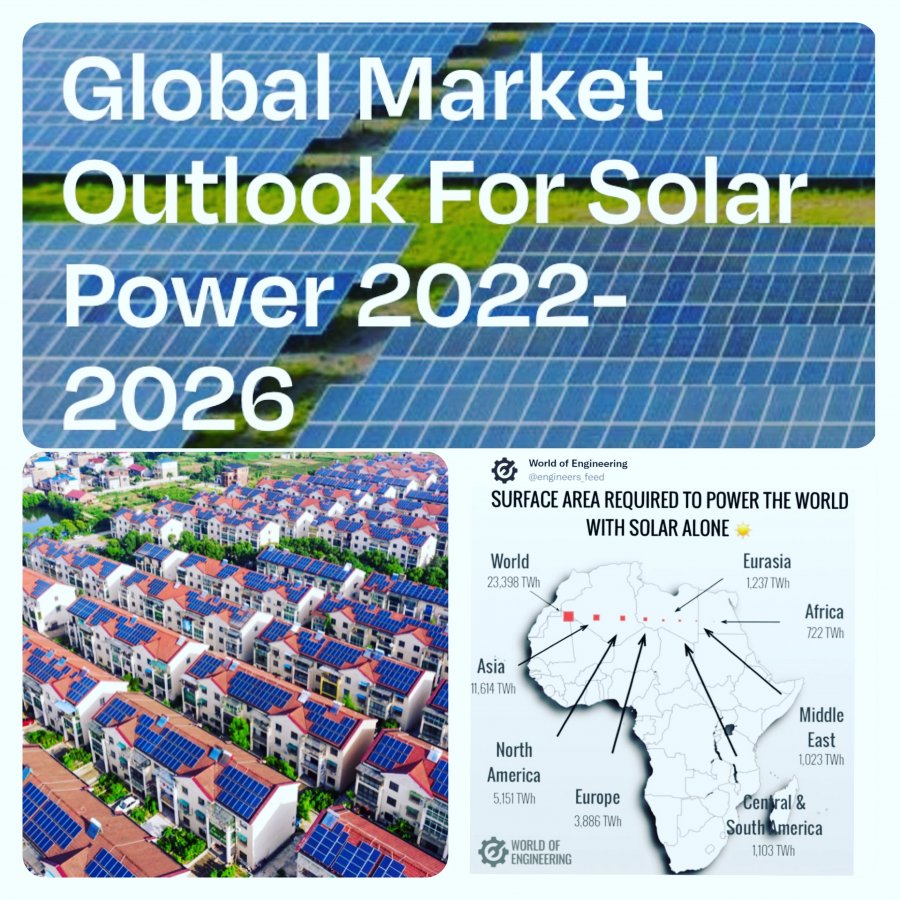
Speaking of the current situation, let me share with you the highlights of the Global Market Report for the 2022-26 period prepared by SolarPower Europe, supported by GÜNDER (International Solar Energy Society – Turkey Chapter), for the global solar energy sector:
During the past year, which saw record electricity prices worldwide due to the ongoing COVID-19 pandemic, economic recovery programs, and the energy crisis, many sectors turned to solar-based solutions for their energy needs. In 2021, 167.8 GW of new solar capacity was connected to the global grid, a 21% growth compared to the 139.2 GW added the year before, marking another annual global record for the sector. These developments not only brought the total active solar power network to 940 GW by the end of 2021, but also meant that the global “terawatt” threshold would be surpassed long before this report’s publication in May 2022.
1) Global capacity reaches the ‘terawatt’ level
Global solar power capacity doubled in three years from 2018, reaching the terawatt level in April 2022. In other words, the global solar market is growing exponentially. While it took approximately 10 years for the total capacity to reach 1 TW from 100 GW in 2012, according to SolarPower Europe’s forecast, this rate will more than double in just three years, to reach 2.3 TW by 2025.
2) Solar energy: The fastest-growing energy technology
Solar energy remains the fastest-growing renewable energy, accounting for more than half of the 302 GW of renewable energy capacity installed globally in 2021. With an increase of 168 GW during the year, solar energy installed more than 70 GW more than its closest ally, wind energy, and more than all non-solar renewable energy combined.
3) Global solar energy production shares
China maintained its market leadership in 2021 with 14% annual growth and an all-time high of 54.9 GW of new production by country, producing twice as much solar energy capacity as its closest competitor, the United States. In contrast, the US also showed impressive growth with a 42% increase in 2021 compared to 2020. India ranked third with 14.2 GW of installed capacity.
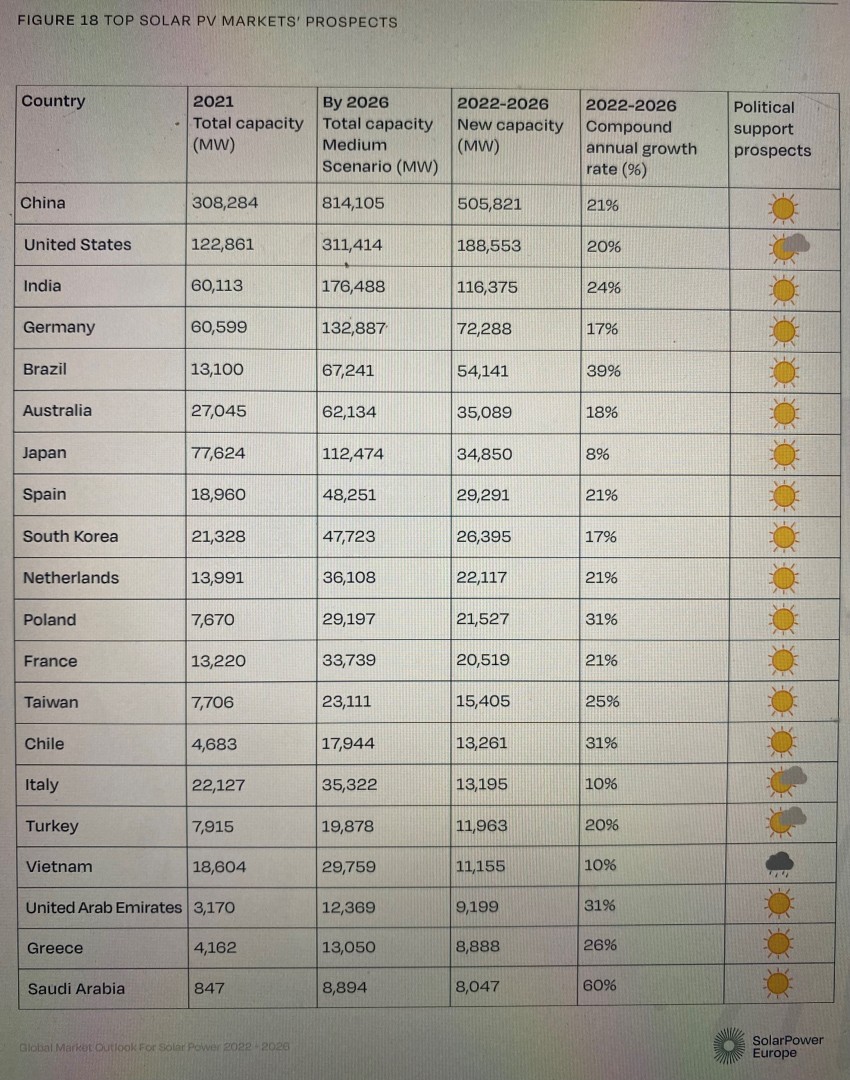
4) Europe’s solar energy trajectory
The European region* continued its positive trend with 33% growth, adding 31.8 GW of solar capacity, missing our 2021 Global Market Report estimates by only 0.1 GW. Russia’s war with Ukraine and related energy security issues, as well as the EU’s climate targets, have impacted the continent’s renewable energy transition, with 25 to 27 EU member states rolling up their sleeves to install more in 2022 than in 2021.
*European region: EU (27) + Albania, Armenia, Azerbaijan, Belarus, Bosnia and Herzegovina, Georgia, Iceland, Kosovo, Montenegro, North Macedonia, Norway, Russia, Serbia, Switzerland, Turkey, Ukraine, and the United Kingdom
Developments in Turkey
The same report summarizes developments in Turkey as follows:
Turkey is one of the fastest-growing energy markets in the world, and its total energy demand is increasing at an accelerating pace. To address numerous challenges, including climate change, the health impacts of air pollution, energy security, and volatile oil prices, the country is turning to renewable energy technologies, and solar energy is a leading source of its future energy solutions mix. By the end of 2021, Turkey had reached approximately 100 GW of installed electricity generation capacity, with solar energy production reaching 7,816 MW (we have currently surpassed 8.3 GW). This represents an increase of 1,148 MW compared to 2020 and accounts for 7.8% of the country’s total generation capacity. The distribution of other energy sources is as follows: 48.3% fossil fuels (natural gas, coal, liquid fuels, etc.), 31.5% hydropower, 10.6% wind energy, and 1.6% geothermal energy. While the most significant increase in installed renewable energy sources is occurring in wind and solar energy, almost all of natural gas and approximately 40% of coal are imported. Therefore, Turkey needs to develop its energy self-sufficiency by unlocking its rich renewable energy potential.
Despite being Turkey’s most valuable energy source with a potential of at least 500 GW, solar energy remains underutilized. The Ministry of Energy and Natural Resources’ 2019-2023 strategic plan aims to increase the ratio of local and renewable energy resources to the country’s total installed capacity from 59% to 65%. This means a total of 56.8 GW of renewable energy resources will be implemented by 2023, including 10 GW of solar, 11.9 GW of wind, 32 GW of hydroelectric, and 2.9 GW of geothermal and biomass.
As GÜNDER (Solar Energy Association), we predict that 10-11 GW of solar energy capacity will be reached by 2022. This figure will rise to at least 13 GW by 2023 and 30 GW by 2030. This will lead to increased employment and a skilled workforce for the sector, enhanced local module technologies and manufacturing capacity, and ultimately, Turkey will become a regional solar energy leader. Furthermore, this increase in solar energy capacity will be supported by the development of storage systems in Turkey.
Obstacles to the Sector in Turkey
The biggest obstacles facing Turkey’s solar energy sector are listed as follows:
The biggest challenge facing the sector is accessing financial support for the deployment and manufacturing of solar panels. Renewable energy projects are technology-intensive investments, and their development primarily depends on appropriate legislation and technologies. Sudden increases in oil, natural gas, and coal prices lead to significant increases in the cost of electricity generation. Considering Turkey’s renewable energy potential, we need to accelerate the development of the solar energy sector and related investments. New investment opportunities in wind, solar, and hybrid power generation facilities will strengthen this process.
The Importance of Investment in Technology
The same report noted that the increase in investment in solar power plants goes hand in hand with the increase in investment in technology:
This increase in solar energy investments has naturally led to the production of photovoltaic cells and panels (PV modules). In 2021, 22 companies produced PV modules, totaling 6,500 MW of annual production, approximately 800 MW of which was achieved with locally produced cells. Today, Turkey is the only vertically integrated manufacturer in Europe in the production of monocrystalline ingots, wafers, cells, and panels. This characteristic is expected to develop rapidly with new investments. While Turkish PV manufacturers are currently primarily focused on the local market, companies are increasing their exports and expanding their portfolios by country and region.
The same goes for our solar cell and panel investments. I hope to be able to share some good news with you soon.
For those who don’t know, 21 June, the longest day, is also celebrated as World Sun Day. On this occasion, I wish all my readers a Happy World Sun Day!
Note: You can access the entire SolarPower Europe Report (including the Turkey section), which forms the basis of this article, at https://www.solarpowereurope.org/insights/market-outlooks/global-market-outlook-for-solar-power-2022 .
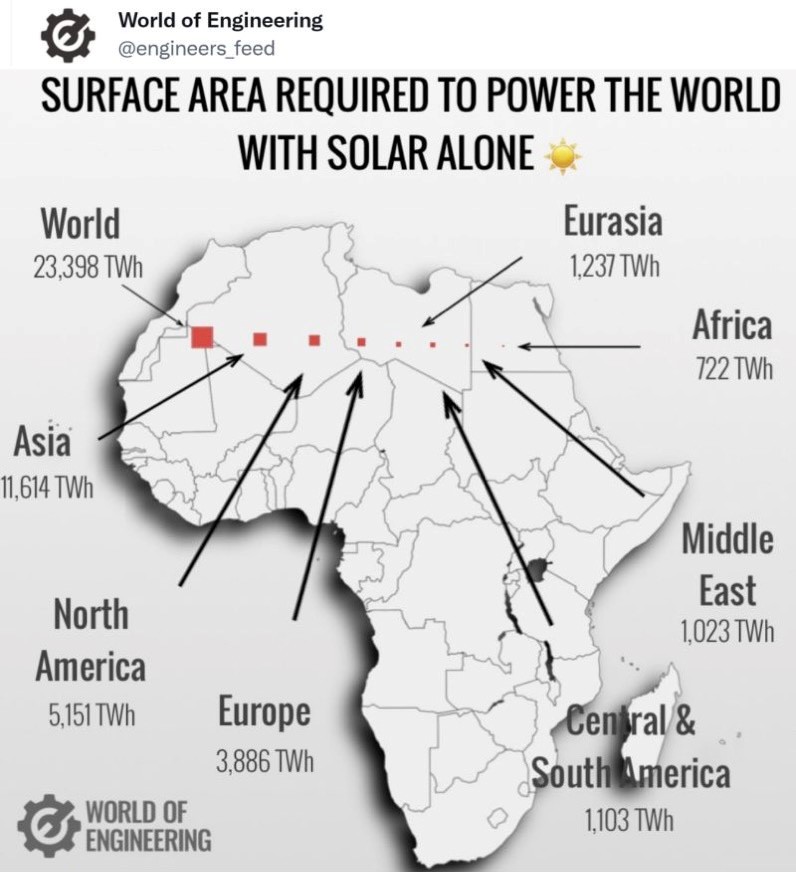
Bonus: We always say this: When you equip regions with high solar irradiance (GHI) rates (such as North Africa) with solar energy systems, you can meet the energy needs of continents, and even the entire world, in a very small area compared to the global scale. To this end, I’d like to share a study conducted by the “World of Engineering” with you below:
Tag: ecology