
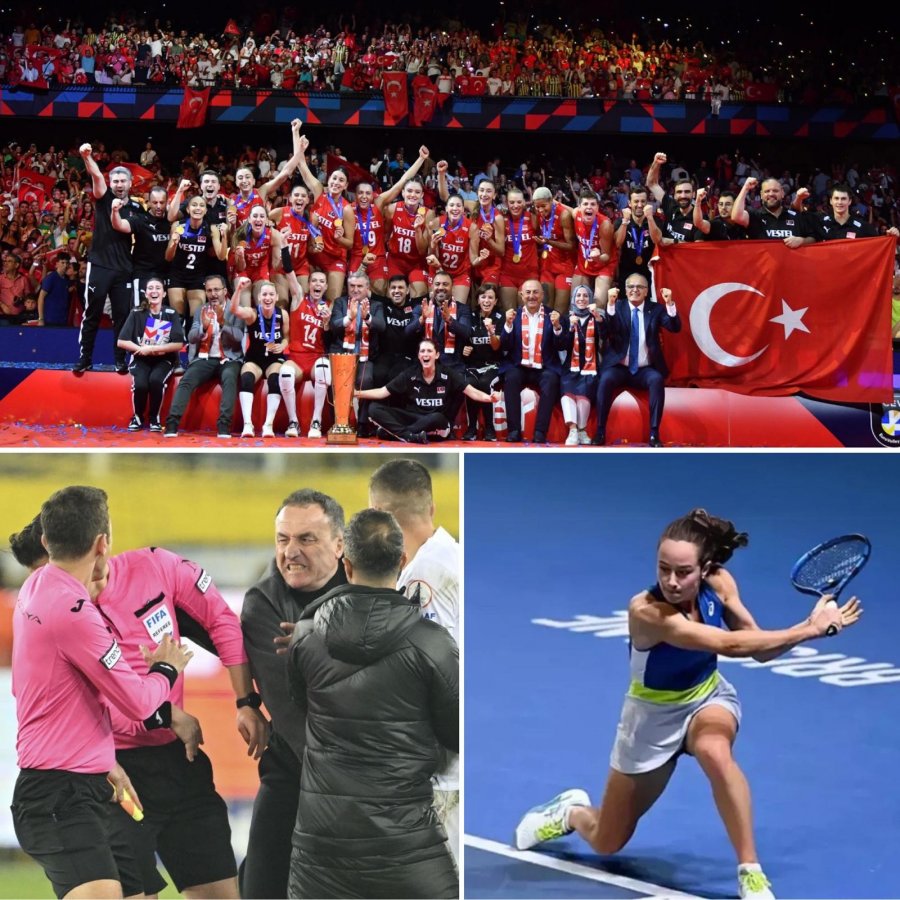
The state of Turkish sports, with its mix of successes and shortcomings, highlights the stark contrast between men’s and women’s branches. On one hand, we have the women’s national volleyball team proudly representing Turkey on the global stage and aiming for the top of the rankings, and Zeynep Sönmez, who has made tennis history. On the other hand, we see a men’s football culture that is constantly in the headlines for all the wrong reasons—chaos, negativity, and scandal. Part of the reason behind our consistently poor performance at the Olympics may well lie in this deep divide between two vastly different sports cultures.
The Turkish women’s national volleyball team has been a source of pride for the country for years, racking up success after success at international tournaments. The team regularly ranks high in European and world championships, standing out for its discipline, solid infrastructure, and strong team spirit. This success is made possible not only by the athletes but also by the contributions of their coaches and technical staff. The consistency in women’s volleyball is a result of long-term, coherent athlete development policies.
Some Highlights from Our Women’s National Volleyball Team
European Championships: Turkey has achieved major success in the European Women’s Volleyball Championships. In 2023, the team won the gold medal, becoming European champions—a landmark moment for Turkish volleyball. In previous years, they also claimed silver and bronze medals multiple times.
Volleyball Nations League (VNL): In 2023, Turkey won the VNL for the first time in history, marking another major milestone. This triumph helped propel the team even higher in the world rankings.
World Championship: The Turkish women’s volleyball team has consistently performed well at the FIVB Volleyball Women’s World Championship, maintaining high positions in global rankings. Recently, they’ve been considered one of the world’s top five teams, alongside Italy, the U.S., China, and Brazil.
Mediterranean Games and Other International Tournaments: The national team has also climbed the podium multiple times at the Mediterranean Games and other international competitions.
Club Successes: Many national team players also compete for top Turkish clubs such as Vakıfbank, Fenerbahçe, and Eczacıbaşı. These clubs have contributed significantly to Turkish volleyball by winning or placing highly in European and world championships.
In both national and club competitions, Turkish women’s volleyball has reached a globally respected status.
Zeynep Sönmez’s Breakthrough in Tennis
We now have a new success story in Turkish tennis: Zeynep Sönmez. Despite her young age, she has claimed a WTA tournament title, helping to elevate Turkey’s presence in the world of tennis. Her achievement is the result of her own dedication, perseverance, and hard work. It also underscores the importance of supporting individual sports and providing proper guidance. Zeynep Sönmez has emerged as one of the rising stars of Turkish tennis, reaching impressive milestones through her personal drive and the support of those around her. Here are some of the key highlights of her career so far:
First WTA Title: This month, she won her first-ever WTA championship at the WTA 250-level Merida Open Akron in Mexico, defeating American player Ann Li in the final with convincing scores of 6–2 and 6–1. This victory propelled her up 36 spots in the world rankings to No. 91, her career-best, earning her a place among the world’s top 100 players. (source)
Grand Slam Experience: In 2024, she made it through the qualifiers to reach the main draw of the French Open (Roland Garros), a rare accomplishment for a Turkish female tennis player. (source)
WTA Semifinal: That same year, she reached her first WTA semifinal at the Merida Open, defeating world No. 62 Renata Zarazua in a three-set match. (source)
ITF Titles: Zeynep has also captured four singles titles on the ITF Women’s Circuit, marking key steps forward in her professional career. (source)
These achievements show that Zeynep Sönmez is becoming a significant figure in Turkish tennis and has the potential to reach even greater heights in the future. In the interview she gave after winning her first WTA title, she shared her thoughts on mental strength, which you can watch here: https://www.instagram.com/reel/DCKVxNQgQ9Y/?igsh=MThkcXo5N2pkaHd5Yg%3D%3D
Sources of Pride
Previously, I wrote a piece titled “The Figures Who Make Us Proud in Turkish Sports” (https://www.serhansuzer.com/tr/turk-sporunun-yuzumuzu-gulduren-sahsiyetleri ), where I highlighted not only our women’s national volleyball team but also Duygun Yarsuvat, Sümeyye Boyacı, Busenaz Sürmeneli, Buse Naz Çakıroğlu, and Mete Gazoz.
Among all the bright faces who uplift Turkish sports, we can also count our football stars—those who have risen to the top of the world’s most popular sport through their personal efforts and talent. Recently, we’ve seen incredible performances from Kenan Yıldız (Juventus), Hakan Çalhanoğlu (Inter), and both Kerem Aktürkoğlu and Orkun Kökçü (Benfica). All of them are performing at the highest level, carrying their teams in domestic leagues and European competitions, and giving us plenty of reasons to be proud.
However, while our women’s volleyball team continues to thrive under consistently good leadership and guidance, and while individual brilliance has propelled our tennis and football athletes forward, we still face disappointment in nearly all other sports—particularly when strong institutions and sound management are lacking, especially during the Olympics.
Lack of Merit and Vicious Cycle in Men’s Football
In my opinion, the biggest problem lies once again with the lack of merit in the relevant federations. The most glaring example of this is the Turkish Football Federation (TFF). What we’ve done, in essence, is replace a poorly managed federation with another administration led by a president and board from whom I personally see no promise whatsoever.
As a result, Turkish men’s football continues to make headlines not for its success, but for its endless controversies. Constant complaints about referees, on- and off-pitch tensions, and mutual insults have become the defining traits of this ecosystem. Club executives resort to perception management to cover up failures, while players and coaching staff further contribute to the vicious cycle.
A clear example of this environment is the stark contrast between Okan Buruk, who defends and uplifts Turkish football, and Mourinho, who openly disparages it.
Despite this, Galatasaray recently defeated a European giant like Tottenham with a superior performance, showcasing the true potential of Turkish football. In contrast, Fenerbahçe’s loss to the far less competitive AZ Alkmaar clearly highlighted the inconsistency and lack of stability in the sport.
Taking Turkish Sports to the Next Level
What needs to be done to elevate Turkish sports is actually quite clear:
- Meritocracy must be established in federations. People who come from within the world of sports—competent and visionary individuals—should be placed in leadership roles.
- Sports club administrators must be closely monitored and held accountable for their decisions and management practices.
- Sports journalists must be regulated, and they should be expected to adhere to professional standards. Instead of speculative news, coverage should focus on objective and realistic analysis.
- Clear rules must be defined for sports clubs, and violations must be penalized. Fair and impartial enforcement of rules will help rebuild trust within the sports community.
We Must Rise According to Atatürk’s Principles
To summarize: education, infrastructure, disciplined effort, and long-term planning must become the cornerstones of Turkish sports. Otherwise, in a country with a population of 85 million, the number of athletes or national teams achieving international success will remain countable on two hands. That’s why, while Germany—with a Turkish population of 3.5 million—continues to produce world-class athletes thanks to the German sporting system, Turkey stagnates despite its much larger population.
Even though the current outlook may seem grim, I personally remain hopeful. This environment that drags us down in every field will eventually change. Competent, ethical, and Atatürk-minded leaders will begin to steer Turkish sports.
And because today is 10 November, I’d like to respectfully commemorate our founding father and end this piece with his powerful words on sports:
“I love the athlete who is smart, agile, and also moral.”
Rest in peace, Atatürk.
One day, in all sports branches, we will reach the level we deserve—just like in developed countries.
Note: I’ve recently started using artificial intelligence to help write my blog posts. This piece marks the first time I’ve done so—the AI assisted particularly with some of the more factual sections.
Tags: culture