
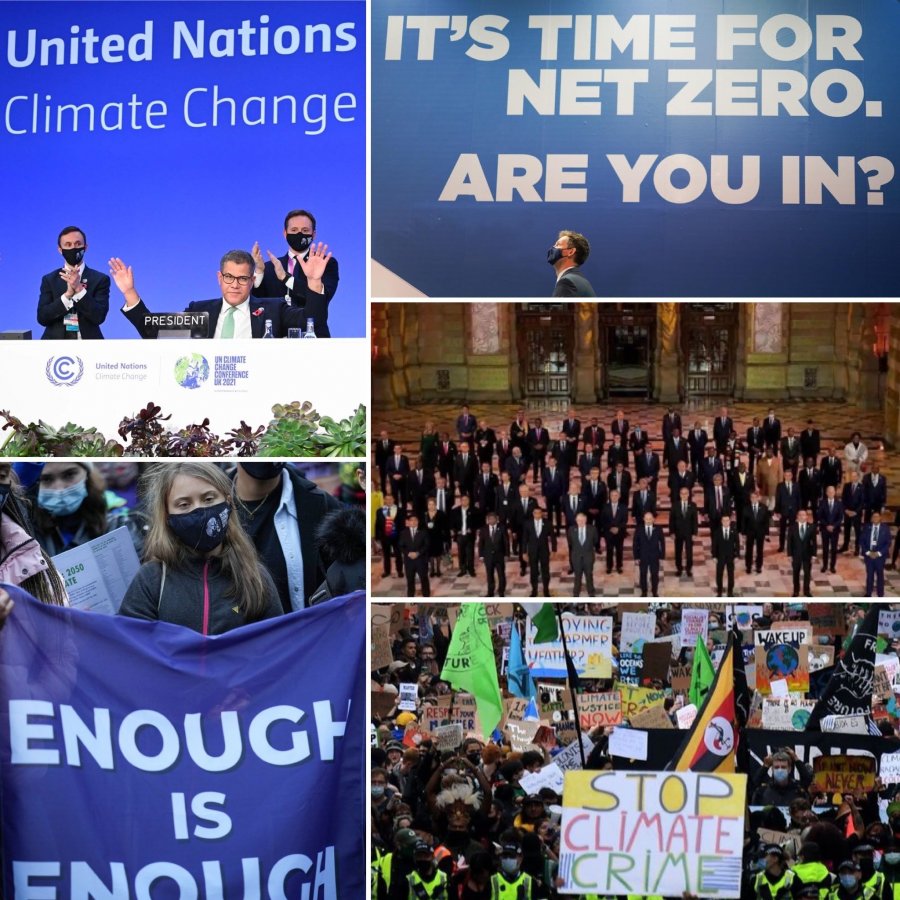
The 26th United Nations Climate Change Conference (COP26) was held in Glasgow, Scotland, between 31 October – 12 November this year. Hosted by the United Kingdom and in cooperation with Italy, the conference featured a leaders’ summit on the first two days.
On the climate diplomacy front, the United States participated in the meetings with a strong delegation including Joe Biden, John Kerry, Barack Obama, and Al Gore, while the European Union and the United Kingdom also participated with high-level delegations. China, Russia, and Turkey also participated at the COP26 ministerial level. The presence of figures such as Bill Gates and Leonardo DiCaprio in the meetings increased interest in the conference.
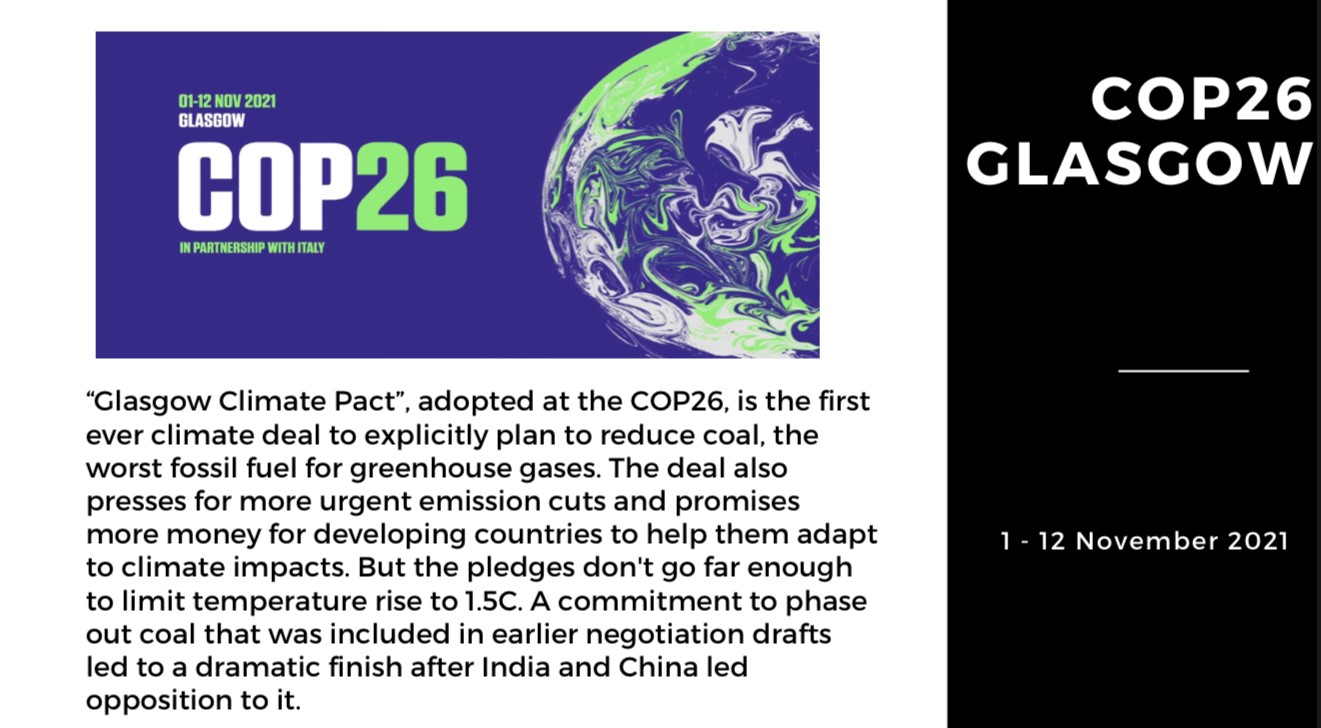
Before delving into the details, let’s examine at the slides I used in my presentation at McGill University, where I summarized the COP26 summit:
COP26 Outcomes
Many new decisions and initiatives were signed during COP26. While some view these outcomes as insufficient and unsuccessful, others view the outcomes as motivating. To summarize the results in terms of participation and overall impact:
- The Glasgow Climate Pact was signed.
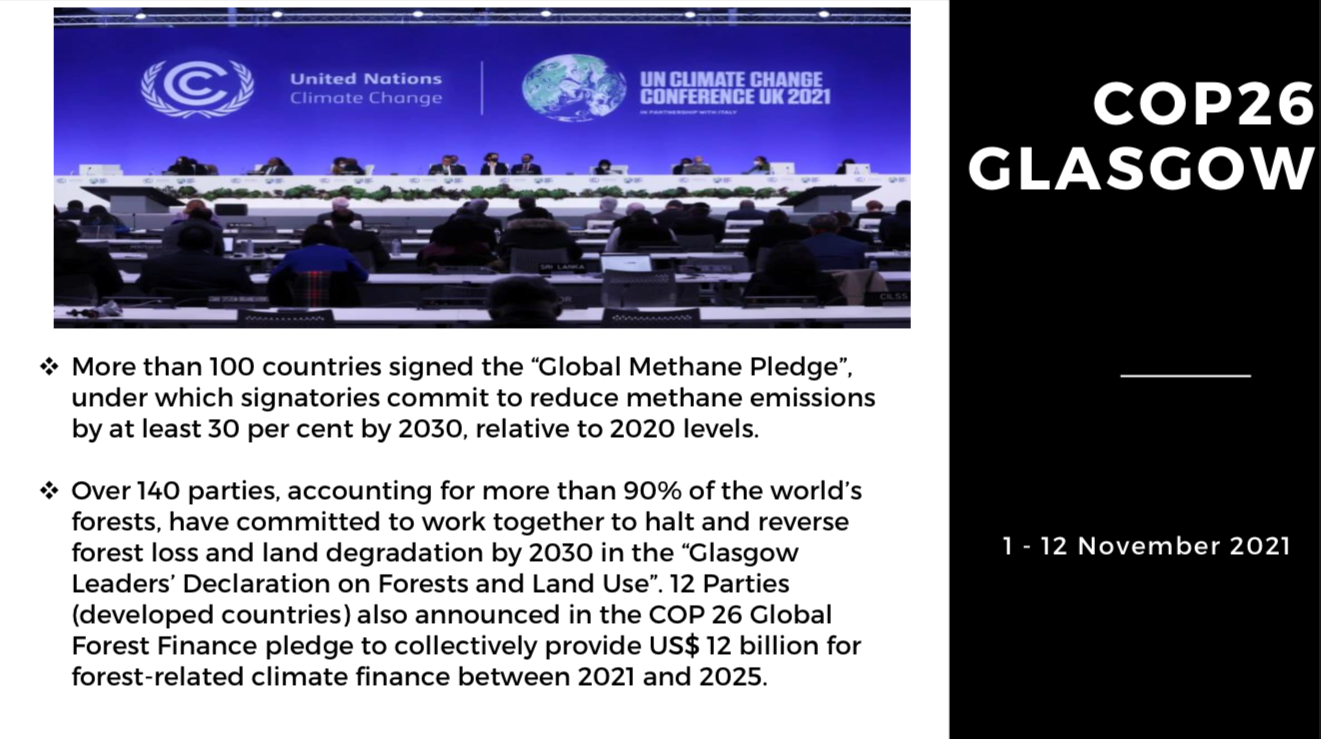
- A commitment was made to reduce methane emissions by 30% by 2030.
- An agreement was reached to halt deforestation and land degradation by 2030.
- The Paris Agreement rulebook was completed.
- Many countries announced unilateral emission reduction commitments to combat climate change.
- Numerous joint initiatives were signed on emissions reduction and adaptation to climate change.
In looking at these results:
- The Paris Agreement’s target of limiting global warming to 1.5°C (based on the industrial revolution) was kept up to date.
- A first-of-its-kind commitment was made to reduce coal use. The phrase “coal phase-out” was removed from the text at the last minute due to India’s objections, and the word “reduction” was added instead.
- While all commitments made before COP26 indicated that global warming would be stabilized at 2.7°C, according to the United Nations, new commitments could reduce the temperature to 2.4°C. According to the International Energy Agency, it could be reduced to 1.8°C. It’s worth remembering that the primary goal in both cases is to limit it to 1.5°C.
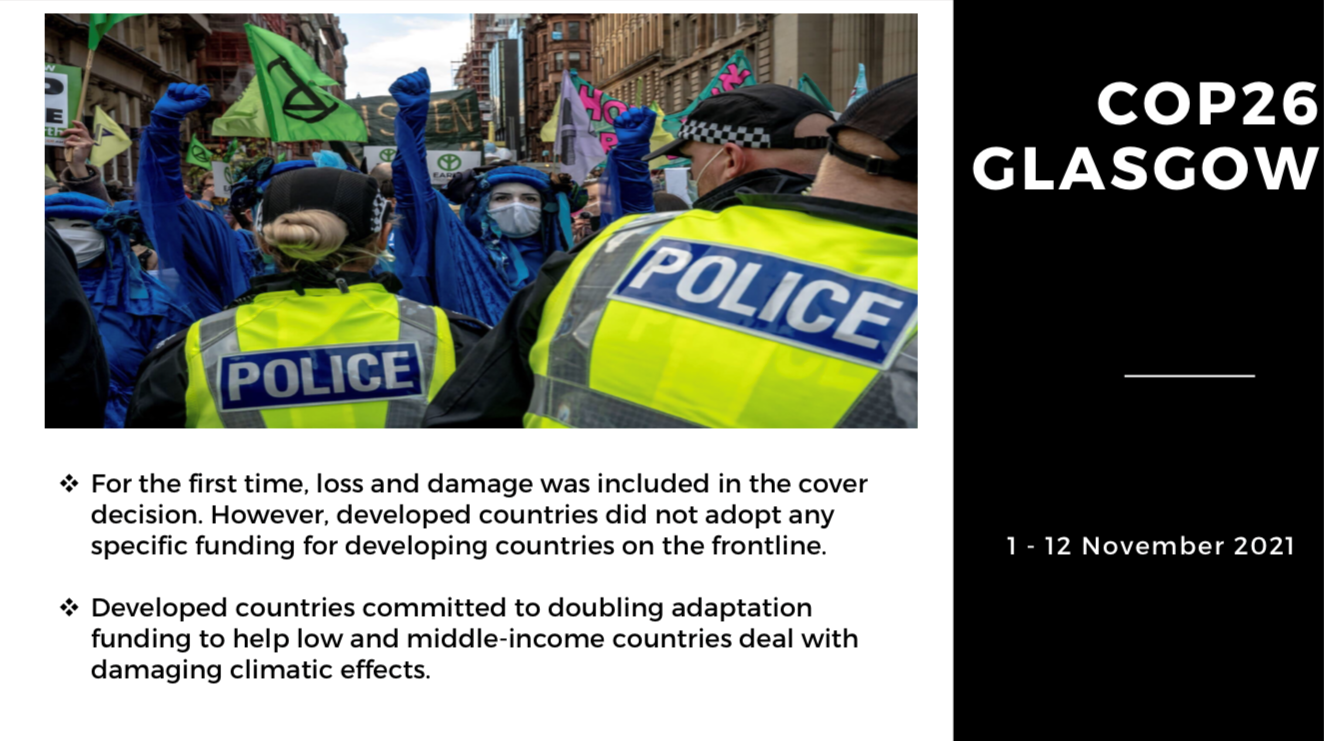
- The demand for compensation for losses and damages arising from climate disasters in underdeveloped countries was raised for the first time; indeed, due to objections from the US and the EU, no decision was made on the matter.
- The $100 billion annual climate finance target has not yet been reached.
- A cooperation agreement was signed between the US and China, which includes reducing fossil fuels, deforestation, and methane use.
- Funding for adaptation projects in underdeveloped countries to combat climate change has been doubled.
- Ten multilateral banks committed to carrying out their work in accordance with the Paris Agreement.
- Regarding the transition from coal to clean energy, 46 countries committed to ending coal production and consumption.
- A joint declaration was published on accelerating the adoption of electric vehicles and sustainable transportation. More than 100 countries committed to making new cars and light trucks zero-emission by 2035 in leading markets and globally by 2040.
- With a joint solar declaration, more than 80 countries aimed to increase access to renewable energy.
- The aim was to strengthen public-private partnerships in forestry, agriculture, and commodity trade dialogue.
- A 10-year “Breakthrough Agenda” project was launched to accelerate the dissemination of clean technologies and sustainable solutions. 2030 targets were published in many sectors with the initiative of more than 40 countries.
- More than 20 countries have committed to limiting global temperature increase to 1.5 ° C. through international aviation CO2 emissions.
- 450 financial institutions have committed to carbon neutrality by 2050.
- Regarding the upcoming calendar, COP27 will be held in Egypt, and COP28 in the United Arab Emirates.
Turkey’s Approach
Among these outcomes, Turkey:
- Signed the declaration on forests and land use.
- Joined the declaration on the Progress Agenda.
- Signed the international aviation climate target.
- Signed the zero-emission vehicle agreement.
At the same time, COP26 will be remembered for its major climate actions. The actions, led by climate activist Greta Thunberg, portrayed the COP26 results as a major failure.
Much more could have been done.
I leave it to you to decide whether it was a success or a failure. If you ask me, much more could have been done. About 10 years ago, when I first started raising these issues, I would discuss climate change with everyone involved (ministries, etc.) and explain the urgent need to do something. Back then, we were laughed at and ridiculed, and no concrete steps were taken. Yes, the renewable energy sector has finally been launched in our country, but initially, it was always approached with a “good to have” attitude, seen as a way to revitalize its image.
These days, especially when I look at the COP26 summit, there’s no longer any snide, tongue-in-cheek banter. Everyone, except for some extremists, is aware of the climate crisis. The only difference is when and how much action needs to be taken. Practices vary across countries.
And of course, from the very beginning, the fossil fuel lobby has been actively doing everything they can to delay the energy revolution. They know their time is limited; they want to maintain the current model of burning coal, oil, and natural gas as energy sources, and while the sector is in its final stages, they intend to fill their pockets as much as they can before these resources run out.
The energy revolution is now inevitable.
It’s no longer a question of whether the energy revolution I described to you will happen. Because no power in the world can stop this change anymore (except, God forbid, by extreme events like a nuclear war or a world war). The question now is “when?” This debate, in my opinion, can be described as the shortest possible timeframe for any sane person. I can hear you asking, “So, what’s the shortest timeframe?” This question was also posed in my speech at McGill. H. Serhan Süzer – I answered this question in the article I wrote about the climate crisis at my university, McGill (serhansuzer.com). You can reread my rough estimates. Below, I’ll reiterate the four slides that make up the energy revolution and when it could be achieved:
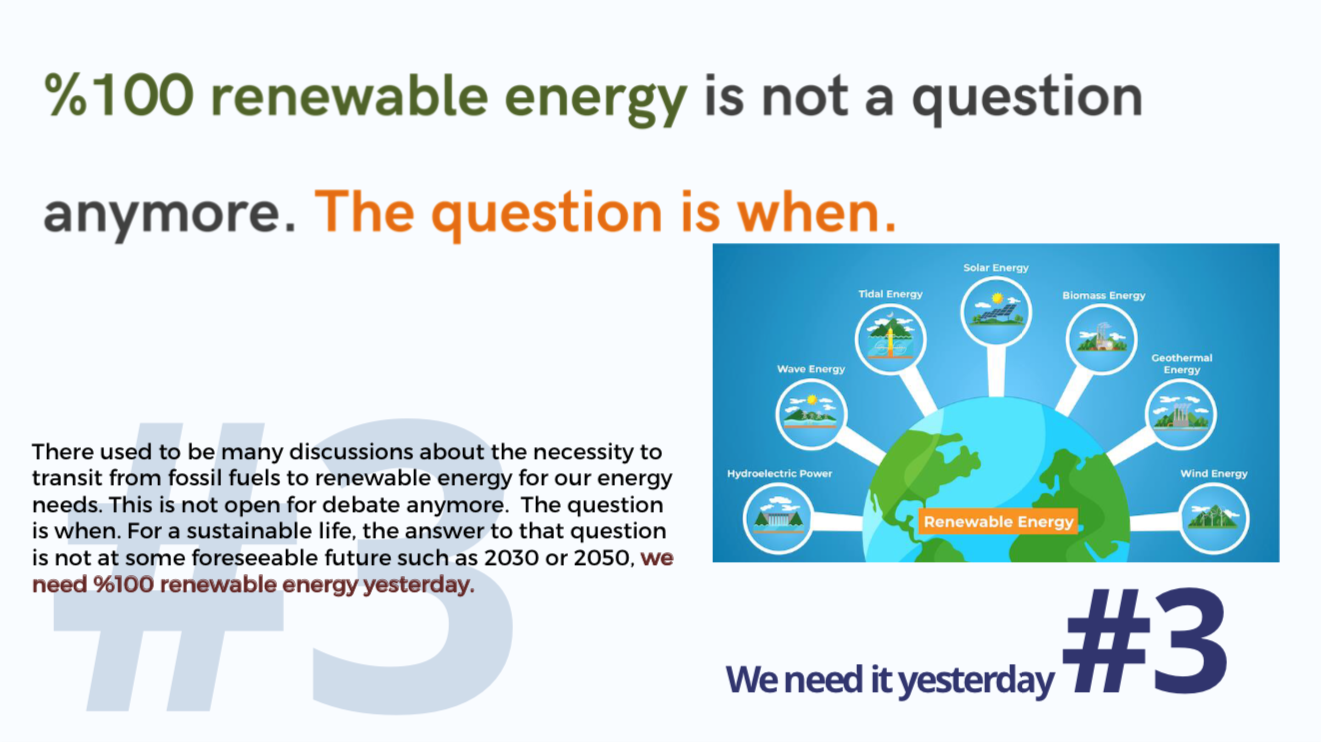
The 100% renewable energy target is a goal that can be achieved within 2-3 years if the government supports it. The steps are clear. This can be achieved without causing any economic harm to either party.
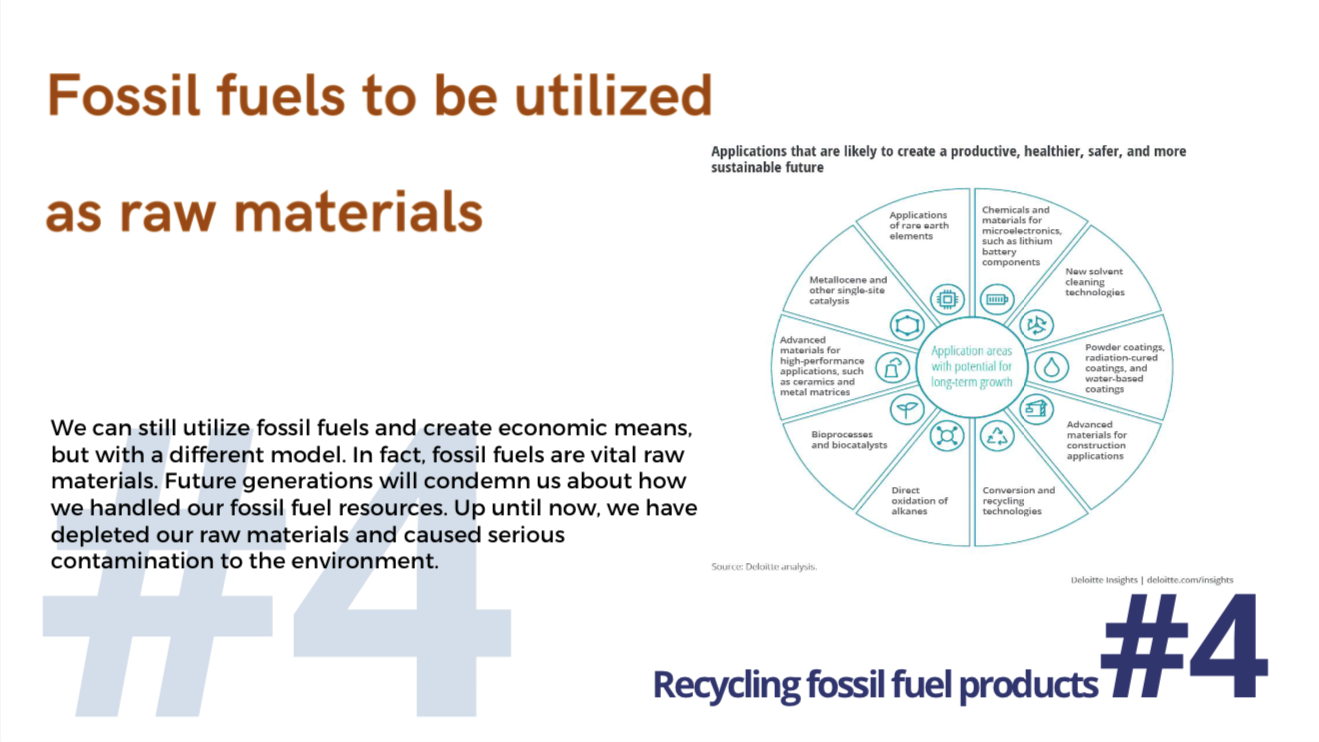
The goal of using fossil fuels as raw materials, not as an energy source, can also be achieved within 2-3 years. This can be resolved with a law. The critical point here is to increase investments in petrochemical facilities and encourage the expansion of existing ones. It is essential that all products produced are recyclable.
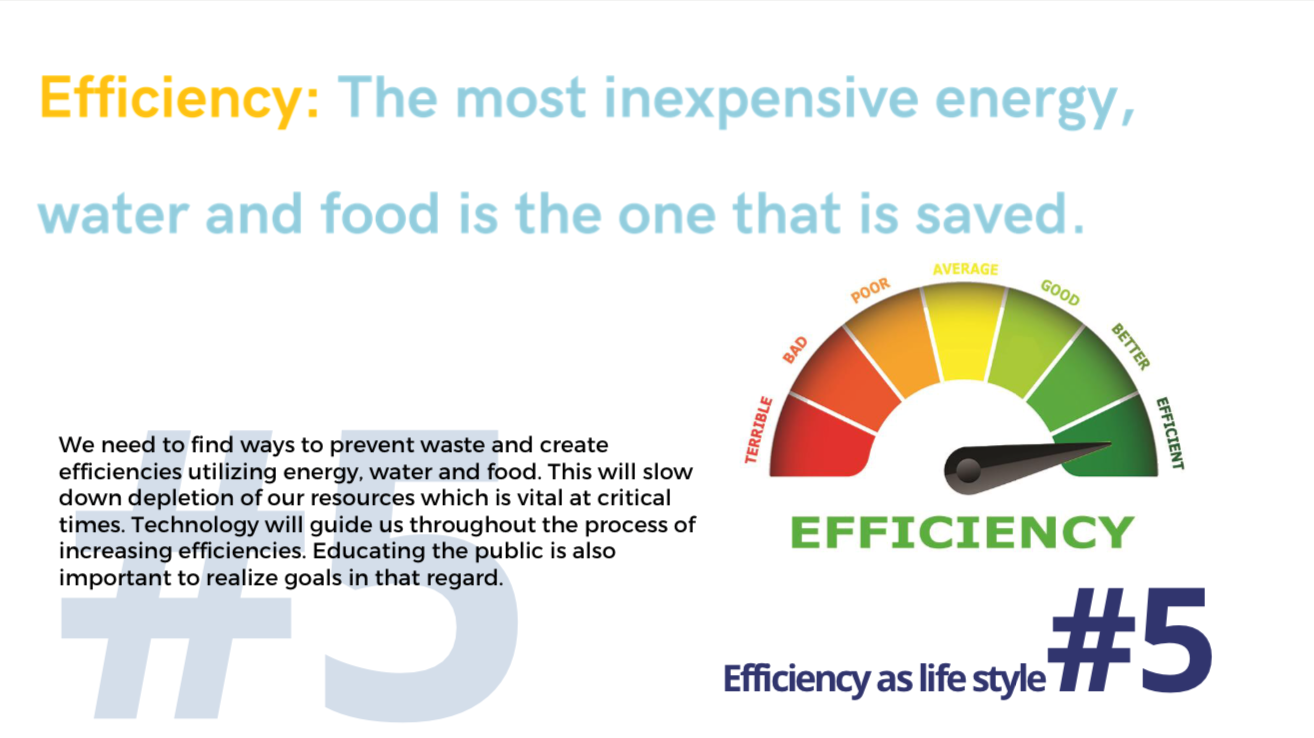
Energy efficiency is a culture. Therefore, it will take generations for everyone to adopt an energy efficiency mindset. However, with legislation, you can ensure everyone prioritizes the fundamental elements of energy efficiency within a year or two.
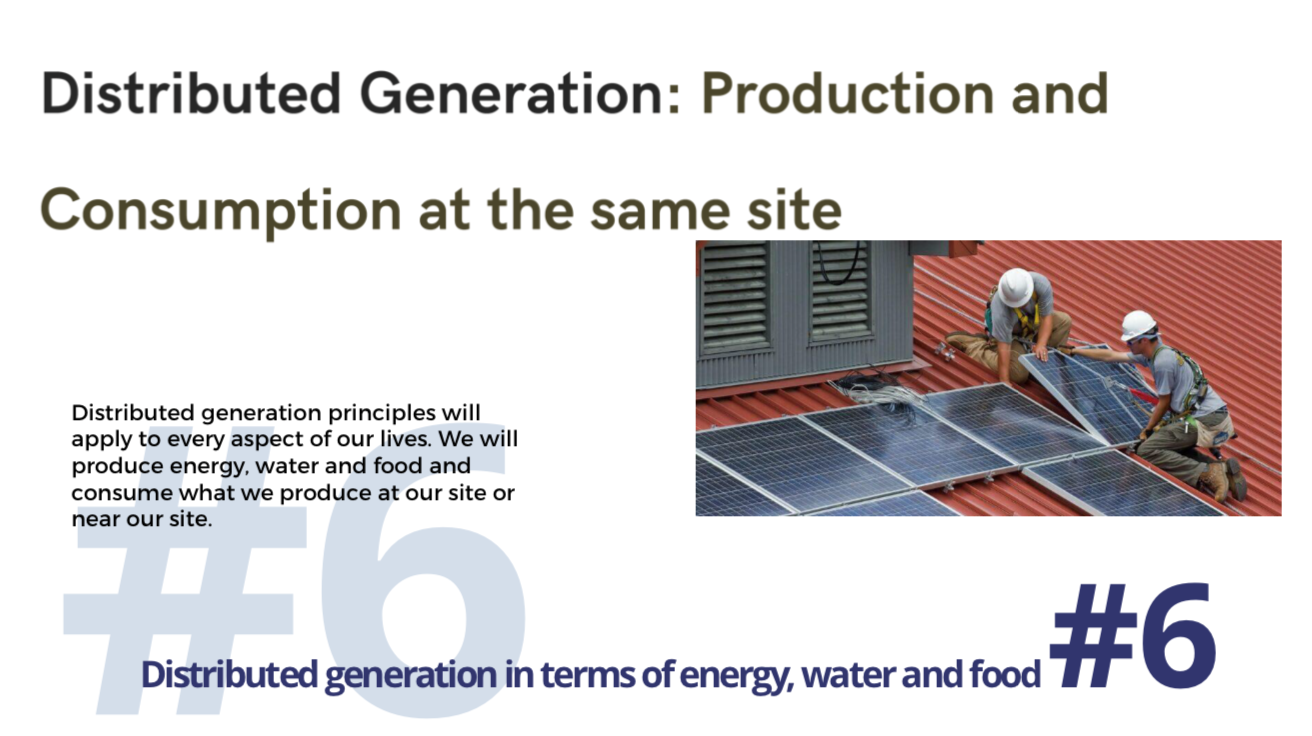
We will witness a transition from large power plants to an “on-site production, on-site consumption” model of energy. This is a goal that can be achieved within five years if the state supports it and banks provide support (through individual loans, etc.). I’m talking about installing solar power plants (SPPs) on the roofs of all buildings.
Good days are coming when the corrupt system will change.
In short, if a fully authorized government had full authority, it would have completed this project in a shorter time than the estimates I’ve given you above, and it would have done a great service to humanity. No one should tell me that distant dates like 2030 or 2050 are success stories. On the contrary, goals achieved at such distant dates will be failure stories. So, is there no brave government capable of implementing the energy revolution as quickly as possible? Or is everyone a puppet of fossil fuels and other vested interests?
Very soon, we will witness a complete overhaul of the corrupt system that could lead to the end of humanity. Good days are coming soon.
Note: Cansu Üttü, who attended COP26 and was able to follow all the events from the ground up, made a significant contribution to my writing this article. I thank her wholeheartedly.
Tag: education