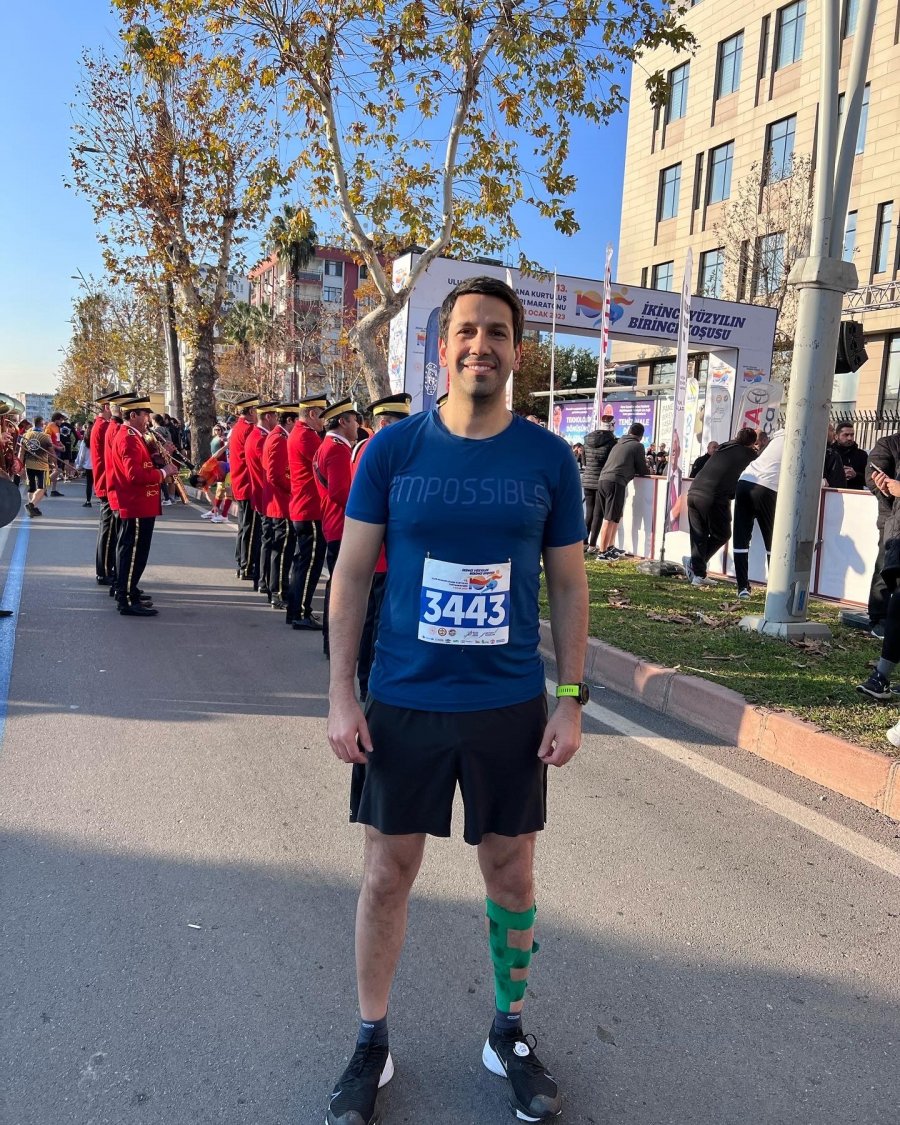
We travelled to Adana on Friday, 6 January. Normally, we’d fly out in the evening, but this time we took a 2:00 PM flight. Our first move, after a pleasant tour and a taste of the delicious snacks, was to visit a food production facility owned by a friend. After a pleasant Friday evening, I had some free time and went to Kazancılar, one of Adana’s classic kebab restaurants. We enjoyed rakı, meze, and Adana kebab. We topped off the meal with kadayıf and Atom (normally, everyone knows the spicy Atom appetizer. Adana also has a dessert called Atom, a mix of dates, honey, and kaymak).
We returned to our hotel on Friday evening feeling happy. The next morning, as we’d planned with the Istrunbul running group, we did a warm-up workout at 8:00 AM. This workout involved circling the Hilton Hotel and jogging around the track in Merkez Park, at an average pace of 6. For my readers unfamiliar with running terminology, 6 pace means we ran 1 K in 6 minutes. So, we covered a total distance of 5 K in this easy half-hour run.
Special precautions for my injuries
Then, as part of the Istrunbul running group, we stretched in the indoor gym on the ground floor of the hotel. Because I’ve been experiencing stress fractures and piriformis pain (a band-like muscle that runs deep in our hips. Piriformis syndrome is characterized by low back, hip, and leg pain, numbness and tingling radiating to the back of the leg and foot), I implemented exercises to relieve these problems. Aylin and her husband Doğan had similar problems, so they offered valuable advice. Aylin, who suffers from both stress fractures and sciatica, has almost the same level of knowledge as a physical therapist. On the advice of my running coach Serpil, my physiotherapist Gizem, and now Aylin, I’ve iced my lower leg, where I have a stress fracture, three times a day for half an hour each. I also did plenty of stretching for my piriforis. After the workout, we had a quick breakfast, then showered and went outside to get our running kits.
Medals distributed from the front
The art center where we were supposed to pick up our running kits was also a complete mess. First, I picked out my number, and as I was queuing to collect my number and bag, one of the attendants started yelling, “Don’t send the medals without giving them away!” After watching him struggle for five minutes, I went up to him, and the following exchange took place:
– Do you hand out medals before the run?
– Yes, we’re waiting for the medals; they haven’t arrived yet, but if they do, we’ll give them to you now.
– Don’t medals normally go to the person who completes the run?
– We can’t please anyone in this country.
– This has nothing to do with satisfaction, sir. People need a purpose in running. Medals are one of them. All organizations distribute medals after the race, but I found it interesting that you distributed them with running kits.
– Well, that’s how we do it in Adana.
– Okay, that’s clear. So, if we don’t get the medals now, won’t we get them after the race either?
– We won’t be giving out medals after the race; it’s now or never.
– Okay, then. What’s done is done, we’ll wait for the medals. When will they arrive?
– It was supposed to have arrived an hour ago, but we’re still waiting; we don’t know when they’ll arrive.
10 minutes after I said that, the man came out, screaming on the phone. Five minutes later, he came back inside with dozens of medals and went behind the tables where the officials were standing. Then, amidst the chaos, they disbursed the medals.
Visit to the Adana Archaeological Museum
We waited about half an hour for them to bring the medals. By that time, I had everything in my bag ready. When the medals arrived, I immediately went to the medal line and collected my medal. Then I took my chip and went out. I saw some friends from our Istrunbul group outside and went over to them. Then I told them the story of the medals. They were very surprised; they had previously left without receiving their medals. I went inside immediately, requested them, and they received them. So, we were all set.
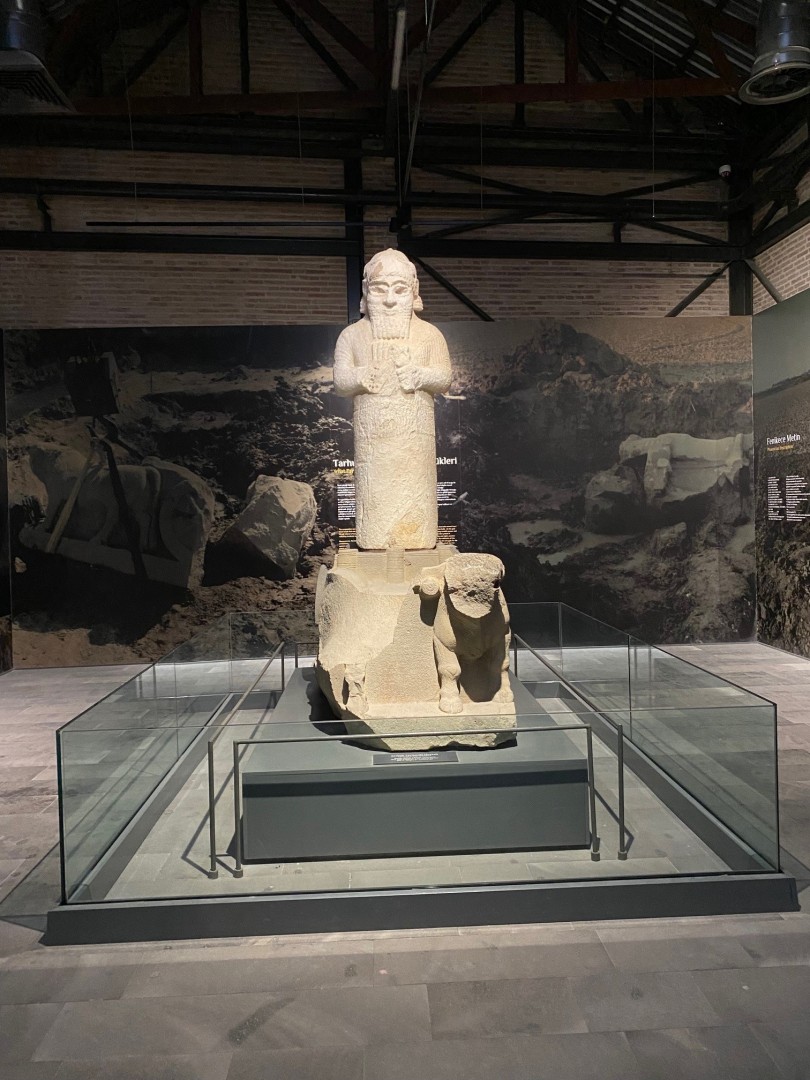
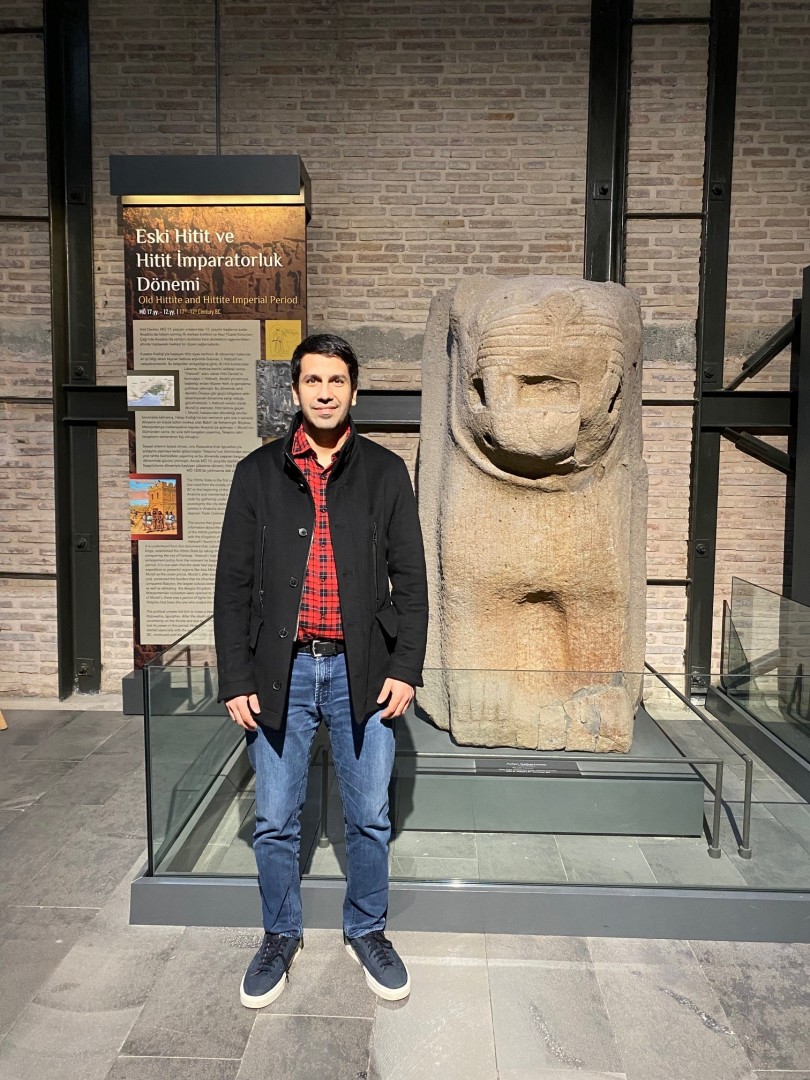
As we had discussed earlier, we decided to go to the Adana Archaeology Museum. Our friend from Adana gave us a ride in his car, but due to my injury, I was no longer able to walk. Many of our friends walked from the Art Center to the Adana Archaeology Museum. We met there.
Original “packaging” for banana milk
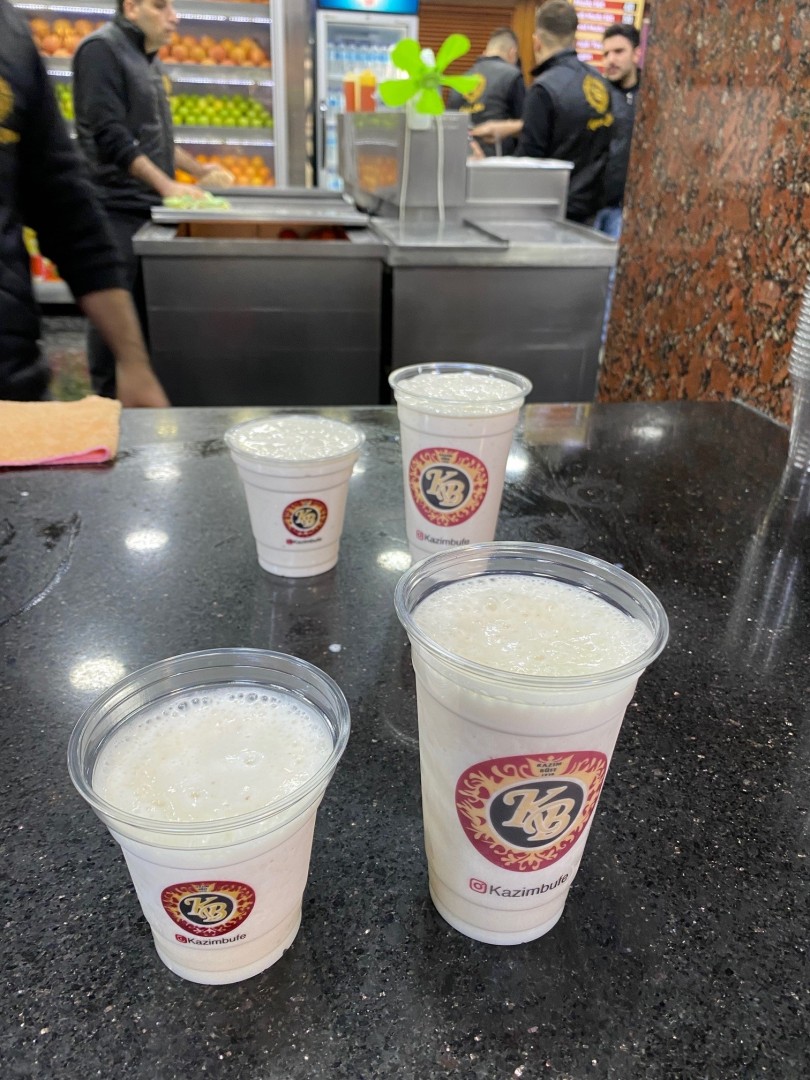
After the Adana Archaeology Museum, we went to Kazım Büfe in Adana for a banana milkshake, a classic from last year. At Kazım Büfe, a place with plenty of originality, when we asked for “1 piece,” they gave us one large and one small glass of banana milk instead of one glass (so, “1 piece” means 1.5 glasses). Our table of six couldn’t finish the unfinished banana milkshakes which we packaged. We thought they meant to put lids on the glasses and let us take them away, but instead, they put the undrained banana milk in plastic bottles and gave it to us. So, they’re using plastic bottles for “take-away” services and undrained banana milkshakes.
A non-kebab alternative: Croma
Then we returned to our hotel. After resting with ice cubes on our legs at the hotel, we went to Croma Restaurant in Adana for dinner, which was relatively early. We arrived at the restaurant at 6:30 PM and returned to our hotel after a delicious dinner with the Istrunbul running group. Incidentally, if you’re looking for something other than Adana Kebab in Adana, I recommend Croma. The restaurant’s signature dish is the Brisket Burger. Since it was the day before the run, I ordered brisket (thinly sliced tenderloin) served with rice instead of the burger bun. The appetizers, the brisket burger, the other main courses, and the desserts—all their products are delicious. You can find more information about Croma on their Instagram page at https://www.instagram.com/cromaadana/ .
I fell asleep within half an hour of arriving in our room. I was already exhausted, and it was early in the morning. We decided to watch a movie, but I fell asleep before I could finish. The next day, I woke up at 6 AM. After a quick shower and getting ready, I went downstairs for breakfast. It was important to eat breakfast two hours before the run, not to overeat, but to have something to boost my energy. So, I poured half a bowl of almond milk with oats, hazelnuts, walnuts, and pistachios, drizzled with honey. I had it with coffee. Then, I went back to my room, made some ice for the last time, and then got ready. After completing my final preparations, I went down to the lobby around 8:30 a.m. as arranged and waited for the other members of the Istrunbul running group. Everyone was downstairs within 5-10 minutes. Then, we all started jogging from the hotel to the race area at a slow pace. This also served as a warm-up for us.
The race start order was also original!
After arriving at the race area, we left our bags containing all our belongings in the kit area. After taking photos and stretching, it was 9:15 a.m. In another original Adana organizational model, the Adana residents announced that they would start the 10 K run at 9:30 a.m. and the half-marathon, the 21 K run at 9:45 a.m. I’d like to point out here that in all the running events I’ve attended, the starting times are typically set from the longest distance to the shortest. For example, in the Istanbul Marathon, the marathon runners start first, followed by the 15 K, 10 K, and finally the public run. Of course, as always, things are handled differently in Adana. We love the vibrant Adana.
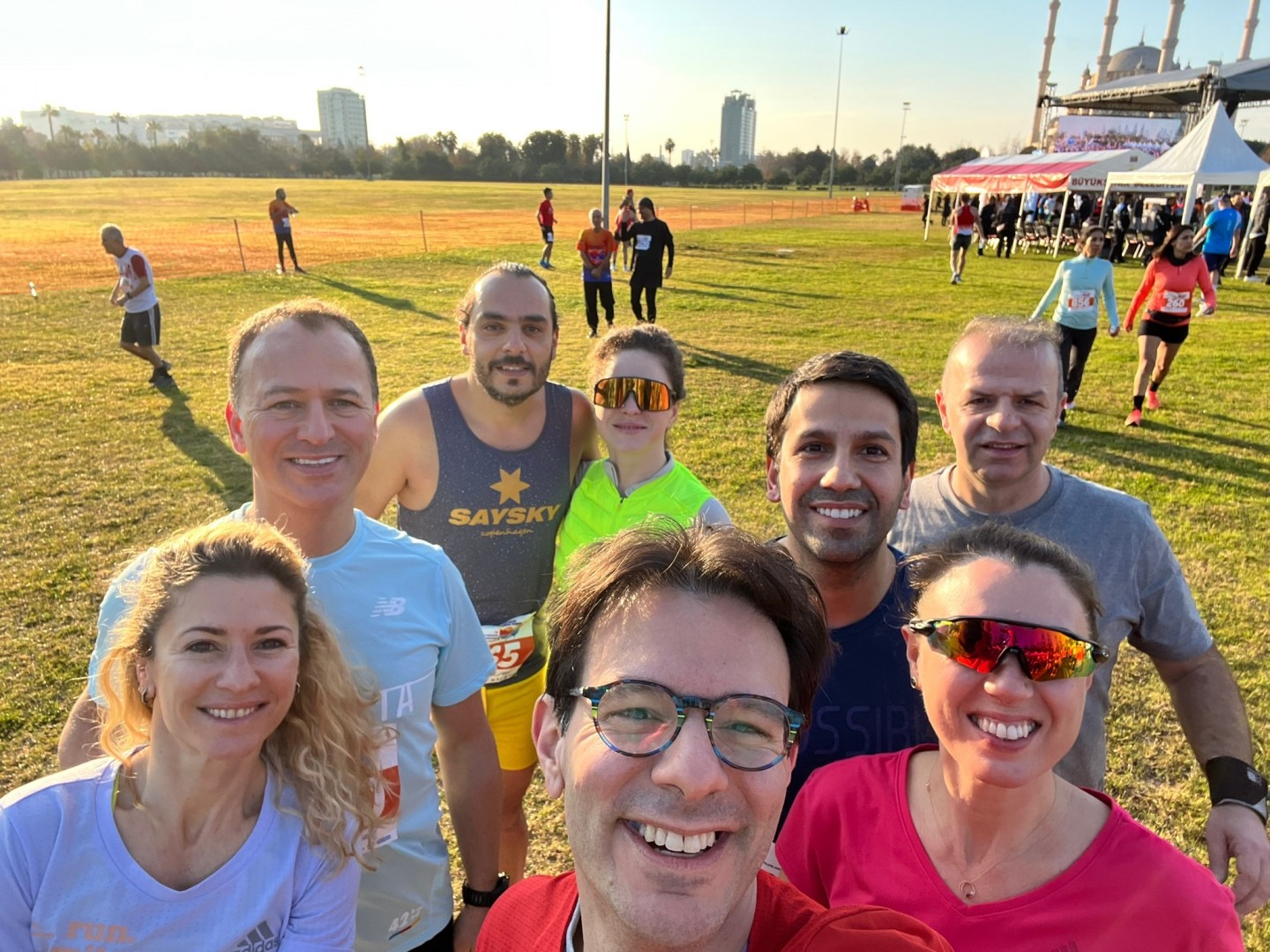
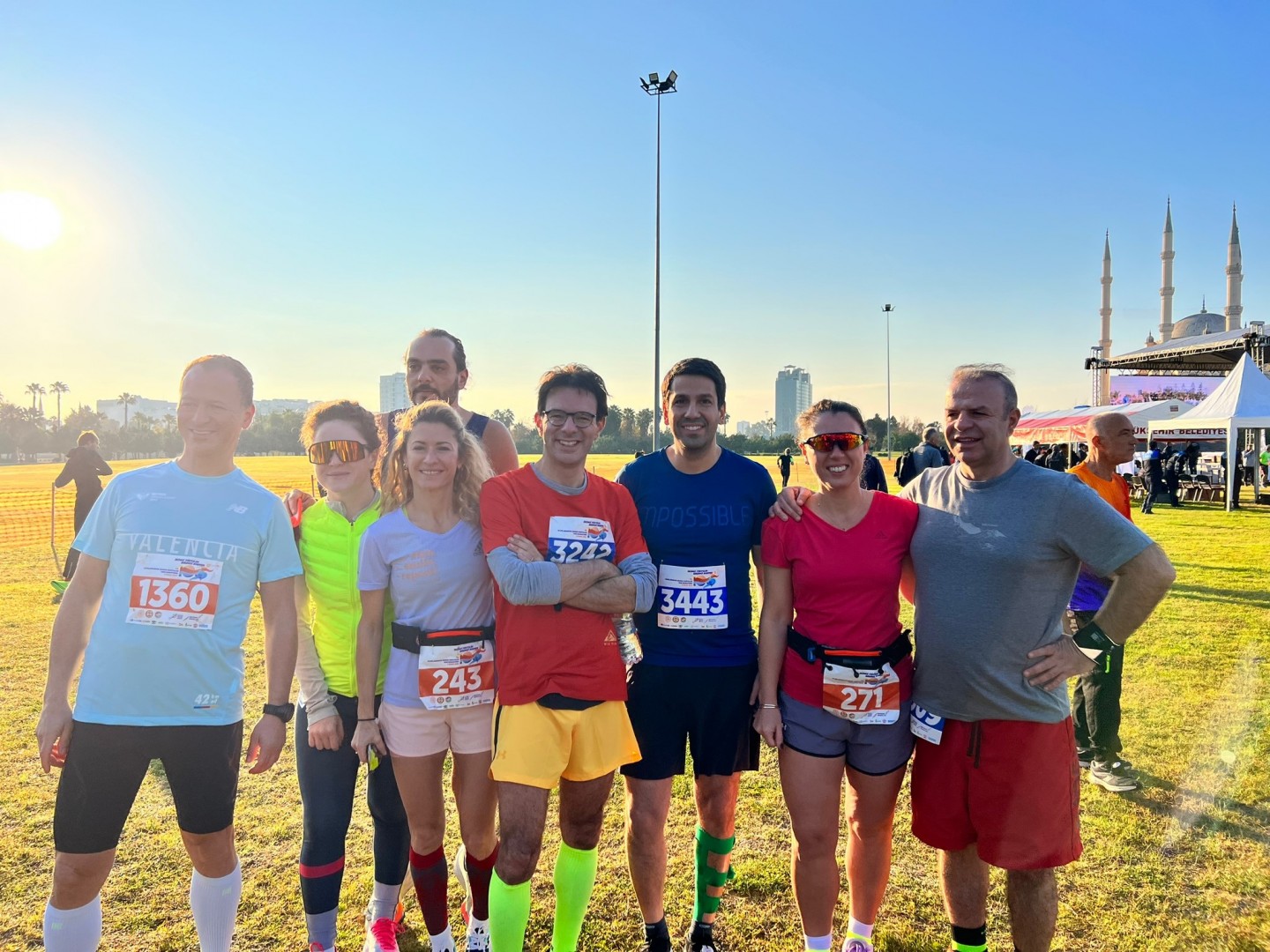
When the clock struck 9:15 a.m., I headed to the track and did my final warm-ups. This included a few 50-meter sprints to get going. After a 5–10-minute warm-up, with 5 minutes left in the race, I entered the track by jumping over the barriers near the start. Since I was going to be running at a fast pace, I moved as far forward as I could to avoid being hindered by those who were running at a slower pace. When I reached third place, I stopped. There were elite athletes ahead of me, so I chose third place to avoid being an obstacle. The race started at 9:40 a.m., 10 minutes later.
Self-suggestion to maintain the pace
I knew I was in the right place as soon as the race started. Those around me were generally running at the same pace. I caught up with a group just ahead of me. They were running a bit faster than my pre-race target of 4:10-4:20. By the way, my target pace was given to me by my running coach, Serpil Hoca, before the race. I ran about 5 K with this group, which ran between 4:00 and 4:10. Of course, I was out of breath because I was pushing myself to go faster than my normal pace. About halfway through the run, after 5.5 K, I started to feel exhausted. I didn’t feel the stress fracture at all, but the hip pain was becoming increasingly noticeable. At this point, I mentally adapted, constantly telling myself during the run, “You’re fine, Serhan. There’s nothing wrong. This hip pain is temporary. You don’t have this pain. Don’t slow down; just keep going.”
These self-suggestions worked. After a while, despite being in significant pain, I stopped feeling it. Of course, the pain returned after the run, but the key was to neutralize the pain during the run.
After 5.5 K, I was forced to slow down my pace. Not only were there clear signs of fatigue, but my legs were finally giving out. So, I was cut off from the group I’d been running with for a long time.
A Running Buddy for a Few Kilometers
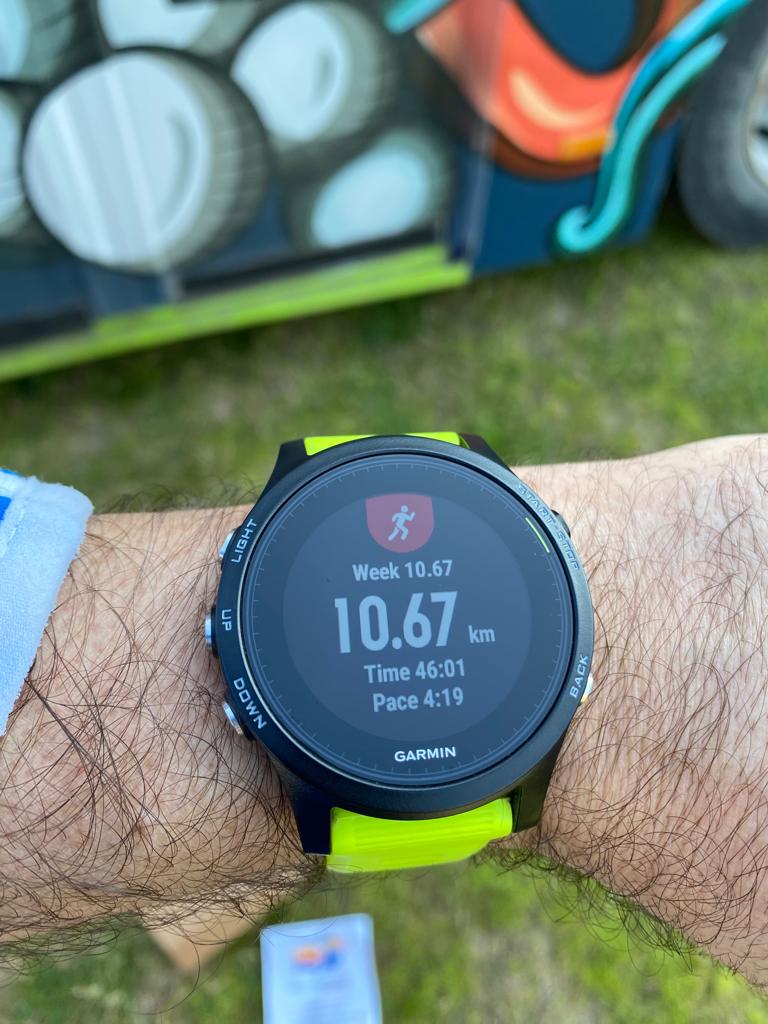
I was constantly slowing down for two minutes when a runner coming up behind me said something like, “You’re running too lean; you need to run upright.” I told him I was tired and that’s why I was running like this. Then I saw this runner running around 4:20-4:30, which was close to my goal. I called out to the guy behind, “I’m coming, let’s run together.” The guy immediately replied, “Oh, come on, I’m waiting.” With all my remaining energy, I straightened up and accelerated, then caught up with him. We started running together. We ran together until the 8km mark, which honestly helped me recover, but as we entered the final kilometers of the race, I experienced something I’d heard and witnessed several times before: runners speeding up with the last 1-2 kilometers remaining. The guy I was running with and the group right in front of us accelerated with the last 2 kilometers. I wanted to respond, but I had no energy left. So, I gradually broke away from the group ahead of me. With one kilometer remaining, I found my last ounce of strength, telling myself, “Come on, Serhan, speed up this last kilometer already, give it everything you’ve got,” and I accelerated. With one kilometer remaining, I dropped back to a 4:00-4:10 pace and completed the 10km in about 42 minutes. But suddenly, something I couldn’t quite grasp happened. I remember asking myself, “Where’s the finish line? Why isn’t this race over?”
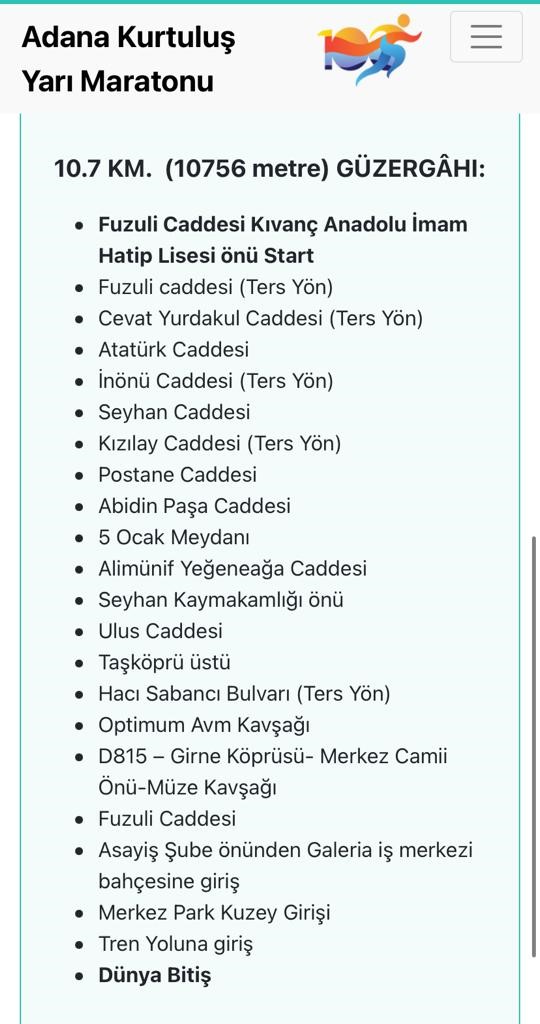
This race taught me the absolute necessity of studying the course before a race. If I had known the race was 700 meters longer than the 10 K, I wouldn’t have slowed down in surprise and would have finished with a better time. Here’s the route description from the Adana Half Marathon website.
A strange rival snarling at the finish line
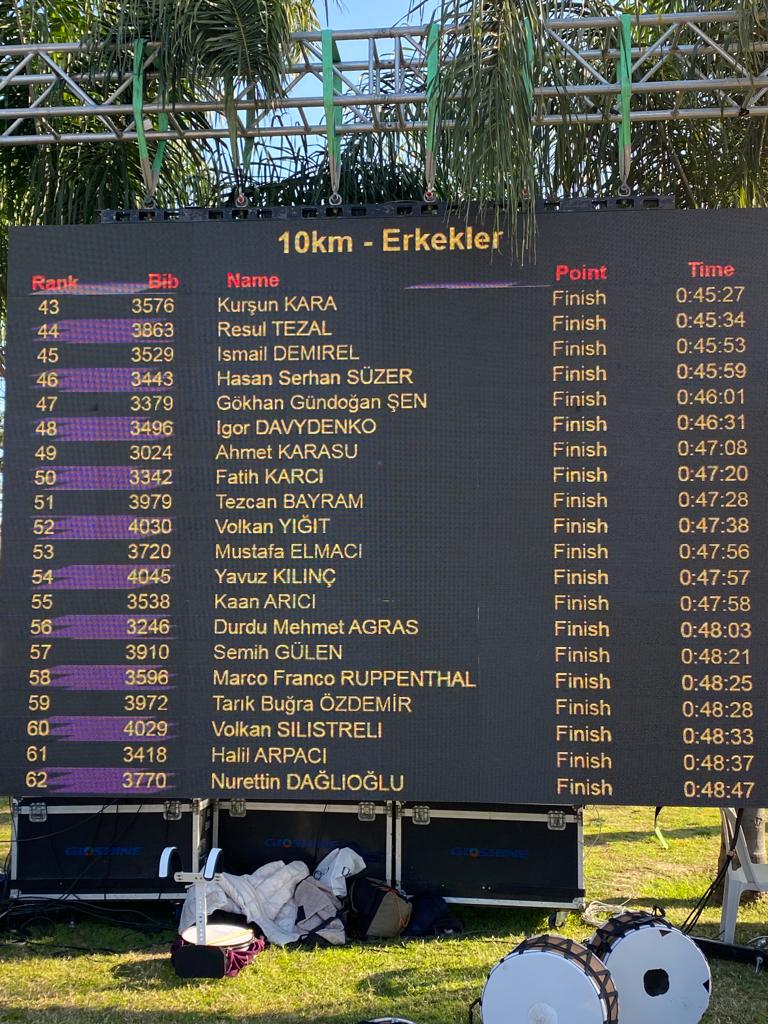
As I was sprinting towards the finish line with confident steps, one last thing happened. Suddenly, I started to hear the increasingly faster steps of someone running behind me, out of breath. Someone behind me was pushing hard to pass me. With 20-30 meters left, I used the last remaining explosive force within me to accelerate and finish the race ahead of this friend. This friend, who had been trying so hard to pass me with such passion, yelled “H…r!” and swore when he fell behind me. After crossing the line, I heard the curse and looked at who was behind me. I saw a runner who was younger than me and clearly a regular exerciser. Normally, I thought sports ethics shouldn’t swear, so I shook my head to show my disapproval and moved on. When I looked at the times later, I saw that the swearing runner was part of the Rundemental runner group, 10 years younger than me. I finished the race two milliseconds ahead of him. I hope this friend has learned the necessary lessons for himself. Incidentally, you can find the race times at http://www.departiming.com/attachments/403/10km_-_Overall.pdf I’m also sharing the photos we took immediately after the run below:
Polite question, aggressive answer
After the run, I immediately went to grab my bag, drank water, and then I ran at a slow pace for 15 minutes to regenerate after the run. I finished 46th overall. So, where was my rank in the 45-50 age group? I went to the organizers to find out. They told me that the team keeping track of the races was in a white van near the finish line. So, I went to the white van to meet the official timing team. “Are there age categories in the 10 K?” I asked. An older man spoke to me with a scolding tone and said, “Brother, this race is just as it’s called, the Adana Half Marathon. This 10 K shouldn’t have happened at all. If we hand out awards and medals to everyone, we’ll be wasting our resources.” I told him, “Then you shouldn’t have included a 10 K category at all. If you do, organize it properly. Include age categories in all of them. If you include one and not the other, it’s a sign of disorganization.” The man grew even angrier. Others intervened. Then I walked away.
I didn’t quite understand why there was such tension in such a fun race. It’s not normally my style, but when the man responded extremely aggressively to a question I’d asked politely, I gave him the necessary reassurance. I think he became so aggressive to cover up his own shortcomings after pointing out his own flaws. Anyway, I convinced myself not to worry too much about it and went back to find my teammates. After finding them, we all returned to the hotel.
Our chance for an early flight back
After showering, getting ready, and packing our bags, we headed to our next stop, the famous kebab restaurant Mesut, on the recommendation of Levent from the Istrunbul running group. After a hearty kebab feast, we returned to our hotel, spent some time in the lobby, and then headed to the airport.
We were supposed to be returning on the 6:15 PM flight, but luckily, we found a seat on the 4:55 PM flight. Despite our 4:55 PM flight, the flight was an hour late. When we asked at the desk, “Is there any room on the 4:55 PM flight?” they said, “You’re in luck. There are four seats left. Can I book your seat here?” Without a second thought, I said, “Yes, let’s do it.” We wanted to arrive in Istanbul early and to be in time for at least the second half of the Fenerbahçe-Galatasaray match. Ignoring the fact that I was traveling at the back of the plane, I landed in Istanbul early and arrived in time for the final minutes of the first half. Galatasaray’s dominant performance capped off a fantastic day with a clean and clear 3-0 victory.
The trip to Adana was auspicious in every sense.
Bonus: I’d like to share an example from the unique Adana scene. You won’t find shopkeepers offering liver shish kebabs and wraps to runners anywhere else during the race (though distinguished provinces like Gaziantep and Hatay also have this potential; everywhere in the country is amazing when it comes to food and hospitality). Here are some colorful images from the Adana Half Marathon: Selim Ağaçdalı on Instagram: Instagram’da Selim Ağaçdalı: “#Adana işi koşu maratonu… Başka şehirde yaşayamam
Tag: memoir