
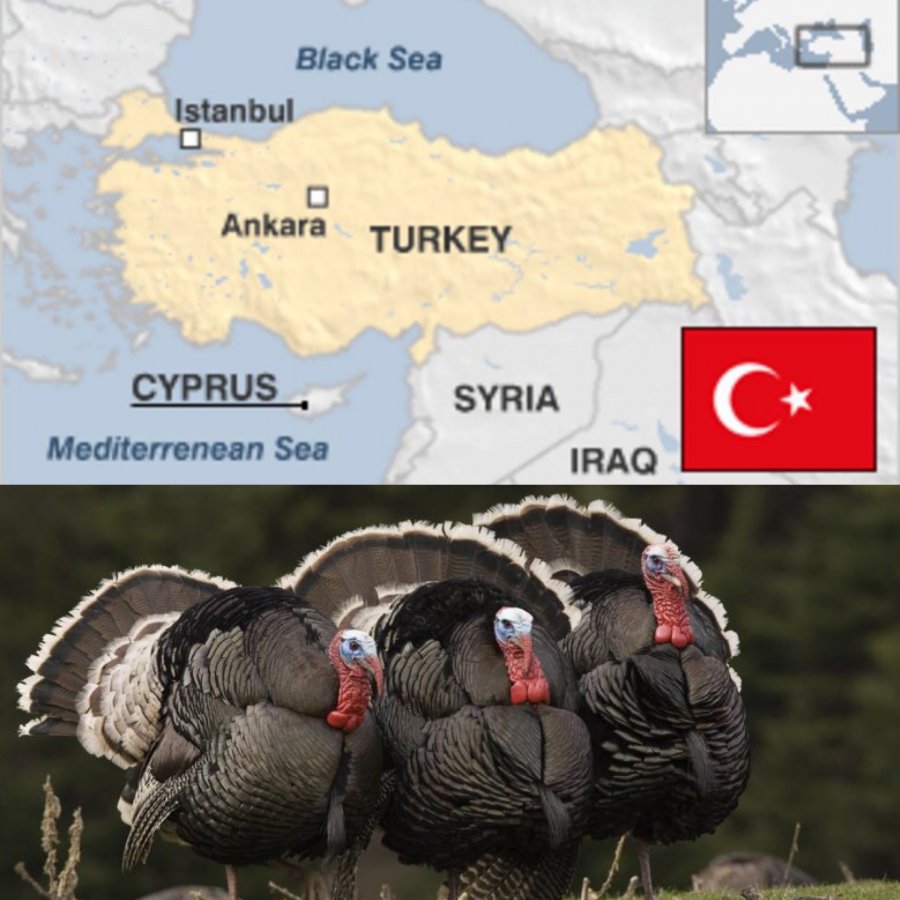
On 12 April 2019, I launched a campaign to change the name of our country from ‘Turkey’ to ‘Turkia,’ reopening a bleeding wound in our country’s image. During the initial campaign and subsequently, the issue flared up again, sparking significant debate, particularly on social media. During the debates:
1) The majority supported me, saying, “Yes, let it be ‘Turkia.’ That’s the right word.”
2) A significant minority stated, “Let it be ‘Turkey.’ Our country’s name is ‘Türkiye,’ so there’s no need to use another word.”
3) A very small portion commented, “Why bother with these issues? Let’s solve the country’s deep-rooted problems. Let’s keep the word ‘Turkey,’ don’t mess with the country’s name.””
It’s the same name as the most mocked animal.
First of all, I strongly disagree with those who say our country should remain ‘Turkey.’ In fact, I perceive this as a betrayal of our country. Because the other meaning of the word ‘Turkey’ in English means ‘turkey,’ which is the most frequently mocked animal, especially in North America. I don’t think there’s any need to delve into the debate about whether the animal was named after our country or our country was named after an animal, because it makes no difference. Ultimately, our country’s name in the world’s most widely spoken language is the same as the name of the poultry which is most frequently mocked by the countries that use that language. This is an insult to our country, which has been a cradle of civilizations for millennia and holds a very important place in human history. I absolutely reject this.
I partially agree with the approach of using “Türkiye” instead of “Turkey” (the argument that if a change must be made, let it be “Türkiye” in our own language). In fact, I personally like the term “Türkiye.” In this sense, I consider the circular published in the official gazette on December 4, 2021, a positive first step.
For a better understanding of the issue, I am sharing the statements in the circular: “Our products, which are a source of pride for our country in international trade, have been introduced with the term ‘Türkiye’ and introduced to the entire world. From now on, the aim is to represent the thousands of years of experience of our state and nation under the ‘Türkiye’ brand in every field. In this context, as part of efforts to strengthen the ‘Türkiye’ brand, the necessary care will be taken to use the term ‘Türkiye’ instead of ‘Turkey’, ‘Turkei’, ‘Turquie’, etc., in all activities and correspondence, especially in official relations with other states and international institutions and organizations.” You can find more detailed information in the published circular and in the news article at https://www.trthaber.com/haber/gundem/urunlerde-made-in-turkiye-ibaresi-kullanilmaya-baslayacak-632675.html .
Why is “Turkia” muxh more useful?
I’d like to emphasize that I consider changing the word ‘Turkey’ to ‘Türkiye’ a positive first step, but it’s not enough. Because ‘Türkiye’ is a Turkish word, and you can’t translate a word from your own language into another language. For example, there’s no letter ‘ü’ in English. In fact, you can’t force English-speakers to pronounce the letter ‘ü’; they’ll lose their tongue. They’ll say ‘u’ instead of ‘Ü.’ They also don’t know how to pronounce the remaining -kiye part of ‘Türkiye.’ Native English speakers will all pronounce the word ‘Türkiye’ differently. Let me give you an example to illustrate. If you ask, “How do you pronounce this?” put the word “Türkiye” in front of the British or Americans, and you’ll get different pronunciations like: “Turkiy,” “Törkiy,” “Turkay,” “Törkay,” “Turkaye,” “Törkaye,” etc. Do you know what I mean? You can read my first blog post, where I launched my campaign, at https://www.serhansuzer.com/tr/ulkemizin-ingilizce-adi-turkia-olmali . In that post, I wrote in detail why Turkey’s English name should be ‘Turkia.’ Let me share a short excerpt to remind you:
The Rationale and World Examples
In English, the suffix -ia is the equivalent of the suffix -istan in Turkish. So, when you add -ia to the end of a nation or ethnicity, you define ‘its country.’ For example, ‘Bulgaria’ means the country of the Bulgarians, and ‘Malaysia’ means the country of the Malays. This is the case all over the world. I could give you many more examples:
“Albania, Algeria, Armenia, Australia, Austria, Bosnia, Bulgaria, Croatia, Estonia, Georgia, India, Indonesia, North Macedonia (no offense to my Greek friends), Malaysia, Mongolia, Nigeria, Romania, Russia, Saudi Arabia, Serbia, Syria, and many more countries I can’t list here.” The phrase “Made in” is English, and then a word of English origin that everyone can pronounce the same should be used. Every language is beautiful, and if new words are to be added to a language, they should be chosen based on their own origins. If English doesn’t have the letter ‘ü,’ we can’t just place it in English by our own imagination. Native English speakers don’t know how to pronounce the word ‘Turkey.’
If you ask me, the change to “Made in Turkey” is an important step in breaking that initial perception. However, after breaking that perception, the phrase “Made in Turkey” should be replaced with “Made in Turkia” in the future, and the phrase “Malı Türk” (Made in Turkey) should be retained in our beautiful Turkish. In my opinion, this is how it should be.
Tag: education