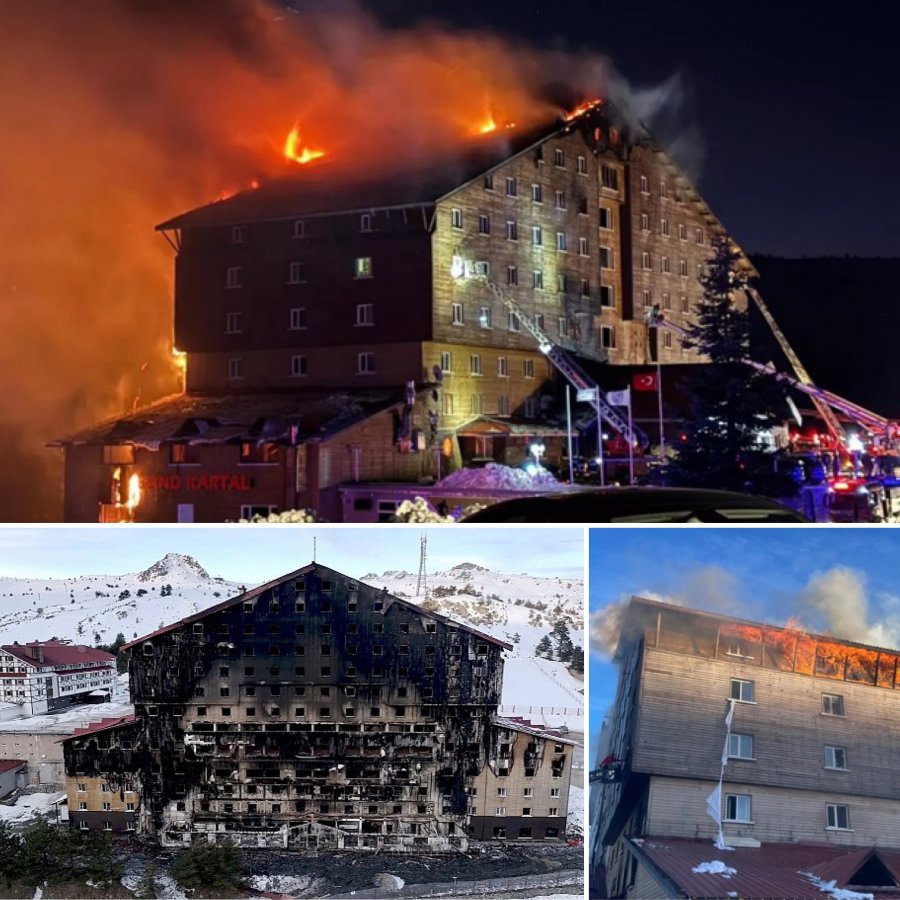
Kartal Hotel is a legendary place closely associated with the history of skiing in Turkey. Anyone in the country who’s into skiing has probably stayed there at least once in their life. In our childhood and teenage years, it was the iconic hotel that put the Kartalkaya destination on the map.
I have many fun and some troubling — memories of Kartal Hotel. Now seems like the right time to share a few.
I think I was around 10. I had been skiing since the age of five, so my technique wasn’t bad, but I still had some hesitation. One day, while skiing on our own, my late uncle-in-law joined us for a couple of runs.
My uncle-in-law’s taunts that pushed me
I clearly remember our last run. Laughing in a mocking tone, he said, “You’ve been skiing for years and still can’t make it down this slope fast?” He had also made some belittling comments earlier in the car on the way to Bolu and after we arrived at the hotel. Even as a kid, I remember feeling a sense of resentment toward him.
Maybe he was just teasing, I don’t know. But as a sensitive child, I really didn’t like his attitude. I remember thinking, “We were all skiing happily without a care, so where is this condescending behavior coming from?” His words stung. Still, I calmly replied, “I ski pretty well for my age.” He shot back, “I can see how you ski — you’re no good at this.” That hit me like a punch to the brain.
“Watch me now!”
Normally I’m calm, but when I hit my breaking point, I can really react — sometimes even surprise myself. He had managed to truly anger me. I snapped, “Watch me now!” I raced up on the only lift they had back then and came down like a ski racer — incredibly fast, in a third of the normal time. He was watching from below. I stopped next to him and asked, “Well? Was that fast enough for you?” He was clearly surprised but chose to keep mocking me: “You made it down, but your form was garbage.” Furious, I said, “Watch me again.” The second time, I kept my legs tightly together and carved my way down in a fast, stylish slalom — trying to show off full technique. Honestly, it was the first time I tried skiing like that, and even I was amazed by myself. At the bottom, I asked, “Well? How was the style this time?” He smiled and nodded. My twin brother Baran was there too and asked, “How did you ski like that?” I replied, “Come, I’ll show you.” I told him the first thing was to not be afraid of anything. My anger had wiped away all fear, hesitation — every negative emotion — which is why I skied so incredibly. I told him, “Don’t fear anything. Visualize skiing this way.” Then we skied down together a few more times. That day was a turning point in my skiing life. Baran got it too and started skiing like me. From that day on, I kept pushing myself. I got bored of regular slopes and began skiing off-piste — I even did heli-skiing (where a helicopter drops you onto an untouched mountaintop to ski down). All of this happened on Kartal Hotel’s original, first slope.
Baran’s shoulder injury on the slope
The second memorable incident was when my twin Baran broke his shoulder. In the years after we started skiing faster and more aggressively, Baran overdid it one day. While bombing down the slope, he lost balance and crashed hard, landing badly on his shoulder. I wasn’t with him at the time — I think I was skiing with a different group. Thankfully, a passing ski instructor picked him up and brought him back. He was in serious pain. Our family rushed him to a doctor, and it turned out his shoulder was broken. He received emergency treatment there, and we returned to Istanbul early. His recovery continued in Istanbul, and he eventually healed. That also happened on Kartal Hotel’s original slope.
The third incident I remember happened about 6–7 years ago. It’s something personal, so I won’t go into detail here — but it really upsets and angers me. I cut the people involved completely out of my life.
“It needs a full renovation”
During that last stay, I noticed how outdated the hotel had become and remember saying, “Why don’t they renovate this place?” Since childhood and through our youth, I don’t recall the hotel being updated. Maybe they did a few touch-ups here and there, but that’s not enough. I told my friends, “As someone who has worked in tourism, I think this hotel needs a complete overhaul.”
The irresponsibility of skipping renovation budgets
The recent fire only confirmed what I saw that day. Most hotels allocate a percentage of their revenue for renovations, and that money is kept aside, untouched. But clearly, Kartal Hotel’s management wasn’t familiar with this concept. Their biggest mistake was investing very little of the money they earned back into the hotel — just enough to fix the most urgent issues — and likely pocketing the rest or using it for other hotel projects. But the primary duty of a hotelier is to maintain their existing assets in the best condition possible.
This renovation budget would’ve included all fire safety systems and essential security upgrades. That investment would’ve only been a small fraction of the hotel’s earnings. Had they made that small investment over the years, 78 people would still be alive today. A real tragedy.
Restless night before the fire
I couldn’t sleep the night the fire broke out — Tuesday night going into Wednesday. I was messaging a friend around 2:30 a.m. and they asked, “You’re still up? That’s rare.” I replied, “Weirdly, I just can’t sleep tonight.” Maybe I sensed something. When I read the news around 6 a.m. about the disaster that had happened overnight, I was in shock.
How did it get to this point? Let’s break it down.
The story of Kartal Hotel
It’s a classic family business tale. You can read the hotel’s origin story on their official website: https://kartalotel.com/hakkimizda/
The founder, Mazhar Mürtezaoğlu, was born in 1926 in Rize. He passed away on April 30, 2019, at age 93. Known as the man who made Kartalkaya what it is, Mürtezaoğlu was a forestry engineer who started working in Bolu in the 1960s. He first opened a restaurant at a roadside rest stop on Bolu Mountain, then built a hotel nearby. With Koru Hotel, he entered the hospitality sector and succeeded. In 1974, he laid the foundation for Kartal Hotel atop the Köroğlu Mountains, opening it in 1978.
Inspired by Austrian resorts, he aimed to turn the area into a ski destination — and he did. In 1998, he opened Grand Kartal Hotel, the one that recently burned down.
The problems began after Mazhar Bey’s death
After his passing, the hotel was taken over by his daughter Emine Ergül and her husband, Halit Ergül. I believe this is when the real problems began.
Many people belong to the family, and you see their photos now and then. But we must distinguish between them. Holding all family members responsible would be unfair. The focus should be on those with executive authority — the ones who made the decisions that led to this disaster. According to news reports, one name stands out: Halit Ergül, the son-in-law who took over full control. You can read his background here: https://www.cnnturk.com/turkiye/galeri/grand-kartal-otel-yangini-halit-ergulun-patronluga-uzanan-hikayesi-ve-buyuk-facianin-perde-arkasi-2229046?page=1
Halit Ergül’s rise to power
Born in Susuzkınık village in Bolu, Halit Ergül started working in the accounting department of Kartal Hotel when it opened in 1978. He later began a relationship with Emine Mürtezaoğlu and married her in 1987. While his brother-in-law Harun lived a more reserved life, Halit pursued business aggressively.
As Kartal Hotel succeeded, Mazhar Mürtezaoğlu built Grand Kartal Hotel and later handed both over to his children in 2004 — Grand Kartal to Emine, and Kartal Hotel to Harun. This created a power struggle between Halit and Harun, as Halit wanted control over both.
In 2007, when Mazhar Mürtezaoğlu was diagnosed with Alzheimer’s and Parkinson’s, Halit gained even more control. Family feuds turned into legal battles. He expanded the Grand Kartal aggressively, opened the Gazelle Hotel, and put his own son-in-law, Emir Aras, in charge. Emir Aras was later arrested in the fire investigation. In my view, both Halit Ergül and Emir Aras are the main people responsible.
How the fire started and the chain of failures
According to reports, the fire started around 3:30 a.m. in the kitchen while staff were preparing breakfast. Someone tried to extinguish hot oil with water, which made it spread uncontrollably. It engulfed the kitchen and quickly spread upstairs.
Had there been proper emergency response in the early moments, the fire wouldn’t have reached the whole hotel. Trained staff would’ve known not to pour water on burning oil. If they had simply covered the fire, it could have been extinguished then. Staff training was a critical failure point.
Second, there were no fire extinguishers near the kitchen. With one, they could’ve intervened early — but nothing. Third, the hotel was part wood, part concrete. If the wooden parts had been treated with fire-resistant materials, the fire wouldn’t have spread so fast.
Fourth, there were barely any fire safety tools anywhere in the building. Fifth, and perhaps most crucially — the fire alarm didn’t work. If it had, everyone would’ve been alerted while the fire was still in the kitchen and evacuated in time. The deactivation of the fire alarm is one of the main causes of the tragedy.
Deactivating the alarm reflects a culture of denial — “We’ll handle this ourselves, no need to alarm the guests” — and that mentality led to 78 deaths.
No fire escape stairs outside!
Sixth, there were no external fire escape stairs. Had they been there, most of the 78 people who died could’ve escaped. This failure shows how poor the management’s priorities and awareness were.
Lastly, there were no nearby fire or emergency teams. By the time firefighters arrived from Bolu, most of the hotel was already consumed, and the deaths had occurred.
All of the victims were educated people from the skiing community. It’s heartbreaking — they lost their lives for nothing due to the dysfunction in this country. May they rest in peace, and may their loved ones find strength.
The flawed star rating system
Clear steps must be taken to prevent disasters like this. One key issue is how everything in Turkey is judged on appearance. Even hotel star ratings are based on physical features — do they have a TV, a mini bar? But the most important factor should be management: the quality of personnel, meritocracy, and the ability to live up to the star rating. The Ministry of Culture and Tourism should prioritize management quality when rating and inspecting hotels.
Corruption, incompetence, greed…
Moreover, measures to prevent disasters like fires and floods must be mandatory in all hotels. Those who fail to comply should be shut down immediately — until proper investments are made and the place becomes safe again. No need for political debates about whether the municipality or ministry is to blame. Whoever is responsible for inspections is to blame. The state failed in Kartalkaya.
In short, this tragedy at Grand Kartal Hotel — a place filled with memories for many of us — was rooted in corruption, incompetence, greed, and a total lack of public service awareness.
Solving these deeply rooted issues will take time — and unwavering determination.
Tag: memory