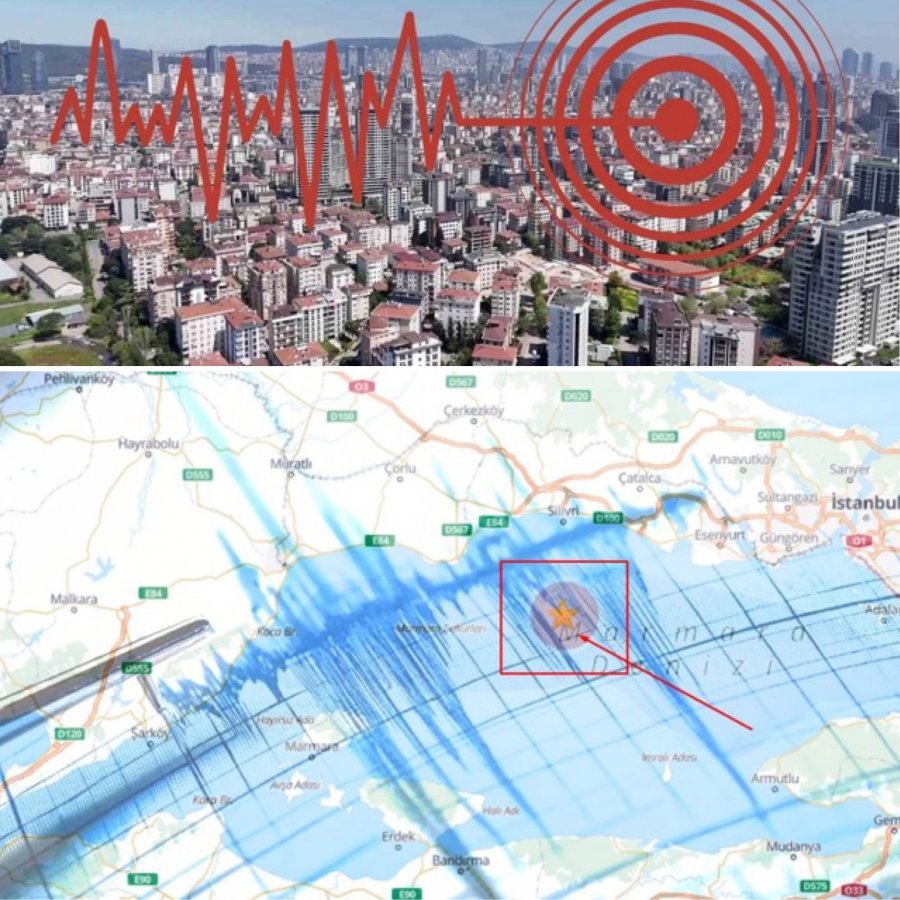
After catching up on the news about the Istanbul quake, I made my calls and was relieved to find that no one I knew had been hurt. From what I gathered, no buildings had collapsed, and there were no fatalities. Still, many of my friends and loved ones were seriously shaken up—including my dogs. Apparently, they barked like crazy during the quake. I tried my best to calm everyone down over the phone.
Honestly, the fact that the quake was below a magnitude of 7 and didn’t last long was a stroke of luck. If it had been stronger—say, 7 or above—or had lasted more than 30 seconds, I don’t even want to imagine what could’ve happened.
From what I’ve read, there are two main scenarios being discussed. In an interview with Sinem Özdemir of DW Turkish, one of Germany’s leading seismologists, Prof. Dr. Marco Bohnhoff, laid out both possibilities.
Two Possible Scenarios
The first scenario is that the 6.2-magnitude quake was the “main event” and that the aftershocks will gradually subside over time. But the second scenario is that the big one is still to come, and this was merely a warning tremor.
We also have qualified experts in Turkey, although unfortunately, we also have so-called “experts” who are more interested in theatrics than science. These ratings-hungry figures muddy the waters with populist claims and unscientific commentary. That’s why I usually turn to German or Japanese experts for guidance whenever an earthquake hits. I take Prof. Bohnhoff’s comments seriously precisely because he works at Germany’s prestigious GFZ (German Research Centre for Geosciences) in Potsdam.
We can’t know for sure which scenario will play out—but the mere possibility that the big quake hasn’t hit yet should be reason enough to spur us into serious action.
What Needs to Be Fixed in the Short Term
It’s clear that, up to this point, we haven’t taken the kind of fundamental steps that would resolve this issue at its core. So, once again, I’d like to spell out what needs to be done. I’m going to break this down into short-term and long-term actions. Let’s start with the short term—by which I mean a maximum timeframe of three years. (Some of what follows is drawn from my earlier blog posts, which I’ve linked in the “Notes” section at the end.)
1) A full review of Istanbul’s building inventory: Every single building in Istanbul must be reviewed objectively, one by one. That means setting engineering criteria based on the worst-case earthquake scenario for the city, and then inspecting every building against those standards—not just visually, but by taking concrete samples for testing. Any buildings that fail the assessment should be demolished, and the occupants relocated to temporary or permanent housing. As for buildings that can be reinforced, the state must ensure the reinforcements are carried out. If a building owner fails to comply within the allotted time, demolition procedures should apply there too.
2) The government must complete all short-term preparedness plans immediately: The government needs to prepare comprehensively for earthquakes. That include:
a) Creating a detailed risk-reduction map for every neighborhood.
b) Ensuring the state’s official search and rescue teams are ready for any situation, with regular drills conducted each year. In other words, a disaster action plan and related rehearsals must be in place.
c) Having a solid plan in place for coordinating aid efforts after a disaster.
d) Anticipating and preparing to meet post-disaster needs like psychological support, etc.
e) Establishing open-air gathering areas in every neighborhood for use immediately after a quake.
f) Permanently banning all future “zoning amnesties.”
g) Dealing with past offenders. Right now, many of the people responsible for constructing buildings that later collapsed are walking free. Sure, a few contractors were jailed, but history suggests they’ll be released before long. The way to ensure that future developers are more competent and ethical than their predecessors is to hold the old ones fully accountable. Anyone whose shoddy construction caused buildings to collapse and led to tens of thousands of deaths must receive the harshest possible penalties.
3) Civil society organizations must complete all their preparations: Neighborhood-based disaster volunteer systems should already be in place across all neighborhoods and regularly participating in annual drills alongside the government’s official search and rescue teams. Additionally, NGOs that respond to post-earthquake needs—such as those providing humanitarian aid or psychological support—must be fully prepared and aligned with state coordination efforts. To ensure all NGOs can operate in a unified and systematic way during disasters, organizational structures must be formalized. One important step, which we previously discussed under the Disaster Platform initiative, is the development and deployment of a centralized Donation Management Platform.
Likewise, to systematically address the critical area of mental health following a quake, we need to develop and implement a program for assigning and dispatching psychologists and psychiatrists. This system must be fully coded and integrated with government agencies to ensure seamless operation during emergencies.
4) The private sector must also be fully prepared: Private-sector organizations can and should establish their own search and rescue teams and contribute to humanitarian relief efforts. Furthermore, any buildings owned by private companies should be assessed immediately, and any required reinforcements must be carried out without delay.
Long-Term Priorities
1) Urban Planning
Flying over Istanbul in a plane and looking down is enough to make your heart ache. It looks like we’ve carved out the natural landscape and filled it in with concrete. On the Asian side and especially the European side, green spaces or even open areas are few and far between. The city appears to be covered in an unbroken layer of concrete buildings, and when you consider what might happen to these structures if the quake exceeds magnitude 7, it’s almost too painful to imagine. What’s more, in many neighborhoods, even if people manage to escape their buildings, there’s nowhere safe and open for them to take shelter.
Istanbul’s urban plan needs to be completely redrawn from scratch—and strictly enforced. This new urban planning effort must prioritize not just aesthetics but also resilience to disasters, using systematic design principles. (For example, in the U.S., streets are laid out in a parallel grid; in Paris, they converge into circular hubs with radiating avenues—both are deliberate, resilient patterns.)
We need to declare a national mobilization around earthquake preparedness. Reviewing each of the 21 million buildings in Turkey—diagnosing, demolishing where necessary, and updating urban plans accordingly—would be a foundational step toward solving the earthquake crisis once and for all. A full-scale mobilization and an uncompromising discipline in urban planning must be established.
In this new approach to innovative urban planning, several key principles must be followed:
a) Strict building standards must be applied to all new construction without exception.
b) Construction permits must be issued based on the characteristics of the land and its geological suitability.
c) Buildings should not just avoid causing harm in disasters—they should be designed to actively protect human life during earthquakes, floods, wildfires, landslides, and other natural events. New buildings must be built to this standard with great care, full transparency, using established systems, and the latest technologies.
d) Construction must be banned outright in high-risk zones such as fault lines and riverbeds.
e) Any company wishing to build must first work with an accredited geological surveying firm to assess the suitability of the site. These accredited firms should be available to serve all construction companies, and engaging them should be mandatory.
f) Just because construction is profitable doesn’t mean everyone should be allowed to build. Land developers will always exist, but they must work exclusively with licensed, qualified construction companies. And those companies must be run by active managers who are themselves civil engineers. The authority to undertake construction projects must be tied to stringent qualification criteria.
g) Every project must be overseen by third-party, independent building inspection experts with specialized training. These building inspectors should be civil engineers, assigned randomly through a computer system to prevent conflicts of interest. They must have no direct contact with contractors whatsoever. Unfortunately, the building inspection process has been deeply compromised in the past. There was even a time when inspectors were paid directly by the very contractors whose buildings they were supposed to scrutinize. We’ve seen contractors begging for approval, threatening inspectors—it was a circus. The new system must be fully insulated from manipulation by developers. We must establish an unshakable, professional inspection system that no contractor can bend to their will.
2) Ethical values and competence
Beyond urban planning, another long-term priority must be instilling strong ethical values and professional competence.
Our education system should prioritize raising generations who have solid moral foundations, a strong sense of ethics, empathy, helpfulness, self-confidence, and real-life awareness. On top of that, the system needs to produce high-level engineers. In the field of civil engineering, there’s a foundational principle taught in introductory classes called the 4E rule: Safety, Economy, Ergonomics, and Aesthetics. The order of the first two must never be reversed economy ,should never come before safety. This is where ethics and moral values must come into play.
From here on, every step of the process should be made more rigorous. When a doctor botches a surgery, one person may lose their life—but when a civil engineer makes a mistake, hundreds can die. Core engineering courses such as statics, dynamics, strength of materials, structural analysis, reinforced concrete, steel structures, soil mechanics, and structural dynamics must have more classroom hours, and students should not be allowed to graduate just by scraping by. Every graduate in civil and other fields of engineering must have full command of their subject and adequate hands-on experience. This requires deep-rooted reforms both in general and vocational education. In essence, it all comes down to education.
To bring about all these changes, we need a government that has the will to carry them out. Public officials must be able to perform their duties without obstruction. In other words, we need a broad set of radical reforms and improvements. I’m talking about a complete system reset. But in today’s political climate, that doesn’t seem very likely. These problems must be solved before disaster strikes, with a proactive approach. Once tragedy hits and we suffer immense losses—both emotionally and financially, there’s not much point left in talking about system resets.
Note: I wrote my very first blog post in 2011, following the Van Earthquake, which occurred after our first and most traumatic experience, the 1999 quake. Since then, I’ve written many times about earthquakes from different angles. I’d like to share a few of those pieces here as a reminder:
https://www.serhansuzer.com/tr/karanlik-zamanlarda-sarki-soylemek
https://www.serhansuzer.com/tr/depremin-yil-donumunde-sorgulanmasi-gerekenler
https://www.serhansuzer.com/tr/turkiyede-afetle-mucadelenin-anti-kahramanlari
https://www.serhansuzer.com/tr/binalarin-insanlari-korumak-icin-yapilmasi
https://www.serhansuzer.com/tr/deprem-bu-kez-baba-yurdunu-fena-vurdu
https://www.serhansuzer.com/tr/elazig-depreminin-1-yil-donumunun-ardindan
https://www.serhansuzer.com/tr/afet-platformu-ve-izmir-depreminde-yaptiklarimiz
https://www.serhansuzer.com/tr/izmirde-bir-kez-daha-gorevimizin-basindayiz
https://www.serhansuzer.com/tr/deprem-degil-bina-oldurur
https://www.serhansuzer.com/tr/elazigda-bizim-stklar-tarih-yaziyor
https://www.serhansuzer.com/tr/bir-depremin-ardindan
Tags: social responsibility, life, health, memoir