
Business life is truly brutal. You have to be very careful, strong, and smart. I don’t know anyone else in my position who has left the family business (I’m talking about leaving it entirely, in other words, not earning any income from it. Just because you continue to receive a salary doesn’t mean you’ve left it) and started their own ventures, especially in strategic sectors like energy, fintech, and Wi-Fi analytics. Renewable energy, in particular, is a sector that requires significant capital and is dependent on the public will, and it requires a great deal of effort to make it work.
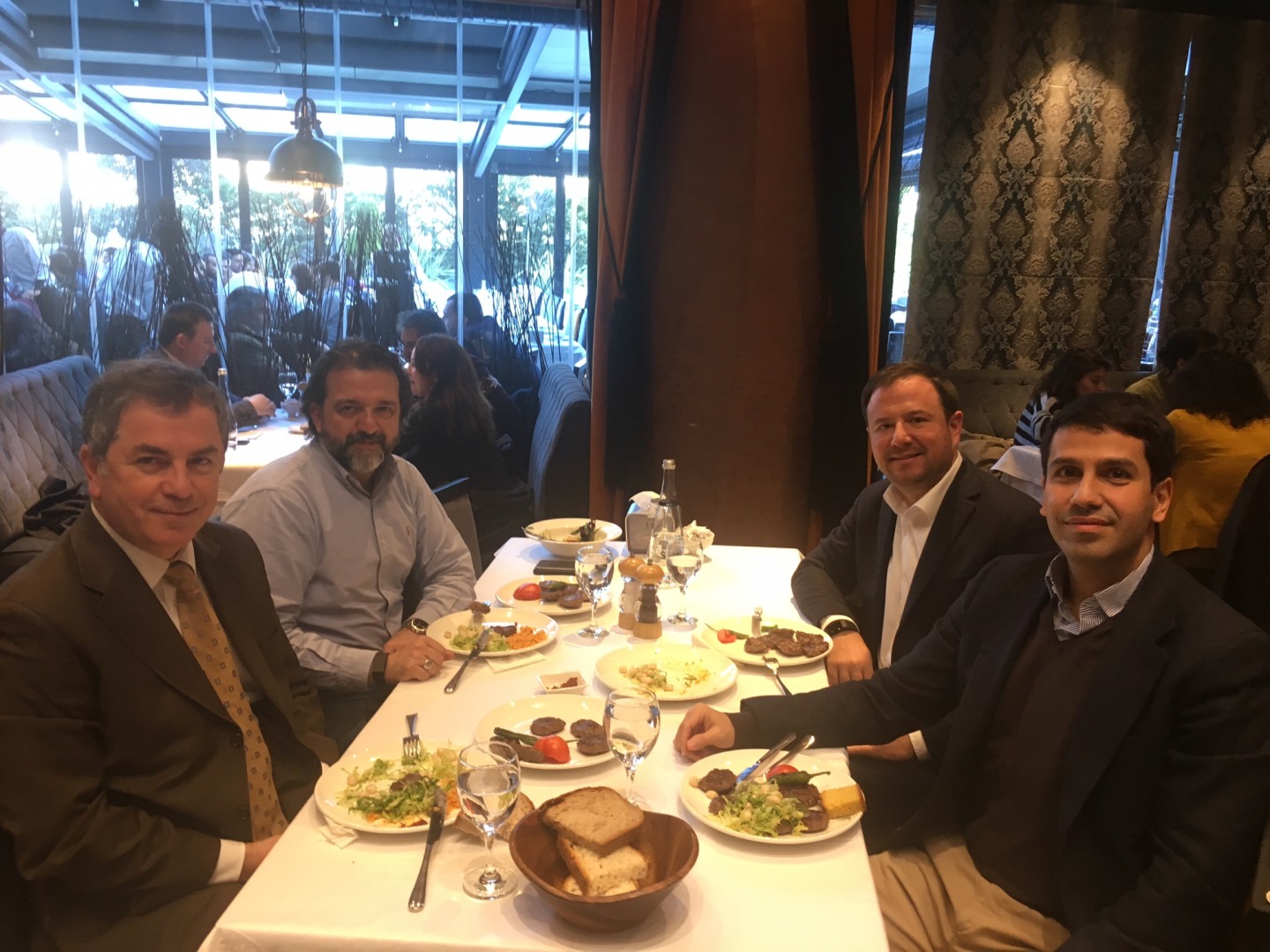
The Energy Group’s square ace. EkoRE Solar General Manager Oğuzhan Haznedar in the front left, myself in the front right, EkoRE Wind General Manager Süheyl Oktamış in the back left, and EkoRE Solar Industry General Manager Zorlu Yalnız in the back right.
In Türkiye, when you try to do something good, you encounter incredible challenges. In all the areas we operate, building a path from entrepreneurship to establishing a corporate structure is truly challenging in the Turkish environment. The ground is slippery, dynamics are constantly shifting, people are changing, and the climate is changing. You’re forced to zigzag along the path you’re on. Therefore, sayings like “stretch your feet according to your blanket” don’t really apply in Türkiye. You think you’re stretching your blanket according to your blanket, but someone is either pulling it from underneath, cutting it, or just ripping it off. You can’t make calculations based on the blanket in Türkiye. All you can do is be vigilant, demonstrate the necessary flexibility, and stay focused on your goal no matter what.
I’d like to explain in more detail the environment in Türkiye that lacks visionary entrepreneurs. First, let’s watch Onedio’s video, “What would have happened if Steve Jobs had been born in Türkiye?”, which is extremely clever in its content and captures the realities of Türkiye:
https://onedio.com/haber/steve-jobs-turkiye-de-dogsaydi-ne-olurdu-764614
This video explains how Steve Jobs was encouraged to abandon all his dreams and either become a profit-seeking businessman or become a civil servant, a job that would guarantee his life. They list the factors that created this environment as follows:
- No one believed him (it wouldn’t work)
- They would fixate on his appearance
- He couldn’t find investors
- Everyone would offer advice
- He would be asked for favors
- He would be hindered as he became successful
- He couldn’t manage business because of sycophants
- He would deal with pirated products
- They would sell him before he could grow
I completely agree with the above. In fact, I have some more to add. Here are a few examples from my own experiences:
- Some people in the same industry constantly undermine you and talk behind your back.
- People in your personal life (your girlfriend, friends, etc.) complain, “Why don’t you spend enough time with us?”
- Instead of supporting you and your long-term vision, banks constantly focus on additional fees, guarantees, and how to raise interest rates. Conversely, they become an additional burden on you.
- Banks are not there for you when you need them most; promises are broken, and timing is often off-time.
- They make personal mistakes, such as failing to make payments due to systemic errors, despite having money in their accounts. Furthermore, other unforeseen problems arise. For example, you apply to work with a branch that knows the energy sector and is comfortable working with, but another branch that works with your family’s business does everything it can to hinder your transfer, delay the process, and speak badly about you. Ultimately, your relationship with the bank reaches the breaking point.
- The public sector issues the Credit Guarantee Fund (KGF) to support the private sector. Instead of stimulating the private sector, banks use this state-guaranteed loan to collateralize their problematic loans. This leaves your loan application pending for a long time for projects and companies that truly deserve the KGF and will stimulate the economy.
- Many banks evaluate everything on paper. During the investment phase, people draw incorrect conclusions based on current ratios and, for example, without understanding the dynamics of the solar energy sector. In other words, evaluations made without understanding the business, its spirit, or its potential are unsound. Ultimately, banks struggle to build bridges with entrepreneurs.
- In the public sector, where you might have developed a single project and progressed on unlicensed projects, a few regulations are suddenly issued (as happened last year), bringing the solar energy sector to a standstill.
- You experience a coup attempt that could only occur in a third-world country. Markets are upended. Life comes to a standstill for three months, and all processes with investors and banks come to a halt.
- You might even get ripped off by some of your friends. Promises are broken, and you’re even talked about.
- You might get ripped off by your employees, too. You’ll encounter many different types of people, including those who betray you, those who speak ill of you even among your most trusted employees, those who demand extra money when you need it most, those who do the exact opposite of your directives, and those who don’t properly follow through on their work.
- Your employees can’t get along with each other. We’re arguably one of the least developed societies in the world with the ability to work collectively. People disagree for very simple reasons; someone constantly rebels within the same team, and teams struggle to work harmoniously.
- You’ll constantly have to explain to foreign investors and all the individuals and companies you collaborate with abroad how important and potentially powerful Türkiye is. Foreign investors, in particular, have a tenuous appetite for investment in our country. Under these circumstances, convincing them to invest in our country is much more difficult than it was 5-10 years ago.
- You find foreign investors or technology providers from abroad. Then, your competitors, noticing this, covertly contact your technology provider, saying, “Leave them alone, it’s not easy for them to find financing, I have plenty of money, come do it with us.” They lie, don’t hesitate to steal someone else’s idea and model, and try to do business in Türkiye with an unidentified offshore financing source. Other well-known companies do this as well. Then, when we anonymously expose them at a meeting held by the Ministry of Energy, they abandon their fraudulent practices.
- The Korean company we purchased the solar panels from refused to deliver them to us for 2.5 months, despite the panels being held at customs (even though we had signed a contract and made a down payment). They made various excuses, blamed the bank, and continually delayed the process. Finally, the chips were down, and the Korean consulate was involved, and progress was made in the process. When we met face-to-face to resolve the issue, they asked, “What’s the status of your panel production facility?” Meanwhile, with each passing day, the power plant’s commissioning gets delayed, resulting in significant losses.
- A significant majority of project development companies in the market operate on a shoestring mentality. Partners in the companies you purchase projects fight among themselves, and this spills over to us. Because they haven’t shared the installments they received from us equitably, the partner who demands more money comes and demands additional money from us. Furthermore, they’ve essentially sold us a broken project. The power plant’s connection line has serious issues. You’ll spend significant time fixing this, at a high cost. Ultimately, you’re close to making a project that’s impossible to realize (and project financing depends on all these dynamics), while the people you bought the project from continue to brazenly demand the final installment, ignoring the fact that you sold a broken project.
- As a fintech (financial technology) company, the banks you work closely with can fail you. The systems of a bank you’ve spent all your transactions on are down all day. Your one-day revenue has been wiped out. The bank doesn’t care.
- As a Wifi Analytics company, one of your biggest competitors launches virtual attacks to prevent you from securing further business. You block the systems they’re trying to hack (which would cause your system to malfunction or crash) with a few moves. When you inform them that you’ve caught them doing this, the other party brazenly replies, “What can we do? We’ve received so much investment, and we’re doing this to avoid disappointing our investors,” and claims these unlawful actions are normal.
- The tone and money-grubbing of the operator of the venue where our social enterprise hosted its first concert put us in a difficult position. He didn’t seem to care that we were an association or organizing this concert to help thousands in need. He insisted on taking the upfront payment from the venue without waiting for Biletix to pay the ticket revenues the day after the concert. The venue owner even threatened to cancel the concert several times, constantly snapped at our colleagues at the venue using street talk (even mafia-like language), and made controversial remarks. We overcame this difficult situation by taking it seriously. The concert was a great success (I’ll write about it in my next blog post). However, I don’t think we’ll ever hold a concert at this venue on the Anatolian side again.
- Even if you start the day positively, you’ll get stuck in traffic and your nerves will be in disarray. Our people drive as if they’re about to fight. In America, there’s a passive driving concept. They encourage everyone to drive carefully and respectfully. Here, everyone is an extremely active driver.
- Due to traffic and many other reasons, appointments often don’t start exactly on time. Meetings often involve many topics far removed from the main topic, and sometimes even gossip.
- Turks have no respect for Turks. I always say that if I had come to Türkiye from Silicon Valley, I would have advanced much faster in business. When they see you as “one of us,” you’re doomed. They only open doors for you when they admire you. Unfortunately, I’ve only been able to open many doors thanks to referrals from abroad. A topic we’ve repeatedly discussed but failed to explain is, for some reason, readily accepted when it comes from abroad.
- Humility is perceived as a weakness in Türkiye. I believe the opposite; I believe people should become humbler as they advance in rank. However, the vast majority in Türkiye perceive the vehicles they use and their possessions as a sign of status and project this to others. This is deeply troubling to me.
- I’ve been operating independently of the family business for approximately five and a half years. I’ve written about this topic before: http://www.serhansuzer.com/tr/15-yillik-is-hayatim-ve-gelecege-notlar. Despite all the negativity and challenges, the successes achieved by companies, each utilizing limited resources, are evident. Yet, some executives of the family-owned holding and related subsidiaries can disinform the market (negative misinformation) about me. This unfortunate behavior and character have harmed me. It doesn’t really matter, because eventually, it will become abundantly clear who’s who. When the time comes (if we consider the family and the family business as a single entity), I will deal with these people who shoot themselves in the foot.
- The entire fate of the country hinges on an election. Foreign and domestic investors, those who owe you money, the public institutions from which you obtain permits—everyone has shifted to a “let’s just wait for this referendum to pass, and we’ll figure it out later” mode. This will seriously damage your business at a time when life is flowing, and business is quite busy.
The list above could be very long. I’m thinking of stopping here for now. I believe the above gives you a sense of what can happen in the Turkish business environment when you act with good intentions and a visionary entrepreneurial spirit.
Being an entrepreneur in our country is very difficult. Especially if you’re firmly committed to a vision and unwilling to compromise, no matter what, it’s nearly impossible to succeed.
I set out to achieve the impossible. Of course, there are many factors that make my work easier and help me along the way. Most importantly, my family and friends who stand by me no matter what; my colleagues who believe in me, support me, and always support me; the companies and stakeholders who work closely with us.
Thanks to these people and certain qualities I trust, I will achieve success. Unfortunately, the positive environment I find myself in when dealing with NGO work doesn’t translate to business life. For me, everything is mutual. I always want to reciprocate the same positive attitude towards those who are willing to help with good intentions. Similarly, I will not allow those with ill intentions who work against me to act. My shields are ready for them, and I will fight as hard as necessary.
I continue with the same determination I started my first venture with five years ago. There’s dedication here. I’ve paid a heavy price and sacrificed my life to realize my vision. I will continue to do what’s necessary. When I achieve my vision, I will simply enjoy these mechanisms, which I wholeheartedly believe will be significant to humanity and passed on to future generations. Of course, I will share them with all my friends.
I’m writing this article to leave a mark on history.
Stay well.
Tags: economy