
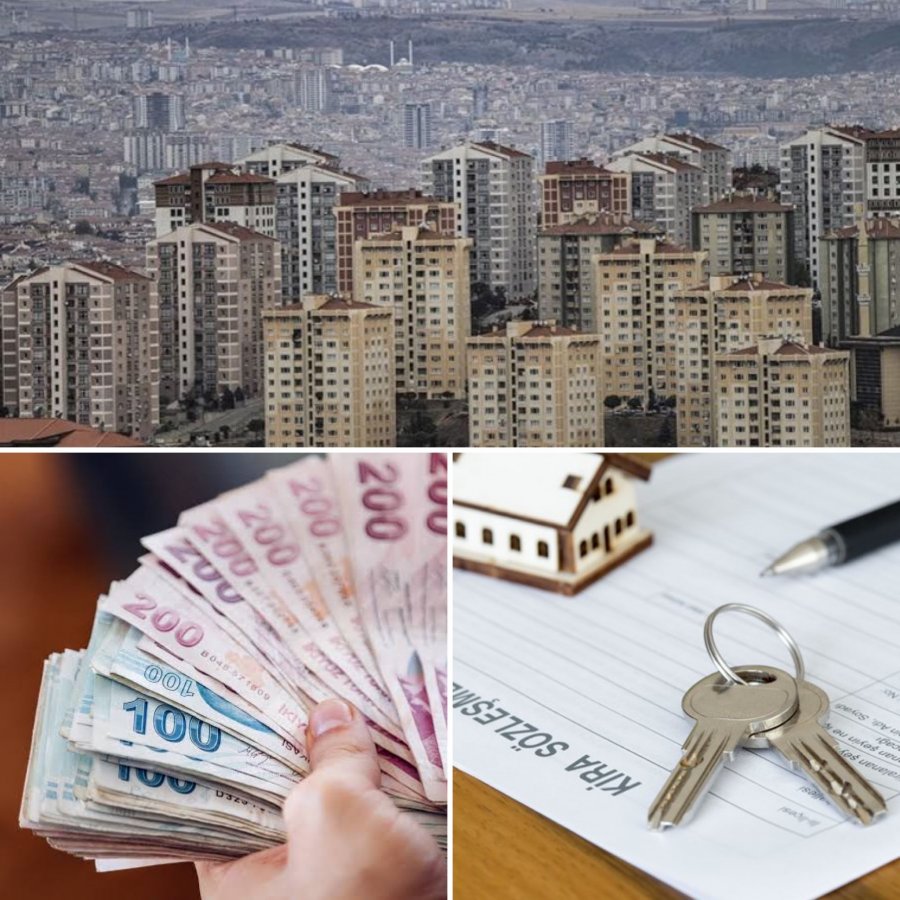
The landlord-tenant dispute, which began with the pandemic and has become a growing problem in Turkey, has become intractable. Everyone I talk to who rents has complaints about this. In fact, they often make serious accusations beyond complaints. I think it’s important to look at the issue from both perspectives. First, let’s try to understand the psychology of landlords.
Why do landlords constantly want to raise the rent or demand very high rent increases? I believe there are several underlying reasons. Even if the landlord has had a good relationship with their tenant for a long time, they can quickly erase the past (thus creating a very unpleasant situation):
Landlords’ Perspective
1) Personality Disorder: Some landlords have a genuine greediness in their personalities. No matter how much they raise the rent, some people are never satisfied, thinking, “Oh, I wish I had raised the rent even more.” It’s difficult for landlords with this personality type to find good long-term tenants.
2) Inflation: From their own experience, they see that the prices of everything are constantly rising, and they panic. Their biggest panic is, “What if the rent I make a living from isn’t enough to meet my needs?” So, driven by a sheer survival instinct, they do everything in their power to raise their rents to the highest possible level.
3) Competition for the market price: Landlords often compare their situation with their surroundings. If they see a similar property renting at a higher price nearby, they tend to immediately raise their rents to that level. In an environment where everyone is constantly raising prices, landlords can find themselves competing for prices.
The Psychology of Tenants
Now, let’s look at the psychology of tenants. Tenants are also tired of constant and high rent increases. Because they frequently face rent increases that exceed their expectations, we naturally observe the following attitudes in their minds:
1) I can’t make any increase. Let them go to court. It will take a few years for the courts to reach a decision, so I can save time.
2) I’ll give the maximum legal increase of 25%, and I won’t interfere with the rest. Let him take it to court if he wants, but I’ll win anyway.
3) I approve an increase above 25% because I think it’s fair (usually around 50-60%), but I can’t do more. Let him take it to court if he wants.
4) Okay, that’s the way the market is, and I don’t want to get into trouble with the landlord. I accept the increase he’s asking for. If I don’t agree and try to rent a new place, re-renting another place will cost me more, so I accept the increase he’s asking for.
The government has imposed a maximum 25% increase rule, which is stated in the law, but the number of people who violate this rule far outweighs the number of people who comply. Tenants are not allowed to increase their rents by more than 25% for lease renewals between 11 June 2022 – 1 July 2023. Aposto conducted a survey with its readers to determine whether the 25% rule is being followed. Accordingly, only one in five people received a rent increase of 25% or less. The remaining 80% experienced increases exceeding 25%. In fact, many of them were significantly higher than 25%. Here’s the relevant Aposto news report: https://www.instagram.com/p/CoMryQsqGRk/?igshid=ZDFmNTE4Nzc%3D
This is unfortunately the reality. The vast majority don’t comply with the government’s rule that “you can raise the rent by a maximum of 25%.” Everyone is trying to raise the rent even more, using various excuses.
My suggested solutions
In conclusion, the real reason behind this rent problem is a high inflationary environment. The prices of everything are rising rapidly, and the price of almost every product is constantly rising, as if we were in a race. This includes property rents. So, how do we fix this environment, which puts the right to housing under pressure? How can we create an environment where people don’t worry about meeting their future housing needs in a sustainable way? I’d like to share my thoughts on this:
1) The Dutch Model: The Netherlands has implemented a “price ceiling.” Housing in the Netherlands is divided into two categories: “social” and “private.” The price of housing is determined through a rating system. In this context, housing is scored based on criteria such as age, number of rooms, bathrooms, kitchens, energy efficiency, and more. In the points system, properties priced below €736 are considered “social housing,” and their rent ceiling can be up to €1,250. The government also decides on rent increases. The respective municipalities control the scoring system. Properties valued above €736 are considered “private housing,” and the rent can be freely determined. With this model, the Dutch government has prioritized the social state, interfering with individuals’ freedom of contract. This aims to protect low- and middle-income groups (Note: The figures here are subject to change over time).
In our country, in major metropolitan areas like Istanbul, rent ceilings may be considered, particularly in order to prevent exorbitant rent increases, by evaluating the characteristics of social housing properties, such as those under TOKİ (Housing Development Administration of Turkey). You can read the relevant news article I quoted at https://www.hurriyet.com.tr/yazarlar/oya-armutcu/hollanda-modeli-cozum-olur-mu-42211877
2) Valorizing Treasury-owned land: A rapid increase in supply could be achieved by planning social housing on treasury-owned land. The dynamism of construction companies in the sector could be leveraged. Mobilization could be declared simultaneously in all cities, particularly Istanbul. Three potential models exist:
- a) The state-owned model: The state, which will pay for the construction of the housing, will own the housing and directly determine the rental rates.
- b) The private-owned model: As with the flat-for-land model for social housing to be built on treasury-owned land, the state could own some of the housing, while the contractor company could own the rest. It’s crucial that the contractor company undertakes the construction adhere to the rental rates set by the state.
- c) Ensuring public home ownership: The most effective approach would be to first ensure that privately owned homes are sold at the set market rates, and then, if necessary, to ensure that the state leases properties to tenants. In both options, the public should make long-term loan payments, similar to the mortgage system in the US, and ownership of these homes should be transferred to the public. The ideal is for everyone to own their own home.
3) Officially limit inflation: When you simply impose a rent cap, no one listens. We need to limit all price increases. Because when property owners increase their rents by 25%, and they see the cost of food, water, and all other necessities rise by far more than 25%, they see the situation as a matter of life and death, and by making excuses, they risk breaking the law—in other words, committing a crime. Therefore, if a limit is to be imposed, it must limit all price increases.
4) Increase the speed and enforcement of legal action: Cases take too long. Decisions can also be violated. As in well-functioning states governed by the rule of law, the speed and effectiveness of legal action must be increased. For example, if the state passes a relevant law and property owners fail to comply, the law must issue its decision within one month, and those who fail to comply must face imprisonment if necessary. Otherwise, a situation of “whoever has the power to do so” a law of the jungle—will emerge. Everyone is trying to outsmart one another with various excuses. This creates an extremely dangerous environment for social security.
It’s essential to solve the problems from the ground up.
I’ve shared the first solutions that come to mind above. Of course, other brilliant ideas could be added to these solutions. One of these, or all of them in a combination, could be implemented simultaneously.
Unfortunately, trust in Turkey has been damaged. No one cares about anyone else anymore. Everyone is in a race to increase prices. This isn’t just in housing; it’s in everything. If the inflation problem is solved, the tenant-landlord problem will also be solved.
Many honest and upright people are crushed by these problems. The key is to see the bigger picture amidst all the strife and chaos and to find a solution that will reassure everyone.
My hope is that this year, as we celebrate the Centenary of the Republic, steps will be taken to fundamentally resolve these problems and create an environment that will allow us to look to the future with greater confidence.
Of course, health comes first. I wish all my readers the best they can in such an environment to relieve stress and enjoy healthy days.
Note: The night I completed this article, a 7.4 magnitude earthquake struck the Pazarcık provincial district of Kahramanmaraş, tragically claiming the lives of thousands of our citizens. On this occasion, I offer my condolences to God for the deceased and offer my condolences to their families. I also want to announce here that I will be addressing the theme of earthquakes in my next article.
Tag: health