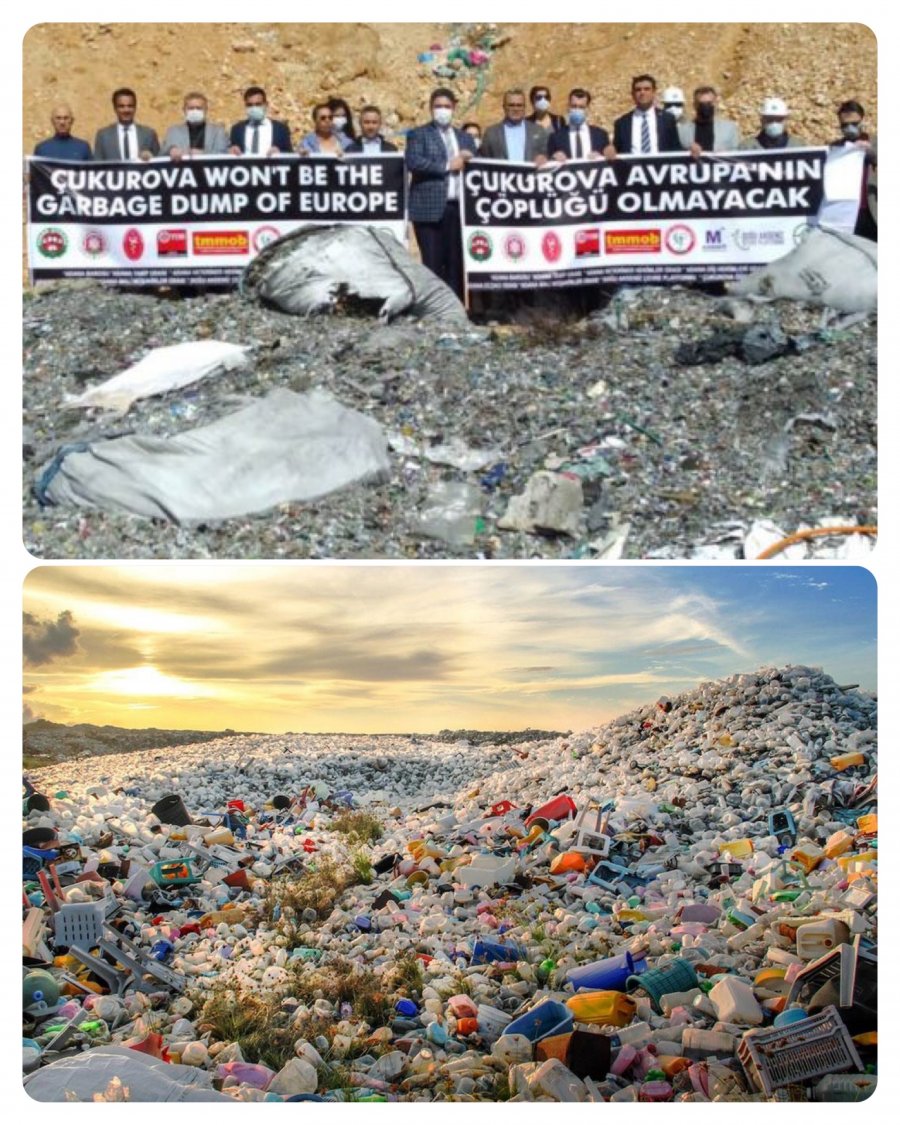
Here’s a video of İzzeddin Akman, a citrus grower from Adana, who says, “I send vitamins to Europe from here, and they send me garbage from there.”
According to Eurostat data, Turkey was the country that received the most garbage from EU countries in 2019, importing 11.4 million tons. The EU exported a total of 31 million tons of garbage, worth €13.4 billion (see: https://www.dw.com/tr/abden-en-%C3%A7ok-%C3%A7%C3%B6p-alan-%C3%BClke-t%C3%BCrkiye/a-53153246 ). I also recommend watching the news report on this topic prepared by DW Turkish:
I first learned about this issue thanks to a campaign launched by Greenpeace. I was among the first supporters (the first 700 members) of Greenpeace, which launched its activities in Turkey in the 1990s. Therefore, I am frequently informed about their campaigns and activities, and I wholeheartedly support them.
The data Greenpeace Akdeniz collected from the European Statistics Office (Eurostat) and the UK Office for National Statistics is as follows (details can be found at https://www.greenpeace.org/turkey/basin-bultenleri/turkiye-yine-avrupadan-en-cok-plastik-cop-alan-ulke-oldu /):
Turkey imported a total of 659,960 tons of plastic waste from European Union countries and the UK in 2020.
In 2019, the amount of plastic waste coming to Turkey from Europe was 582,296 tons. Plastic waste imports increased by 13% in one year.
Turkey remained the country that imported the most plastic waste from Europe in 2020. Türkiye accounted for 28% of European plastic waste exports.
Plastic waste imports have increased 196-fold in the last 16 years (since 2004).
The top five countries sending the most plastic waste to Turkey in 2020 were:
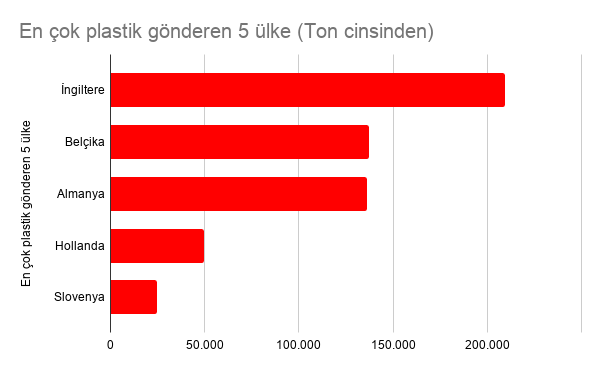
In full figures: UK (209,642), Belgium (137,071), Germany (136,083), Netherlands (49,496), and Slovenia (24,884).
Regarding Europe’s top plastic recipient countries, you can see the significant change in waste-receiving destinations from 2004 to the present day at the following Instagram link: https://www.instagram.com/p/Cccde-cM27g/?igshid=MDJmNzVkMjY=
Turkey’s rapid “rise”
Accordingly, after China, one of the world’s largest importers of plastic waste, banned its imports in 2017, Turkey became one of the largest importers. If you look at the annual waste import indicators above, you can see that Hong Kong and China did not lose their leadership to anyone until 2017 (Hong Kong is also under Chinese administration), but then they suddenly disappeared from the scene, and Turkey suddenly rose to first place as an alternative destination.
Let’s listen to the statement made in 2021 by Çiğdem Özkan, Greenpeace’s Mediterranean Communications Officer, who launched the “Don’t Let Turkey Become a Plastic Dump” campaign in 2020:
“As a result of our ‘Don’t Let Turkey Become a Plastic Dump’ campaign launched last year, the Ministry of Environment and Urbanization reduced the plastic waste import quota. We stated at the time that this step was welcome but insufficient. Based on the data and what we see in the field, we remain the largest plastic dump in Europe. In fact, the increase has continued since the quota was reduced. This demonstrates the need for tightened control mechanisms. Furthermore, the Minister of Environment and Urbanization stated in January that the goal is zero waste imports. We demand that the Ministry urgently fulfill this commitment, announce its action plan for the plastic waste import ban, and increase its control and transparency mechanisms.”
Greenpeace campaign
I would also like to share the short video Greenpeace prepared for their campaign here: Greenpeace Akdeniz – Türkiye – Türkiye çöplük olmasın | Facebook
I would also like to share the dire results of Greenpeace’s study, “Highly Detected Pollutants in Adana and the Diseases They Cause,” below:
Dioxin-Furans: Scientists found that the levels of dioxins and furans detected in Adana were the highest ever reported in Turkey—400,000 times higher than the control area. Dioxins and furans are known to be carcinogenic. These substances can be toxic to unborn babies, trigger tumors, and affect hormone and immune systems.
Polychlorinated Biphenyls (PCBs): In Adana, the total concentration of polychlorinated biphenyls (PCBs) in soil was found to be 30,000 times higher than the control sample. Exposure to PCBs can harm the embryo and fetus. PCBs, which can cause hormonal disruptions, can be passed from mother to baby through breastfeeding.
Metals and metalloids: Samples from Adana were examined for 18 different metals and metalloids, and levels of lead, known to be harmful to human health, were found to be 15 times higher than the control soil, and levels of cadmium, also a human carcinogen, were found to be 30 times higher than the control soil.
Polycyclic aromatic hydrocarbons (PAHs): High levels of chlorinated benzene compounds were detected in four of the five regions in Adana. Some of these can affect the blood, causing skin lesions and liver disease. Benzo(a)pyrene, a known human carcinogen, was detected in some regions above the permitted limit for residential soils in Turkey.
You can read the comprehensive report Greenpeace prepared two months ago at the link “Europe’s plastic waste is poisoning Turkey” – Greenpeace Mediterranean Turkey. You can also access their comprehensive report, “Waste Games,” from the link “Waste Games Report” – Google Drive.
I fully support Greenpeace. I ask my readers to support Greenpeace in this cause. You can visit http://www.coplukolmasin.org/ and sign their campaign. Turkey should not be Europe’s dumping ground. I recommend watching other campaign videos to understand the issue from different perspectives:
What needs to be done?
Let me share what needs to be done:
1) Europeans, as developed countries, need to process their waste within their own countries. Technology provides this capability sufficiently. Beyond separation, they need to engage in detailed recycling and, if necessary, dispose of it in a way that doesn’t harm the environment. This requires some significant investment. This is the responsibility of governments. They should bear the responsibility of their own countries and not send their waste to another country. Everything should be handled on-site.
2) I even go a step further than the idea that every country should process and utilize its own waste (recycle and dispose of what it can’t recycle). Beyond the country itself, waste management needs to be handled within a more micro-level system, in line with the logic of recycling. In other words, recycling should be handled within buildings (homes, offices, shopping malls, hospitals, etc.) or building groups (e.g., residential complexes, villages, towns, etc.) using distributed systems (on-site production, on-site consumption).
The Importance of Recycling
I can’t emphasize enough the importance of recycling. I’d like to highlight two key aspects:
1) Environment: The spread of waste materials, especially toxic substances and plastics, into nature in this way causes environmental disasters wherever they are disposed. This affects all living things: humans, animals, and plants. If this waste is recycled for a more livable world, we can prevent environmental disasters.
2) Economy: Recycled products create economic value and contribute significantly to the economy. After all, we live in a world where everything is limited. Recycling is also critical for the supply of raw materials. While we, or previous generations who lived in abundance, may not fully grasp the importance of this, future generations will seriously experience the problem of depleting raw materials. Therefore, every product produced must be recyclable. This principle must be made mandatory in business models through legislation.
A bag’s 3,200-kilometer journey
Let me explain what I mean with a more concrete example: An article in the US-based publication Bloomberg entitled, “A bag’s 3,200-kilometer journey reveals the complex truth about recycling” recounted the story of a shopping bag from a famous UK supermarket chain that reached Turkey. You can read the related article at https://www.sozcu.com.tr/2022/saglik/bir-alisveris-posetinin-londradan-adanaya-3200-kilometre-yolculugu-7041219/.
People need to completely change their consumption habits. First and foremost, single-use plastic bags need to be eliminated. Non-plastic bags, which are reused repeatedly, should also be made from recyclable materials. Instead of shipping waste from 3,200 km away, that waste should be processed and recycled in the UK, and any non-recyclable materials should be disposed of and rendered harmless to the environment. But this must be done in the UK, and even in the village, town, or neighborhood where the bag was dumped. Of course, the same applies to other European countries.
View point of Turkey needs to change.
Europe also needs to change its perspective on Turkey. They need to stop viewing Turkey as a dumping ground or a buffer zone for migrants. In other words, they need to stop viewing Turkey as a place where they can sweep away all their problems, benefit economically, and enjoy cheap holidays.
If they want to revitalize a powerful Europe, Europeans need a dynamic country like Turkey, located in the same geography and with significant potential in every respect. They can put prejudices aside, keep the center of technological development in Europe, and shift their production centers to Turkey instead of China. This would provide them with a significant economic advantage. By shifting its waste from China to Turkey, Europe can easily shift its production from China to Turkey.
We can also send our delicious, vitamin C-rich oranges, tangerines, and many other high-quality products from prominent Mediterranean destinations like Adana to Europe.
This is the model we want to see between Turkey and Europe. First and foremost, Europeans need to put us in the right place. If they see Turkey as a partner with whom they can create synergies through cultural, economic, and military collaborations, rather than as a country worthy of its waste, they will strengthen Europe in every way.
Bonus: You can watch Soltv’s documentary “Çöpova” below.
Tag: education