
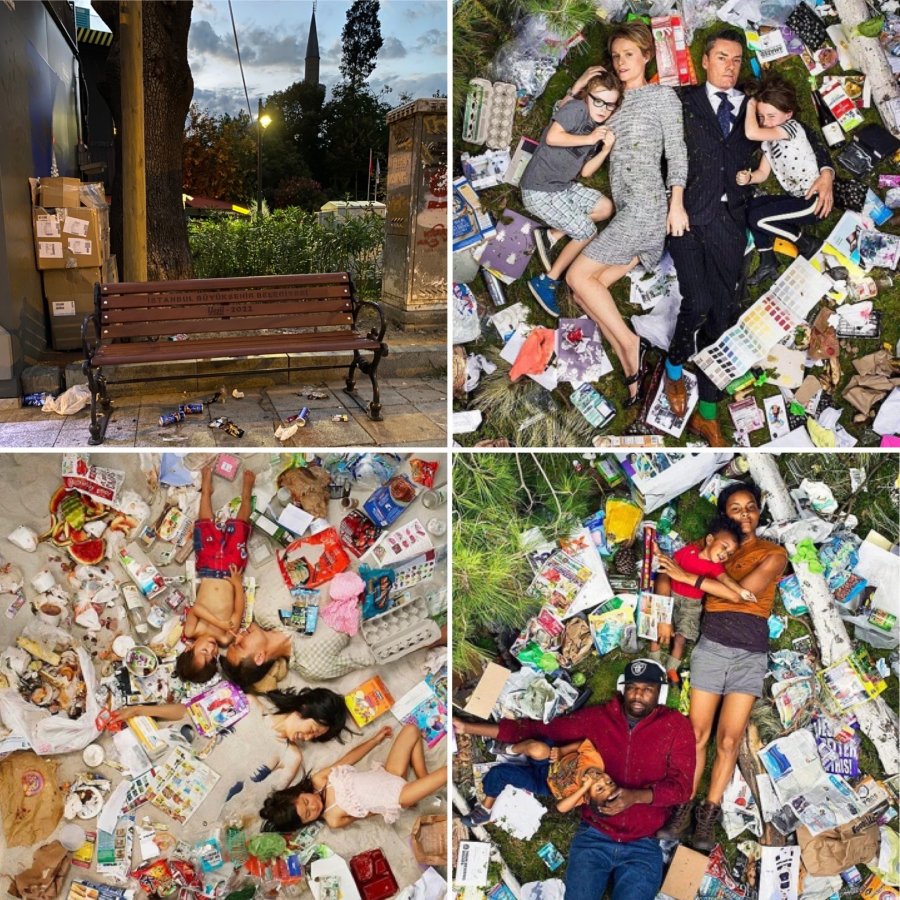
While jogging along the Bosphorus at 5 or 6 a.m., before dawn, I never fail to encounter litter strewn across the roads. We encounter all kinds of litter everywhere, whether on the roadside, on the road itself, on the sidewalk, in the grass—in fact, everywhere. Among this litter, you’ll find beer or iced coffee cans, glass drink bottles, plastic water or soda bottles, all sorts of bags and food waste, glass, plastic, cardboard boxes, burnt tires, and every other type of debris you can imagine.
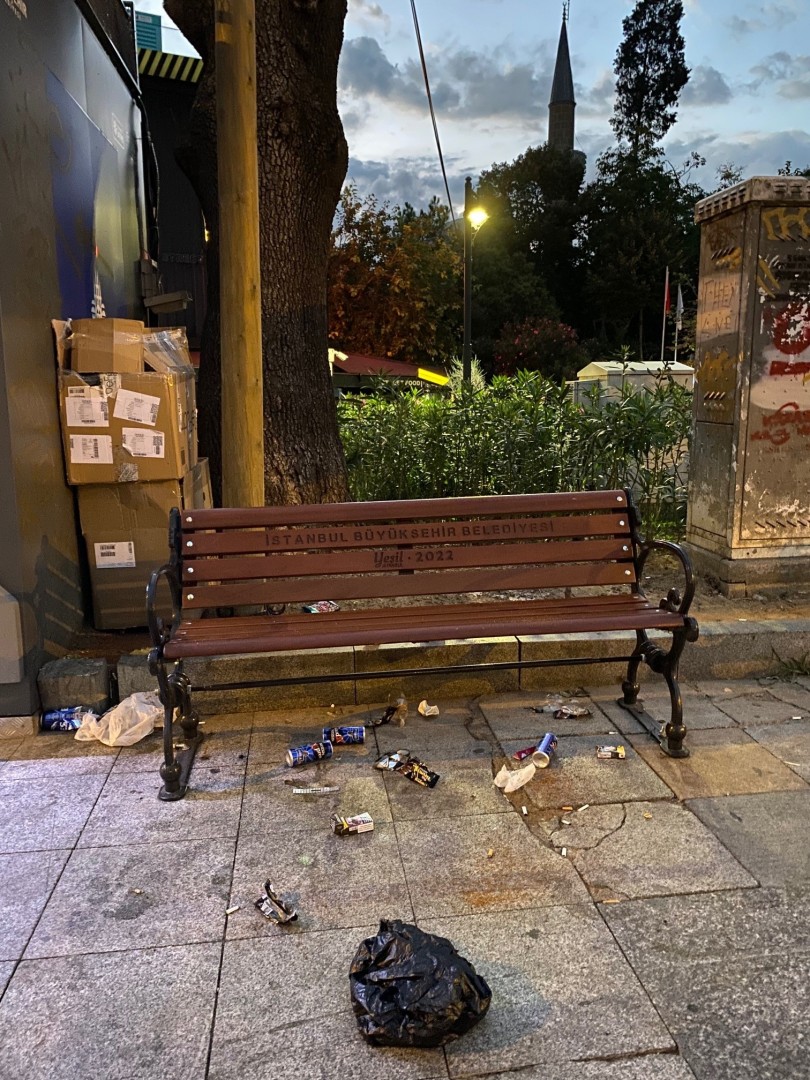
I’m sharing the above photo I took at the entrance to Bebek Park at 5:30 a.m. These scenes of garbage in Bebek, one of Istanbul’s most beautiful neighborhoods, are truly shameful.
When I encounter these scenes, I can’t help but wonder, “When did we become such a nation of indifference, hygiene-deficient, and empathy?” Later, when I read articles on this topic, I realize that this problem, with some exceptions, concerns the entire world. So, except for examples like the Scandinavian countries with advanced education and culture (I’m sharing the news that Sweden is running out of garbage: https://www.ntv.com.tr/turkiye/isvecin-copu-bitti,iq_62LVaOECOEIF3TvLOug ), similar problems are emerging almost everywhere in the world. People need to make a decision: Do we want to leave our children a huge garbage dump that’s getting worse every year due to climate change?
Confronting our seven-day garbage!
While planning to write an article about the garbage issue, I recently came across an article by Şeriban Alkış in my daily newsletter, ‘Kapsül.’ I’ll quote it verbatim:
“I think the hardest part about ordering takeout is trying to fit the waste into the trash after eating. The waste comes in packages so large that even the trash can, which doesn’t even fill with the waste from three meals I prepared, is insufficient. Pizza boxes, plastic containers, soda bottles, wet wipes, straws, plastic cutlery, layers of food wrapping paper and plastic bags… Another garbage bag opened to fit all of this… These bags, which we tie up and throw away to join the other 2.12 billion tons of garbage in the world, should surprise us.
Yet, the consumer culture in our cities has normalized our relationship with waste. Behind this normalization lies the defense, ‘Yes, but the system is like this, there’s not much I can do.’ The waste problem is so vast and the climate crisis so deep that people can feel powerless to do anything.
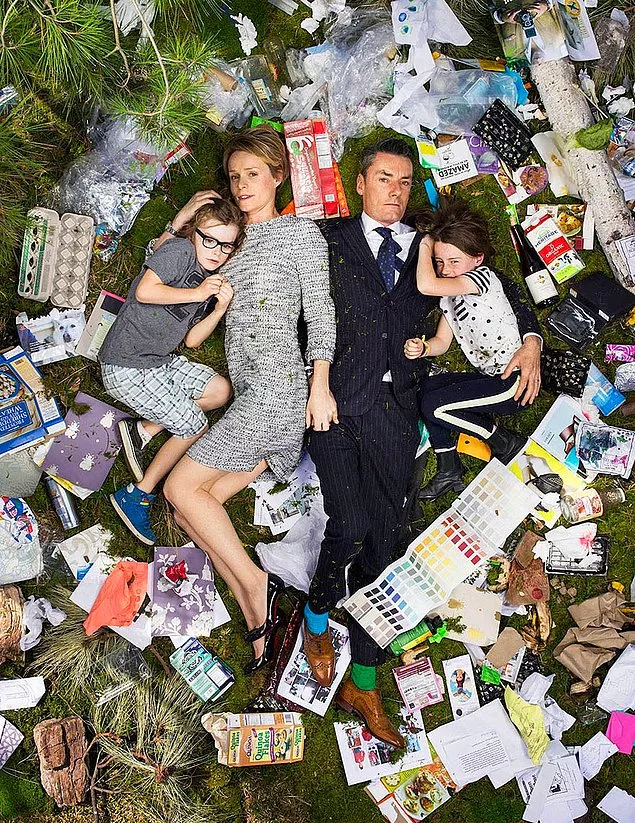
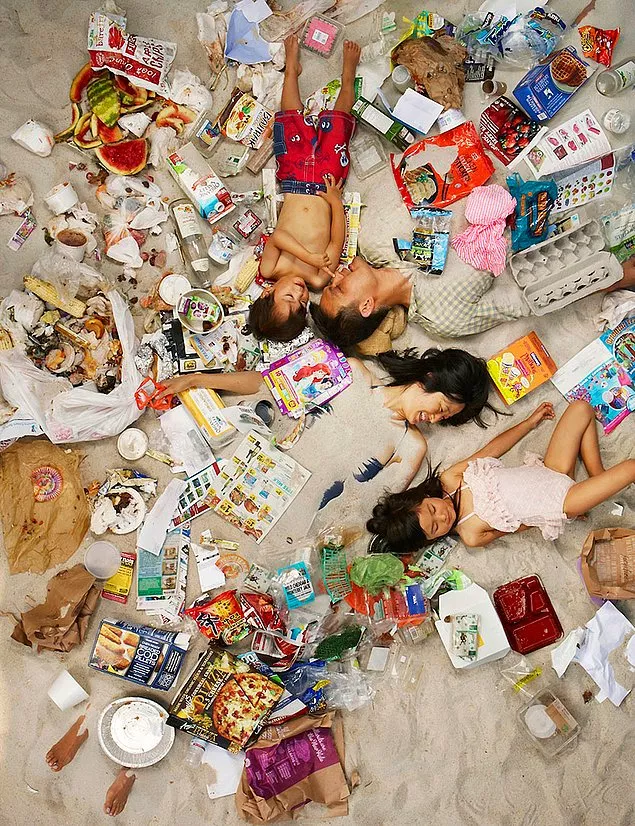
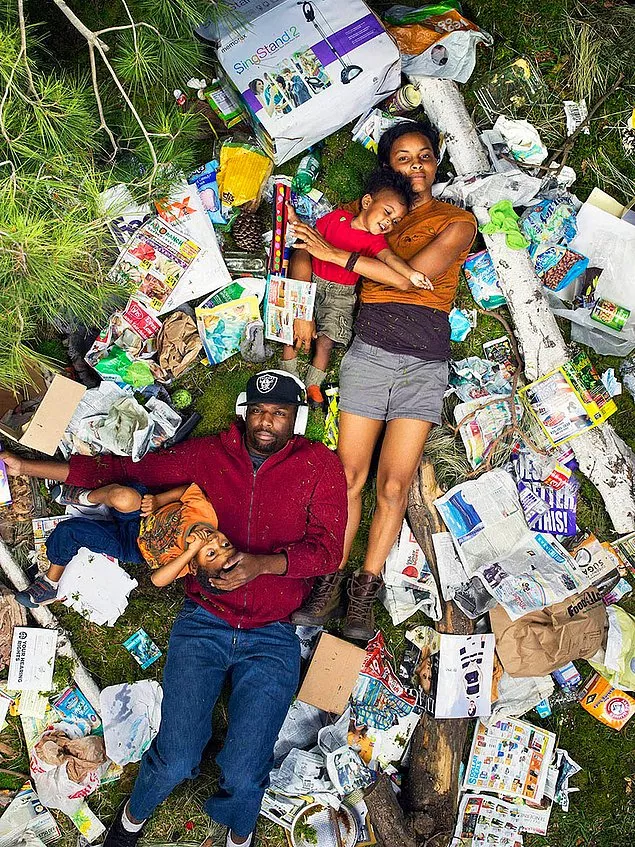
Photographer Gregg Segal, even if he’s an individual, is addressing this global problem. He believes something can be done. To this end, he launched the “Seven Days of Garbage” project, a collection of 11 photographs to illustrate the importance of waste in our lives: “We are both victims and perpetrators of the waste problem. I wanted to take these photographs to counter those who ignore the individual aspect of the consumption and waste problem.”
Segal asked individuals and families, including his relatives, to collect their trash for a week. He photographed the accumulated trash and the people in the natural settings he created in his backyard in California, USA. Segal says that convincing people to collect their trash is as difficult as asking them to carry it home. He even had someone wash and clean their trash before bringing it back.
Segal says that the people who had been lying and posing among the trash they had collected for a week were a little surprised when the trash was immediately thrown away after the photo shoot. “Normally, we don’t think about it; we don’t even realize how much trash we’ve created. We use it for just a moment, and then it’s garbage. Out of sight, out of mind. It’s thrown away, and it’s not your problem anymore.” Homes are the first places we encounter waste and judging by the garbage we produce in just one week, it’s no wonder that plastic, which was unheard of 100 years ago, now blankets the world.
You can find thought-provoking photos and explanations of the project at https://onedio.com/haber/kendi-coplerinde-bogulan-insanlarin-sok-eden-goruntuleri-505678 . To help you visualize this, I’m sharing three family photos taken during this project below:
Garbage Should First Be Eliminated “On-Site”
The key to eliminating waste globally and achieving a sustainable recycling is to dispose of it ”on-site.” In other words, all homes must immediately address waste wherever it’s collected.
First and foremost, the primary goal is to reduce waste generation. For example, instead of constantly buying glass and plastic bottles for products like water, soda, and milk, we should bring our own glass and plastic bottles and refill them. This way, you can proactively prevent the glass and plastic bottles that come with liquid products and are produced each time from becoming waste. This is just one example. Supermarket refill stations can be used for a wide variety of products. We could cite thousands of examples, such as honey, jam, fruit juice, cereal, and liquid soap. Manufacturers and retailers need to be smart and embrace these models, which will significantly contribute to the fight against climate change. This also translates to significant savings for all manufacturers.
The same logic can be applied to different business models, as well as retailers. Let me give you an example to illustrate: A pizza delivery service might offer a discount on the product if an empty pizza box from the same company is provided. This way, pizza boxes from the same company can be collected at the pizzeria for recycling. Similarly, every fast-moving consumer goods company could develop its own model. The initial goal is to minimize waste.
Recyclable products like glass, metal, plastic, and paper should be processed in homes, buildings, residential complexes, villages, or, at the largest scale, neighborhoods. For example, imagine a household with plastic bottles, and a mechanism that would immediately accept and accept them, even melting them down and converting them into raw materials if necessary. Furthermore, those who donate these bottles would be compensated with cash or an equivalent. This would then lead all families to generate income from their own waste and voluntarily do the right thing.
In other words, products like plastic, glass, metal, and paper would be given to a recycling mechanism, and organic waste would be fertilized using composting principles. This would create both economic value and be a significant step toward maintaining ecological balance.
I believe such a system will be established in the future.
Education alone is not enough.
As someone who has previously undertaken numerous projects through TİDER (Turkish Industrialists’ Association) on waste prevention and waste disposal, I can contribute to the necessary steps in this sector. When I talk about what needs to be done, it definitely doesn’t work simply by trying to educate people. Because even the most educated and informed can be extremely ignorant about waste. It may take generations to educate those people, and the results may be limited. Instead, we can solve the garbage problem as quickly as possible by ensuring that people who contribute to recycling benefit from it.
My priority work in the field of sustainability is currently ongoing. However, I can also initiate this “on-site recycling” movement to prevent the seas and land from being covered with garbage and to prevent climate change. Let me make a note of this now.
My videos and articles on the subject.
For now, let me share two videos of my past projects through TİDER, which I founded:
A video about TİDER’s campaign to collect, separate, and recycle garbage during the Bozcaada Run: https://www.youtube.com/watch?v=E5cOP9FgF4Y
Similarly, here’s a video of a similar event organized by TİDER during the Cunda Triathlon: https://www.youtube.com/watch?v=KSo8ZBHLheY
And a video of the activity in Bozburun, the first step of a campaign planned by Ukrainian Polina to collect garbage in Turkey, which I recently came across: https://youtu.be/t6PZwSL8zEo
Finally, I’d like to remind you of some of my past blog posts on the subject of garbage:
The “Turkey is Europe’s Garbage Dump” mentality: https://www.serhansuzer.com/tr/avrupanin-coplugu-turkiye-zihniyeti
The COP26 Summit and its implications for our future: https://www.serhansuzer.com/tr/cop26-zirvesi-ve-gelecegimize-dair-dusundurdukleri
TİDER prevented waste in Bozcaada and launched a campaign for 115 families: https://www.serhansuzer.com/tr/tider-bozcaadada-hem-israfi-onledi-hem-de-115-aile-icin-kampanya-baslatti
The Cunda Triathlon after a year: https://www.serhansuzer.com/tr/bir-yilin-ardindan-cunda-triatlonu
An ideal model for combating poverty: The Support Project: https://www.serhansuzer.com/tr/yoksullukla-mucadelede-ideal-bir-model-destek-projesi
Action must be taken for “on-site recycling”
Technology support is essential to ensure waste elimination in all countries and, most importantly, to ensure that every piece of discarded waste has economic value. Since these technologies are currently unavailable, especially at the micro-scale, we will manage with education, awareness-raising, and effectively operating centralized systems for now. Meanwhile, we can also utilize technology in centralized systems. For instance, in countries with no tradition of sorting or simply unable to do so, we can use artificial intelligence to separate collected waste and turn it into economic value. I’m talking about robotic systems that select and separate products like glass, metal, plastic, and paper, and then collect organic waste elsewhere, similar to an on-site recycling model. This sorting is certainly happening on a certain scale, but its effectiveness needs to be questioned. Therefore, we still expect people to do this sorting manually. Even with the tremendous efforts of those who have made a career out of collecting metal, plastic, and glass with wheeled garbage sacks, and despite municipalities installing sorting bins throughout the city, the results are insufficient. Therefore, the effective use and continuous development of technology in centralized systems is crucial.
These developed technologies must also be scaled down to the micro-scale in the future. Because when the “on-site recycling” movement begins soon, the landscape will change. Only then will we prevent the pollution of our environment, a source of shame for humanity, and ensure that waste acquires economic value. Better days for solving the garbage problem are not imminent, but they are near. I believe this problem will cease to exist within the next 10 years. Of course, if we can start the necessary work within the next 3-5 years.
Tag: education