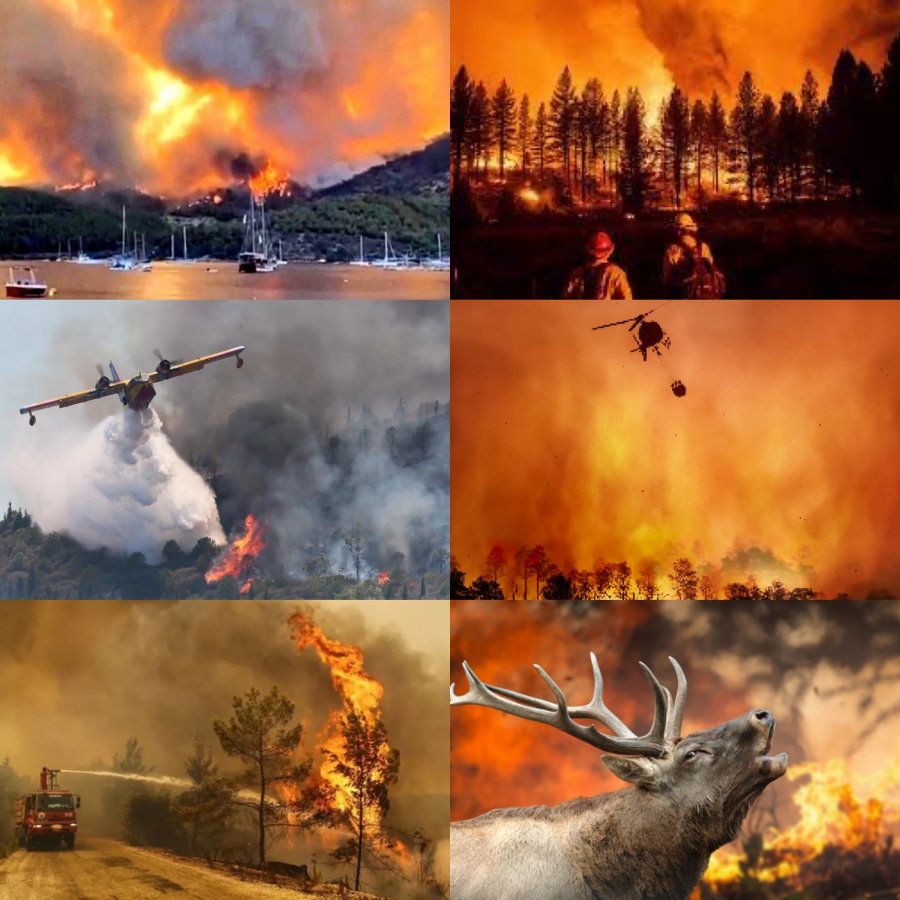
A few years ago, after working on the firefighting efforts in Köyceğiz, I remember visiting and speaking with the General Directorate of Forestry (OGM) in our region. My goal was to train our wind power plant (WPP) personnel in the Kandıra district of Kocaeli as First Response Teams. If a fire broke out in the forest where our WPP was located, we would be the first to intervene and prevent a major fire or extinguish it completely before the fire department or OGM teams could reach the site. I remember speaking to the OGM regional directorate, “Educate us and guide us on the equipment we need to purchase.” That project hasn’t materialized yet, but my passion for protecting and even increasing our forests remains unchanged.
First of all, I’m sharing the Good4Trust article, which you can read at https://blog.good4trust.org/2023/11/15/orman-yanginlarina-karsi-neler-yapabilir/ , verbatim, without any alterations. I’ll add my own comments later:
Because forest fires are considered natural disasters, it’s sometimes thought there’s no way to prevent them. However, most forest fires occur due to human-caused causes. Even naturally occurring forest fires can be prevented with the precautions we take or at least slow their spread.
Today, the leading mistake made in fighting forest fires is investing in firefighting, not prevention. However, we can take measures to prevent the spread of fires at a much lower cost than purchasing or renting helicopters for firefighting. Of course, the most important precaution we can take is to raise awareness among both villagers and those who produce near forests.
What precautions can be taken against forest fires?
There’s a significant relationship between the location of agricultural lands and forest fires in our country. Therefore, educating those who farm near forests about forest fires and fire prevention measures has become crucial. However, we can’t say that the Ministry of Forestry in our country provides much training for farmers about fire. However, if a farmer causes a fire, they can be held accountable.
One of the most important things for those who own agricultural land near forests is to maintain a distance between the agricultural land and the forest. To achieve this, a minimum of 2 meters of space should be maintained between agricultural land and forest land, and the field should be plowed at a distance two plows wide.
Stubble burns very easily after harvesting. To prevent stubble fires from spreading into the forest, adding another plow after harvesting can be a solution. If the distance between the field and the forest is maintained, stubble fires, already known as low-energy fires, can be easily extinguished before they reach the forest.
The design of residences located within or adjacent to forests also requires careful consideration when it comes to forest fires. Careful planning should be made regarding the placement of fuelwood, the materials used for roofing, the distance between surrounding houses, and the presence of firefighting plans. Without necessary precautions, even a small fire can quickly spread into the forest.
In olive-growing lands, converting a portion of the field into a vineyard or planting fig trees can also contribute to easier control of potential fires. Carob trees, often blamed for starting fires, pose no danger when managed properly. As they age, carob trees dry out and become more susceptible to fire. However, by pruning the trees every five years to replace them with new shoots, the risk of fire can be reduced, as older trees are more difficult to burn.
When developing a firefighting plan, regional characteristics must be examined and a plan specific to that region developed. Due to the numerous variables such as vegetation, mountain range, altitude, and wind direction, trying to formulate a single formula for all of Turkey is unfortunately insufficient to achieve the desired effect. Using native plants appropriate to the region’s characteristics is also crucial in firefighting. A list of fire-resistant plants appropriate to the region’s characteristics can be utilized in this process.
Misconceptions about forest fires
When forest fires occur, forest villagers and farmers are often blamed. However, forest villagers learn from their ancestors how to protect the forest because forests are their primary source of income. Similarly, nomads, whose numbers are decreasing today, are also engaging in activities that prevent fires from starting. It is said that goats cause fires. However, goats, with their natural feeding habits, reduce the amount of flammable material in the forest. This, of course, occurs during planned grazing.
However, the number of forest villagers and nomads in our country has rapidly decreased due to the migration to cities and modernization. People have forgotten the knowledge inherited from their ancestors about protecting the forest. When they began to face economic hardship, they burned pinecones to stay warm. Many people found it easy to blame these people instead of providing them with opportunities to prevent this situation.
In recent years, we’ve seen restrictions on entering the forests at certain times. Banning people from entering the forest isn’t a solution to the risk of forest fires. Instead, encouraging people to enjoy and spend time in the forests is a constructive approach that can create a butterfly effect.
What can we do as individuals to combat the fire risk?
One of the most important steps we can take as individuals is to strive for accurate information and to question all information, regardless of who is reporting it. Then, we can take simple actions we know to be accurate.
Even if it’s just three or five people, we can gather and go to the Regional Forestry Directorate or the Operations Directorate and request permission for simple actions. While we’re likely to be rejected the first time, we can’t achieve results without putting in the effort. For example, we could request permission to collect flammable materials from the roadside and remove them from the system. This could spark a movement, and this could help clear the entire region of flammables.
In regions with high fire potential, we can organize awareness campaigns in groups with slogan-themed t-shirts or banners.
If we smoke, we can be mindful of where we toss our butts.
There are many precautions we can take at the individual or community level to prevent forest fires. If we live or produce in a forested area, we should be aware of the conditions and risks of forest fires and take the necessary precautions. Just as in an earthquake, taking precautions in a fire early on is much more beneficial than trying to extinguish it after it starts.
Note: This article was prepared based on the webinar conducted by Prof. Dr. Tunca Neyişçi on 25 October 2023, as part of the Fire-Resistant Production Models Project. You can read our first blog post about the webinar here and watch the full webinar below.
https://www.youtube.com/watch?v=qTQfMzTrnjQ
Prof. Dr. About Tuncay Neyişçi: After completing his pre-university education in Izmir, he entered Istanbul University’s Faculty of Forestry, graduating in 1972. He prepared his doctorate in Fire Ecology. He then taught various courses at the Western Mediterranean Forestry Research Directorate and at Akdeniz University. Between 1998 and 2008, he served as the national coordinator of UNESCO’s SEMEP (Southeast Mediterranean Environment Project). He currently serves as a board member of this association. He has published and spoken on various measures against forest fires.
My own additions
I have some things to add to these insightful comments and the related blog post by Prof. Dr. Tuncay Neyişçi. When we went to extinguish the fire in Köyceğiz three years ago, the main cause of forest fires was still being debated. Some claimed it was human caused, while others emphasized that it was caused by climate change. Ultimately, both are factors. However, I believe we can prevent human-caused fires. I have more radical views on this matter. Ultimately, climate change is a contributing factor, but the initial spark that causes forest fires is largely caused by humans. In my opinion, the way to prevent this is through education, but until that culture and awareness are developed, the following sanctions must be implemented (and if we started rigorous education today, it would take one or two generations for this to change):
1) People need to be banned from smoking in the forest.
2) Barbecues need to be banned.
3) Littering needs to be banned. Glass waste, in particular, poses a serious risk.
4) Those who start fires for profit should be caught and given life sentences.
5) We need to utilize technology to the fullest. Drones, night-vision infrared cameras, the installation of fire extinguishers (automatic systems) at regular intervals, satellite surveillance outside observation towers, and so on—nothing should be spared.
6) Beyond punishing people, we need to educate and empower forest villagers, ensuring they can earn a good income if they take good care of their forests.
7) Aircraft and helicopters should be purchased to respond immediately to every forest area in the event of a fire, and they should be kept on alert in the regions.
My previous fire-related articles
I’ve been pondering the topic of fires for a long time. I’ve written many articles about fires both here and abroad. I’m sharing them below as a reminder:
The nightmare of fires starting again and early: https://www.serhansuzer.com/tr/yeniden-ve-erken-baslayan-yangin-kbusu
The birth of the forest fire fighting platform: https://www.serhansuzer.com/tr/orman-yanginlariyla-mucadele-platformunun-dogusu-
Thoughts forest fire disasters evoke: https://www.serhansuzer.com/tr/orman-yangini-felaketlerinin-dusundurdukleri
The fires in Australia call the world to action: https://www.serhansuzer.com/tr/avustralyadaki-yangin-dunyayi-goreve-cagiriyor
The greed behind the disaster in our neighbor: https://www.serhansuzer.com/tr/komsudaki-felaketin-ardinda-yatan-acgozluluk
I hope many of the recommendations in this article are implemented, or at least we will proactively prevent future major fires. May God always be with all our citizens living in the forest, forest engineers, those whose expertise is forestry, those working professionally in forests, and our government. May we not suffer serious forest losses in our lifetimes and in future generations.
Tag: education