FIFA, or Fédération Internationale de Soccer Association (French: Fédération Internationale de Soccer Association), is the world’s highest-level governing body for soccer and futsal. Founded in Paris on 21 May 1904, the organization is headquartered in Zurich, Switzerland, and is chaired by Swiss national Gianni Infantino. With 211 national soccer associations as members, FIFA not only organizes various soccer tournaments but also governs, implements, and modifies the rules of world soccer. Its most important tournament is the FIFA World Cup, held since 1930 (see: https://tr.wikipedia.org/wiki/FIFA ).
The tournament, currently being held in Qatar, is the 22nd World Cup. Brazil, the only team to have participated in every tournament, is the most successful team with five titles. Italy and Germany have each won four; Argentina, France, and Uruguay have two; and England and Spain have one title each. The reigning champions are France, who took home the trophy in the 2018 tournament.
“FIFA’s Inner Inside”
Let’s move on to the topic of hosting the World Cup in Qatar, the subject of this article. First, let’s take a deeper look at FIFA itself. Founded in 1904, this non-governmental organization, which shapes soccer, has had only nine presidents since its inception. FIFA’s presidency has been held three times by Englishmen, twice by Frenchmen, and once each by Belgians, Swiss, Brazilians, and Italians. Below is a list of FIFA’s presidents:
| № | Name | Start of Term | End of Term |
| 1 | Robert Guérin | 22 May 1904 | 4 June 1906 |
| 2 | Daniel Burley Woolfall | 4 June 1906 | 24 October 1908 |
| 3 | Jules Rimet | 1921 | 1954 |
| 4 | Rodolphe Seeldrayers | 1954 | 7 October 1955 |
| 5 | Arthur Drewry | 1955 | 25 March 1961 |
| 6 | Stanley Rous | 1961 | 8 May 1974 |
| 7 | João Havelange | 8 May 1974 | 8 June 1998 |
| 8 | Joseph Sepp Blatter | 8 June 1998 | 8 October 2015 |
| – | Issa Hayatou (proxy) | 8 October 2015 | 26 February 2016 |
| 9 | Gianni Infantino | 26 February 2016 | To Date |
At this stage, I highly recommend watching the documentary series FIFA Uncovered (FIFA Insider) on Netflix. The information I’m about to share with you about FIFA is largely based on what I watched in this documentary. I’m sharing the trailer for the documentary below:
To understand the events at FIFA, you need to consider the transformation within FIFA since João Havelange. Previously struggling with extremely modest budgets and aiming solely to develop soccer globally, FIFA broke out of its shell to launch high-budget, high-profile events, and the industrialization of soccer occurred during Havelange’s time. During that time, Havelange began working with Sepp Blatter as a senior advisor to increase its cash flow. Blatter, in his role, secured FIFA’s first major sponsorship deal with Coca-Cola. Later, other major international companies, following Coca-Cola’s lead, began vying to sponsor FIFA, particularly its biggest tournament, the World Cup. Sepp Blatter, having fulfilled his duty and ushered FIFA into a new era, was appointed General Secretary in 1981 under Havelange’s presidency.
Criticisms During the Havelange Era
Under Havelange’s presidency and Sepp Blatter’s general secretaryship, FIFA continued to improve and achieved success for 17 years, until Sepp Blatter was elected president. However, there are two issues that have drawn significant criticism of FIFA during this period:
1) Corruption: Through the close collaboration of Adidas founder and owner Adolf Dassler with Havelange, Adidas established a company called “International Sport & Leisure.” This company took over all of FIFA’s sponsorship activities. International Sport & Leisure, which now commands a significant financial flow, assumed control of FIFA’s flowing water. While this situation occasionally sparked dissenting opinions within FIFA, such as, “Why did we outsource FIFA’s entire future to a company?,” this system persisted for many years.
2) Becoming a tournament for dictators: FIFA has been criticized for supporting dictators who use the World Cup, the world’s most popular sports tournament, to legitimize their actions and boost their popularity. For example, following the 24 March 1976 coup, the bloodiest and last of six military coups in Argentina in the 20th century, known as the “period of state terror” and the “dirty war period,” the holding of the World Cup in Argentina in 1978 drew considerable criticism. During the period of civil-military dictatorship known as the “National Reconstruction Process,” which lasted from 1976 to 1983, the country was ruled by a military junta consisting of Jorge Rafael Videla, Roberto Eduardo Viola, Leopoldo Fortunato Galtieri, and Reynaldo Benito Bignone, who staged a coup against Martinez de Peron. Despite everything, FIFA, which had consistently maintained its momentum until the 2010 World Cup in South Africa, announced the results of the bidding for two tournaments in the same year. Meanwhile, the money South Africa had sent to some FIFA members to develop soccer was also the subject of serious criticism. In 2015, controversy flared when the 2018 World Cup was awarded to Russia, while this year’s trophy was awarded to Qatar. It was alleged that Russia and Qatar, whose governance was deemed undemocratic by millions, just as Argentina, under junta rule in 1978, were being awarded the World Cup, were simply whitewashing their actions with this popular tournament.
The Shady Blatter and the Nonsensical Infantino
At the center of all these controversies was FIFA President Sepp Blatter. After being elected FIFA President on 8 June 1998, succeeding João Havelange, Blatter was re-elected in 2002, 2007, 2011, and 2015, remaining in office for five terms despite all the criticism. Meanwhile, the documentary “Inside FIFA” depicts Blatter’s transition from general secretary to president as follows: Sepp Blatter, having uncovered the incumbent president’s corruption and used it as blackmail, told then-president João Havelange, “Leave with honor, and I will ensure that the payments from this Adidas company of yours remain undisclosed. Let’s organize a transition period, and then support me as president,” thus securing Havelange’s support. However, during his final term, the level of criticism and accusations, particularly with FIFA members being detained after the FBI’s intervention, intensified to such an extent that the ethics committee he himself created imposed an eight-year suspension on him from soccer. Before he could fully complete his final term, in 2015, the year he won his last election, he was temporarily replaced by Issa Hayatou of Cameroon, the President of the Confederation of African Soccer, whom he had defeated in the 2002 elections. Issa Hayatou held this position temporarily until 2016 and was replaced by current FIFA president Gianni Infantino in the next elections.
Infantino, who has been president of UEFA, the governing body of European soccer, instead of admitting that past actions were wrong, instead delivered a passionate defense of Qatar in a nearly hour-long press conference in Doha. However, even Infantino’s successor, Blatter, has recently admitted that awarding the World Cup to Qatar was a mistake: Former FIFA President Blatter: Awarding the World Cup to Qatar was a mistake – BBC News Turkish
Let’s turn to the criticisms and allegations leveled against Qatar:
1) It won the tournament by bribery
One of the criticisms leveled against Qatar was that while the voting for the next World Cup winner normally determines the next World Cup winner, the 2015 World Cup was decided by two consecutive World Cups. Consequently, after the announcement that the 2018 World Cup was awarded to Russia and the 2022 World Cup to Qatar, Swiss prosecutors and the US Department of Justice launched corruption investigations.
Qatar denied any allegations of corruption, and FIFA concluded in 2017 that there was no obstacle to Qatar hosting the World Cup following its own investigation.
Supporters of the decision argued that hosting such international sporting events in societies under pressure from various segments of society would be a positive force for development and change in these countries.
Frankly, I advocate that the World Cup should be awarded as a reward. Because awarding the World Cup to struggling countries legitimizes their governance rather than improving them. Certain criteria must be established. For example, for a country to win the World Cup:
a) The country’s president must not have served more than two terms in office.
b) It must be among the top 50 countries in terms of human rights.
c) The entire world should be divided into four regions, and each year, the event should be awarded to one of these regions.
i) Europe and countries with physical territory in Europe (Turkey, Russia, etc.)
ii) Asia and countries in the Pacific Ocean (such as Australia and New Zealand)
iii) The Americas (North, Central, and South America)
iv) Africa and surrounding island nations
For instance, after a country or countries in Europe are granted the right to compete in the World Cup, the World Cup can return to Europe only after countries in the other three regions qualify. This means that one full round must be completed each time.
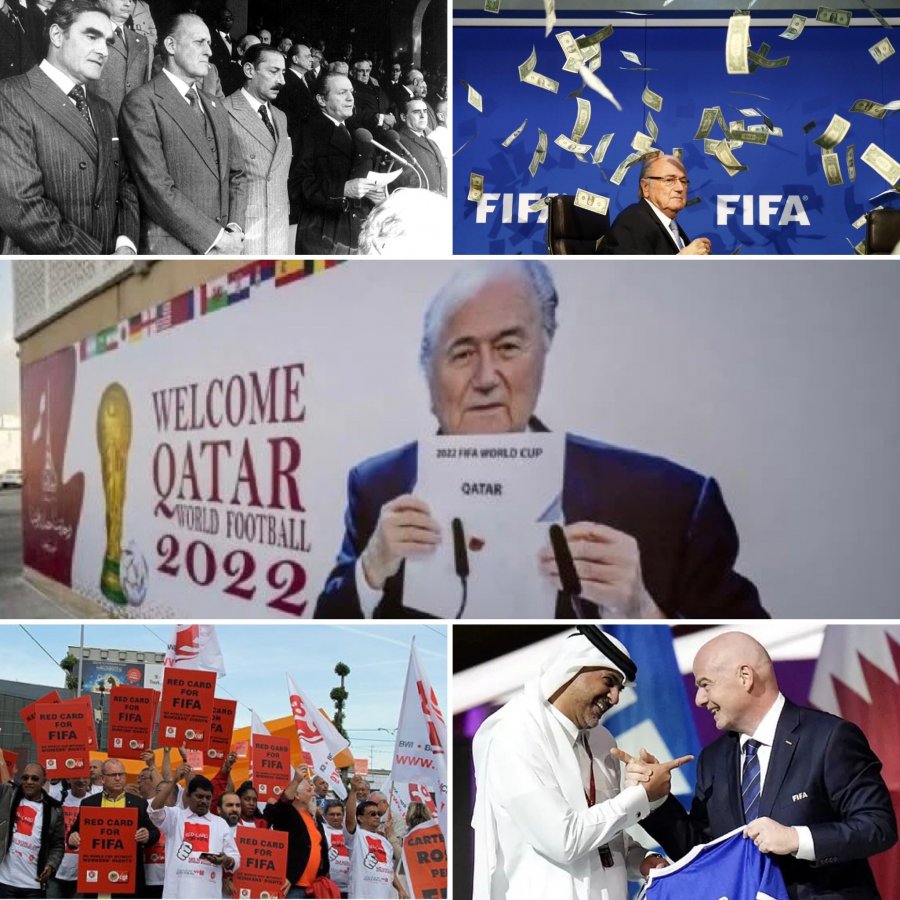
Meanwhile, some FIFA members were proven to have taken bribes and were imprisoned. Contrary to everyone’s expectations, Sepp Blatter’s bribery was not proven, and the cases against him were dropped. In other words, it was revealed that President Sepp Blatter did not take bribes, but decision-making members did. From this, we can conclude that Sepp Blatter is partially guilty of failing to prevent corruption in an institution he chaired. However, his position is questionable because he did not directly accept bribes. Still, Blatter is also at fault in the public eye, which has occasionally led to very violent protests. Here’s the protest against the bribery paid at FIFA after the World Cup was awarded to Qatar in 2022:
2) Problems related to Qatar’s geographical location
Criticisms are being raised: “How can such a large-scale event be held in such a small country?” The World Cup, normally held in a large country or divided among several countries, is being criticized for being held in a very small Middle Eastern country with a surface area of 11,571 km². It would have been more appropriate to share this large event rather than hosting millions of people in such a small area. For example, it would have been logical to include the United Arab Emirates and Bahrain in the tournament instead of holding it solely in Qatar.
3) The organization’s impact on climate change
The fact that Qatar, with its desert climate, is investing so much in the World Cup, while lacking any proper infrastructure, brings with it criticism that it is fueling climate change. Constructing high-density construction, constructing glass buildings and concrete structures, and building infrastructure in a small, desert-like area further exacerbates summer temperatures that can reach 50 degrees Celsius, making the region even more uninhabitable, especially during the summer months.
4) Changing the World Cup Date for Qatar
Rescheduling the World Cup, which traditionally begins in June and ends in early July, to begin in November and end in December in Qatar seems utterly absurd. Of course, we all understand why this is being done. Organizing a healthy tournament in summer temperatures reaching 50 degrees Celsius is impossible. However, another valid reason for not holding the tournament in Qatar is the refusal to change the date. The World Cup, held every four years in the same season, is a physical impossibility for a place like Qatar. Even if it were held in the southern hemisphere, it would be during the winter months, and no one would object. The June start date shouldn’t have been changed because the leagues and European cups (or tournaments on other continents) that were in full swing were consequently given a pointless pause, giving some teams an advantage and others a disadvantage. However, the classic logic of “when tournaments held in all countries end, the World Cup begins” was the most appropriate way to organize.
5) Violation of workers’ rights
While discussing the massive construction effort in such a small area, attempting to carry out such intensive construction with inexperienced workers brought from underdeveloped countries like India, Pakistan, Bangladesh, and the Philippines, and the allegations that thousands of workers lost their lives during construction, have led to serious criticism of Qatar regarding workers’ rights. Qatar’s claim is that the number of workers killed is in the tens, not the thousands.
The Guardian newspaper reported in February that 6,500 migrant workers have lost their lives since Qatar was announced as the World Cup host. This figure was obtained from countries with embassies in Qatar. The Qatari Government maintains that this number is misleading and that not all the deaths were from workers working on construction sites for the World Cup.
What good would it be if it weren’t for the World Cup? The fact that 6,500 migrant workers lost their lives in Qatar in a short period of time already tells you something about the conditions there. Shame on you.
6) Violation of LGBT rights
Homosexual relations and promoting them are illegal in Qatar. Those suspected of engaging in or encouraging homosexual relations face penalties ranging from fines to death. Despite this, World Cup officials stated that anyone who wants to watch the games is welcome and that there will be no discrimination against anyone. All LGBT rights advocates and many opinion leaders are criticizing and even protesting the hesitation of gay people to attend the World Cup, one of the world’s most popular tournaments.
Here’s an example. A British comedian went viral for apparently shredding £10,000 in shreds to protest David Beckham’s role as Qatar’s World Cup ambassador, given Qatar’s repressive record on LGBTQ+ and human rights. However, in a follow-up video, comedian Joe Lycett admitted the shredded bills were fake. “The money that went into the shredder was real, but the money that came out was fake. I would never destroy real money. I would never be that irresponsible. In fact, before I even pressed send on the first tweet last week, £10,000 had already been donated to LGBTQ+ charities. I never expected to hear from you (meaning Beckham), it was a false threat designed to get people to speak out,” Lycett said. At the end of the video, he handed a photo of David Beckham from a gay magazine cover to the shredder (see: https://www.instagram.com/reel/ClPneTwhOXW/?igshid=MDJmNzVkMjY%3D).
7) Alcohol bans
In Qatar, drinking in stadiums was banned. This also sparked criticism. While I personally consider this decision a positive measure in preventing crowds of spectators drinking and lashing out, I’d like to remind you that tournaments held in Western countries don’t have such bans, and they maintain order through other means, such as increased security. Meanwhile, the famous beer company Budweiser announced that it would donate all the beer it couldn’t sell at the World Cup to the winning country: https://www.instagram.com/p/ClUZU2Lr5DF/?igshid=MDJmNzVkMjY
Let’s summarize all this criticism in an Aposto article: https://www.instagram.com/reel/ClIspJeKtp6/?igshid=MDJmNzVkMjY
Now, let’s talk about how FIFA President Infantino handled all this backlash. According to the news you can read at https://www.bbc.com/turkce/articles/cmlkekw1kx2o , Infantino went so far in his defense of FIFA’s Qatar decision that he began his speech with the words, “I feel strongly today. Today, I feel Qatari, I feel Arab, I feel gay, I feel disabled, I feel like a migrant worker.”
Emphasizing that he was speaking for European and Western countries, Infantino also took a jab at himself, saying, “Before we lecture, we must apologize for what we have done in the past 3,000 years and what we will do in the next 3,000 years.”
Punchable lessons from Infantino
Here are excerpts from Infantino’s press conference, which lasted nearly an hour:
“If Europe truly cares about the fate of these migrants, it will open legal avenues, as Qatar has, to allow these people to come to Europe to work. It will provide them with a future and some hope.”
“I struggle to understand the criticism. We all need to educate ourselves. Many things are not perfect, but change takes time.” “This one-sided moralizing is pure hypocrisy. I don’t understand why no one wants to see the progress that has been made here since 2016.”
“It’s not easy to accept criticism for a decision made 12 years ago. Qatar is ready, and this will be the best World Cup yet.”
“I don’t have to defend Qatar. They can defend themselves. I defend soccer. Qatar has made progress in many areas.”
“Of course, I’m not Qatari, I’m not Arab, I’m not African, I’m not gay, I’m not disabled, or I’m not a migrant worker. But I understand them because I know what it means to be discriminated against as a foreigner in a foreign country.”
The unbearable pain of freckle discrimination!
Infantino continued his remarks, explaining that he knows about discrimination, that he was born Italian in Switzerland and was mocked for his red hair and freckles.
Speaking about the decision to ban alcohol from the stadium, made two days before the tournament’s start, Infantino said, “If this is the biggest issue, I’m resigning and going to bed on the beach.” The FIFA President maintained that the decision was made jointly by Qatar and FIFA. Infantino, noting that alcohol bans in stadiums also exist in countries like Spain and Portugal, said, “When you’re a Muslim country, it’s a big problem! The reason for this last-minute change was to see if we could make it through.”
I’d also like to share the link to The Guardian, the British newspaper that reported on Infantino’s mind-boggling speech: https://www.theguardian.com/soccer/2022/nov/19/fifa-gianni-infantino-world-cup-qatar?utm_source=newsletter&utm_medium=email&utm_campaign=%F0%9F%92%8A+130+y%C4%B1ll%C4%B1k+miras%3A+M%C3%BCze+Gazhane
Infantino continued by describing Qatar’s efforts to improve migrant workers’ conditions and stated that compensation for workers involved in accidents is guaranteed by law.
There’s a lot to say to Infantino. I think he’s lost his mind too. Someone capable of handling this task and responding to such criticisms objectively needs to be elected FIFA president. I think he’s completely ridiculous. For example, what if you pay compensation for the deceased workers? What if you don’t? After all, we’re talking about the loss of thousands of lives.
Here’s a social media post from Aposto about Qatar, where everything but soccer is discussed: https://www.instagram.com/p/ClRAS_xoyZT/?igshid=MDJmNzVkMjY
My proposed solution and the finale I’m dreaming of
In these articles, after describing the problem, I also outline the solution. The solution here is clear. Either you completely overhaul FIFA’s structure to make it transparent, impartial, and equipped with the dynamics to foster the development of humanity and soccer, or you create an alternative organization to FIFA and entrust the patronage of soccer to safe hands that everyone will approve. This won’t just happen with the push of the US or Switzerland. All sensible developed countries will need to come together, decide, and act. I’d like to digress a bit from this rather depressing article and conclude with a prediction and a wish. The final I’m dreaming of: Argentina vs. Portugal. It would be fantastic to see Messi and Ronaldo, both at the tail end of their careers, in the final. Furthermore, I have a strong fondness for Argentina in every tournament because of Messi. I also support Portugal because they eliminated us. So, as a consolation, it’s a relief to say that the Turkish National Team lost to a team that has at least reached the World Cup final in the qualifiers. Below, the World Cup qualifying game against Portugal ended 3-1 with the score at 2-1. Burak Yılmaz missed a penalty in the 85th minute, which not only missed a chance to equalize but also completely lost the game as a team, and we conceded a goal in the 90+4 minute (after which Portugal qualified for the World Cup):
Following the initial games, it shouldn’t be difficult to predict that, in addition to Spain, France, England, and Brazil, Belgium, the Netherlands, and Germany are among the potential contenders for the quarterfinals, semifinals, or finals. See you in about a month on another blog post, this time analyzing the World Cup with soccer-focused commentary…
Tag: economy