- The link to my article explaining how I was invited to this historic ceremony and what I experienced before it: http://www.serhansuzer.com/tr/birlesmis-milletlerde-tarihe-taniklik-etmek-1
- The link to my article explaining the thoughts that crossed my mind before the Paris Agreement signing ceremony and some important information about sustainability: http://www.serhansuzer.com/tr/birlesmis-milletlerde-tarihe-taniklik-etmek-2
- I was invited to the United Nations for the first time last June, at the historic ceremony on 22 April. Here’s the link to my article about “Transforming the World with Sustainable Energy, Leaving No One Behind,” which covers my experiences before the first-ever ‘Agora’ event, my presentation where I discussed sustainability from various perspectives, and my observations afterward: http://www.serhansuzer.com/tr/birlesmis-milletlerde-tarihe-taniklik-etmek-3
In my first article, I mentioned that I entered the United Nations building early in the morning and took my place on the balcony. Everyone around me represented institutions and organizations that had proven themselves in the field of ‘sustainability’ and were doing important work in this area. Security measures were excessive. As usual, I think American security had overdone it. They were constantly warning everyone they encountered, and even sent a Hispanic friend, a representative of the Global Catholic Climate Movement, from the front to the back because security had taken a picture of his organization’s sign. I understand the need for high security in an environment where hundreds of countries’ heads of state, prime ministers, ministers, and top-level bureaucrats are present, but I must say that I find it strange that security would treat attendees with prominent careers who had already been subjected to rigorous scrutiny at such an important event in this manner.
The Future is Now!
UN Secretary-General Ban Ki-moon opened the event, followed by a speech by a 13-year-old Tanzanian child, Getrude Clement. The young woman concluded with, ‘The Future is Now.’ Ban Ki-moon then returned to the podium and delivered a speech in French, continuing in English. In short, he emphasized the historic importance of this day, stating that all countries must act for our future, that this agreement is not merely a promise; it is now the time for all states and governments to act. Finally, he thanked all countries for their leadership in this matter.
After concluding his speech, Ban Ki-moon invited French President François Hollande to the podium. Hollande also thanked all states, including Ségolène Royal for the efforts made in Paris on 12 December 2015, a milestone, and King Mohammed VI of Morocco for hosting the next UN Forum in Morocco and for assuming leadership on sustainability issues.
He stated that the most important steps regarding global warming were taken on 12 December 2015, which was considered the beginning of the historic Paris Agreement. The French President continued: “After the Paris Agreement, governments and the private sector began to fulfill their responsibilities. We need to monitor how words translate into action. Global warming is causing severe damage in many countries. Island nations like Fiji, disappearing lakes, storms, and 12 hectares of forest burned and lost every year… Because of all this, we need to act. 175 countries are coming together and taking a very important step by signing this agreement. After this signing, everyone will be obligated to fulfill their obligations under international law. From now on, the goal will be for the 55 countries that produce 55% of carbon emissions to fulfill the requirements of the Paris Agreement. This is the short-term goal of this agreement. We are racing against time; we must accelerate our actions. We need to find more than $100 billion in financing and implementing these actions. Not just governments, but everyone (people) is acting. Not everyone has to do everything; we can solve these problems only if everyone does their part. Humanity has its own destiny. We must ensure that it exists in a secure future where there will be no worries about it.”
Not the end, but the beginning
After making these remarks, he invited General Assembly President Mogens Lykketoft to the podium. Lykketoft began his remarks by congratulating all states and everyone who contributed to the Paris Agreement. He expressed hope that all countries will fulfill their responsibilities in the outcome of this historic agreement.
Afterward, Peruvian President Ollanta Humala summoned Tasso. He stated that he was pleased that Peru played a significant role in the signing of the Paris Agreement and that COP 20, organized in their country, was one of the architects of the Paris Agreement. He stated that this was the most important agreement ever made for our planet and would be a pioneer in tackling climate change. Tasso also made the following statement: “Lima wants to initiate work on the Paris action agenda to make Peru a ‘Climate Responsible Country’ by 2021. It wants to achieve carbon neutrality by 2021. We are celebrating a victory with this agreement, and it is not the end, it is the beginning. This will be the most important step in combating climate change, our common enemy, and it will enable us to move forward.”
Following this speech, President of the Democratic Republic of Congo Joseph Kabila took the floor and briefly touched on the following points: “The most important steps regarding climate change have been taken by the least developed countries. 47 least developed countries have declared their commitments, even though they don’t need them. Together, we are determined to take firm steps on an irreversible path. We will do everything in our power to keep temperature rise below 1.5° Celsius by the end of this century. We must secure the necessary financing and take the necessary actions. We aim to reduce carbon emissions by 17% between 2020 and 2030. To achieve all of this, technology investment, easy financing, and the most efficient use of natural resources must be our fundamental objectives. Food security and the protection of water resources are also among our important duties. The future of humanity is at stake.”
After Kabila concluded his remarks, Ban Ki-moon offered a polite warning, jokingly: “I don’t want to embarrass any head of state or senior state officials, but no one except General Assembly President Lykketoft has adhered to their own timeframe. Please adhere to the timeframe allocated to you.”
Mother Earth or Death!
Bolivian President Evo Morales stated that today is also Earth Day (which includes the meanings of earth and soil), that they have learned from their ancestors to perceive the earth as a ‘mother,’ and that we must do everything to protect our environment. He noted that we all witness droughts and disasters even with a mere 1-degree increase in temperature. He said, “The rights of Mother Earth are more important than our individual rights. Therefore, we must establish universal rules and sanctions to protect the rights of Mother Earth.” He concluded his remarks with the slogan “Pachamama o muerte! ¡Venceremos!” (Pachamama is the name given to ‘Mother Earth’ according to the beliefs of the indigenous people of the Inca Empire, which historically spanned the lands of present-day Bolivia, Ecuador, Chile, and Peru. The translation of his final words is: “Mother Earth or death! We will overcome!”)
Brazilian President Dilma Rousseff then took the podium. In her speech in Portuguese, Rousseff declared this agreement a success and thanked Ban Ki-moon and François Hollande for their efforts. She expressed pride in Brazil’s contribution to this agreement and thanked the Minister of the Environment and his team for managing and concluding these processes. She stated that Brazil will fulfill the requirements of this agreement on time. She emphasized the importance of creating a life without relying on fossil fuels. In a world experiencing climate change, she stated that developed countries must limit their ambitions and not refrain from contributing to the entire world. She emphasized the importance of $100 billion in financing to achieve this, and that the private sector must also take concrete steps in this regard. Dilma Rousseff emphasized that signing this agreement is the first and easiest step, continuing: “We are committed to reducing carbon emissions by 37% by 2025. We will reverse the deforestation process in the Amazon, aim to increase agricultural land to 5 billion hectares, and reach 45% of total renewable energy production by 2030. Those who will not take the necessary steps should make this clear. Equality and poverty reduction are crucial for sustainability. Brazilians are hard-working people who have fought hard for their freedom. We have fought hard against autocracy in the past. We will do everything in our power to ensure the continuity of these values.”
Justin Trudeau Receives Record Applause
Following this, Zhang Gaoli, Vice President of the People’s Republic of China, the country that emits the largest amount of greenhouse gases into the atmosphere, took the floor and stated that the Paris Agreement was a turning point and that by signing it, they wanted to take new steps. China emphasized that it had done its part to finalize the Paris Agreement and played a significant role in the negotiations, stating: “We will do everything in our power to fulfill the requirements of the Paris Agreement. According to the 13th Five-Year Plan, we plan to reduce carbon emissions by 18% in the next five years. China will continue to lead in the processes following the Paris Agreement. We will also provide financing to developing countries that want to take action on climate change. We will continue to do everything we can for both our generation and future generations.”
Justin Trudeau then took the podium to applause. As Canadians do, he delivered his speech in a mix of English and French. In this speech format, to which I am personally accustomed, he once again demonstrated his personal popularity to the entire audience, earning the loudest applause. In his speech, he stated that they had allocated billions of dollars in financing to reduce carbon emissions, would invest in technology, and encouraged private sector leadership. “We’re not doing this to look good; even though Canada is perceived this way, we are doing concrete things to address climate change. For example, over $300 billion has been invested in renewable energy, and this continues.” He then said, “Protecting developing countries is the responsibility of Canada and other developed countries,” and announced that they would provide billions of dollars in financial assistance, which drew applause from the hall. Trudeau concluded his speech with these words: “As Ban Ki-moon said, things that were once unthinkable have become unstoppable. Everyone must do their part; we will do it. We are in this together, and we will achieve this together.” Italian Prime Minister Matteo Renzi then took the floor and said: “Let’s close our eyes for a second and imagine. We can imagine our own children and grandchildren in this hall. We have finally been able to create a common vision without divisions. We have finally given them hope. We Italians are very happy with these results. Finally, the policies give hope to future generations. We will closely monitor the requirements of this agreement.” Following Italy, Tuvalu Prime Minister Enele Sosene Sopoaga took the podium (Tuvalu, a Polynesian nation comprised of nine coral islands in the Pacific Ocean, is in the area between Australia and Hawaii) and delivered the following message: “The Paris Agreement will change our lives. Signing this agreement is only the first step, and it is crucial that the necessary steps are taken in the subsequent process. As a small island, we are proud to sign this agreement and believe that measures must be taken against climate change before it is too late. As a small island, we are not the only ones in great danger; the entire world is facing this threat. I want to emphasize that 62,000 people are displaced and migrated to different places every day due to climate change. We want to stay on our own island, but we are endangered by climate change. Access to the necessary financing for climate change must be facilitated. We hope to receive funding. We must fully implement the Paris Agreement so that we can save Tuvalu and the world.”
Russia and the US’s Views
Following the speech, Russian Deputy Prime Minister Alexander Khloponin stated that they aim to reduce carbon emissions by 70% below 1990 levels by 2030. He emphasized the importance of protecting and increasing forests. He stated that plans for low carbon emissions by 2050 must be meticulously pursued and emphasized the importance of technological development. To advance this, Putin announced plans to hold a scientific congress on technological development and expressed Russia’s enthusiasm for the Paris Agreement and the processes it will follow.
Following Russia, US Secretary of State John Kerry spoke. Kerry, representing the US, which had not previously signed the Kyoto Protocol, emphasized that he had experienced many historic moments in his 46-year career, but that the Paris Agreement, finally marking a unified resolve by all countries, was a very special moment for him. Kerry summarized his views as follows: “Paris was a turning point, and today is a day to celebrate it and make a commitment to continue it. Nature is changing irreversibly. With the power of this agreement, we are sending the right messages to all parties. Thanks to the power of this agreement, we will increase the potential of the private sector. We have invested $330 billion in renewable energy. Despite the sharp decline in oil prices, investments in renewable energy are increasing rapidly, and we will continue to make significant investments in the future. We have observed that temperatures have steadily increased and polar ice caps have diminished significantly from past to present. As of this year, it is time for everyone to take action. Americans have been delivering environmentalist messages since the first ‘Earth Day.’ Some things seem impossible until they are truly achieved. But we absolutely must implement these measures for the sake of our children and grandchildren.”
Following the US, Moroccan Princess Lalla Salma began her remarks by stating that the country will do everything in its power to swiftly fulfill the requirements of the Paris Agreement. She expressed her honor at hosting COP 22 in Morocco (Marrakesh). He stated that Morocco has developed an ambitious and integrated plan, aiming to meet more than 50% of its needs with renewable energy by 2030, and that they will be able to share their knowledge on this issue. He emphasized the importance of transparency, know-how transfer among all countries, and increased project financing, incentives, insurance, and other financing tools for the transition in energy production. He concluded by saying, “We will be honored to host you in Morocco on 18 November 2016.”
“The day will come when you won’t be able to find the people to implement it.”
Following this, representatives of the business community and civil society representing India and Chad took the floor and evaluated the summit. Speaking on behalf of the indigenous peoples and women of Chad, Hindou Oumarou Ibrahim stated that 30 years ago, water and food were accessible to mothers, but now, due to the depletion of these resources, they are becoming refugees. He said, “Climate change is adding poverty to poverty every day. My message is to developed countries. We, the underdeveloped countries, are left to fend for ourselves. When I left my country, it was 48° C. Our people are having to cope with it. We don’t use electricity, but countries like us are suffering the effects of the carbon emissions of your industries. If you don’t make renewable energy available everywhere, one day you won’t find people to implement it. It’s time to do what’s necessary for my country, Chad.” This was one of the most emotional and meaningful speeches at the summit. Then, the famous actor Leonardo DiCaprio delivered the final speech before the signing ceremony. DiCaprio, who is also a UN Messenger of Peace, emphasized that the agreement will not save the world’s future and that fossil fuel use must end.
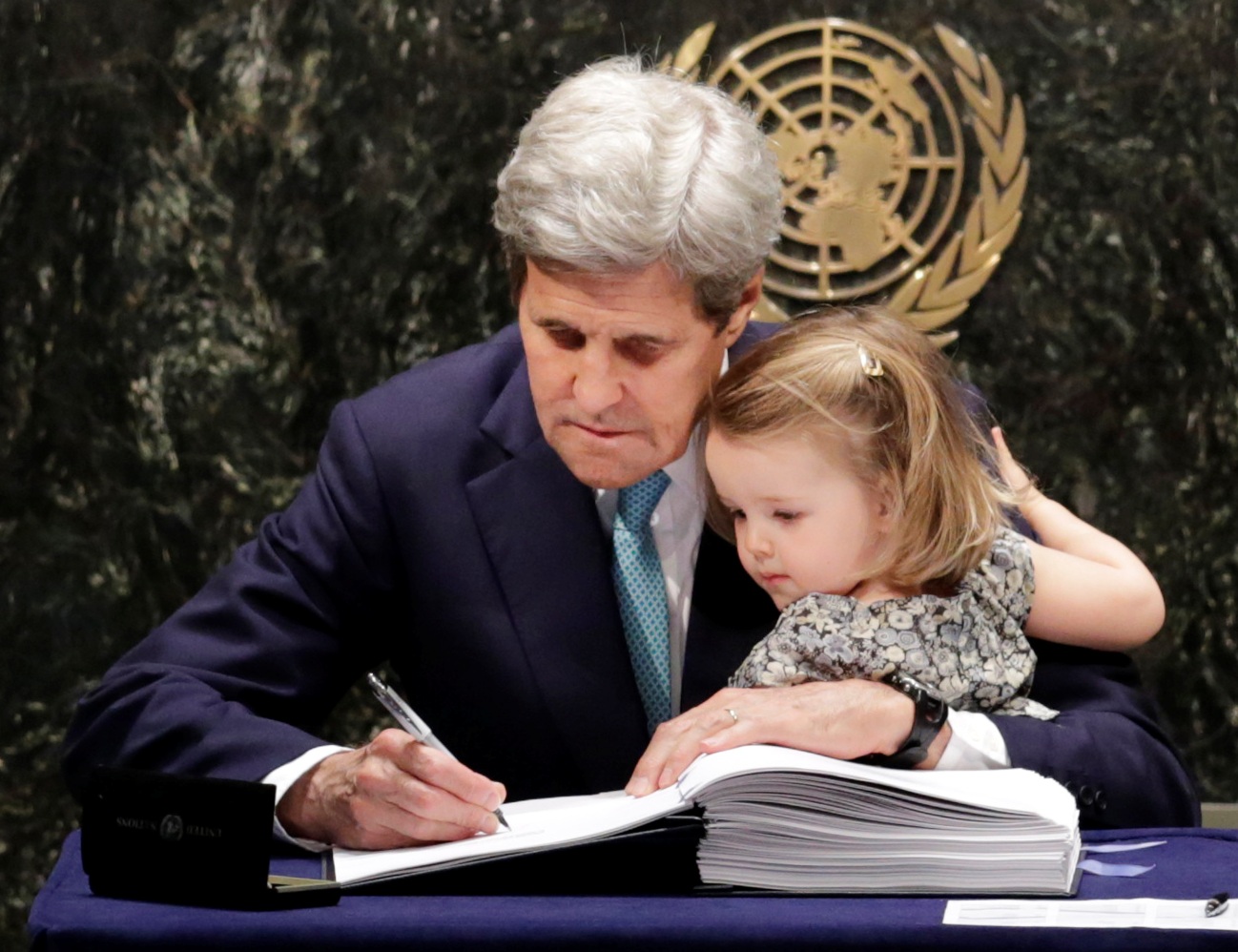
After all these speeches, the signing ceremony began. 175 countries, their names read one by one, came to the stage and signed. One of the most striking moments of the ceremony was when Secretary of State Kerry of the United States, the second-largest greenhouse gas emitter after China, signed the agreement with his grandson in his arms. Thus, the Climate Change Agreement, reached in Paris in December 2015, was signed by 175 countries at the United Nations headquarters in New York on Earth Day, the 46th anniversary of the agreement.
Conferences and events continued throughout the afternoon. I tried to participate in the speeches and discussions as much as I could. My day was full.
The Paris Agreement, which aims to limit greenhouse gas emissions, is the most comprehensive climate agreement signed to date, holding the distinction of being the international agreement with the highest number of signatures in a single day.
The agreement aims to limit global average temperature rise to between 1.5° and 2° C. by the end of the century.
For the Paris Agreement to enter into force in the countries where it is signed, it must also be ratified by the parliaments of those countries. Approximately 15 island nations, particularly threatened by global warming and at risk of being submerged, ratified the agreement and brought it into force.
Türkiye: Commitments and Real Needs
While the Paris Agreement doesn’t set a radical target for reducing greenhouse gas emissions, it’s considered a diplomatic success because it’s the agreement that has reached the largest number of agreements to date.
Turning to our own country, Türkiye demonstrated its support for the global movement by signing the Paris Agreement at the signing ceremony on 22 April. Like other countries, we must pass and ratify this agreement in parliament and then fulfill its requirements.
Türkiye had stated that it would increase its emissions by 21% by 2030 compared to the reference scenario. Energy analyst and journalist Özgür Gürbüz emphasized that Türkiye had signed relatively easy-to-achieve targets, emphasizing that the real challenge lies in Türkiye’s failure to fulfill its commitments.
Türkiye pledged to reduce its greenhouse gas emissions by 21% in 2030, from 1,175 million tons of CO2 equivalent to 929 million tons of CO2 equivalent. Özgür Gürbüz states that Türkiye can achieve these values even if it does nothing, with its current policies.
In my opinion, we need to set aside this formal commitment and approach the issue with a greater and more realistic sense of responsibility. In other words, we need to go beyond the easily realized commitments in the Paris Agreement and do much more.
100% Renewable Energy Target
To those who ask what lies beyond the 100% Renewable Energy Target, I can briefly say this: As we always say (for instance, in my article in Turkish Policy Quarterly entitled Why Should Türkiye Aim for 100% Renewable Energy?: http://turkishpolicy.com/article/632/why-Türkiye-should-aim-for-100-renewable-energy-summer-2013) , we need to increase the use of renewable energy, prioritize energy efficiency, and minimize this rate by implementing significant reforms in high-carbon sectors such as transportation, tourism, and real estate. Furthermore, governments and the private sector must be meticulous about educating our citizens who will implement all these applications and support R&D efforts that will ensure technological advancement.
Having said all this, I’d like to emphasize that I’ve fulfilled my responsibility through our company, EkoRE. In the future, I’ll share some details about our work and my perspectives on the solar energy sector and R&D in Türkiye.
For future generations, thank Mother Earth!
Tag: ecology