
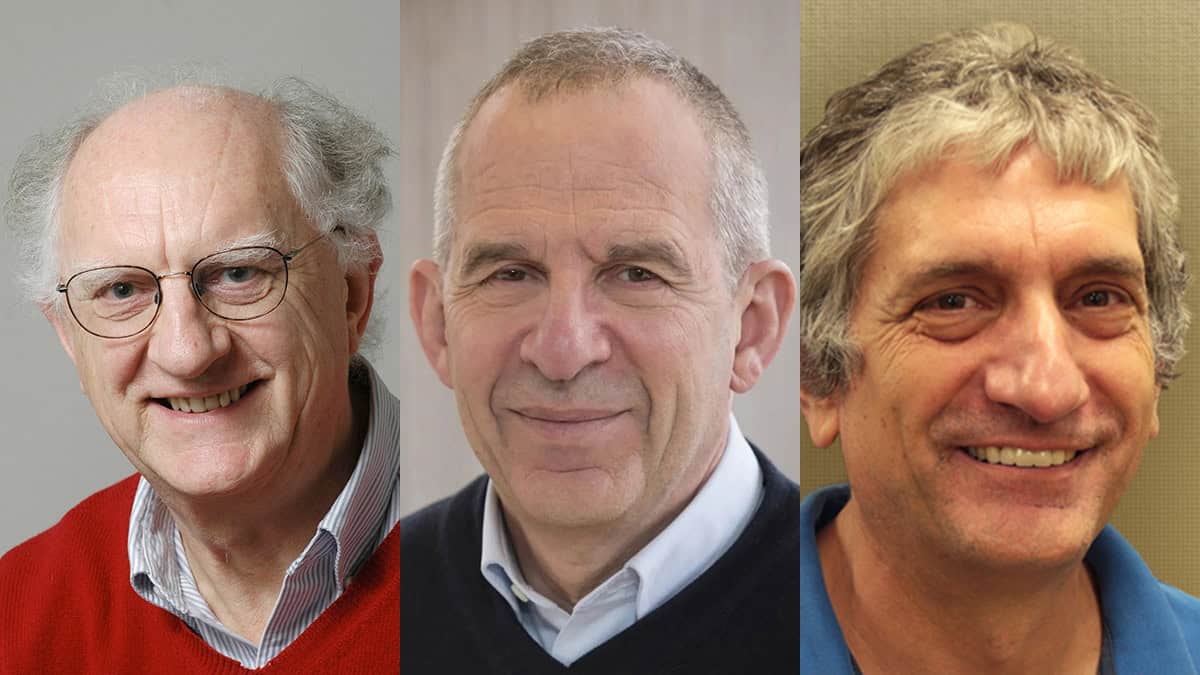
The 2025 Nobel Prize in Physics was jointly awarded to John Clarke, Michel H. Devoret, and John M. Martinis for their “discovery of macroscopic quantum-mechanical tunneling and energy quantization in an electrical circuit.” Before delving into the details, let’s take a brief look at the biographies of the 2025 Nobel Prize winners.
John Clarke
- Born on 10 February 1942, in Cambridge, England.
https://www.britannica.com/biography/John-Clarke-physicist
- He is particularly known for his work on superconducting circuits and the Josephson effect; he is also a pioneer in superconducting magnetic flux detectors (SQUIDs). https://www.britannica.com/question/What-is-John-Clarke-known-for-in-the-field-of-physics
- In 2025, she shared the Nobel Prize in Physics with Devoret and Martinis for “the discovery of macroscopic quantum mechanical tunneling and energy quantization in an electrical circuit.”
https://www.nobelprize.org/prizes/physics/2025/clarke/facts/
Michel H. Devoret
- He was born in 1953 in Paris (France).
https://www.britannica.com/biography/John-M-Martinis
- He is known for his experimental work on superconducting qubits and quantum computer technology, focusing particularly on high-quality qubit fabrication and the development of quantum processors.
https://www.ucsb.edu/about/faculty-and-alumni/john-martinis
These scientists, joint winners of the 2025 Nobel Prize in Physics, have demonstrated that quantum mechanical phenomena—for example, tunneling through a barrier or discrete energy levels—can occur not only at the atomic or subatomic scale, but also in an electrical circuit large enough to be seen and touched.
This award recognition meets several criteria, including novelty (quantum tunneling in circuits), experimental rigor, conceptual clarity, and future significance. The award is well deserved from a physics perspective. This work represents a milestone, demonstrating that quantum phenomena can exist not only in small, isolated systems but also in constructible and controllable circuits. The laureates’ work has revealed that the boundaries of quantum behavior are much broader than anticipated, and the next step is to push them even further.
Why is this discovery so important?
It explores the concept of Bridging the Quantum and the Macroscopic. One of the big conceptual questions in physics is: “How big can a system be and still exhibit ‘quantum’ behavior?” The 2025 Nobel Laureates in Physics have demonstrated that superconducting circuits composed of many particles can still exhibit quantum-mechanical properties.
Laying the foundation for quantum technology
This work laid the groundwork for future quantum computing, quantum sensors, and quantum metrology. The Nobel Committee emphasized that while quantum mechanics is an “old” theory, such discoveries bring new surprises as today’s quantum technologies become part of everyday life.
The elegance of experiment
Translating an abstract idea (quantum tunneling, energy quantization) into a measurable and controllable circuit is both technically challenging and conceptually clear. For example, John Clarke’s work on superconducting interference devices (SQUIDs) is part of this vein.
Results and impacts
In conclusion, this selection for the 2025 Nobel Prize in Physics meets the criteria of both “profound scientific insight” and “foundation of future technology.” It marks a significant milestone in the transformation of quantum physics into engineering.
This discovery has been described as “a milestone in the transformation of quantum physics into engineering.” In this context, the award is expected to stimulate the following studies in the coming years:
1) Superconducting quantum circuits and qubit development
The prize will accelerate the development of qubits based on Josephson junctions because it demonstrates that superconducting circuits can still exhibit quantum properties. This is critical for making quantum computers more stable, scalable, and error free.
2) The proliferation of quantum technologies
The prize demonstrates that quantum physics is not only a fundamental theory but also forms the basis of technologies applicable in everyday life. This will encourage increased investment in areas such as quantum sensors, quantum metrology, and quantum communications.
3) Studying quantum behavior in macroscopic systems
Researchers will continue to explore the question, “How large can quantum behavior be preserved in large systems?” This will stimulate new experimental and theoretical studies on decoherence (quantum incoherence), error correction, and scaling.
4) New approaches to physics education
This discovery, which links quantum phenomena beyond abstract concepts to real circuits and measurable systems, will lead to a greater emphasis on the practical aspects of quantum physics in physics education.
5) The convergence of fundamental physics and applied science
Finally, this award reinforces the understanding that “fundamental physics guides modern engineering.” This will encourage academic-industry collaborations, hybrid quantum systems research, and the commercialization of quantum technology.
In short, the 2025 Nobel Prize in Physics not only honors past discoveries but also represents the beginning of a new era for the construction of future quantum technologies.
Note: I wrote this article based on excerpts from the assignments we prepared for the course. I would like to express my gratitude to our instructor, Prof. Sabri Altıntaş, for making this possible.