
In my previous article, I discussed the “unwritten rules of tennis.” In that article, I highlighted the upright character and exemplary qualities of our tennis player Zeynep Sönmez, who made us proud by reaching the third round of the Australian Open. On the other hand, I noted that her opponent, Kazakh (Russian) tennis player Putintseva, was equally a disrespectful individual who violated the ethical rules of tennis and angered tennis fans with her disrespectful behavior. I concluded that last article with the following paragraph:
As Djokovic emphasized, the key to success is perhaps not constantly trying to think positively, but rather not spending too much time on negative thoughts. It’s about cutting off negative thinking, focusing on the present moment, and looking ahead. Those who can maintain and strengthen their mental fortitude in this way can become elite athletes, architects, engineers, chefs, businesspeople, etc.
A Final Success at 38 Years Old
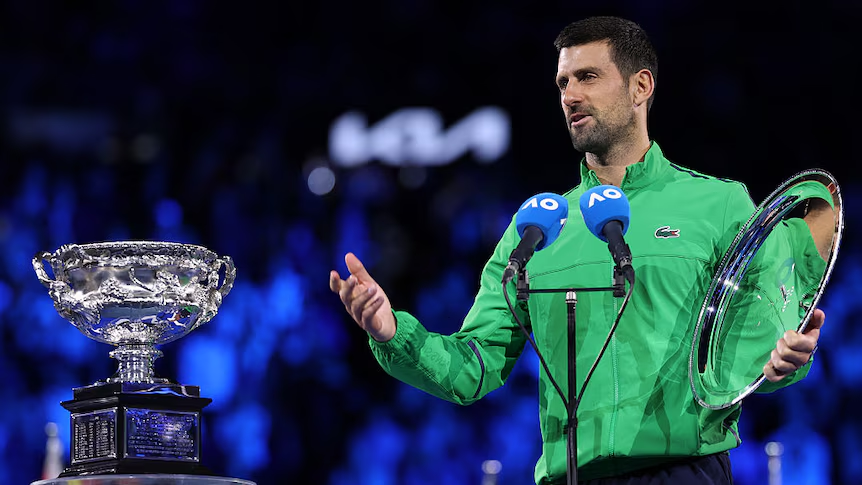
Speaking of Djokovic; Despite being only 38 years old, he delivered an incredible performance last Sunday, reaching the final of the Australian Open Grand Slam tournament. Although he lost in the final, his exemplary attitude earned him widespread sympathy.
Now, let’s rewind a bit and analyze Djokovic’s journey. My first article about Federer, Nadal, and Djokovic was written in October 2020 under the title “Who will be the greatest tennis player of all time?” (See: https://serhansuzer.com/tr/tenisin-gelmis-gecmis-en-buyugu-kim-olacak/ ). In this article, I explored the question: “Last Sunday, the French Open Tennis Tournament was won by Nadal, who defeated Djokovic in another epic final. Nadal, by far the player with the most French Open titles, won his 13th title, increasing his Grand Slam count to 20 and equaling Federer’s record for most Grand Slam wins of all time. At this point, the question on everyone’s mind is: Who will be considered the greatest of all time before their careers end? Federer? Nadal? Djokovic?”
Federer’s Retirement
Exactly two years after this article, in my piece titled “Farewell to a True Tennis Legend” (See: https://serhansuzer.com/tr/gercek-bir-tenis-efsanesine-veda/ ) regarding Federer’s retirement, I summarized the following:
Even if he lags behind in all statistics, Federer holds a special place. In my opinion, Federer is to tennis what Muhammad Ali was to boxing and Michael Jordan was to basketball. Throughout his playing career, he was always at the pinnacle of tennis. He’s 40 years old and still in the top five. He has always been the highest quality and best role model among them all.
For me, statistics aren’t the only criterion for being the GOAT, or “Greatest of All Time.” The real criterion is how many people he inspired and how many hearts he touched. Therefore, no matter how this competition ends, Federer is the GOAT of tennis.
The Spanish Sun That Ended an Era
Following this article, in my first piece about the young tennis player Alcaraz titled “The Spanish Sun That Ended the Big Three Era in Tennis” (See: https://serhansuzer.com/tr/teniste-3-buyukler-donemini-sona-erdiren-ispanyol-gunesi/ ), I described Alcaraz by saying: “Exactly 20 years ago, Roger Federer, who started the Big Three era by winning Wimbledon, had one of his two biggest rivals in his career: Novak Djokovic, the last and most successful representative of the Big Three, who continues to beat everyone even at the age of 36. And now, the new Spanish sun, Carlos Alcaraz, a compatriot of the third Big Three, the successful and athletic Rafael Nadal, defeated Djokovic with a superior game, showing the whole world that the Big Three era has come to an end.”
After this article, in 2024, Djokovic won another championship at the Roland Garros tennis tournament in Paris, surpassing everyone in the statistics. I explained this situation in my article entitled “Djokovic Became the Greatest in Tennis History,” which you can read at this link: https://serhansuzer.com/tr/tenisin-gelmis-gecmis-en-buyugu-djokovic-oldu/ , stating: “In the past, I wrote an article titled ‘Who Will Be the Greatest in Tennis History?’ In that article, comparing Roger Federer, Rafael Nadal, and Djokovic, I wrote that my first choice was Federer, my second was Nadal, and I included Djokovic last. This year, Djokovic proved statistically that he is the greatest tennis player of all time with his gold medal win at the Paris 2024 Olympics.”
My Reasons for Not Being Able to Accept It
From all that I’ve written, you can understand that I, too, have never been able to fully accept Djokovic. There are several reasons for this:
1) In his games against Federer and Nadal, Djokovic initially gave the impression of resorting to trickery to win, trying to prove himself. For example, in matches where he realized he was going to lose, he would feign injury at crucial moments, stay inside for a long time, and cool down the match. When he returned, he would turn the game around.
2) We sometimes witnessed him shouting unnecessarily during matches.
3) Again, in matches, he displayed an overly aggressive demeanor, constantly arguing with the referees and grumbling. He couldn’t exhibit the “cool” behavior we expect from a role model in tennis.
4) In a period when two legendary tennis players like Federer and Nadal were sweeping the championships, he unexpectedly entered their ranks as a third player, creating the image of a disruptive force. Although he didn’t exhibit the same extreme behavior as Putintseva, and despite being more successful than Federer and Nadal, two of the greatest tennis players of all time, Djokovic never managed to garner the same level of sympathy.
5) Djokovic never had an exciting style of play. He generally succeeded by playing a monotonous game and never giving up until the end. He lacked a standout feature. In other words, he didn’t excel in his serve, forehand, backhand, or athletic abilities – the strokes and physical attributes that make tennis what it is. In total, and by always turning turning crucial moments to his advantage, he achieved the statistics of the best tennis player of all time.
6) In 2021, when he arrived in Australia to participate in the Australian Open during the pandemic, he defied the country’s rules by attempting to enter without getting vaccinated. He was denied entry, held under detention for a period, and then asked to leave the country, and of course, he couldn’t participate in the tournament. This behavior received great support from anti-vaccination activists and in his home country of Serbia. Conversely, it drew the opposite reaction from those, like myself, who believed that vaccination would stop the pandemic.
Despite all the negativity and the negative narratives surrounding him, Novak Djokovic continued on his path. A sportsman who has developed his mental strength to the highest level, Novak achieved great success (See: https://www.oggusto.com/spor/novak-djokovic-kimdir ).
Djokovic’s Achievements
Let’s start with his achievements in Grand Slam tournaments, considered the pinnacle of tennis:
- The player with the most Grand Slam titles in men’s tennis
- Multiple championships in all four Grand Slam tournaments
- The player with the most Australian Open titles in tournament history
- Consistency in semi-finals and finals across Grand Slam tournaments over many years
Djokovic’s Grand Slam achievements are not limited to the number of trophies. These victories, achieved in different periods, against different opponents, and under different court conditions, elevate his career from a period of success to a lasting standard.
Grand Slam Championship Distribution
| Tournament | Number of Championships |
| Australian Open | 10 |
| French Open | 3 |
| Wimbledon | 7 |
| US Open | 4 |
| Total | 24 |
Now let’s look at his achievements in all major tournaments:
Major Tournament Achievements – Summary Table
| Tournament Category | Championships |
| Grand Slam | 24 |
| Masters 1000 | 40 |
| ATP Finals | 7 |
| Olympic Games | 1 |
| Total Major Tournaments | 72 |
Let’s also look at his achievements from a general perspective:
- Gold medal in men’s singles at the Paris 2024 Olympic Games
- Longest time as world number 1 in ATP history with 428 weeks
- 8 times year-end world number 1
- 99 ATP singles titles
- Record 24 Grand Slam titles in men’s tennis
- The only player to win all four Grand Slam tournaments at least three times each
- All Masters 1000 tournaments at least twice
- The only tennis player to win
- Record-breaking 16,950 ATP points achieved as World Number 1
- First player in ATP history to reach 250 top-10 wins
- Tennis player with the highest total career prize money
- Positive head-to-head record against Roger Federer, Rafael Nadal, and Andy Murray
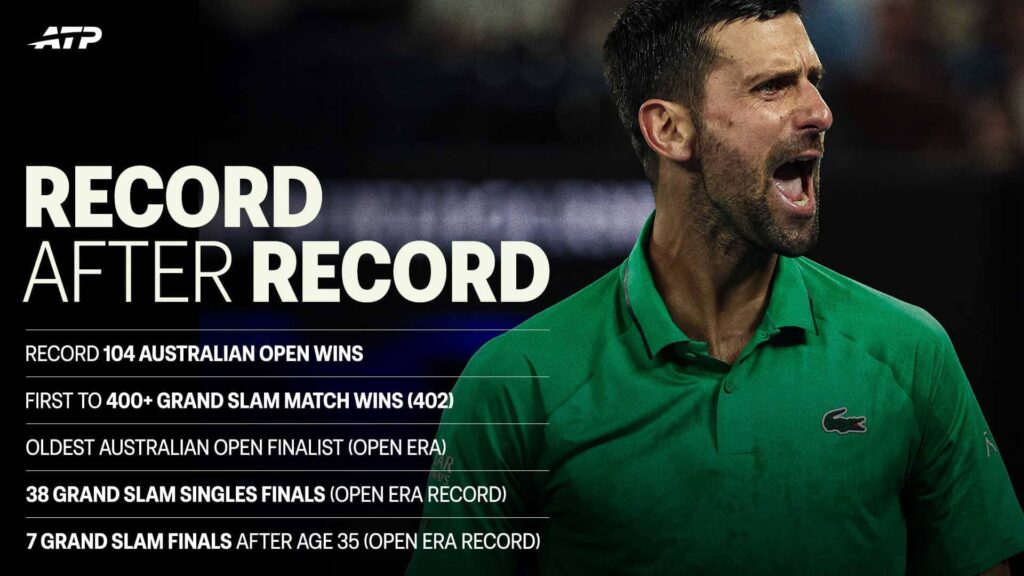
Speaking of his superiority over his biggest rivals, let’s elaborate on this point:
The Battle for the Top: World Number 1 Rankings
One of the elements that makes these rivalries historically significant is the length of time the ATP world number 1 ranking has been shared:
- Djokovic: 428 weeks world number 1, 8 times year-end number 1
- Federer: 310 weeks world number 1, 5 times year-end number 1
- Nadal: 209 weeks world number 1, 5 times year-end number 1
- Djokovic and Federer have faced each other 50 times, with Djokovic holding a 27–23 advantage in total matchups.
- Djokovic and Nadal have faced each other 60 times, with Djokovic holding a 31–29 advantage in total matchups.
After sharing all these statistics, despite Djokovic’s statistical superiority, I would like to reiterate that my favorites in this three-way rivalry are always Federer and Nadal, respectively, due to their superior character and role model status throughout their careers.
Djokovic’s Success in Self-Improvement
Djokovic, on the other hand, possesses a constantly renewing and improving character, and I’ve come to like him because of his superior performance and personality in recent times. To give examples of his positive attitude:
1) Instead of his old aggression on the court, he radiates positivity with a calm and mature energy.
2) He makes everyone smile with his jokes and witty remarks, from ball boys to spectators.
3) He sets an example for young people by giving talks on personal development on social media.
4) He inspires all professional athletes, and even people going through difficult times, especially in terms of mental strength.
5) He earned the admiration of all Turks by going to congratulate and encourage our tennis player Zeynep Sönmez, who lost her match in the 3rd round of the women’s tournament. For a tennis player like Zeynep, who is open to personal development and has a good character, receiving praise from one of the greatest tennis players of all time, Djokovic, has been a great motivation. He also praised the Turkish crowd who passionately supported Zeynep during her match against Putintseva. I personally liked that. After all, we are from the same region. We understand each other well.
6) At the Australian Open Grand Slam tournament, despite being 38 years old, he challenged all the younger players and reached the final. His elimination of Sinner, one of the two most successful tennis players of recent times, in the semi-final was a huge surprise for everyone.
7) In the final, he signaled that he could pull off a big surprise by winning the first set against Alcaraz, who dominated the game. However, Alcaraz recovered his game and won the next three sets, becoming champion with a 3-1 score. Djokovic’s performance at the age of 38 was met with a standing ovation.
8) Despite losing such an important final, there was no trace of his old negative attitude. On the contrary, he faced this defeat with great maturity and once again set an example for all tennis players and professional athletes.
Finally, he gained my sympathy.
I can say that after this, I started to sympathize with Djokovic and support him. Of course, I’m an Alcaraz fan in the new generation. However, I wouldn’t have been upset even if Djokovic had won the final. This alone shows how much my feelings towards him have turned positive. That’s why I want him to win another Grand Slam at this age so that he can show everyone that it’s possible.
Djokovic’s positive attitude in recent times and the fact that he has toned down his negative traits befits a true champion who has broken all the records.