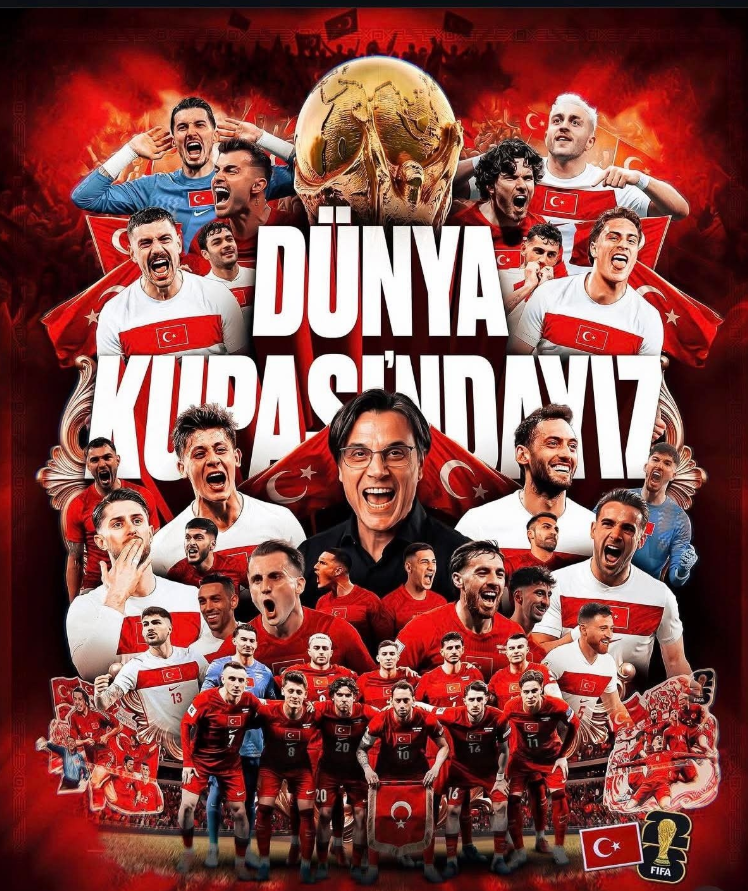
The Turkish National Football Team has qualified for the World Cup again after 24 years, following their historic achievement of finishing 3rd in the 2002 World Cup. Let’s recall how this challenging process unfolded (thanks, ChatGPT):
Türkiye secured its 2026 World Cup ticket not by finishing first in its group, but through the UEFA play-offs. They finished second in Group E behind Spain; therefore, they did not qualify directly. According to the UEFA format, group leaders qualify directly, while group runners-up go to the play-offs.
Subsequently, Türkiye reached the final on March 26, 2026, by defeating Romania 1-0 in the play-offs, and then secured their World Cup qualification by beating Kosovo 1-0 on March 31, 2026.
Now let’s look at the results from the group that included Spain, Türkiye, Georgia, and Bulgaria:
Group E
- 4 September 2025: Georgia 2-3 Türkiye
- 7 September 2025: Türkiye 0-6 Spain
- 11 October 2025: Bulgaria 1-6 Türkiye
- 14 October 2025: Türkiye 4-1 Georgia
- 15 November 2025: Türkiye 2-0 Bulgaria
- 18 November 2025: Spain 2-2 Türkiye
With these results, Türkiye finished Group E with 4 wins, 1 draw, and 1 loss, accumulating 13 points; Spain topped the group with 16 points, and Türkiye finished second. Therefore, they advanced through the play-offs, not directly.
In the first leg of the two-round play-offs, played on March 26, Türkiye won 1-0 at home against Romania.
Later, in the second and final round of the play-offs on 31 March, Türkiye defeated Kosovo away with the same score of 1-0, securing their World Cup ticket.
Having qualified for the most important tournament in football again after 24 years since our last participation in the 2002 World Cup, let me share my thoughts on what the national team did right this time:
Our strengths:
1) Team camaraderie was at a high level: Despite a player with a problematic character like Kerem, overall camaraderie in the national team was excellent. A group of players who love, respect, and support each other is always successful.
2) European-born Turks carried the team: Players like Ferdi, Orkun, and Hakan, who had successful careers in Europe and possessed good character, made a great contribution to the national team. The general character of Turkish people is fluctuating. Players born and raised in Europe balanced these fluctuations. Except for the match against Spain at home, we always played well at a certain standard.
3) Coach Montella was successful: While we sensed outside interference in some of Montella’s team setups, he generally built good teams and established a certain order. Furthermore, his Mediterranean character, his ability to convey emotion and motivate, improved the team’s performance in some matches.
4) Successful results in Europe boosted the team’s self-confidence: Galatasaray’s success in the Champions League, in particular, had a positive impact on the national team. A Turkish team defeating European giants in the Champions League, Europe’s and therefore the world’s most important club tournament, instilled in this generation the confidence that “we can compete at the highest level.” This confidence was reflected in the results.
5) The federation didn’t interfere with the team: From what we observed, the federation generally didn’t interfere with the team, leaving the execution to Montella. Except for a few matches, Montella made the best use of this freedom.
Our Challenges
Now let’s talk about the challenges we faced:
1) The Federation President’s unnecessary outbursts and comments put the team in a difficult position: Turkish Football Federation President İbrahim Ethem Hacıosmanoğlu’s statement before the play-off matches, “It’s not good to make big statements, but if we can’t beat Romania, Kosovo, and Slovakia, let’s not go to America,” was absurd. Because these words resonated with Romania and Kosovo, and they used it as a source of motivation. One of the reasons the Kosovo match was so difficult was the “Türkiye underestimates us, we will show them who we are” approach. Does a country’s Federation President motivate the teams of other countries they will be playing against? In the current environment, without proper education, merit, and capacity, the federation president doesn’t know what he’s saying or should say, and can make things difficult for the national team.
2) The Spain defeat was very heavy: After beating Georgia 3-2 away in our first match, we lost 6-0 at home to Spain. This unexpected result not only pushed the national team behind in the group and put them in a difficult situation, but also psychologically devastated the team’s morale and motivation. Thankfully, Montella motivated the team well for the next match, and in the following game, we beat Bulgaria 6-1 away, shaking off the weight of that defeat. Then, scoring 4 goals against Georgia at home restored the team’s confidence, and we continued to achieve successful results.
3) Geopolitical problems can affect national teams: Türkiye is located in a difficult geographical region and is at the center of everything. This high level of visibility and the fact that football is essentially a stage can increase the pressure on players in some matches. Unfortunately, geopolitical and political problems sometimes affect football and especially motivate national teams. Türkiye felt this pressure particularly in matches against its neighbors Georgia, Romania, and Kosovo.
4) Qualifying for the play-offs created extra stress: It wasn’t expected that we would be first against a team like Spain, which has won both the World Cup and the European Cup and is a powerhouse in world football. As expected, finishing second behind Spain and playing tough play-off matches stressed everyone out. Both the Romania and Kosovo matches were difficult. We didn’t play well in either match, and despite the risk of losing, we managed to win by a single goal.
5) Kerem Aktürkoğlu, the troublemaker: Kerem was beaten up by his teammates twice while playing for Galatasaray. As a Galatasaray fan, I always condemned these actions against Kerem and said that the players who took these actions should be punished in the harshest way possible. Afterwards, the way he left Galatasaray, his transfer to Fenerbahçe through a rigged operation, and his attitude and behavior after starting to play for Fenerbahçe, made me understand why he was beaten. Kerem truly has character issues. We saw this in the Kosovo match as well. His going to the Kosovan player lying on the ground and shouting at him, further inciting the Kosovan players, and his frantic attempt to block Orkun’s shot that was about to go into the net, creating an offside risk, all reinforced the negative opinion of Kerem. Erman Toroğlu comments on this best: https://www.sozcu.com.tr/erman-toroglu-kosova-turkiye-macini-yorumluyor-p306237
I haven’t quite decided whether Kerem’s head isn’t working or if his character is problematic. In any case, it’s certain that he disrupted the environment he was in. Despite a character like Kerem, the camaraderie in the national team remained at a high level.
Let’s celebrate winning, not just participating.
In wrapping, this great success, which came after 24 years, was inexplicably not reflected in the streets. The Turkish people, who usually rush out to celebrate even the smallest success, did not go out for this achievement. The streets remained empty. The weak performance against Kosovo in the last play-off match, the fact that figures like the federation president and Kerem, who create tension and divide people, played leading roles, and our increasingly polarized politics, left people’s joy in their throats.
Whatever happens, it is necessary to celebrate every national success achieved out of national consciousness and to keep our country, which is struggling with difficulties, with its head held high. In my next article, I will touch upon the sporting successes achieved at the club level and in different branches, outside of the national team. For now, I wish our national team success in the World Cup to be played in the USA, Canada, and Mexico.
My wish is for us to become regulars in all World Cup tournaments, like Brazil, Argentina, Germany, and France. Let’s stop celebrating just qualifying for the World Cup and start celebrating winning it.